Manual of First and Second Fixing Carpentry
eBook - ePub

Manual of First and Second Fixing Carpentry

  1. 286 pages
  2. English
  3. ePUB (mobile friendly)
  4. Available on iOS & Android
eBook - ePub

Manual of First and Second Fixing Carpentry

About this book

Les Goring's book covers all the detailed knowledge required for carrying out first fixing carpentry – such as modern and traditional roofing and fitting and fixing modern and traditional floor joists on new-build sites before plastering or drylining of walls and ceilings takes place – and second fixing carpentry – such as fitting staircases, hanging doors, skirting and architraves and kitchen units after dry-lined plastering has taken place and the shell of the building is watertight. In the opening chapters, this work also covers reading-of-drawings' knowledge, tools and fixing-devices.

This new edition, with over 500 coloured drawings supporting its step-by-step approach, has been updated throughout to take into account current industry practices and changes in the UK's Building Regulations. Two new chapters have also been added, covering the formwork carpentry for casting in situ, reinforced concrete stairs and landings, and making and fixing different shelf arrangements to correct spans.

The breadth of coverage and clear 'how-to-do-it' text makes this book an essential in-and-after-college resource for the 2000 apprentices per year taking NVQs and the 1500 students following Construction Awards within the Wood Occupations from the City & Guilds' Construction Skills. The in-depth technical detail and practical focus makes this book an essential purchase for all aspiring woodworkers, craft teachers and construction lecturers – to either read now and/or use as a future reference manual. It should also be of value to general builders and DIY enthusiasts, whose carpentry knowledge might (understandably) be sketchy in certain areas.

Frequently asked questions

Yes, you can cancel anytime from the Subscription tab in your account settings on the Perlego website. Your subscription will stay active until the end of your current billing period. Learn how to cancel your subscription.
No, books cannot be downloaded as external files, such as PDFs, for use outside of Perlego. However, you can download books within the Perlego app for offline reading on mobile or tablet. Learn more here.
Perlego offers two plans: Essential and Complete
  • Essential is ideal for learners and professionals who enjoy exploring a wide range of subjects. Access the Essential Library with 800,000+ trusted titles and best-sellers across business, personal growth, and the humanities. Includes unlimited reading time and Standard Read Aloud voice.
  • Complete: Perfect for advanced learners and researchers needing full, unrestricted access. Unlock 1.4M+ books across hundreds of subjects, including academic and specialized titles. The Complete Plan also includes advanced features like Premium Read Aloud and Research Assistant.
Both plans are available with monthly, semester, or annual billing cycles.
We are an online textbook subscription service, where you can get access to an entire online library for less than the price of a single book per month. With over 1 million books across 1000+ topics, we’ve got you covered! Learn more here.
Look out for the read-aloud symbol on your next book to see if you can listen to it. The read-aloud tool reads text aloud for you, highlighting the text as it is being read. You can pause it, speed it up and slow it down. Learn more here.
Yes! You can use the Perlego app on both iOS or Android devices to read anytime, anywhere — even offline. Perfect for commutes or when you’re on the go.
Please note we cannot support devices running on iOS 13 and Android 7 or earlier. Learn more about using the app.
Yes, you can access Manual of First and Second Fixing Carpentry by Les Goring in PDF and/or ePUB format, as well as other popular books in Technology & Engineering & Civil Engineering. We have over one million books available in our catalogue for you to explore.

1

Reading Construction Drawings

1.1 Introduction

Construction drawings are necessary in most spheres of the building industry, as being the best means of conveying detailed and often complex information from the designer to all those concerned with the job. Building tradespeople, especially carpenters and joiners, should be familiar with the basic principles involved in understanding and reading drawings correctly. Mistakes on either side – in design or interpretation of the design – can be costly, as drawings form a legal part of the contract between architect/client and builder. This applies even on small jobs, where only goodwill may suffer; for this reason, if a non-contractual drawing or sketch is supplied, it should be kept for a period of time after completion of the job, in case any queries should arise.
image
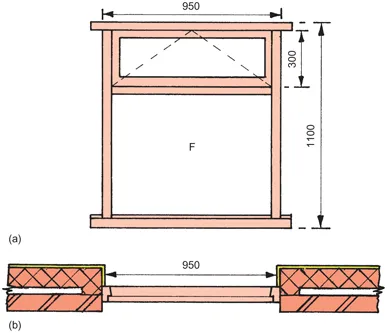
Figure 1.1 (a) Client’s sketch drawing. (b) Horizontal section showing client’s mistake

1.1.1 Retention of Drawings or Sketches

A simple sketch supplied by a client in good faith to a builder or joinery shop for the production of a replacement casement-type window, is shown in Figure 1.1(a). The client’s mistake in measuring between plastered reveals is illustrated in Figure 1.1(b). Retention of the sketch protects the firm from the possibility of the client’s wrongful accusation.
Another important rule is to study the whole drawing carefully and be reasonably familiar with the details before starting work.
The details given in this chapter are based on the recommendations laid down by the British Standards Institution, in their latest available publications entitled Construction drawing practice, BS 1192:
Part 1: 1984, and BS 1192: Part 3: 1987. BS 1192: Part 5: 1990, which is not referred to here, is a guide for the structuring of computer graphic information.
image
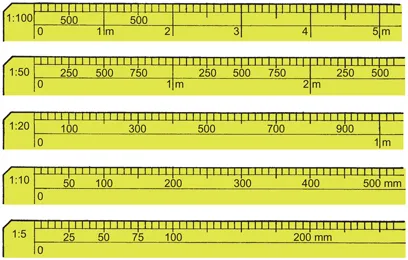
Figure 1.2 Common metric scales

1.1.2 Scales Used on Drawings

Parts of metric scale rules, graduated in millimetres, are illustrated in Figure 1.2. Each scale represents a ratio of given units (millimetres) to one unit (one millimetre).
Common scales are 1:100, 1:50, 1:20, 1:10, 1:5 and 1:1 (full size). For example, scale 1:5 = one-fifth (j) full size, or 1 mm on the drawing equals 5 mm in reality.
Although a scale rule is useful when reading drawings, because of the dimensional instability of paper, preference should always be given to written dimensions found on the drawing.

1.1.3 Correct Expressions of Dimensions

The abbreviated expression, or unit symbol, for metres is a lower case (small) letter m, and letters mm for millimetres. Symbols are not finalized by a full stop and do not use a letter ‘s’ for the plural. Confusion occurs when, for example, 3| metres is written as 3.500 mm – which means, by virtue of the decimal point in relation to the unit symbol, 3 2 1 millimetres! To express 3 1 2 metres, it should have been written as 3500 mm, 3.5 m, 3.50 m, or 3.500 m. Either one symbol or the other should be used throughout on drawings; they should not be mixed. Normally, whole numbers should indicate millimetres, and decimalized numbers, to three places of decimals, should indicate metres. Contrary to what seems to be taught in schools, the construction and engineering industry in the UK does not communicate in centimetres. All references to measurement are made in millimetres and/or metres, i.e. 2 cm should be expressed as 20 mm.

1.1.4 Sequence of Dimensioning

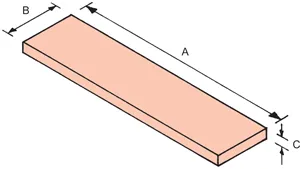
The recommended dimensioning sequence is illustrated in Figure 1.3. Length should always be given first, width second and thickness third, for example 900 × 200 × 25 mm. However, if a different sequence is used, it should be consistent throughout.
image
Figure 1.3 Dimensioning sequence A×B×C

1.1.5 Dimension Lines and Figures

A dimension line with open arrowheads for basic/ mo...
Table of contents

  1. Cover
  2. Halftitle Page
  3. Title Page
  4. Copyright
  5. Table of Contents
  6. Preface
  7. Acknowledgments
  8. Health and Safety Awareness
  9. Abbreviations
  10. Technical Data
  11. 1 Reading Construction Drawings
  12. 2 Tools Required: their Care and Proper Use
  13. 3 Carpentry Fixing-Devices
  14. 4 Making and Fixing Shelving Arrangements
  15. 5 Making Site-Equipment Items
  16. 6 Fixing Doorframes,Linings and Doorsets
  17. 7 Fixing Wooden and uPVC Windows
  18. 8 Fixing Traditional and Modern Floor Joists and Flooring
  19. 9 Fixing Interior and Exterior Timber Grounds
  20. 10 Fixing Stairs and Balustrades
  21. 11 Stair Regulations Guide to Design and Construction
  22. 12 Making and Fixing Formwork for In Situ Concrete Stairs
  23. 13 Constructing Traditional and Modern Roofs
  24. 14 Erecting Timber-stud and Metal-stud Partitions
  25. 15 Geometry for Arch Shapes
  26. 16 Making and Fixing Arch Centres
  27. 17 Fixing Architraves, Skirting, Dado and Picture Rails
  28. 18 Fitting and Hanging Doors
  29. 19 Fitting Locks, Latches and Door Furniture
  30. 20 Fixing Pipe Casings and Framed Ducts
  31. 21 Designing and Installing a Fitted Kitchen
  32. 22 Site Levelling and Setting Out
  33. Appendix: Glossary of Terms
  34. Index