- 318 pages
- English
- ePUB (mobile friendly)
- Available on iOS & Android
eBook - ePub
About this book
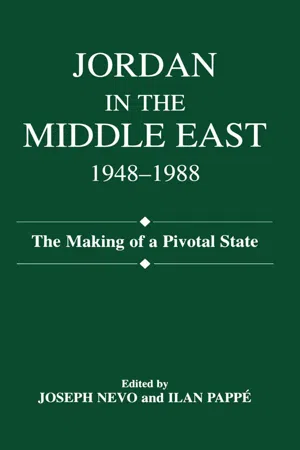
A collection of articles assessing Jordan's position in the region in light of its quest for legitimacy as a state and as a Hashemite monarchy. Describes the country's role in the conflict with Israel and the balance of power between Palestinians and East Bankers.
Information
Part I
Jordan on the Eve of the 1990s
1 The Hashemite Monarchy 1948–88: The Constant and the Changing – An Integration
The starting date in the title of this chapter contains an element of arbitrariness. The date might have been 1921, when the British government, or rather its Colonial Secretary Winston Churchill, appointed the Hashemite prince Abdallah, second son of King Hussein of the Hijaz, to the administration of Trans-Jordan. It might have been 1928, when Amir Abdallah achieved juridical recognition by means of an official agreement with the British government, which recognized him as hereditary ruler of Trans-Jordan – though still within a British Mandate and accountable to the British High Commissioner in Jerusalem. Or 1946, when that mandate was abolished, and Amir, soon King, Abdallah became ‘sovereign’. Or 1953, when Abdallah's grandson, Hussein, assumed his constitutional duties as head of state, thus supplying the most conspicuous facet of ‘constancy’ in the kingdom up to this very day. Or 1967, when the kingdom lost the territories west of the Jordan River that had been acquired as a result of the Palestine war of 1948–49. Instead, 1948 was chosen, for from then on, the Hashemite monarchy had to cope with a sector of Palestinians among its population, whose inclusion in the monarchy was an event of cataclysmic character to start with and who, through their number, qualities and the force of circumstances may reasonably be considered the most significant single factor among the various pressures on the Jordanian entity.
If this starting point is accepted, then there is here, by definition, both constancy and change. First, though, the other constants will be examined; then the changes will be addressed. The first constant is expressed in the title of this chapter, and indeed that of the state: the Hashemite Kingdom is still the Hashemite Kingdom. The Hashemite king still reigns and rules; in this respect, the succession of Abdallah by Talal, and of Talal by Hussein made no difference. His rule is authoritarian, but not totalitarian (more on this below). He stresses his adherence to Islam and Islamic values, as befits a linear descendant of the Prophet's daughter in the male line. Western constitutional precepts have existed ever since the Hashemite monarchy took shape. The present constitution was promulgated in 1952 and, though changes have been introduced since, they are not radical; the constitution of 1947 and the ‘organic law’ of 1928 are recognizably its forerunners. Although emergencies necessitating royal strong-arm measures are well provided for by the constitution, they arepart of the constitution. The civil service is ‘royal’ today as it has always been – in spirit, discipline and training. The army remains the prop of the regime: overwhelmingly professional, recruited among the Trans Jordanian tribes as much, and among the Palestinians as little, as feasible. The economy – and the state budget – have remained wildly unbalanced; somehow the stability and working order of the kingdom have been unaffected, until now. In its foreign relations, Jordan is still aligned with the West in global, and to ‘moderate’ countries in regional, affairs. Occasional aberrations from this rule merely underline this pragmatism – opportunism, if you will – which has always characterized the Hashemite rulers. Last but not least, the territory of the kingdom is, as it was on 15 May 1948, – the land east of the Jordan River, its frontiers definitively fixed by the early 1930s.1
The constants enumerated above will now be examined for elements of change over the last 40 years, and conclusions will be drawn – separately and together. The Hashemite blood will be preserved in its peculiar purity by the next bearer of the crown, barring any mishaps. The Hashemites have always preferably married within their extended family. Hussein himself is the son of cousins and so, of course, is his brother, Crown Prince Hasan, born in 1947.2 The basic traits of the Hashemite rule – conservatism, authoritarianism – must on examination be regarded as constants sans phrase,though the march of time has not been propitious. In his last years Abdallah retreated from positions it may have been genuinely impossible to hold after the Palestine war; moreover, he was conscious of his rapid aging. Even so, it cannot be said that by the time of his death he was less authoritarian (and certainly not less conservative) than at any other time – though he found it much harder to get his own way. Abdallah's son Talal, during his brief reign, passed the constitution that Abdallah had promised. It reserved for the king the prerogatives needed to captain the state effectively. Talal's rule was too short to allow speculation as to how he would have used those prerogatives, but the tale, then widespread, of his democratic inclinations may be discounted.
Hussein undertook his duties at the age of seventeen and a half (eighteen according to the Muslim calendar). Naturally he was naive and easily influenced, but in terms of self-confidence and resolution he was king from the first. During one period, in 1956–57, he experimented with parliamentary rule; during another, between 1968 and 1970, he came near to sharing his power with consistent enemies of his rule, the Palestinian organizations then gathering momentum in the aftermath of the Six Day War. Each episode brought him to the brink of doom; in both cases, however, he reasserted himself – at the very last moment, it would appear. He certainly never intended to divest himself of the ultimate authority in the state, which according to his faith is his alone. So far he has succeeded, by applying that see-saw policy of tolerance and toughness that he masters so well. Thus, the ban on political parties, imposed in April 1957, has never been lifted, but it has also not been imposed at all times with the same degree of severity; apart from trade unions – legal in principle, but no better liked for that – political organizations proper have occasionally been tolerated, more or less in the open. Obviously, quasi-toleration has excluded groups that are fanatically hostile to the regime, such as the ‘rejectionist’ groups within the PLO, like Habash's Popular Front and Hawatmeh's Popular Democratic Front. It did not exclude the Communist Party, which, since 1967, has surfaced from time to time covered with fig leaves and playing down its fundamental rejection of the Hashemite regime (which earned it unrelenting persecution under Abdallah and Hussein until 1967). (The Muslim Brotherhood organization, though fitting into this pattern, is part of an important phenomenon, which is discussed separately, below.) As for parliamentary representation, much has changed in the written, and curiously little in the unwritten – and hence more important – rules of the game ever since the West Bank became represented in 1950. On the initiative of the regime the membership of Jordan's senate and chamber has greatly increased. After the Six Day War, it seemed as if the regime had decided to keep the entire parliamentary system in suspended animation. Since 1984, however, parliamentary life has been officially restored, much on the terms that obtained from 1957 to 1967. A batch of by-elections was even held in 1986 – also largely on the lines that can be described as ‘influence’ and corruption, modified by pragmatism and an aversion to the grosser forms of arm-twisting, and hence offering no watertight guarantee for ideal results from the government's viewpoint. By and large, however, the results served to keep the system in working order (with the exception of the October 1956 elections, which were a lesson Hussein never forgot).
As to foreign alignments, the basics have been preserved for over 40 years. Although some elaboration is indicated, nothing need be said that would have seemed intrinsically absurd during Abdallah's last years. Within the Arab world, the dynastic considerations, antipathies more than sympathies, that still colored much of Abdallah's thinking disappeared during the first years of Hussein's reign. The last vestiges vanished when the Qassim coup of 1958 destroyed the ‘Arab Federation’ between Jordan and Iraq, significantly known as the ‘Hashemite Federation’ and which had been the cause of some wariness in Saudi Arabia. Hashemite Jordan has always been a subject of suspicion and dislike to much of the Arab world (with the Six Day War, when Jordan sacrificed more than any other Arab state, as an uncharacteristic break); the particular sets have been changeable. As a rule it can be said that Jordan has been on poor terms with the ‘radical’ regimes, terms that improve when such regimes acquire the image of moderation, in whatever circumstances. Abd al-Nasser's UAR after 1967 and Saddam Husayn's Iraq during the war with Iran are telling instances. Relations with Israel have remained true to the pattern first set up between the Zionist organization and the Hashemites in the Weizmann-Faysal talks of 1918: contacts in a friendly spirit; search for far-reaching cooperation based on the common ground presumed to exist between the parties; no consummation. It seems of late that common Arab resentment of this traditional Hashemite stance has become more muted, though it has certainly not vanished. On the other hand, Israeli attitudes, denying that the Hashemite entity east of the Jordan River does Israel any good, with drastic inferences expressed in drastic terms, show a tendency of becoming more articulate – although these attitudes, too, go back to the very beginning of the confrontation and still do not dominate the Israeli scene. As to the Western world outside the region, Jordan is still with the West. A certain softening process derived from both global and Jordanian developments, interconnected, has of course been going on for decades.
The former Soviet Union with its allies and followers is today far from b...
Table of contents
- Cover
- Half Title
- Title Page
- Copyright Page
- Dedication
- Table of Contents
- List of Maps
- Acknowledgements
- Introduction
- Part I Jordan on the Eve of the 1990s
- Part II The Regional System
- Part III Jordan, Israel and the Palestinians
- Part IV The International Scene
- Notes on Contributors
Trusted by 375,005 students
Access to over 1.5 million titles for a fair monthly price.
Study more efficiently using our study tools.
Frequently asked questions
Yes, you can cancel anytime from the Subscription tab in your account settings on the Perlego website. Your subscription will stay active until the end of your current billing period. Learn how to cancel your subscription
No, books cannot be downloaded as external files, such as PDFs, for use outside of Perlego. However, you can download books within the Perlego app for offline reading on mobile or tablet. Learn how to download books offline
Perlego offers two plans: Essential and Complete
- Essential is ideal for learners and professionals who enjoy exploring a wide range of subjects. Access the Essential Library with 800,000+ trusted titles and best-sellers across business, personal growth, and the humanities. Includes unlimited reading time and Standard Read Aloud voice.
- Complete: Perfect for advanced learners and researchers needing full, unrestricted access. Unlock 1.5M+ books across hundreds of subjects, including academic and specialized titles. The Complete Plan also includes advanced features like Premium Read Aloud and Research Assistant.
We are an online textbook subscription service, where you can get access to an entire online library for less than the price of a single book per month. With over 1.5 million books across 990+ topics, we’ve got you covered! Learn about our mission
Look out for the read-aloud symbol on your next book to see if you can listen to it. The read-aloud tool reads text aloud for you, highlighting the text as it is being read. You can pause it, speed it up and slow it down. Learn more about Read Aloud
Yes! You can use the Perlego app on both iOS and Android devices to read anytime, anywhere — even offline. Perfect for commutes or when you’re on the go.
Please note we cannot support devices running on iOS 13 and Android 7 or earlier. Learn more about using the app
Please note we cannot support devices running on iOS 13 and Android 7 or earlier. Learn more about using the app
Yes, you can access Jordan in the Middle East, 1948-1988 by Joseph Nevo,Illan Pappé in PDF and/or ePUB format, as well as other popular books in Politics & International Relations & Middle Eastern History. We have over 1.5 million books available in our catalogue for you to explore.