- 400 pages
- English
- ePUB (mobile friendly)
- Available on iOS & Android
eBook - ePub
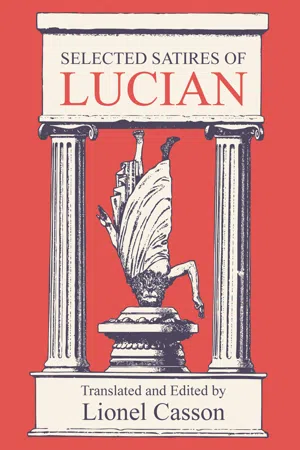
Selected Satires of Lucian
About this book
The unsurpassed satirist of the ancient era was a young Syrian named Lucian, who, writing in Greek in the second century a.d., combined wit, irony, fearless candor, and exuberant comic fantasy to create the triumphantly irreverent dialogues and stories contained in this book. His genial mockery, aimed at man's omnipresent feelings, has never gone out of date. The jabs he gave the hypocrites; grandstanders, fakers and boobs of the ancient world can just as appropriately be administered to their counterparts in the modern world.Lucian's most typical genre is a parody of a Platonic dialogue, in which Zeus, Hermes, Eros, and other Olympians jabber in undivine harassment as some clever mortal (who very much resembles Lucian) is about to make scandalous fools of them. He also excelled at straight narrative, his two most famous tales being the elaborate science fiction spoof; "A True Story," and an old folk tale retold outrageously, "Lucius the Ass." His works were the product of an unrelentingly rational and skeptical mind, and have had an incalculable effect on writers and painters through the ages.Until this volume, the English language reader of today to appreciate the importance and intelligence of Lucian. No volume of representative selections in translation is in print. There are satisfactory versions of the complete works, but the reader who takes this long will most likely lose a good deal of the sting of Lucian's needle. Lionel Cassen also illustrates the full range of Lucian's subject matter and various literary forms and when translating tried to focus on the Greek spirit as opposed to the literal meaning.
Information
MAN’S WORLD
MEN
Charon
Timon
Alexander the Quack Prophet
Charon
Timon
Alexander the Quack Prophet
MAIDS
Dialogues of the Courtesans
Dialogues of the Courtesans
PHILOSOPHERS
Philosophies for Sale
The Fisherman
The Death of Peregrinus
Philosophies for Sale
The Fisherman
The Death of Peregrinus
CHARON
Hermes and Charon
Charon meets Hermes in the street of some city, presumably Athens. It is a day during the middle of the sixth century B.C.— not any particular day of a particular year since Lucian, to suit his convenience, has conflated events that took place at widely separated times during the century.
HERMES. Charon, what are you laughing at? And what’s the reason for leaving the ferry and coming up to our bailiwick? You’re not one for poking your nose into the goings on up here.
CHARON. Hermes, I wanted to see what life was like—what men do with themselves during it, and what they give up that makes them wail so when they come down to us below. Not one of them, you know, ever makes the crossing without tears. So, just like that young fellow from Thrace,1 I got permission from Pluto for a day’s leave, and I deserted the ship and came up to the sunlight. It was a lucky break that I ran into you, the man who knows all about this place. Of course you’re going to take me around and show me everything—give me a real guided tour.
HERMES. I don’t have the time, ferryman. You see, I’m off on an errand for the commander-in-chief up above, some business about men. He’s got a mean temper, and I’m afraid if I’m not prompt he’ll hand me over to the gloom —assign me to full-time duty with you people.2 He might even do to me what he did to Hephaestus3 the other day—grab me by the foot and heave me over “the threshold of heaven"; then there’d be two of us to give the gods a laugh by limping as we wait on table.
CHARON. You mean you’ll stand by and watch me blunder around this place? You, my friend, my shipmate—the man I lead shades with? My dear Hermes, there’s a thing or two you ought to keep in mind. Did I ever order you to bail? Did I ever make you take a turn at the oars? You’ve got all that muscle and yet you either flake out on the deck and snore away or, if you can find some talkative shade, spend the whole trip gabbing, while an old man like me handles the oars all by myself. Please, Hermes, in the name of your father, be a good fellow and don’t leave me stranded. Give me a tour of all the things in life so I can at least see something before I go back. If you go off and leave me, I’ll be just like the blind. You know how they slip and stumble in the dark; well, that’s just the way I am, blinking and dazzled by the light. Hermes, please do me this favor. I’ll never forget it.
HERMES. I’m liable to get a beating for doing this. I’ve a good idea right now of the pay I’ll receive for your guided tour—and it includes the knuckles of a certain fist. No matter, I’ll help you out. I’ve got to: what else can a person do when it’s a friend who’s putting on the pressure? But to take a careful look at every single thing is out of the question, Charon. We’d spend years at it. And, if that happened, Zeus would be forced to post notices for my arrest the way they do for runaway slaves, you’d be kept from carrying on your death duties, and, with no deliveries of shades from you over a long period of time, Pluto’s affairs would be hard hit. What’s more, Aeacus, who handles the receipts, would get good and angry over not taking in a single obol. No, getting you a look at the high spots of what’s going on, that’s what we’ve got to work on right now.
CHARON. Hermes, you figure out what’s best. I’m a stranger; I don’t know a thing about what goes on up here.
HERMES. I’ll tell you what we need, Charon: some point high enough to give you an over-all view. Now, if you could only get up to heaven, we’d have no problem; you could look down from there and get a panorama of the world. But, since anyone who associates with shades every day isn’t allowed to set foot in Zeus’s palace, let’s start looking around for some tall mountain.
CHARON. You know what I’m always telling all of you when we’re under way. Whenever there’s a squall, and the wind shifts and takes the mainsail aback, and the waves run high, all of you, since you don’t understand such things, start ordering me to shorten sail or slack the sheet a bit or run before the wind, and I have to tell you to keep quiet, that I know better. The same system applies here: you do whatever you think is right because you’re skipper now. And I’ll do what passengers are supposed to—stand by in silence, ready to obey your orders to the letter.
HERMES. True enough. All right, I’ll see to what has to be done and find us a lookout point that’ll serve the purpose. Let’s see, will the Caucasus do? Or is Parnassus higher? Or is Olympus over there higher than both of them? By the way, looking at Olympus just gave me an idea that isn’t at all bad. But you’ll have to pitch in and help.
CHARON. Just give the orders. I’ll help all I can.
HERMES. According to Homer,4 the sons of Aloeus—there were just two of them, like us—when they were still young children, wanted to tear Ossa from its foundations, put it on Olympus, and put Pelion on top of the two; they figured all this would make a scaffold high enough to get them up to heaven. Now both these youngsters were punished because they were wild and up to no good. But what we have in mind has nothing to do with harming the gods. So why don’t we do some building too? Roll mountains on top of one another so that we can get up higher and have a better view?
CHARON. You think just the two of us could lift and stack either Pelion or Ossa?
HERMES. Why not? Or maybe you think two gods don’t measure up to that pair of babies?
CHARON. Oh no! It’s just that the job seems to me to involve an incredible amount of work.
HERMES. Naturally—because you’re like the man in the street, Charon; there isn’t even a trace of the poet about you. Now our noble Homer has made a “gateway to heaven” for us with just two verses—that’s how easily he stacks mountains. I’m amazed that you consider these things so extraordinary. Certainly you know about Atlas5 —he’s only one man and yet he holds up heaven with all of us on it. And you’ve probably heard how my brother Heracles once took over for that very Atlas and gave him a bit of rest from drudgery by shouldering the load himself.
CHARON. I’ve heard those stories. But whether they’re true or not—you and your poets would know about that.
HERMES. They’re absolutely true, Charon. Why would wise and intelligent men tell lies? So let’s pry up Ossa first, just the way the poem and our poet-architect tells us, and then
pile upon Ossa
Well-wooded Pelion.
See how easily just a bit of poetry did the trick? Now I’ll climb up and take a look to see if this is enough; maybe we’ll have to do some more building. Oh lord! We’re still down in the foothills of heaven. I can barely make out Ionia and Lydia to the east, no further than Italy and Sicily to the west, only as far as the Danube to the north, and Crete very dimly to the south. Ferryman, it looks as if we’ll have to add Oeta6 and then Parnassus on top of them all.
CHARON. Let’s do that. But watch out that we don’t keep adding to this scaffold beyond the safety point and make it too rickety. If that happens, we’ll discover how bad Homer’s method of construction can be—we’ll come crashing down, scaffold and all, and bash our heads in.
HERMES. Don’t worry. It’ll be perfectly safe. Shove Oeta over here. Now let’s roll up Parnassus. That’s it. I’m going up for another look. Fine! I see everything. You can come up now.
CHARON. Give me a hand, Hermes. This is some contraption you want me to climb up!
HERMES. You wanted to see everything, you know. Going in for vistas and keeping out of danger don’t mix. Here, hold on to my hand and be careful not to step where it’s slippery. Good! See? You made it. Parnassus has two peaks, so let’s each take one and sit down. Now turn in a complete circle and take a good look at everything.
CHARON. I see a lot of land surrounded by some sort of huge lake,7 mountains, rivers that are bigger than Cocytus or Pyriphlegethon, people—but they’re very tiny —and things that must be their dens.
HERMES. Dens you call them? Those are cities!
CHARON. Hermes, do you realize we haven’t gained a thing? All this shoving around of Parnassus with its springs, of Oeta, and of the other mountains was a sheer waste.
HERMES. Why?
CHARON. I can’t see a thing clearly from up here. I didn’t want to see just cities and mountains the way you do on maps. I wanted to see the people themselves and what they’re doing and to hear what they’re saying, just as I was doing when you first ran into me and saw me laughing and asked what I was laughing at. I had just heard something that amused me no end.
HERMES. What was that?
CHARON. This man, as I gathered, had been invited to dinner tomorrow by one of his friends. “Of course I’ll come,” he was saying, and as he stood there talking, a roof tile fell down—someone must have knocked it loose —and killed him. I burst out laughing at the thought that he wouldn’t keep his promise. Well, I think I’ll work my way down right now to where I can see and hear better.
HERMES. Hold it. Dr. Hermes can take care of that too. I’ll give you the eyes of an eagle in a second by just going to Homer and getting a magic charm for this as well. Now the minute I’m finished reciting, remember—no more blinking; you’ll have perfect vision.
CHARON. Start reciting.
HERMES.
Now I have lifted the mist which has covered your eyes till this moment.
Now can you clearly distinguish the two—who is god, and who mortal.8
How about it? Can you see now?
CHARON. Marvelously! Lynceus9 was blind compared with me. Now the next step is for you to turn teacher as well and answer my questions. How about my phrasing them à, la Homer just to show you I’m not exactly an ignoramus when it comes to his poems?
HERMES. You? All your life a sailor, always pulling an oar? How were you able to learn any Homer?
CHARON. See here, that’s an insult to my profession. It so happens when I ferried his shade across I heard him recite a lot of his poetry and I still remember some of it—in spite of having had a pretty bad storm during the crossing. You see, he began to recite some poem that wasn’t exactly encouraging for people on the water—about how Poseidon gathered the clouds, churned up the waters by using his trident like a ladle, raised the winds, and lots more of that sort of thing.10 Well, all this poetry started to rile up the sea, clouds came up, and a storm hit us that almost capsized the boat. At which point he got seasick and threw up most of his poetry—Scylla, Charybdis, the Cyclops, and so on. It was no hard job for me to save at least a few things out of all he was sending over the rail. Now then, tell me:
Who is that man there? The one that’s so thickset, so mighty and valiant,
Towering head and broad shoulders o’er all who are standing about him?11
HERMES. Milon,12 the athlete from the city of Croton. The Greeks are applauding him because he’s picked up a bull and is carrying it through the middle of the stadium.
CHARON. Just think how much more they ought applaud me! Pretty soon I’m going to take Milon himself and stow him aboard the skiff. He’ll come down to us after wrestling with that invincible opponent, Death, who’ll pin him to the mat without his even realizing how he was knocked off his feet. And he’ll treat us to some wailing, no question about it, when he remembers all his medals and this applause. Now he’s all puffed up because everybody’s amazed at the way he carried that bu...
Table of contents
- Cover
- Half Title
- Title Page
- Copyright Page
- Dedication
- Contents
- Preface
- Introduction
- A BIT OF AUTOBIOGRAPHY
- TWO ROMANCES
- ZEUS’S WORLD
- PLUTO’S WORLD
- MAN’S WORLD
Trusted by 375,005 students
Access to over 1.5 million titles for a fair monthly price.
Study more efficiently using our study tools.
Frequently asked questions
Yes, you can cancel anytime from the Subscription tab in your account settings on the Perlego website. Your subscription will stay active until the end of your current billing period. Learn how to cancel your subscription
No, books cannot be downloaded as external files, such as PDFs, for use outside of Perlego. However, you can download books within the Perlego app for offline reading on mobile or tablet. Learn how to download books offline
Perlego offers two plans: Essential and Complete
- Essential is ideal for learners and professionals who enjoy exploring a wide range of subjects. Access the Essential Library with 800,000+ trusted titles and best-sellers across business, personal growth, and the humanities. Includes unlimited reading time and Standard Read Aloud voice.
- Complete: Perfect for advanced learners and researchers needing full, unrestricted access. Unlock 1.5M+ books across hundreds of subjects, including academic and specialized titles. The Complete Plan also includes advanced features like Premium Read Aloud and Research Assistant.
We are an online textbook subscription service, where you can get access to an entire online library for less than the price of a single book per month. With over 1.5 million books across 990+ topics, we’ve got you covered! Learn about our mission
Look out for the read-aloud symbol on your next book to see if you can listen to it. The read-aloud tool reads text aloud for you, highlighting the text as it is being read. You can pause it, speed it up and slow it down. Learn more about Read Aloud
Yes! You can use the Perlego app on both iOS and Android devices to read anytime, anywhere — even offline. Perfect for commutes or when you’re on the go.
Please note we cannot support devices running on iOS 13 and Android 7 or earlier. Learn more about using the app
Please note we cannot support devices running on iOS 13 and Android 7 or earlier. Learn more about using the app
Yes, you can access Selected Satires of Lucian by Lionel Casson in PDF and/or ePUB format, as well as other popular books in Letteratura & Collezioni letterarie antiche e classiche. We have over 1.5 million books available in our catalogue for you to explore.