eBook - ePub
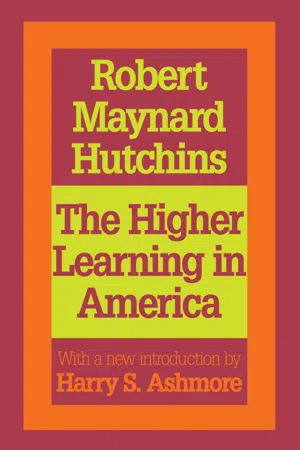
The Higher Learning in America
A Memorandum on the Conduct of Universities by Business Men
- 141 pages
- English
- ePUB (mobile friendly)
- Available on iOS & Android
eBook - ePub
The Higher Learning in America
A Memorandum on the Conduct of Universities by Business Men
About this book
Perhaps the pivotal book in the reform of higher education in the United States, Robert M. Hutchins' classic is once again available, with a brilliant personal and professional appreciation by Harry S. Ashmore. When it was published in 1936The Higher Learning in Americabrought into focus the root causes of the controversies that still beset the nation's educational system. Taking office in 1929 as president of the University of Chicago, Hutchins began his tenure by declaring the learning available in even the most prestigious universities grossly deficient.He cited himself as case in point. At Yale he had graduated at the top of his college class and set a record in the law school that led to appointment as professor and, at 26, promotion to dean. But he had acquired only "some knowledge of the Bible, of Shakespeare, andFaust,of one dialogue of Plato, and of the opinions of many semi-literate and a few literate judges, and that was about all."The curricular reforms and administrative reorganization he undertook at Chicago are set forth in this volume, along with the philosophical arguments he worked out to explicate and defend his views. His goal was to reestablish the liberal arts and humanities as the basis for undergraduate education, consigning specialization and research to graduate and professional schools. Hutchins envisioned the university as a community of scholars who, in addition to teaching and research, provided independent thought and criticism of a society being rapidly transformed by science and technology. Challenging the educational establishment at every pertinent level, he became the most celebrated and most controversial intellectual of his era.After twenty-two years at Chicago, Hutchins became associate director of the newly enriched Ford Foundation, where he was primarily responsible for the bold reforms sponsored by its Fund for the Advancement of Education and Fund for Adult Education. In 1960 he est
Information
IV. THE HIGHER LEARNING
E have now examined the external conditions under which American education operates. We have seen what the dilemmas of the higher learning are. We have seen that they may be resolved in part by developing a general education. We have seen what a general education is. Our object is now to discover what, given general education, the higher learning should be.
Let me make clear at the outset that I am here considering the university as an educational institution. I yield to no one in my admiration for and belief in the accumulation of data, the collection of facts, and the advance of the empirical sciences. These taken together constitute one of the grand activities of modern times. It must be continued and encouraged. I wish merely to point out that this activity must be conducted in such a way as not to confuse or prevent that intellectual training and development which in my view are education. How this may be done I shall hope to show later.
I know, of course, that thinking cannot proceed 90 from the facts and from experience. All questions of organization and management, however, are questions of emphasis. By emphasizing the intellectual content of education I do not mean to minimize the importance of the collection of data.1 I do mean to put it in its proper place. That place is, in any intelligible scheme of higher education, a subordinate one.
I beg to call attention in this connection to two meanings of the word research. Research in the sense of gathering data for the sake of gathering them has, as I shall show, no place in a university. Research in the sense of the development, elaboration, and refinement of principles together with the collection and use of empirical materials to aid in these processes is one of the highest activities of a university and one in which all its professors should be engaged.
Let me say, too, that I concede the probable necessity in some fields of practical training which the young man or woman should have before being
i. De Tocqueville, Democracy in America, Part II, First Book, Ch. X, "In the present age the human mind must be coerced into theoretical studies; it runs of its own accord to practical applications; and, instead of perpetually referring it to the minute examination of secondary effects, it is well to divert it from them sometimes, in order to raise it up to the contemplation of primary causes."
permitted to engage in the independent practice of a profession. Since by definition this training cannot be intellectual, and since by definition a university must be intellectual, this type of specific preparation for specific jobs cannot be conducted as part of the university's work. How it may be conducted without interfering with university education I shall suggest as we proceed.
Under an intelligible program of general education, the student would come to the end of the sophomore year with a solid knowledge of the foundations of the intellectual disciplines. He would be able to distinguish and think about subject matters. He would be able to use language and reason. He would have some understanding of man and of what connects man with man. He would have acquired some degree of wisdom.
On his emergence from general education what would he find ? He would find a vast number of departments and professional schools all anxious to give him the latest information about a tremendous variety of subjects, some important, some trivial, some indifferent. He would find that democracy, liberalism, and academic freedom meant that all these subjects and fractions of subjects must be regarded 92 equally valuable. It would not be democratic to hint that Scandinavian was not as significant as law or that methods of lumbering was not as fundamental as astronomy. He would find a complete and thoroughgoing disorder.
He would find, too, that we were proud of this disorder and resisted attempts to correct it by calling them undemocratic and authoritarian.2 As the free elective system denies that there is content to education, so the organization of the modern university denies that there is rationality in the higher learning. The free elective system as applied to professors means that they can follow their own bents, gratify their own curiosity, and offer courses in the results. The accumulation of credits in these courses must lead, like those in any other courses, to the highest academic degrees. Discrimination among courses would be undemocratic. The student would, then, confront an enormous miscellany, composed principally of current or historical investigations in a terrifying multiplicity of fields.
2. Cf. the remarks of Judge Learned Hand to the Harvard alumni, June 18, 1936: "There is no democracy among human values, however each may cry out for an equal vote. It is the business of the soul to impose her own order upon the clamorous rout; to establish a hierarchy appropriate to the demands of her own nature . . ."
He would find that these collections were offered him on either of two assumptions, or both: one, that they were good in themselves, or two, that they would train him for something. They are good in themselves because they are the results of the pursuit of truth for its own sake. They will train him for something because they are the latest reports from the front on which he will have to fight the battle of life. He would find, to his surprise, that the schools and departments offering to prepare him for the learned professions were somewhat less learned than the rest and that their courses of study did not indicate where or what the learning was that made the profession learned. He would find that the other departments that wanted to train him wanted to train him to be a technician or a practitioner or a person who knew how to make the observations, scientific or historical, which they were making themselves.
He would find an especially strange mixture in the field of what might be called the productive arts. He would discover in the natural sciences that making a highly refined gadget to make highly refined measurements was as important as the development of a new theory of the cosmos. He would find that 94 music, sculpture, or painting was as much a university discipline as theology. But he would discover that the Fine Arts, under the influence of the empirical sciences and the popular notion of pursuing the truth for its own sake, had become an empirical, historical, and "scientific" discipline, too. The microscopic study of Byzantine mosaics to determine their age and lineage by looking at their teeth, as it were, is as important as understanding them; in fact it is more so, because such investigation is "scientific research," and understanding is not.
This is what the young man would see as he stood gazing across the threshold of the higher learning. It may be briefly described as chaos. Who would blame him if, after one look, he decided to go into the comparative order and sanity of the business world ?
How can these things be ? Why is it that the chief characteristic of the higher learning is disorder ? It is because there is no ordering principle in it. Certainly the principle of freedom in the current sense of that word will not unify it. In the current use of freedom it is an end in itself. But it must be clear that if each person has the right to make and achieve his own choices the result is anarchy and the dissolution of the whole. Nor can we look to the pursuit of truth 95 its own sake to unify the higher learning. Philistines still ask, what is truth? And all truths cannot be equally important. It is true that a finite whole is greater than any of its parts. It is also true, in the common-sense use of the word, that the New Haven telephone book is smaller than that of Chicago. The first truth is infinitely more fertile and significant than the second. The common aim of all parts of a university may and should be the pursuit of truth for its own sake. But this common aim is not sufficiently precise to hold the university together while it is moving toward it. Real unity can be achieved only by a hierarchy of truths which shows us which are fundamental and which subsidiary, which significant and which not.
The modern university may be compared with an encyclopedia. The encyclopedia contains many truths. It may consist of nothing else. But its unity can be found only in its alphabetical arrangement. The university is in much the same case. It has departments running from art to zoology; but neither the students nor the professors know what is the relation of one departmental truth to another, or what the relation of departmental truths to those in the domain of another department may be.
The medieval university had a principle of unity. It was theology. The medieval theologians had worked out an elaborate statement in due proportion and emphasis of the truths relating to man and God, man and man, and man and nature. It was an orderly progression from truth to truth. As man's relations to God were the highest of which he could conceive; as all his knowledge came from God and all his truths, the truths concerning God and man were those which gave meaning and sequence to his knowledge. Theology ordered the truths concerning man and man; humanism was theocentric; man loved his brothers in God.3 Theology ordered the truths of man and nature, for God created the world; he created man to live in it, and placed him in definite relation to other creatures. The insight that governed the system of the medieval theologians was that as first principles order all truths in the speculative order, so last ends order all means and actions in the practical order. God is the first truth and the last end. The medieval university was rationally ordered, and, for its time, it was practically ordered, too.
3. Summa Theologica, Part II, Q. 2, Art. 7, "But man is not to be loved for his own sake, but whatever is in man is to be loved for God's sake."
But these are other times; and we are trying to discover a rational and practical order for the higher learning of today. Theology is banned by law from some universities. It might as well be from the rest. Theology is based on revealed truth and on articles of faith. We are a faithless generation and take no stock in revelation. Theology implies orthodoxy and an orthodox church. We have neither. To look to theology to unify the modern university is futile and vain.
If we omit from theology faith and revelation, we are substantially in the position of the Greeks, who are thus, oddly enough, closer to us than are the Middle Ages. Now Greek thought was unified. It was unified by the study of first principles. Plato had a dialectic which was a method of exploring first principles. Aristotle made the knowledge of them into the science of metaphysics. Among the Greeks, then, metaphysics, rather than theology, is the ordering and proportioning discipline. It is in the light of metaphysics that the social sciences, dealing with man and man, and the physical sciences dealing with man and nature, take shape and illuminate one another. In metaphysics we are seeking the causes of the things that are. It is the highest science, the first 98, and as first, universal. It considers being as being, both what it is and the attributes which belong to it as being.
The aim of higher education is wisdom. Wisdom is knowledge of principles and causes. Metaphysics deals with the highest principles and causes. Therefore metaphysics is the highest wisdom. So much is this the case that Aristotle feels called on to refer to the suggestion that this knowledge must be confined to God. He says:
But the divine power cannot be jealous, nor should any other science be thought more honorable than one of this sort. For the most divine science is also most honorable, and this science alone must be, in two ways, most divine. For the science which it would be most meet for God to have is a divine science, and so is any science that deals with divine objects; and this science alone has both these qualities; for (1) God is thought to be among the causes of all things and to be a first principle, and (2) such a science either God alone can have or God above all others.
It is a science which is divine in the sense that Aristotle elsewhere concludes that happiness is divine: it is not beyond nature and reason; it is widely diffused and accessible to all who are capable of virtue.
Metaphysics, then, as the highest science, ordered the thought of the Greek world as theology ordered that of the Middle Ages. One or the other must be called upon to order the thought of modern times. If we cannot appeal to theology, we must turn to metaphysics. Without theology or metaphysics a unified university cannot exist.
Both are almost totally missing today. And with them has gone any intelligible basis for the study of man in his relations with other men. The truths of ethics, for example, are now merely common-sense teachings about how to get along in the world. Morals degenerate into the mores unless they have a higher meaning imparted to them by theology or metaphysics.4
A similar degeneration overtakes natural science. If the world has no meaning, if it presents itself to us as a mass of equivalent data, then the pursuit of truth for its own sake consists of the indiscriminate accumulation of data. We cannot understand it;
4. Kant, Fundamental Principles of the Metaphysic of Ethics (loth ed.), ρ· 5> "A metaphysic of morals is therefore indispensably necessary, not merely for speculative reasons, in order to investigate the sources of the practical principles which are to be found a priori in our reason, but also because morals themselves are liable to all sorts of corruption, as long as we are without that clue and supreme canon by which to estimate them correctly."
there is no need to try. Whether we can understand the world or not, however, we can seek to master it. That is a useful and a popular thing to do. But its educational and scientific consequences are voca-tionalism, empiricism, and disorder; and its moral consequences are an immoral morality. As a contemporary has said:
In order to reign as a demi-urge over nature, man in his intelligence and in his life must in reality subordinate himself to inhuman and technical necessities and to the energies of the natural order which, originally placed in operation by him, are now invading the human mind. . . . Whatever the acquired gains may be from other points of view, the conditions of life of the human being are thus becoming more and more inhuman. . . . Behold man the center of the world, a world all the parts of which are inhuman and press against him. ... In such a morality, not man nor human life as such, but agents exterior to man, material forces, instruments of human life, are subjected to reason. . . . This morality does not liberate man but on the contrary weakens him, dispossesses him, and makes him slave to all the atoms of the universe, and above all to his own misery and egoism. What remains of man? A consumer crowned with science. That is the last gift, the twentieth century gift of the Cartesian reformation.
We believe, then, that if we can gather enough information about the world we can master it. Since we do not know precisely which facts will prove to be helpful, we gather them all and hope for the best. This is what is called the scientific spirit. From our study of man and nature this notion has extended to our study of man and man. Power becomes the great word in political science; and the prediction of what the courts will do takes the place of justice as the object of the lawyer and the legal scholar. The scientific spirit leads us to accumulate vast masses of data about crime, poverty, unemployment, political corruption, taxation, and the League of Nations in our quest for what is known as social control. A substantial part of what we call the social sciences is large chunks of such data, undigested, unrelated, and meaningless.
The study of man and nature and of man and man has thus sunk under waves of empiricism and vocationalism. Saddest of all is the fate that has overtaken theology itself. Displaced from its position as the queen of the sciences, it now finds itself a feeble imitator of all the rest. In general its students are its students in name only. They are actually studying history or languages or experimental psychology or 102 empirical social sciences or even the empirical natural sciences, trying to find a place for a church and a religion that know no theology. They employ the information thus gained for vocational purposes: they hope it may adjust them to their professional environment. The institutional church, religious education, and the training of various types of "leaders" for religious, semireligious, or nonreligious organizations occupy more and more of the attention of the divinity schools. How to Conduct a Business Men's Forum on Public Affairs may shortly be a more important section of the curriculum than theology. Theology has now been degraded to the bottom of the educational hierarchy. Its nominal followers, frightened out of their wits by the scientific spirit, have thrown theology overboard and have transferred their affections to those overdressed hoydens, the modern versions of the natural and social sciences.
With theology has gone metaphysics. It is now but a shrunken shadow of its former self. It makes an attenuated appearance in a department called philosophy, by the creation of which we apparently mean to indicate that philosophy has nothing to do with what is studied in the rest of the university. Yet 103 is impossible to keep metaphysics completely out of the consideration of any subject.5 For example, the science of physics, as Newman has pointed out, requires the admission of certain metaphysical postulates, if it is to be more than a theory or hypothesi...
Table of contents
- Cover Page
- Title Page
- Copyright
- Contents
- Introduction to the Transaction Edition
- I. External Conditions
- II. The Dilemmas of The Higher Learning
- III. General Education
- IV. The Higher Learning
Trusted by 375,005 students
Access to over 1.5 million titles for a fair monthly price.
Study more efficiently using our study tools.
Frequently asked questions
Yes, you can cancel anytime from the Subscription tab in your account settings on the Perlego website. Your subscription will stay active until the end of your current billing period. Learn how to cancel your subscription
No, books cannot be downloaded as external files, such as PDFs, for use outside of Perlego. However, you can download books within the Perlego app for offline reading on mobile or tablet. Learn how to download books offline
We are an online textbook subscription service, where you can get access to an entire online library for less than the price of a single book per month. With over 1.5 million books across 990+ topics, we’ve got you covered! Learn about our mission
Look out for the read-aloud symbol on your next book to see if you can listen to it. The read-aloud tool reads text aloud for you, highlighting the text as it is being read. You can pause it, speed it up and slow it down. Learn more about Read Aloud
Yes! You can use the Perlego app on both iOS and Android devices to read anytime, anywhere — even offline. Perfect for commutes or when you’re on the go.
Please note we cannot support devices running on iOS 13 and Android 7 or earlier. Learn more about using the app
Please note we cannot support devices running on iOS 13 and Android 7 or earlier. Learn more about using the app
Yes, you can access The Higher Learning in America by Robert Maynard Hutchins in PDF and/or ePUB format, as well as other popular books in Education & Education General. We have over 1.5 million books available in our catalogue for you to explore.