- 385 pages
- English
- ePUB (mobile friendly)
- Available on iOS & Android
eBook - ePub
About this book
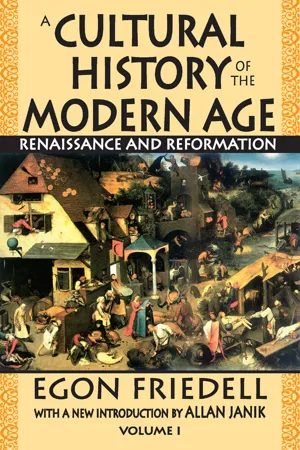
Historian, philosopher, critic, playwright, journalist, and actor, Egon Friedell was a key figure in the extraordinary flowering of Viennese culture between the two world wars. His masterpiece, A Cultural History of the Modern Age, demonstrates the intellectual universality that Friedell saw as guarantor of the continuity and regeneration of European civilization. Following a brilliant opening essay on cultural history and why it should be studied, the first volume begins with an analysis of the transformation of the Medieval mind as it evolved from the Black Death to the Thirty Years War. The emphasis is on the spiritual and cultural vortex of civilization, but Friedell never forgets the European roots in pestilence, death, and superstition that animate a contrary drive toward reason, refinement, intellectual curiosity, and scientific knowledge. While these values reached their apogee during the Renaissance, Friedell shows that each cultural victory is precarious, and Europe was always in danger of slipping back into barbarism. Friedell's historical vision embraces the whole of Western culture and its development. It is a consistent probing for the divine in the world's course and is, therefore, theology; it is research into the basic forces of the human soul and is, therefore, psychology; it is the most illuminating presentation of the forms of state and society and, therefore, is politics; the most varied collection of all art-creations and is, therefore, aesthetics. Thomas Mann regarded Friedell as one of the great stylists in the German language. Like the works of the great novelist, A Cultural History of the Modern Age offers a dramatic history of the last six centuries, showing the driving forces of each age. The new introduction provides a fascinating biographical sketch of Friedell and his cultural milieu and analyzes his place in intellectual history.
BOOK I: RENAISSANCE AND REFORMATION
From the Black Death to the Thirty Years’ War
CHAPTER I
THE BEGINNING
“Does not the best everywhere begin with illness?”
Novalis
The will to pigeonhole
A little reflection shows that all the classifications ever made by man are arbitrary, artificial, and incorrect. But an equally simple reflection shows these same classifications to be useful and indispensable, and indeed unavoidable, because they arise out of an inborn tendency of our mind. For the will to classify is deeply rooted in the human being. He takes a strong and even passionate delight in dividing things up, placing them in compartments, and labelling them. With many children boxes are the favourite toy; but grown-ups too always carry an invisible grid about with them. The simple, lucid arrangement of most of nature’s products: the clearly defined segmentation of an animal body, the regular knots of a flower stalk, that are, as it were, the stories of its structure, and the sharp-cut surfaces and angles of the crystal — all these have for us a peculiarly refreshing look. We demand that a poem should have stanzas, a drama acts, a symphony movements, a book sections: without these we feel oddly worried, estranged, and wearied. A face without definitely marked features strikes us as unlovely or meaningless. We esteem people and natures according to their skill in grading, analysing, separating: that which we call art is, indeed, almost identical with the power to do these things. The Greek architects and sculptors have been the teachers of thousands of years because they were masters of classification and proportion. Dante’s fame as poet rests partly on his having made the mysterious world of the beyond transparent and tangible by defining the circles of which it was composed. And has it not ever been qcience’s sole task to parcel out reality into groups, and by skilful disparting and ranking to enable us to understand and deal with the mass of factual material? We say indeed that Nature makes no leaps. But it would seem that the intermediate forms through which she has to pass do not seem to her of great importance, since she has preserved none of them, but uses them merely as auxiliary lines and temporary bridges to bring her to her actual goal — the sharply distinct groups and kingdoms. Striking contrasts, not smudged transitions, are what she aims at. Or, rather, let us say that this is the only way in which we can see it. In observing a development process, what fascinates and stirs us is always that mysterious jump, and it is almost never absent. In every biography it is the sudden illumination and darkenings, transformations and turnings, cuts and changes of accent, that hold our sympathy; that which marks the section, the epoch. In short, we only feel comfortable in an articulated, graded, punctuated world.
The right to periodize
This applies particularly to everything which runs a course in time. Time is perhaps the most terrible of all the terrors with which mankind is surrounded — transient and uncanny, formless and unfathomable, a point of section between the two threatening uncertainties. There is the past, which no longer is and yet looms oppressively over our Now, and there is the future, which is not yet and nevertheless weighs heavily on our today; but the present we can never grasp. Time, therefore — our noblest and most precious dowry does not belong to us. We try to possess it and instead are possessed by it, are driven relentlessly on towards a phantom which we call “tomorrow” and yet can never reach. But for that very reason man endlessly strives to divide and apportion time into ever smaller and more exact portions, calling on air, sand, water, light, and all the elements to help him to perform the task better and better. His strongest craving, his perpetual dream, is to bring chronology into the world. Once we have made time systematic and comprehensible, measurable and calculable, we delude ourselves into thinking that we control it, that it belongs to us. Even the savage has his rough, simple methods of doing this. Classical man, more earthly and less subtilizing than Christian man, was content with the sun’s shadow, but even the Middle Ages were acquainted with clocks and we of today with our never-stilled fear of life and our Faustian restlessness have apparatus to register the four hundred thousandth part of a second. It is just the same if we exchange the time microscope for the time telescope and make a broad survey of our race; we are no longer satisfied with our ancestors’ naïve, symbolical division into the golden, the silver, and the iron age; we insist upon more precise, sharper, more comprehensive divisions. It is, of course, easy to indulge in polemics against every kind of periodization: to say, for instance, that everything is one great single river which, like any other river, covers long spaces in its preparatory stages and other long spaces in its development, and, in fact, is without definable limits in either direction; and that we might as well try to cut up the ocean into sections. Yet, do we not in fact do this very thing when we draw our meridians and parallels ? We are always being assured that throughout nature and life there are only step-by-step transitions, degrees, and differentials. And we hear these subtle arguments and admit them, but do not believe them. For at the bottom of our thought there is a knowledge that is more positive and original than all scientific cognitions, and this native, wholesome, unswerving knowledge, common to the vulgar and the truly learned, rejects this posthumous wisdom and clings firmly to its postulate that every course should have its beginning and its end, its overture and its finale. If we look at the life of the individual, which is more easily examined than the evolution of the totality, we shall see that blurred transitions are by no means the rule, but rather that the entry into a new period of life takes place with the abruptness of an explosion. Suddenly — “overnight,” as people say — puberty or senility is there. It has, naturally, been “prepared,” but it becomes actual usually in the form of an astonishing physiological jerk, and it is often also the solution of some profound spiritual experience. Then we say: “Why, you’re a man all at once,” or (behind his back) “Why, he’s become an old man all at once.” Wilhelm Fliess, in his interesting book Der Ablauf des Lebens says: “Suddenness is proper to all life’s processes. It is fundamental. … The child is suddenly in possession of a new articulation. … Equally certain it is that the child suddenly begins to walk.” Man grows mysteriously in the womb, becoming worm, fish, reptile, and mammal in turn; yet every one of us has his definite birthday, even his birth-minute. And so we may say of the history of our race that there are definite points in time at which a new kind of man is born, only these points will not be days, but possibly years or even decades.
The conception of the new man
But if we pursue this analogy somewhat more closely, we at once see a point where need for a correction presents itself. When does a human life “begin”? Obviously not at the moment of birth, but at the moment of conception. In the marvellous and illuminating investigations into the mysterious phenomenon of periodicity which have been undertaken during the last decades in connexion with Fliess’s work, calculations are always based on a point about nine months before the date of birth. Astrologers did the same in casting a horoscope of birth. The beginning of a new section in history should, therefore, be set at that point in time when the new man is conceived, using the word in its double sense. A new era does not start with the beginning or the end of a big war, a powerful political upheaval, or an important redistribution of territory; it is born at the moment when a new variety of the human race appears on the scene. For in history it is only the inner experiences of mankind which count. At the same time, the immediate impulse may often arise out of some overwhelming external event, some general catastrophe, a profound readjustment of the social stratification, extensive invasions, or sudden economic crises. As a rule, then, the beginning is made by some great trauma, some shock— for example, the Doric invasion, the Great Migration of the peoples, the French Revolution, the Thirty Years’ War, the World War. This is followed by a traumatic neurosis, which really constitutes the incubator of the new being. By it everything is thrown about and broken down into a labile, anarchic, chaotic condition; mental and spiritual standards are shaken up and, so to say, mobilized. Only later does the “psychomotor superstructure,” as the psychiatrists call it — namely, the system of cerebral regulations, checks, and safeguards by which the normal course of the soul’s functions is guaranteed — begin to take shape: all “classicisms” belong in this group of epochs.
Working on this scheme now, we propose to risk the assertion that the year 1348, that of the Black Death, was the year in which modern man was conceived.
The “transitional period”
Modern times do not, therefore, begin where the schools would have them begin. There has indeed always been a dim suspicion that the traditional dates fixed for this begining only very summarily and superficially express the real content of the facts. Most historians help themselves out with a “transition period,” by which they mean in a general way the fifteenth century. Breysig introduces the idea of a “late Middle Age,” which he dates as “the time between about 1300 and about 1500.” Houston Chamberlain goes further back in his clever if rather one-sided Foundations of the Nineteenth Century. For him the “pivot” of European history is the awakening of the Germans to their world-historical mission as founders of an entirely new civilization and an entirely new culture; and the year 1200 is the mean moment of this awakening. Scherer, it is true, adheres to a “declining” Middle Age, yet he opens his chapter on that period with the words: “The Flagellants and the first German university stand significantly at the entrance of a three-hundred-year epoch which lasts until the Peace of Westphalia.” It is only natural, however, that the obvious necessity of recognizing an earlier beginning for modern times should have dawned much sooner on the “laity” than on the experts. Even Vasari placed the Rinascita at the beginning of the Trecento. Gustav Freytag writes in his Bilder aus der deutschen Vergangenheit, which remains to this day the most vivid, impressive, and convincing cultural history of the German people: “On closer examination we see that silent forces had long been actively preparing these great events … which determined the fate not only of the Germans, but of all the nations on earth… From this point of view the time between the Hohenstaufen and the Thirty Years’ War, the four hundred years between 1254 and 1648, appears as a uniform, self-contained period in German history, which stands out sharply against the periods that preceded and followed.” And Fritz Mauthner, too, in his Atheismus and seine Geschichte im Abendland, arrives at this formula: “If by the Middle Ages we understand all the centuries in which ecclesiastical conceptions were still operative … then the period lasted until the Peace of Westphalia … but if we understand it as meaning only those centuries in which theocracy reigned undisputed … these Middle Ages would have to stop long before the end of the fifteenth century — about two hundred years earlier.”
We see, then, that the new age entered the world at the opening of the sixteenth century, but that it came into being in the fourteenth and fifteenth. And, further, it came into being through disease. This apparently paradoxical explanation — that disease is something productive — must, therefore, have first place in our investigations.
Beginning of the excursus on the value of sickness
All disease is a functional disturbance within the organism. But only a very superficial method of study would content itself with lumping the notions of functional disturbance and of injury together. Even from the history of political and social life, of art, of science, and of religious belief, it must be obvious that the overthrow of the existing equilibrium is certainly not always to be classed among pernicious phenomena; rather is it clear that a new idea, if it is to bear fruit, or a new form, if it is to be beneficial, can only fulfil itself by way of a catastrophe, through some disintegration of the parts and displacement of the existing parallelogram of forces. And, from a conservative standpoint, such a condition must invariably appear one of sickness. An inkling that disease is closely bound up with the mystery of “becoming” has been widespread in the humanity of every age. Popular instinct has always regarded sick people, particularly the mentally sick, with a certain reserve, compounded of fear and respect. The Romans called epilepsy “morbus sacer, morbus divinus”; the Pythia, who was entrusted with the solution of Greece’s most important problems and with the divination of the future, would seem, judging by what we know of her, to have been what today we should call a hysterical medium. The high value that is placed on suffering in so many religions has its roots in the conviction that it raises rather than lowers the vital functions and leads to a knowledge from which the healthy are debarred. Asceticism is, in both its oriental and its Western manifestations, an attempt — by every imaginable “weakening” device such as under-nourishment, insomnia, flagellation, solitude, and sexual abstinence — to make the organism artificially morbid and thereby to translate it into a higher state. In legend almost all the saints and the like who are distinguished in some way by God show bodily inferiorities. It is only another aspect of this conception that earlier centuries tended to regard hysterical women as witches, as the elect of God’s great enemy, whom the belief of that day credited with almost as great a power as the Creator’s. In short, we meet everywhere the more or less definite feeling that a sick man is constitutionally more blessed, more enlightened, more pregnant with life, that he represents a higher form of life than his healthy fellows.
The healthiest being is the amœba
It must, of course, be clear to even the most philistine mind that every human being learns through the condition of illness. The diseased organism is more restless and therefore more desirous of learning; more sensitive and therefore more capable of learning; more precariously situated and therefore more alert, sensing and hearing more acutely; living permanently in familiarity with the neighbourhood of danger and therefore bolder, more regardless, more enterprising; nearer to the threshhold of the other world and its spiritual state and therefore more incorporeal, transcendent, and spiritualized. After all, generally speaking, every step in the direction of spiritualization represents at bottom a phenomenon of illness, the last means of self-preservation, provided by nature when the physique is exhausted. Higher things are, therefore, invariably less healthy things. The very complication of an organism, if very high, involves a liability to constant disturbance of equilibrium, or at the very least to the danger of such disturbance, and hence insecurity, disequilibrium, lability. “Healthiest” of all is undoubtedly the amœba.
All that is becoming is decadent
Wherever something new is being formed, there is weakness, sickness, and “decadence.” Wherever new germs are developing, there is an apparent condition of reduced vitality, as in pregnant women, children cutting teeth, or moulting canaries. In spring all nature is in a sort of neurasthenia. Pithecanthropus was certainly a decadent. The disease commonly known as nervousness is in fact nothing but enhanced susceptibility to irritants, and increased rapidity of reaction, richer and bolder power of association: in a word, spirit. The more highly developed an organism, the more nervous it is. The white man is more nervous than the Negro, the townsman than the countryman, modern man than mediæval man, the poet than the Philistine. In the animal world there is the same relativity: a sportsman’s dog is more nervous than a butcher’s dog, and a butcher’s dog than a bullock. Hystericals have so much power of spirit that they can control matter. On their own bodies they are able to produce at will swellings, hæmorrhages, stigmata, and even trances, and have frequently been found to have second sight. On a smaller scale all this repeats itself in the neurasthenic, with his acuteness of vision. In his case is simply that his senses are less dormant, making him keener, more easily moved and stirred and more curious. All the current definitions of neurasthenia are nothing but ugly circumlocutions for the physiological states of talent.
The convalescent feels his condition as one of curious buoyancy and exaltation, in comparison with which full return to health appears as a set-back. This is because every illness represents a heroic struggle for existence, a final desperate exertion of strength, which is the threatened organism’s reply to insults and invasions from without, The body is then in an exceptional warlike condition, a state of general insurrection in which the individual cells rise to feats of energy, intensifications of vitality, controls of reserves and reactions of which they could never have been supposed capable.
It is not surprising that the problem of the value of illness has roused the attention of some of our most intensive modern thinkers. Hebbel noted in his Diaries: “The states of illness are in fact nearer to the true (the durable-eternal) than those of so-called health.” Noyalis asserts that illnesses probably form “the most interesting stimulant and material for our reflectiveness and our activity” if only we possessed the art of using them, and he asks: “Might riot illness be a means of obtaining a higher synthesis?” And Nietzsche, the passionate opponent of modern decadence, has nevertheless stressed in many passages the great importance of disease in mental self-discipline. In the preface to Fröhliche Wissenschaft he even arrives at this conclusion: “As regards illness, are we not almost tempted to ask whether we could possibly do without it?”
Higher value of organs in lowered condition
Alfred Adler, in his Studie über Minderwertigkeit von Organen, was the first to handle this question in a strictly scientific manner. When this brief work appeared, in 1907, it remained practically unnoticed and it was later, and chiefly through his psychoanalytical investigations, that the author became widely known. These did not, as is generally assumed, combat Freud’s doctrine, but were much more in the nature of a supplement to it — which shows that it would indeed be a good thing if we indulged less in amateurish and fruitless polemics and took to heart Goethe’s remark apropos his relation to Schiller: that people ought to he “glad there were a couple of fellows...
Table of contents
- Cover
- Half Title
- Title Page
- Copyright Page
- Dedication
- Table of Contents
- Introduction to the Transaction Edition
- Introduction What is Cultural History and Why is It Studied?
- Book I: Renaissance and Reformation from the Black Death to the Thirty Years’ War
- Chronology
- Index
Trusted by 375,005 students
Access to over 1.5 million titles for a fair monthly price.
Study more efficiently using our study tools.
Frequently asked questions
Yes, you can cancel anytime from the Subscription tab in your account settings on the Perlego website. Your subscription will stay active until the end of your current billing period. Learn how to cancel your subscription
No, books cannot be downloaded as external files, such as PDFs, for use outside of Perlego. However, you can download books within the Perlego app for offline reading on mobile or tablet. Learn how to download books offline
Perlego offers two plans: Essential and Complete
- Essential is ideal for learners and professionals who enjoy exploring a wide range of subjects. Access the Essential Library with 800,000+ trusted titles and best-sellers across business, personal growth, and the humanities. Includes unlimited reading time and Standard Read Aloud voice.
- Complete: Perfect for advanced learners and researchers needing full, unrestricted access. Unlock 1.5M+ books across hundreds of subjects, including academic and specialized titles. The Complete Plan also includes advanced features like Premium Read Aloud and Research Assistant.
We are an online textbook subscription service, where you can get access to an entire online library for less than the price of a single book per month. With over 1.5 million books across 990+ topics, we’ve got you covered! Learn about our mission
Look out for the read-aloud symbol on your next book to see if you can listen to it. The read-aloud tool reads text aloud for you, highlighting the text as it is being read. You can pause it, speed it up and slow it down. Learn more about Read Aloud
Yes! You can use the Perlego app on both iOS and Android devices to read anytime, anywhere — even offline. Perfect for commutes or when you’re on the go.
Please note we cannot support devices running on iOS 13 and Android 7 or earlier. Learn more about using the app
Please note we cannot support devices running on iOS 13 and Android 7 or earlier. Learn more about using the app
Yes, you can access A Cultural History of the Modern Age by Egon Friedell in PDF and/or ePUB format, as well as other popular books in History & European Renaissance History. We have over 1.5 million books available in our catalogue for you to explore.