eBook - ePub
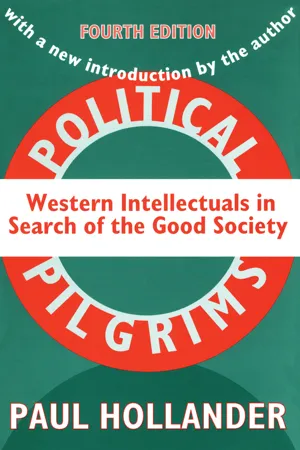
Political Pilgrims
Western Intellectuals in Search of the Good Society
- 526 pages
- English
- ePUB (mobile friendly)
- Available on iOS & Android
eBook - ePub
Political Pilgrims
Western Intellectuals in Search of the Good Society
About this book
Why did so many distinguished Western Intellectuals from G.B. Shaw to J.P. Sartre, and. closer to home, from Edmund Wilson to Susan Sontag admire various communist systems, often in their most repressive historical phases? How could Stalin's Soviet Union, Mao's China, or Castro's Cuba appear at one time as both successful modernizing societies and the fulfillments of the boldest dreams of social justice? Why, at the same time, had these intellectuals so mercilessly judged and rejected their own Western, liberal cultures? What Impulses and beliefs prompted them to seek the realization of their ideals in distant, poorly known lands? How do their journeys fit into long-standing Western traditions of looking for new meaning In the non-Western world?These are some of the questions Paul Hollander sought to answer In his massive study that covers much of our century. His success is attested by the fact that the phrase "political pilgrim" has become a part of intellectual discourse. Even in the post-communist era the questions raised by this book remain relevant as many Western, and especially American intellectuals seek to come to terms with a world which offers few models of secular fulfillment and has tarnished the reputation of political Utopias. His new and lengthy introduction updates the pilgrimages and examines current attempts to find substitutes for the emotional and political energy that used to be invested in them.
Information
1
Themes
A world purified of all evil and in which history is to find its consummation—these ancient imaginings are with us still.
NORMAN COHN1
A great deal of intelligence can be invested in ignorance when the need for illusion is deep.
SAUL BELLOW2
The Political Judgment of Intellectuals— A Point of Departure
Although much has been written about Western intellectuals, the relationship between their critical and uncritical attitudes—or, between estrangement and affirmation—remains to be more fully explored and much better understood.
My interest in this matter was sparked initially by the political judgments of contemporary Western intellectuals, both distinguished and less distinguished. For many years prior to conceiving of this book, I harbored misgivings about their ability to make what I considered sound political judgments. It seemed that they had a tendency for a selective preoccupation with various historical and social events and issues while allowing others to bypass them completely. I was struck by a puzzling juxtaposition of insight and blindness, sensitivity and indifference. As time went by, I came to discern a pattern. It appeared to me that most of these intellectuals tended to be rather harsh on their own societies, and surprisingly indulgent of as well as uninformed about others, unless the defects of these societies were somehow linked to their own.
My misgivings gradually broadened into an interest in the political values, cultural beliefs, and deeper apprehensions of intellectuals about the social world they inhabited. As the signs of psychic and political discomfort multiplied among Western intellectuals during the 1960s and early 70s, I became increasingly eager to comprehend better their attitudes and the less self-evident sources thereof. It appeared that the broader ramifications of this study were associated with the ambiguous position of intellectuals in contemporary Western societies and with their contradictory attitudes toward power and powerlessness, belief and disbelief, social order and disorder. Intellectuals in Western societies at once articulate, occasionally attempt to solve, and sometimes themselves create certain social problems and conflicts. Their self-images too are often ambiguous, replete with paradox as they combine self-doubt with a sense of entitlement to influence, assertions of powerlessness with claims on power, humility with self-righteousness. Many Western intellectuals view themselves as the true elite of our times, especially in their capacity as opinion makers, and there are those among them who would feel comfortable with the appellation "engineers of the soul."3
I came to believe that the most distinctive trait of a large segment of contemporary Western intellectuals has been the fluctuation in their attitudes between estrangement and affirmation. Moreover, I felt that a more systematic examination of the relationship between the two could lead not only to a better understanding of these intellectuals but also of certain socio-cultural problems in contemporary Western societies.
I discovered that there is a body of literature that could provide much of the information required to examine the connections between estrangement and affirmation and between belief and disbelief: the reports of intellectuals on their visits to societies they found appealing. Such writings contained both lengthy statements about the attractions of the countries visited and detailed criticisms of the social system of their own countries. These books and articles offered more than an outline of the political values of a sizable group of Western intellectuals: they contained their notions of good and bad society, social justice and injustice. Almost invariably they contrasted the defects of their own societies with the virtues of those visited. Not surprisingly, these writings revealed more about their authors—and about the societies which nurtured them, if that is the right word—than about the countries ostensibly depicted.
The phenomenon of such political tourism, and the accounts written about it, provided an excellent opportunity for an inquiry into the grasp of reality, common sense, and political "instinct" of these tourists. Moreover, an examination of the politically purposeful travelers was bound to intersect with the broader issue of the relationship between alienation and Utopian impulses in contemporary Western societies.
In recent times intellectuals in pursuit of political utopia have been particularly interested in four countries. Naturally enough, following the October Revolution of 1917, the Soviet Union was the first focus of attention, although many of the visits only took place after the mid-1920s, and the greatest number of such visitors arrived there in the early and mid-1930s. Less numerous but propelled by similar motives were the trips undertaken to Cuba, especially in the first years after the 1958 revolution, and to North Vietnam in the mid- and late 60s.* Interest in China among American intellectuals intensified after the diplomatic initiatives in 1972 which also allowed for the spectacular expansion of visits. Western European intellectuals visited China in more substantial numbers during the 1950s and 1960s.
Those political tours and pilgrimages are significant in several ways. In the first place they provide documents that can aid in understanding the values, aspirations, longings, and revulsions of an important and influential segment of Western intellectuals. The reports of the travelers have also molded our conceptions of the societies they described, and of those from which they have become estranged. At a minimum, the surge of favorable assessments of these societies contributed to the drowning out of voices more critical (or reduced their credibility) and certainly neutralized the expression of many skeptical viewpoints. By sheer repetition certain seemingly unassailable platitudes and axioms have evolved, gained footholds, and acquired plausibility.†
The travel reports also offer some startling illustrations of selective perception and the associated capacity for selective moral indignation and compassion—attitudes which were among the principal concerns of this study.
Why was it that sensitive, insightful, and critical intellectuals found societies like that of the USSR under Stalin, China under Mao, and Cuba under Castro so appealing—their defects so easy to ignore (or, if observed, to excuse)—and so strikingly superior to their own societies? How was it possible for many of them to have visited these societies often at their most oppressive historical moments (as was clearly the case of the USSR in the 1930s and China during the Cultural Revolution) and yet not notice their oppressiveness? Or, if they did, what psychological and ideological mechanisms enabled them to take a tolerant view?* One's sense of bewilderment deepens, since it is usually taken for granted that a key attribute of intellectuals is a keenly critical mind, fine tuned to every contradiction, injustice, and flaw of the social world.
Intellectuals critical of their own society proved highly susceptible to the claims put forward by the leaders and spokesmen of the societies they inspected in the course of these travels. They were inclined to give every benefit of doubt to these social systems and were successful in screening out qualities that might have detracted from their positive vision. How could such contradictory attitudes coexist and be reconciled with one another in such a highly patterned way? How do intensely critical (even suspicious) frames of mind blend with highly impressionable and uncritical mental postures? Do such opposing mental postures form some sort of a "dialectical" unity? Are they mutually supportive and made possible by one another, or do they represent compartmentalized contradictions?6 Or is it perhaps possible that what appears at first a merciless, but realistic, critical impulse—exhibited by these intellectuals toward their own society—is also distorted because they are predisposed to attribute the worst to the social setting with which they are familiar and systematically to ignore its positive characteristics? To what extent were the favorable perceptions and judgments induced by the way the hosts controlled and manipulated the impressions and experiences of the visitors?
While the manipulations of the visitors' experiences—or as I call them, the techniques of hospitality—doubtless influenced the judgments—both by exposing them to reality selectively and by the highly flattering personal attentions they showed them—I do not believe that these techniques were decisive. What was decisive was the predisposition of the intellectuals themselves. And this leads us back once more to the crucial question: under what circumstances and for what motives do "critical intellectuals" become uncritical ones? What pressures lead to the apparent suspension of critical judgment in certain situations? How can sensitivity to social injustice and indignation over the abuses of political power so abruptly give way to the cheerful acceptance, or denial, of comparable flaws in other social systems?
The answer to these questions lies in the realization that intellectuals, like most other people, use double standards and that the direction of their moral indignation and compassion is set and guided by their ideologies and partisan commitments.
I hope that this study may contribute to a reexamination of certain widely held views about intellectuals. It will, if nothing else, show that their political attitudes and moral commitments are more contradictory and complex than has generally been envisaged. It will also show that their critical impulses are neither infallible nor consistent—above all, that being of a critical disposition per se may not be the major defining characteristic of Western intellectuals but instead an attribute of their ideal, or rather idealized, image.
Alienation, Utopia Seeking, and Choosing the Model Societies
The most striking paradox in the political judgment of intellectuals involves the contrast between their views of their own society and of those they designate—from time to time—as lands of promise or historical fulfillment. Correspondingly, in the interstices and interconnections of these two attitudes—estrangement and affirmation—lie the cherished values of Western intellectuals, their conceptions of good and evil in politics and history.
Not surprisingly, my inquiry found that alienation from one's own society and susceptibility to the attractions, real or imagined, of others are very closely linked. The late 1920s and early 1930s provide an excellent example. Then, as in the 1960s and early 1970s, Western intellectuals responded to the crises and problems of their society with intensified criticism and a surging interest in alternatives. The Soviet case offered the most hopeful alternative to the economic and social chaos of the first period. In more recent times the problems of Western societies were less economic and more spiritual and political in nature. In the 1960s and early 70s the putative emptiness of affluence and material comforts provided the broad background against which specific causes for discontent and social criticism came to be projected: Vietnam, race relations, corporate capitalism, consumerism, or the bureaucratization of life. More generally, I contend that in recent times the increasing strains of secularization played an important part in predisposing many intellectuals to admire such societies as China under Mao or Cuba under Castro. These were social systems which exuded a sense of purpose and appeared to have provided meaningful lives for their citizens. Evidently social criticism must rest on a vision of alternatives. Hence, estrangement from one's society invariably precedes or accompanies the projection of hope and affirmation upon other ones. This reciprocal process is enhanced by the circumstance that the societies these Western intellectuals tend to idealize in turn attack Western societies—through their spokesmen and mass media—on almost exactly the same grounds as the estranged intellectuals. Kindred voices are raised, it would seem, across the various geographical and ideological boundaries, which denounce capitalistic greed and wastefulness, excessive military expenditures, racism, poverty, unemployment, the impoverishment of human relationships, the lack of community, the vulgar noises of advertising, the crudeness of commercial transactions—practically everything that is intensely disliked by the Western intellectual. How could he fail to find some sense of affinity with those who seemingly share his values, his likes and dislikes?
The remarks of Tom Hayden and Staughton Lynd are illustrative of these attitudes:
. . . we also discovered that we felt empathy for those more fully "other" members of the other side, spokesmen for the Communist world in Prague and Moscow, Peking and Hanoi. After all, we call ourselves in some sense revolutionaries. So do they. After all, we identify with the poor and oppressed. So do they.7
Thus a favorable predisposition toward these societies was based in part on the belief that they stood for the values the intellectuals cherished. Moreover, their very existence meant that Western intellectuals did not have to retreat to purely Utopian alternatives to the evils they deplored. Intellectuals critical of their society must believe that social institutions superior to those in their own society can be created. They must be in a position to point, at least tentatively, to the actualization of their ideals in some existing society in order to lend strength to their social criticism at home. If other societies are no better than the one they know best how can they rise to intense moral indignation about the defects of their own society? While it is possible to reject one's society without becoming favorable toward another, it is psychologically difficult and rare to do so, for it generates a sense of hopelessness. Much of the literature we examined shows that most people estranged from their own society tend to drift to the idealization of others—or, rather, they cannot idealize others without a previous alienation from their own. The admission or realization that other social systems represent little or no improvement over one's own dilutes moral outrage; if social injustices and defects are endemic and discernible even in "new" revolutionary societies, it becomes difficult to sustain an impassioned criticism of one's own. Most of us are not capable of vehement and prolonged criticism about such ills which are widespread, seem to resist eradication, and appear determined more by impersonal forces than by identifiable human beings. By contrast, when particular defects of a society are seen as easily remediable, and when specific societies can be pointed to as illustrative of such improvements, a new and vastly superior basis for the critique of one's society is created.
It was precisely this need for new alternatives—along with certain historical facts and new information increasingly difficult to ignore—that explains why the Western intellectuals' attachment to the Soviet model-exemplar was relinquished with the passage of time. Since the late 1950s there has been not only an impressive accumulation of information concerning the departure of Soviet society from its revolutionary origins and ideals, but also the emergence of new and seemingly more authentic revolutionary societies—such as Cuba, China and North Vietnam—which could absorb sentiments and sympathies which had earlier been reserved for the Soviet Union.* H. Stuart Hughes's comment about the late J. P. Sartre (one of the few older intellectuals whose political attitudes and commitments formed a bridge between two periods and generations, having shifted from pro-Soviet to pro-Cuban and other more diffuse "Third World" sympathies) is readily applicable to many New Left radicals of the 1960s in search of new models of political rectitude: "Like Lenin before him, Sartre discovered the underdeveloped world when he needed it most to buttress a faith that seemed increasingly inapplicable to European conditions."9
The importance of unfamiliarity as a component of the appeal of distant societies and their leaders was also noted by Hannah Arendt in her comment on the popularity of Mao, Castro, Che Guevara, and Ho Chi Minh as compared with the lack of interest in and enthusiasm for the much more accessible Yugoslav system and its leader, Tito.10 It should be stressed, however, that geographical distance as such is not the decisive criterion in endowing countries with some sense of mystery, promise, or exotic attraction. The recently emerged popularity of Albania among Western European radicals shows that geographic proximity can be compatible with political appeal if little is known about the country in question. Thus, for example:
A recent visitor to a Scandinavian university, after a heated debate with a group of students who had complained bitterly about the ...
Table of contents
- Cover
- Half Title
- Title
- Copyright
- Dedication
- Contents
- Introduction to the Transaction Edition
- Preface to the 1990 Edition
- Preface to the 1982 Edition
- Preface to the 1981 Edition
- Acknowledgments
- 1. Themes
- 2. Intellectuals, Politics, and Morality
- 3. The First Wave of Estrangement: The 1930s
- 4. The Appeals of Soviet Society: The First Pilgrimage
- 5. The Rejection of Western Society in the 1960s and 70s
- 6. New Horizons: Revolutionary Cuba and the Discovery of the Third World
- 7. The Pilgrimage to China: Old Dreams in a New Setting
- 8. The Techniques of Hospitality: A Summary
- 9. Conclusions Concerning the Nature of Intellectuals, Estrangement, and Its Consequences
- Notes
- Selected Bibliography
- Index
Trusted by 375,005 students
Access to over 1.5 million titles for a fair monthly price.
Study more efficiently using our study tools.
Frequently asked questions
Yes, you can cancel anytime from the Subscription tab in your account settings on the Perlego website. Your subscription will stay active until the end of your current billing period. Learn how to cancel your subscription
No, books cannot be downloaded as external files, such as PDFs, for use outside of Perlego. However, you can download books within the Perlego app for offline reading on mobile or tablet. Learn how to download books offline
Perlego offers two plans: Essential and Complete
- Essential is ideal for learners and professionals who enjoy exploring a wide range of subjects. Access the Essential Library with 800,000+ trusted titles and best-sellers across business, personal growth, and the humanities. Includes unlimited reading time and Standard Read Aloud voice.
- Complete: Perfect for advanced learners and researchers needing full, unrestricted access. Unlock 1.5M+ books across hundreds of subjects, including academic and specialized titles. The Complete Plan also includes advanced features like Premium Read Aloud and Research Assistant.
We are an online textbook subscription service, where you can get access to an entire online library for less than the price of a single book per month. With over 1.5 million books across 990+ topics, we’ve got you covered! Learn about our mission
Look out for the read-aloud symbol on your next book to see if you can listen to it. The read-aloud tool reads text aloud for you, highlighting the text as it is being read. You can pause it, speed it up and slow it down. Learn more about Read Aloud
Yes! You can use the Perlego app on both iOS and Android devices to read anytime, anywhere — even offline. Perfect for commutes or when you’re on the go.
Please note we cannot support devices running on iOS 13 and Android 7 or earlier. Learn more about using the app
Please note we cannot support devices running on iOS 13 and Android 7 or earlier. Learn more about using the app
Yes, you can access Political Pilgrims by Paul Hollander,Edward Banfield in PDF and/or ePUB format, as well as other popular books in Politics & International Relations & 20th Century History. We have over 1.5 million books available in our catalogue for you to explore.