- 284 pages
- English
- ePUB (mobile friendly)
- Available on iOS & Android
eBook - ePub
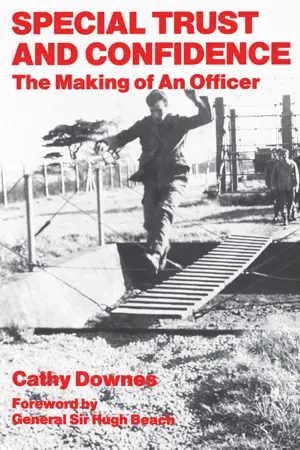
About this book
This is an examination and an analysis of the systems of recruitment, selection, education and training for junior officers in the British Armed Forces. It is a study based around four core institutions: The Royal Military Academy, Sandhurst, The Britannia Royal Naval College, Dartmouth, the Department of Initial Officer Training, Royal Air Force College, Cranwell and the Officers Training Wing, Commando Training Centre, Royal Marines, Lympstone. The conclusions reveal the enduring dilemmas involved in the preparation of officer aspirants for entry to the British military profession.
Information
1
The Challenge
How is it being done and how well is it being done?
We now live in what surely has become the most potentially lethal, morally ambivalent and volatile of worlds. We have been no less ingenious and successful than our forefathers in inventing weapons of destruction and methods of inflicting them upon our fellow man. The notion of nuclear deterrence, with its underlying assumption of the redundance of armed forces as instruments of waging war, belies the realities of our world. Between 1945 and 1970 for example, the British Army alone was engaged in some 64 military campaigns. In the eight major ones, over 1,800 soldiers were killed and over 5,200 were wounded. There is only one year this century in which no British soldier has been killed in defence of Britain and her interests.1
While we can always hope that history is not destined to repeat itself, we cannot escape the seemingly preordained course which will continue to require members of our communities to sally forth and defend our lives and property with their skills, knowledge and ultimately their lives. We have a serious need to know how the young men and women, who will lead these actions in our defence, are to be prepared for this task. Not only does society have a need to know, it has an obligation to understand and scrutinise the processes by which a layman civilian, in most cases, is transformed into a professional military officer and leader of people. For indeed, as in the past, and as surely in the future, it will be the sons and daughters of society who will be placed under the command and direction of such people.
The task of educating and training military officers is a complicated one. The fact of its complexity is used as an argument by military professionals (as by members of other professions), to deter public scrutiny. The professions retain their monopoly ownership over their professional skills, knowledge and mysteries so long as the lay community stands in awe of a realm of knowledge it is ignorant of; as long as the mysteries remain mysteries. However, as Sun Tzu commented: "war is a matter of vital importance ... the province of life and death; the road to survival or ruin".2 This fact gives us the right to ask: if what is being done is so important, how can we not concern ourselves with how it is being done, how well it is being done, and how it could be improved?
In response, the military professional would argue that only the professional has the knowledge and understanding necessary for effective examination and scrutiny. This argument is founded on what I as a New Zealander can describe as the "been-there, done-that" syndrome. However, if we were deterred from seeking greater knowledge and understanding because we lacked actual experience, the whole foundation of academic scholarship would be threatened. For example, John Keegan's The Face of Battle might never have been completed if Keegan had paled in the face of his confession in its opening pages: "I have not been in a battle; nor near one, nor heard one from afar, nor seen the aftermath."3 I too have never been in a battle and I have not been educated and trained as a military officer. I am even less eligible, in certain eyes, by reason of my being a woman. I am not even British, although my birth and upbringing in an ex-colony - New Zealand - at least has saved me from total condemnation as a foreigner.
The subject of officer education and training is a controversial one, particularly amongst members of the military profession. It raises passions of an unexpected intensity. For many a senior officer, there is the nostalgic, but nonetheless strong, conviction that the system under which they were trained is the best one. After all, has not this method produced them? Just as intense in their convictions are other officers who vilify and savage their own systems, or those of other services or nations. In between the two extremes, one encounters an array of strong, genuine and well-reasoned arguments for and against one scheme or another.
As one of the aims of military education and training is socialisation - the internalisation of appropriate attitudes, frames of references and loyalties - it is arguable as to whether or not the military officer is the best scrutineer of his own and other systems of officer education and training. In contrast, the academic scholar is trained to observe, analyse and investigate without reservation. Without a "bandwagon" to push, it is the academic scholar who can make an effective and objective contribution to understanding "how it is done and how well it is done". Finally, while I cannot speak with the voice of experience, I have followed John Keegan's advice to the battle historian, to spend as much time as possible with my subjects of study. The limits of my "windows" of experience may bring the scorn of professionals down upon my head. However, as far as it has been possible, I have tried to get mud on my boots. Such experiences have allowed me to gain
[a] perception of the hostilities as well as the loyalties which animate a society founded on comradeship, some appreciation of the limits of leadership and obedience, a glimpse of the far shores of courage, a recognition of the principle of self-preservation ever present in even the best soldier's nature, incredulity that flesh and blood can stand the fears with which battle will confront it and which ... [my] own deeply felt timidity will highlight.4
The British record on winning wars may support a degree of complacency about, and ignorance of, how military officers are recruited, selected, educated and trained. However, while the armed forces may apparently be relied upon to win the war, their performance in battle has not always been so consistent. And failure has not always been readily attributable to overwhelmingly superior opposition, awful weather or just bad luck. While the military profession does possess instruments for self-scrutiny and reform, it also possesses procedures which can be used to inhibit and sabotage these processes. Change for the better, and occasionally for the worse, has often occurred when informed society itself has been prepared to take an active interest in the development of its armed forces. Unfortunately, all too often such attention only becomes focused by catastrophic defeats, costly "victories" and scandals. Yet, ironically, society's usual lack of interest in the affairs of its military surely contributes to the occurrence of such latter events.
There is a need to ensure that a broader range of groups within society are aware of the demands of performance in the contemporary military operational environment, and the nature of the effort required to prepare people to operate effectively in that environment. Such an awareness can act to counter and defuse the wrathful indignation and recriminations which have been society's usual response to military failure. It can contribute to a cooperative effort to improve the character and quality of officer preparation and development. Finally, such knowledge can be used to contest the validity of changes prompted by motives other than the desire to provide young officers with the optimal chance to prepare themselves for their duties and responsibilities.
In this final category can be highlighted the overwhelming influence of economic priorities in determining educational and training practices. In the search for less expensive options for educating and training officers, the knowledge and skill demands of military performance have been restricted and unacceptably narrowed to permit the contraction of many training programmes, the sabotage and non-expansion of others, and the "purchase" of new schemes through the retrenchment or abandonment of other programmes. In this process of "bean-counting" and robbing Peter to pay Paul, the money-men have remained unmoved by the falseness of the economy to be achieved in sacrificing the education and training of an armed force in order to supply them with state-of-the-art weaponry and equipment. As du Picq observed in his Battle Studies-. "The instruments of battle are only valuable if one knows how to use them."5
The underlying assumption of the econometric approach is that whatever comes under its scrutiny can benefit from being reduced. In regard to the practices of junior officer education and training, the application of economic scrutiny has centred on three activities: first, quantifying the minimum competencies required by the officer which will permit him safely to enter the Service; second, establishing what is the minimum time required to learn these skills and knowledge; and third, determining the minimum numbers of staff required to impart these competencies.
Quantification, despite its definition, is an imprecise and inflexible tool with which to evaluate and assess the achievements of the officer training establishment. For example, the more intangible aspects of learning, because they are non-quantifiable, are factored out as irrelevant, extraneous as one RAF officer observed:
whenever a case has to be argued to retain part of a syllabus ... the easiest cases to defend are those which can be justified with facts ... it is easy to say "To fulfil his day to day duties satisfactorily, a junior officer must be able to X, and must know Y and it will take Z hours to teach this." It is much harder to say "To fulfil all the obligations implicit on him, a junior officer will need to have learned the importance of A, the value of B, and the reasons for C."6
Often it is not deemed necessary to make a comprehensive evaluation of all the career skills and knowledge required by the officer. For example, by defining the purpose of the officer training establishment as that of minimal preparation for junior officership, the economic approach does not take into its assessment, training needs which may not manifest themselves until 15 or 20 years into an officer's career. Even in terms of immediately utilisable skills and knowledge, the economic method is inadequate. The approach can enumerate the financial savings to be derived from a five-week reduction in a training course. It cannot, with the same mathematical certainty, predict the consequences of committing to a situation an officer who has had five weeks less training than another:
Shorter training periods could lead to incompetence or to personal stress afflicting a hastily trained officer. The harrowing streets of Belfast demand greater cerebration than the brave acceptance of death in the trenches after two months training in 1918 ... It has been argued that the basic problem is lack of time ... The young Sandhurst officer ... may not have had the time to mature and develop greater caution and common sense. Too many young officers have rushed into booby-trapped deaths in Ulster ...7
While training course lengths have been steadily reduced, subjects excised or summarised, and staff numbers cut, there has been no commensurate decline in the complexity and demands of the job of officer ship. Indeed, quite the contrary. Military officership has often been regarded as "a very simple business requiring common sense and plenty of practice".8 However, common sense is now not a sufficient substitute for the array of skills and competencies the young officer needs to have learned prior to taking up his duties. Moreover, on-the-job learning, as a substitute for preparation, entails learning by trial and error. In contemporary circumstances of public accountability, there is a low tolerance for the costs of practice-makes-perfect.
What circumstances have combined to make what was regarded as a simple job complex? What happened to the successful combination of raw courage, ritual and regulations? Technological, political, social and economic developments have changed not only the nature of society, from which the armed forces draw their recruits, but also the nature of the professional task. For example:
Advances in technology have brought exponential increases in the lethality, range, accuracy and mobility of weapons. Even the infantry soldier has a comparatively awesome array of deadly weapons at his disposal: ... 200 years ago, the sword was the major personal weapon of the military commander ... Today one M-16 has as much firepower as the entire English complement of archers at Agincourt... the concentration of destructive power has now made the individual or small crew-served weapon the equal of entire mass weapon systems of the past.9
At almost all levels of command, this state ol technology has intensified the difficulties of management, control and application of force. For example, with each increase in rate of fire, range and muzzle velocity, there is a commensurate decline in the time available to the commander to make decisions. When a machine gun is brought into action, it is capable of killing more people before they can be ordered from an exposed position than a semi-automatic or single-shot weapon. Nelson could advise his officers that they could do little wrong if they placed their ships alongside those of the enemy. Today, both the nature of conflict and the level of technology applied to warfare often requires that restraint is the most needed quality, and the avoidance of casualties the highest priority.
While technology enhances the lethal capacity of weapons and reduces the time available for decisions as to their use, it has also been utilised to improve communications, advance warning and threat identification capabilities. One consequence has been that the traditional fog of battle has manifested itself in another form. Officers in staff and command positions must now learn to deal with significant communication and information overloads, and this requires the capacity to sift the wheat from the chaff, the relevant from the irrelevant - often under conditions of considerable physical and mental stress.
The application of technology to warfare has followed a consistent pattern of action and reaction. With increasingly sophisticated methods of camouflage have come infra-red and heat responsive detection systems. As the importance of communications has increased, so too have the efforts to jam, distort and corrupt communication and intelligence-gathering systems. As a consequence of this flow-on process, officers have to learn how to utilise effectively both strike and counter-strike weapons and techniques.
The existence of arsenals of nuclear weapons has so far held the Superpowers and Europe back from the brink of ali-out confrontation of arms. The unacceptable costs of nuclear war, and the potential for instability and escalation, have persuaded these nations to date to settle their disputes and attenuate their security concerns by recourse to alliance building, participation in international organisations and diplomatic efforts. However, despite this, politics and discourse have not replaced the bullet and the bomb as instruments of persuasion in the international arena. Indeed, "just as the new technology has expanded the means of violence, so the new pattern of world politics has expanded the possible occasions of violence to which soldiers must be able to adapt."10 Armed forces have become embroiled in a diverse and complex range of low-intensity conflicts, which have demanded the development and internalisation of new skills, operating procedures and leadership styles.
For example, between the Korean and Falklands Wars, the British armed forces have been routinely engaged against opponents who are neither similarly trained nor motivated professional soldiers. Their opponents have most often been organised civilian paramilitary forces with political motivations and justifications for their actions. The level and intensity of violence, the access to highly sophisticated arms and armaments, and the preparedness to use these weapons without regard for ethical, moral or legal conventions, has produced situations which are beyond the capacity of police forces to handle. To deal with such situations, the armed forces have had to develop new or modified procedures and tactics.
The major effort in policing operations consists of presence and intelligence gathering. Therefore, in the terrorist and guerrilla warfare situations, the principal interface is between the armed forces and the surrounding civilian community, rather than with the terrorist or guerrilla group itself. Officers and soldiers of junior ranks are called upon, under these circumstances, to display qualities of restraint, coolness, often under extreme provocation, and indeed even charm, in the on-going hearts-and-minds effort amongst the civilian population.
The terrorist situation in Northern Ireland has thrown up its particular difficulties. As the province remains part of the United Kingdom, legally the armed forces are employed to protect and assist the police forces. There has been no declaration of war or martial law. The historical abhorrence of an armed presence in a civilian community has led to rules of engagement which, although necessarily holding the military accountable for their actions, are often a handicap to reasonable and effective action. For example, the rules tend to place the soldier in a position of extreme vulnerability on all sides. If he follows the instructions to the letter, he may endanger his own life, or the lives of others around him. If he fails to adhere to the instructions and a casualty occurs, he may be charged and convicted under civil law. Because of the backdoorstep location of Ulster and the importance of publicity and propaganda to terrorist campaigns, the armed forces have also been forced to operate under the spotlight glare of intense media interest. Again, the requirement is for leadership which stresses and exemplifies self-control and restraint:
In urban areas, a small patrol can easily become embroiled in a framed "riot", stoned or attacked by women and children, egged on by IRA sympathizers to become a target for a sniper or the center of a contrived propaganda story. Patrolling among the civilian population requires strict discipline and self-constraint by individual soldiers (and officers) ... The consequences of failure mean death, injury and always an escalating situation.11
The sorry events in Northern Ireland depicted night after night on our television screens are ... responsible for this greater public awareness of the British soldier. But this publicity might so easily have been of the adverse kind had it not been for the conduct and self-restraint of the ordinary regimental officer and sold...
Table of contents
- Cover
- Title
- Copyright
- Contents
- Foreword
- Acknowledgements
- Glossary
- 1. The Challenge: How is it being done and how well is it being done?
- 2. Reviews and Revisions
- 3. Competition and Command Tasks
- 4. Programmes, Programmes and More Programmes
- 5. Professional Socialisation
- 6. There is a Method in the Madness
- 7. Where to From Here?
- 8. Problems That Don't Go Away
- APPENDICES
- Notes
- Bibliography
- Index
Trusted by 375,005 students
Access to over 1.5 million titles for a fair monthly price.
Study more efficiently using our study tools.
Frequently asked questions
Yes, you can cancel anytime from the Subscription tab in your account settings on the Perlego website. Your subscription will stay active until the end of your current billing period. Learn how to cancel your subscription
No, books cannot be downloaded as external files, such as PDFs, for use outside of Perlego. However, you can download books within the Perlego app for offline reading on mobile or tablet. Learn how to download books offline
Perlego offers two plans: Essential and Complete
- Essential is ideal for learners and professionals who enjoy exploring a wide range of subjects. Access the Essential Library with 800,000+ trusted titles and best-sellers across business, personal growth, and the humanities. Includes unlimited reading time and Standard Read Aloud voice.
- Complete: Perfect for advanced learners and researchers needing full, unrestricted access. Unlock 1.5M+ books across hundreds of subjects, including academic and specialized titles. The Complete Plan also includes advanced features like Premium Read Aloud and Research Assistant.
We are an online textbook subscription service, where you can get access to an entire online library for less than the price of a single book per month. With over 1.5 million books across 990+ topics, we’ve got you covered! Learn about our mission
Look out for the read-aloud symbol on your next book to see if you can listen to it. The read-aloud tool reads text aloud for you, highlighting the text as it is being read. You can pause it, speed it up and slow it down. Learn more about Read Aloud
Yes! You can use the Perlego app on both iOS and Android devices to read anytime, anywhere — even offline. Perfect for commutes or when you’re on the go.
Please note we cannot support devices running on iOS 13 and Android 7 or earlier. Learn more about using the app
Please note we cannot support devices running on iOS 13 and Android 7 or earlier. Learn more about using the app
Yes, you can access Special Trust and Confidence by Cathy Downes in PDF and/or ePUB format, as well as other popular books in Education & Education General. We have over 1.5 million books available in our catalogue for you to explore.