eBook - ePub
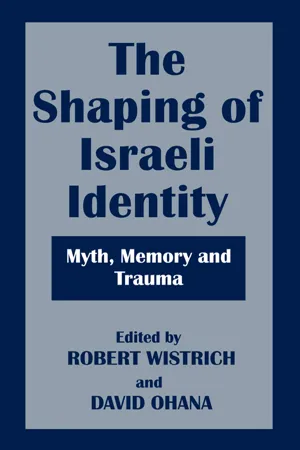
The Shaping of Israeli Identity
Myth, Memory and Trauma
- 256 pages
- English
- ePUB (mobile friendly)
- Available on iOS & Android
eBook - ePub
The Shaping of Israeli Identity
Myth, Memory and Trauma
About this book
A dozen essays document the evolution of national myths in Israel as the heroic figures and events of independence and survival transmute into blind fanaticism, great-power manipulation, and traditional colonialism and genocide. Without passing any judgement on the changes, they delve into the meani
Theodor Herzl: Zionist Icon, Myth-Maker and Social Utopian
THEODOR HERZL, the creator of political Zionism, was not only a living legend in his own lifetime but had already become the personification of the “Jewish State” 50 years before its actual creation in the land of Israel. When Herzl wrote in his diary in 1897 that he had “founded the Jewish State” at the First Zionist Congress in Basle, he knew that in the eyes of most contemporaries this could appear as little more than an idle fantasy or perhaps even worse as the megalomaniacal dream of a political demagogue. Yet despite the difficulties and the strength of the opposition to his ideas, especially in the Jewish world, Herzl was supremely confident in the validity of his prophecy. This confidence did not arise out of a mystical religious faith rooted in traditional Judaism but rather from the complex interaction between his personality structure, his liberal utopianism, his understanding of the Jewish condition and of the role of myth in politics. More than any other Zionist leader of his time, Herzl was attuned to the importance of myth as a vital rallying-cry and driving-force in modern national movements and mass politics. This sensitivity, as we shall see later, was closely, related to his Austro-Hungarian background and to his intimate familiarity with German Bildung and Kultur.
But awareness of the centrality of myth and symbolism was also something that came naturally to Herzl as part of his own highly developed aesthetic consciousness. From an early age, his poetic and dramatic inclinations, and the attention to outward appearance and deportment which he had inherited from his mother, were striking features in his personality. His instinctive sense of stage management and ceremonial occasion led him to insist on formal black dress and white ties at the First Zionist Congress and helped ensure the required aura of dignity and solemnity. In organizing the Zionist movement, Herzl displayed that sense for imagery, design, symbolism and dramatic spectacle that helped transform it from a literary debating club into a factor of international politics. He gave to Zionist assemblies and gatherings that binding, quasi-sacred feeling of a shared experience of solidarity, elation and strength. As a product of Central European culture, Herzl was only too aware of how important folklore, myths, legends and national heroes were in forging the imagined pasts out of which modern nations were born or being reborn in the course of the nineteenth century. Though not a religious believer or a traditionalist himself, he understood that to cement a modern Jewish national consciousness he would have to find analogous ways to fuse modernity and tradition. The methods of organization, agitation and propaganda employed by political Zionism might be modern but its emotional appeal resided in much more ancient, even archaic symbols like the “Promised Land”, the Covenant or the “faith of the fathers”. This tradition would have to be tapped into, resurrected and reinterpreted in the light of current political needs in order to regenerate the demoralized Jewish masses.
Herzl was convinced that his aim of national renaissance could never be achieved without recourse to those “imponderable”, unconscious factors in the lives of individuals, groups and whole nations, which make them ready to die for a cause. Not for nothing was Herzl, as a contemporary of Sigmund Freud and of the Frenchman, Gustave Le Bon (whose pioneering study of Crowd Psychology first appeared in 1895, the year of Herzl’s conversion to Zionism) so fascinated by the new mass politics which had arisen in fin-de-siècle Austria, Germany and France. From his own observation of the populist movements of the 1890s he could see just how important the appeal to archaic myths had become in modern political movements.
Ironically, of course, Herzl himself was to become one of the most potent myths and symbols of the Zionist movement which he had created. In his outward appearance and bearing, he exuded the strength, pride, nobility and physical beauty which Zionism offered as a counterweight to the “degeneration”, the ugliness and misery of ghetto life. If Zionism proposed to create a new muscular Jewry (as Herzl’s leading lieutenant, Max Nordau, constantly insisted) and a new Jewish man – upright, virile, honourable and dignified – then Herzl appeared perfectly fitted for the role. In his physiognomy the core of the Zionist programme already seemed to be contained. The manly figure, the handsome face, the gravity, the impressive beard (recalling the prophets of Israel) and the penetrating, melancholy eyes, embodied for many of his followers the Zionist promise of regeneration. When he ascended the podium at the First Zionist Congress, for some observers he looked like “a royal scion of the House of David, risen from the dead, clothed in legend and fantasy and beauty”. It was as if, after 2,000 years of exile, the Messiah himself had come to inaugurate a new epoch of Jewish history.
The Zionist mythology that developed around his person, especially after his untimely, early death in 1904, reinforced the power of Herzl’s legend. His picture now adorned virtually every Zionist meeting hall, office or reading room just as it would gaze out over his followers at future Congresses of the movement. It could be found on trademarks of Jewish ceremonial objects, household articles, canned milk or cigarette boxes. Herzl’s portrait would still be there in May 1948 behind David Ben-Gurion as he read Israel’s historic declaration of independence and he would silently preside henceforth over the debates in the Israeli parliament. This iconization of Herzl has been a useful and unifying cohesive force for Zionism, transcending the gulf between Right and Left, liberals and conservatives, secular and religious Jews. There is potentially something for everybody in Herzl’s rhetoric of unity, in his visionary “third way” between capitalism and socialism, in his enlightened, optimistic liberalism.
But it is perhaps less the content of Herzl’s Zionist programme than his image itself, which captured the imagination of the Jewish people a century ago. Zionism in its bold aim to radically transform Jewish consciousness and the external conditions of Jewish life, desperately needed a hero and a founding myth. The hero must symbolize the manliness and vigour that had been stunted by centuries of ghetto life, divorce from the soil and nature. He must radiate authority if a fragmented, dispersed and demoralized people were to be mobilized and work towards a common end. He must be a man of high culture and of the wider world, if he were to command the respect of Jews and non-Jews alike. Herzl fitted all of these criteria and more, for he was driven by that quasi-messianic sense of personal mission and readiness to sacrifice his own comfort and security for a greater cause, that is part of the heroic persona. The fact that he underwent a kind of personal “martyrdom” in the service of Zionism could only add to the aura of the mythical hero.
For the Jewish masses in Eastern Europe, with their own latent messianic longings for social redemption and national liberation, Herzl’s image was even more potent because he was a “Westerner” who had scaled the peaks of German culture and was used to dealing with princes, politicians and priests. The regal bearing echoed distant memories of ancient Jewish kings, the full beard seemed a reassuring link with Jewish tradition, the elegant, flowing prose was the mark of the Jew who had successfully conquered “the ordeal of civility”. But to grasp how this Herzlian myth was constructed, we need to return to the world into which Herzl was born – that of the fin-de-siècle Austro-Hungarian Empire.
The only son of a middle-class merchant family in Budapest, Herzl grew up in a social milieu which cultivated a deep love of German language and literature while retaining a certain loyalty to Jewish values and tradition. In a short autobiographical sketch, written in January 1898 for the London Jewish Chronicle, Herzl recalled: “I was born in 1860 in Budapest in a house next to the synagogue where lately the rabbi denounced me from the pulpit in very sharp terms because, forsooth, I am trying to obtain for the Jews more honour and greater freedom than they enjoy at present. On the front door of the house in the Tabakgasse where I first saw the light of this world, 20 years hence a “notice” will be posted up with the words – ‘This house to let’.”1
From 1866 Herzl attended the primary school of the Budapest Jewish community, where he studied Hebrew for four years as well as secular and religious subjects.2 Excelling in Hungarian, German, arithmetic and science, he received only “good” for his efforts in lashon ha-Kodesh (the holy tongue). In his autobiography, the Zionist leader observed, not without humour: “My earliest recollection of that school consists of the caning which I received from the master because I did not know the details of the Exodus of the Jews from Egypt. At the present time a great many school masters want to give me a caning because I recollect too much of the Exodus from Egypt.”3
In the autumn of 1870 Theodor joined the Realschule, a secondary school which emphasized the sciences and modern languages rather than classical studies. His marks in mathematical and technical subjects were disappointing (ending his dream of becoming an engineer like his boyhood hero, Ferdinand de Lesseps) and in religion they were lower-than-average.
His adolescent imagination was, however, sparked by a book of Jewish legends which he received as a Bar-Mitzvah gift in May 1873. As Herzl later confessed to Reuben Brainin shortly before he died, it was the Messiah legend which excited him the most – “the coming of the Messiah whose arrival is awaited daily by many Jews even in this generation”.4 He dreamed that the King-Messiah had taken him up in his arms into the heavens where they encountered Moses.5 The Messiah in the dream, echoing the words of the biblical Hannah to her son Samuel, had called to Moses: “It is for this child I have prayed.” To the 13 year old Herzl, the King-Messiah had reportedly said: “Go declare to the Jews that I shall come soon and perform great wonders and great deeds for my people and for the whole world.”6 Herzl kept the dream secret and its conscious effect on his political path is difficult to assess, but his unconscious identification with the example of Moses and with a special calling to lead the Jews, was a revealing pointer to his future career.
The interests of the adolescent Herzl were increasingly turning to literature and, at the age of 13, he began to organize a pupils’ literary society Wir (“We”) in Budapest – “to enrich our knowledge, to make progress in the use of the language, and perfect the style”. He wrote essays in fluent Hungarian (as well as in German) on subjects as diverse as Napoleon, Savonarola, Muhammad, on Hungarian patriots and poets, on Greek mythology, religion and heroism; there were also short stories, sketches, literary criticism and speeches on topics like “The Achievements of Modern Civilization”.7 The essays reveal that he was thoroughly c...
Table of contents
- Cover
- Half Title
- Title Page
- Copyright Page
- Contents
- Introduction
- Theodor Herzl: Zionist Icon, Myth-Maker, and Social Utopian
- Zarathustra in Jerusalem: Nietzsche and the “New Hebrews”
- Ben-Gurion’s Mythopoetics
- The Zionist Right and National Liberation: From Jabotinsky to Avraham Stern
- The Multivocality of a National Myth: Memory and Counter-Memories of Masada
- Political Dimensions of Holocaust Memory in Israel
- “In Everlasting Memory”: Individual and Communal Holocaust Commemoration in Israel
- Paradigms Sometimes Fit: The Haredi Response to the Yom Kippur War
- Isaac Rebound: The Aqedah as a Paradigm in Modern Hebrew Poetry
- Israel as a Post-Zionist Society
- The Jewish-Arab Conflict in Recent Israeli Liteture
- Modernity and Charisma in Contemporary Israel: The Case of Baba Sali and Baba Baruch
- Index
Trusted by 375,005 students
Access to over 1.5 million titles for a fair monthly price.
Study more efficiently using our study tools.
Frequently asked questions
Yes, you can cancel anytime from the Subscription tab in your account settings on the Perlego website. Your subscription will stay active until the end of your current billing period. Learn how to cancel your subscription
No, books cannot be downloaded as external files, such as PDFs, for use outside of Perlego. However, you can download books within the Perlego app for offline reading on mobile or tablet. Learn how to download books offline
Perlego offers two plans: Essential and Complete
- Essential is ideal for learners and professionals who enjoy exploring a wide range of subjects. Access the Essential Library with 800,000+ trusted titles and best-sellers across business, personal growth, and the humanities. Includes unlimited reading time and Standard Read Aloud voice.
- Complete: Perfect for advanced learners and researchers needing full, unrestricted access. Unlock 1.5M+ books across hundreds of subjects, including academic and specialized titles. The Complete Plan also includes advanced features like Premium Read Aloud and Research Assistant.
We are an online textbook subscription service, where you can get access to an entire online library for less than the price of a single book per month. With over 1.5 million books across 990+ topics, we’ve got you covered! Learn about our mission
Look out for the read-aloud symbol on your next book to see if you can listen to it. The read-aloud tool reads text aloud for you, highlighting the text as it is being read. You can pause it, speed it up and slow it down. Learn more about Read Aloud
Yes! You can use the Perlego app on both iOS and Android devices to read anytime, anywhere — even offline. Perfect for commutes or when you’re on the go.
Please note we cannot support devices running on iOS 13 and Android 7 or earlier. Learn more about using the app
Please note we cannot support devices running on iOS 13 and Android 7 or earlier. Learn more about using the app
Yes, you can access The Shaping of Israeli Identity by Robert Wistrich, David Ohana, Robert Wistrich,David Ohana in PDF and/or ePUB format, as well as other popular books in History & Holocaust History. We have over 1.5 million books available in our catalogue for you to explore.