- 337 pages
- English
- ePUB (mobile friendly)
- Available on iOS & Android
eBook - ePub
About this book
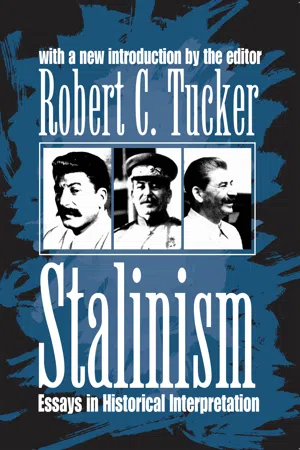
In the years since Stalin's death, his profound influence upon the historical development of Communism has remained elusive and in need of interpretation. Stalinism, as his system has become known, is a phenomenon which embraced all facets of political and social life. While its effect upon the Soviet Union and other nations today is far less than it was while Stalin lived, it is by no means dead.In this landmark volume some of the world's foremost scholars of the subject, in a concerted group inquiry, present their interpretations of Stalinism and its influence on all areas of comparative Communist studies from history and politics to economics, sociology, and literary scholarship. The studies contained in this volume are an outgrowth of a conference on Stalinism held in Bellagio, Italy, sponsored by the American Council of Learned Societies.In his major contribution to this book, Leszek Kolakowski calls Stalinism "a unified state organism facing atom-like individuals." This extraordinary volume, augmented by a revealing new introduction by the editor, Robert C. Tucker, can be seen as amplifying that remark nearly a half century after the death of Joseph Stalin himself.Contributors to this work are: Wlodzimierz Brus, Katerina Clark, Stephen F. Cohen, Alexander Erlich, Leszek Kolakowski, Moshe Lewin, Robert H. McNeal, Mihailo Markovic, Roy A. Medvedev, T. H. Rigby, Robert Sharlet, and H. Gordon Skilling. Robert C. Tucker's principle work on Stalin has been described by George F. Kennan as "the most significant single contribution made to date, anywhere, to the history of Soviet power."
Part One Old and New Approaches
Bolshevism and Stalinism
Stephen F. Cohen
Every great revolution puts forth, for debate by future scholars and partisans alike, a quintessential historical and interpretative question. Of all the historical questions raised by the Bolshevik revolution and its outcome, none is larger, more complex, or more important than that of the relationship between Bolshevism and Stalinism.
It is, most essentially and generally, the question of whether the original Bolshevik movement that predominated politically for a decade after 1917, and the subsequent events and social-political order that emerged under Stalin in the 1930’s, are to be interpreted in terms of fundamental continuity or discontinuity. It is also a question that necessarily impinges upon, and shapes the historian’s perspective on, a host of smaller but critical issues between 1917 and 1939. With only slight exaggeration, one can say to the historian of these years: Tell me your interpretation of the relationship between Bolshevism and Stalinism, and I will tell you how you interpret almost all of significance that came between. Finally, it is—or it has been—a political question. Generally, apart from Western devotees of the officiai historiography in Moscow, the less empathy a historian has felt for the revolution and Bolshevism, the less he has seen meaningful distinctions between Bolshevism and Stalinism.
A reader unfamiliar with Western scholarly literature on Soviet history would therefore reasonably expect to find it full of rival schools and intense debate on this central issue. Not only is the question large and complex, but similar ones about other revolutions—the relationship of Bonapartism to 1789 being an obvious example—have provoked enduring controversies. Still more, the evidence seems contradictory, even bewildering. If nothing else, there is the problem of interpreting Stalin’s revolution from above of the 1930’s, an extraordinary decade which begins with the abrupt reversal of official policy and the brutal collectivization of 125 million peasants, witnesses far-reaching revisions of official tenets and sentiments, and ends with the official destruction of the original Bolsheviks, including the founding fathers, and their historical reputations.
All the more astonishing, then, is the fact that the question has produced very little dispute in our scholarship. Indeed, during the great expansion of academic Soviet studies (I speak here mainly of the Anglo-American school) between the late 1940’s and 1960’s, a remarkable consensus of interpretation formed on the subject of Bolshevism and Stalinism. Surviving various methodologies and approaches, the consensus posited an uncomplicated conclusion: no meaningful difference or discontinuity was seen between Bolshevism and Stalinism, which were viewed as being fundamentally the same, politically and ideologically. Inasmuch as the two were distinguished (which was neither frequent nor systematic since the terms Bolshevik, Leninist, Stalinist were used interchangeably), it was said to be only a matter of degree resulting from changing circumstances and necessary adaptation. Stalinism, according to the consensus, was the logical, rightful, triumphant, and even inevitable continuation, or outcome, of Bolshevism. For twenty years this historical interpretation was axiomatic in virtually all of our major scholarly works.1 It prevails even today.
The purpose of this essay is to reexamine this scholarly axiom, to suggest that it rests upon a series of dubious formulations, concepts, and interpretations, and to argue that, whatever its insights, it obscures more than it illuminates. Such a critique is long overdue for several reasons.
First, the view of an unbroken continuity between Bolshevism and Stalinism has shaped scholarly thinking about all the main periods, events, causal factors, actors, and alternatives during the formative decades of Soviet history. It is the linchpin of a broader consensus, also in need of critical re-examination, about what happened, and why, between 1917 and 1939.2 Second, the continuity thesis has largely obscured the need for study of Stalinism as a distinct phenomenon with its own history, political dynamics, and social consequences.3 Finally, it has strongly influenced our understanding of contemporary Soviet affairs. Viewing the Bolshevik and Stalinist past as a single undifferentiated tradition, many scholars have minimized the system’s capacity for reform in the post-Stalin years. Most of them apparently share the view that Soviet reformers who call upon a non-Stalinist tradition in earlier Soviet political history will find there only “a cancerous social and political organism gnawed by spreading malignancy.” 4
Two disclaimers are in order. A single essay cannot explore fully all the dimensions and aspects of this long-standing interpretation. I can do so here only elliptically, with the purpose of raising critical questions rather than providing adequate answers. Nor do I wish to devalue the many important scholarly works which adhere to the continuity thesis. Indeed, it is testimony to their enduring value that many contain rich materials to refute it.
I
The history and substance of the continuity thesis warrant closer examination. Controversy over the origns and nature of Stalin’s spectacular policies actually began in the West early in the 1930’s.5 For many years, however, it remained a concern largely of the political Left, especially anti-Stalinist Communists, and most notably Trotsky. In the mid-1930’s, after an initial period of inconclusive and contradictory statements, the exiled oppositionist developed his celebrated argument that Stalinism was not the fulfillment of Bolshevism, as was officially proclaimed, but its “Thermidorian negation” and “betrayal.” By 1937, Trotsky could add: “The present purge draws between Bolshevism and Stalinism … a whole river of blood.” 6
Unequivocal, though somewhat ambiguous in its reasoning, Trotsky’s charge that Stalinism represented a counter-revolutionary bureaucratic regime “diametrically opposed” to Bolshevism became the focus of an intense debate among Western radicals, and among Trotskyists (and lapsed Trotskyists) themselves. The discussion, which continues even today, suffered from an excess of idiomatic Marxist labeling and ersatz analysis—Was the Stalinist bureaucracy a new class? Was Stalin’s Russia capitalist, state capitalist, Thermidorian, Fructidorian, Bonapartist, still socialist?—and from some understandable reluctance, even on the part of anti-Stalinists, to tarnish the Soviet Union’s legitimacy in the confrontation with Hitlerism.7 Nonetheless, the debate was interesting, and it has been unduly ignored by scholars; it anticipated several arguments, favoring both discontinuity and continuity, that later appear in academic literature on Bolshevism and Stalinism.8
Academic commentary on the subject began in earnest only after the Second World War, with the expansion of professional Soviet studies. The timing is significant, coinciding with the high tide of Stalinism as a developed system in the Soviet Union and Eastern Europe, and with the onset (or resumption) of the Cold War. This may help explain two aspects of the continuity thesis which are not easily documented but which seen inescapable. One is the dubious logic, noted by an early polemicist in the dispute, that “Russian communism had to turn out as it has because it now can be seen to have, in fact, turned out as it has.”9 The other is that early academic works were, as a founder of Russian studies once complained, “too often written in the atmosphere of an intense hatred of the present Russian regime.”10 These perspectives undoubtedly contributed to the scholarly view that the evils of contemporary Stalinist Russia were predetermined by the uninterrupted “spreading malignancy” of Soviet political history since 1917.
The theory of a “straight line” between Bolshevism (or Leninism, as it is regularly mislabeled) and major Stalinist policies has been recently popularized anew by Aleksandr Solzhenitsyn.11 But it has been a pivotal interpretation in academic Soviet studies for many years, as illustrated by a few representative statements.
Michael Karpovich: “Great as the changes have been from 1917 to the present, in its fundamentals Stalin’s policy is a further development of Leninism.” Waldemar Gurian: “All basic elements of his policies were taken over by Stalin from Lenin.” John S. Reshetar: “Lenin provided the basic assumptions which—applied by Stalin and developed to their logical conclusion—culminated in the great purges.” Robert V. Daniels: “Stalin’s victory … was not a personal one, but the triumph of a symbol, of the individual who embodied both the precepts of Leninism and the techniques of their enforcement.” Zbigniew Brzezinski: “Perhaps the most enduring achievement of Leninism was the dogmatization of the party, thereby in effect both preparing and causing the next stage, that of Stalinism.” Robert H. McNeal: “Stalin preserved the Bolshevik tradition …” and approached the “completion of the work that Lenin had started.” Adam B. Ulam: Bolshevik Marxism “determined the character of postrevolutionary Leninism as well as the main traits of what we call Stalinism.” Elsewhere Ulam says of Lenin: “His own psychology made inevitable the future and brutal development under Stalin.” Arthur P. Mendel: “With few exceptions, these attributes of Stalinist Russia ultimately derive from the Leninist heritage. …” Jeremy R. Azrael: “The ‘second revolution’ was, as Stalin claimed, a legitimate extension of the first.” The recitation could continue; but finally H. T. Willets, who confirms that non-Soviet scholars regard Stalinism “as a logical and probably inevitable stage in the organic development of the Communist Party.” 12
What is being explained and argued in this thesis of “a fundamental continuity from Lenin to Stalin” should be clear.13 It is not merely secondary features, but the most historic and murderous acts of Stalinism between 1929 and 1939, from forcible wholesale collectivization to the execution and brutal incarceration of tens of millions of people. All this, it is argued, derived from the political—that is, the ideological, programmatic, and organizational—nature of original Bolshevism.14 The deterministic quality of this argument is striking, as is its emphasis on a single causal factor. It is generally characteristic of our scholarship on Soviet history to explain social and political development after 1917 almost exclusively by the nature of the party regime and its aggression upon a passive, victimized society. Authentic interaction between party-state and society is ignored. Not surprisingly, the literature of academic Soviet studies contains little social history or real social studies; it is mostly regime studies.
None of this is wholly explicable apart from the “paradigm” that dominated Soviet studies for so many years. Much has been written in recent years critical of the “totalitarianism” approach in terms of political science. But its unfortunate impact on our historiography has gone relatively unnoticed. In addition to obscuring the subject by using “totalitarianism” as a synonym for Stalinism, the approach contributed to the continuity thesis in two important ways.
While most Western theorists of Soviet “totalitarianism” saw Stalin’s upheaval of 1929–33 as a turning point, they interpreted it not as discontinuity but as a continuation, culmination, or “breakthrough” in an already ongoing process of creeping “totalitarianism.” Thus Merle Fainsod’s classic summary: “Out of the totalitarian embryo would come totalitarianism full-blown.”15 As a result, there was a tendency to treat the whole of Bolshevik and Soviet history and policies before 1929 as merely the antechamber of Stalinism, as half-blown “totalitarianism.” The other contribution of the approach, with its deterministic language of “inner totalitarian logic,” was to make the process seem not just continuous, but inevitable. To quote one of many examples, Ulam writes: “After its October victory, the Communist Party began to grope its way toward totalitarianism.” He adds: “The only problem was what character and philosophy this totalitarianism was to take.” 16
The continuity thesis was not the work of university scholars alone. A significant role was played by the plethora of intellectual ex-Communists (Solzhenits...
Table of contents
- Cover Page
- Title Page
- Copyright
- Contents
- Introduction
- Part One Old and New Approaches
- Bolshevism and Stalinism
- Trotskyist Interpretations of Stalinism
- Stalinism and the Mono-Organizational Society
- Stalinism as Revolution from Above
- Part Two Dimensions of Stalinism in Russia
- The Social Background of Stalinism
- Stalinism and Marxian Growth Models*
- Stalinism and Soviet Legal Culture*
- Utopian Anthropology as a Context for Stalinist Literature
- New Pages from the Political Biography of Stalin*
- Part Three Stalinism in Eastern Europe
- Stalinism and the “Peoples’ Democracies” *
- Stalinism and Czechoslovak Political Culture
- Part Four Stalinism versus Marxism?
- Marxist Roots of Stalinism
- Stalinism and Marxism
- Conclusion: Some Questions on the Scholarly Agenda
- The Contributors
- Index
Trusted by 375,005 students
Access to over 1.5 million titles for a fair monthly price.
Study more efficiently using our study tools.
Frequently asked questions
Yes, you can cancel anytime from the Subscription tab in your account settings on the Perlego website. Your subscription will stay active until the end of your current billing period. Learn how to cancel your subscription
No, books cannot be downloaded as external files, such as PDFs, for use outside of Perlego. However, you can download books within the Perlego app for offline reading on mobile or tablet. Learn how to download books offline
Perlego offers two plans: Essential and Complete
- Essential is ideal for learners and professionals who enjoy exploring a wide range of subjects. Access the Essential Library with 800,000+ trusted titles and best-sellers across business, personal growth, and the humanities. Includes unlimited reading time and Standard Read Aloud voice.
- Complete: Perfect for advanced learners and researchers needing full, unrestricted access. Unlock 1.5M+ books across hundreds of subjects, including academic and specialized titles. The Complete Plan also includes advanced features like Premium Read Aloud and Research Assistant.
We are an online textbook subscription service, where you can get access to an entire online library for less than the price of a single book per month. With over 1.5 million books across 990+ topics, we’ve got you covered! Learn about our mission
Look out for the read-aloud symbol on your next book to see if you can listen to it. The read-aloud tool reads text aloud for you, highlighting the text as it is being read. You can pause it, speed it up and slow it down. Learn more about Read Aloud
Yes! You can use the Perlego app on both iOS and Android devices to read anytime, anywhere — even offline. Perfect for commutes or when you’re on the go.
Please note we cannot support devices running on iOS 13 and Android 7 or earlier. Learn more about using the app
Please note we cannot support devices running on iOS 13 and Android 7 or earlier. Learn more about using the app
Yes, you can access Stalinism by Robert C. Tucker in PDF and/or ePUB format, as well as other popular books in History & World History. We have over 1.5 million books available in our catalogue for you to explore.