- 251 pages
- English
- ePUB (mobile friendly)
- Available on iOS & Android
eBook - ePub
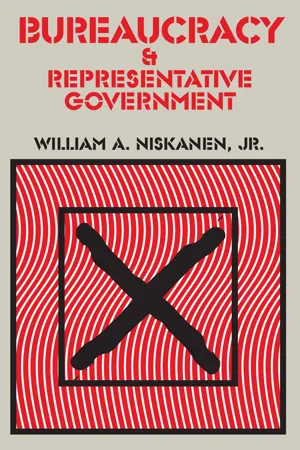
Bureaucracy and Representative Government
About this book
This is the first book to develop a formal theory of supply by bureaus. Niskanen develops an original and comprehensive theory of the behavior of bureaus with the institutions of representative government. He challenges the traditional view that monopoly bureaus are the best way to organize the public sector, and he suggests ways to use competitive bureaus and private firms to perform operations such as delivering mail, fighting wars, or running schools more efficiently than the present government agencies.The theory concludes that most bureaus are too large, grow too fast, use too much capital, and exploit their sponsor. His theory explains the relation of the output and budget of a bureau to demand and cost decisions. It compares bureaus with other forms of organization facing like conditions and delineates the production and investment behavior of a bureau, the behavior of nonprofit firms with no sponsor, the behavior of mixed bureaus with financing from a sponsor and from the sale of services, the effects of competition between a bureau and a competitive industry.The book also develops a simple theory of the market for public services financed through a representative government; the final section suggests a set of changes to improve the performance of our bureaucratic and political institutions, based both on theory and Niskanen's professional experience. It is essential reading for professionals and students in the social sciences and could prove instrumental in reforming some of our government institutions.
Information

I
Introduction

1
Introduction
Context
Bureaucracy and representative government are at the center of a storm. A large part of our population wants to expand the role of government, particularly to alleviate poverty and improve the environment. A correspondingly large part of our population is exasperated by the methods of bureaucracy and dissatisfied by its performance. The world view of two smaller groups has been uprooted by both of these contrary attitudes: The “establishment liberals”—not understanding what went wrong—have withdrawn into academic specialization, the legends of a lost Camelot, and despair. The restless young—reacting to an experience limited to family paternalism, university bureaucracy, and military authority—are torn between collective expressions of rage and the mysticism of rock, sex, and drugs. Only the uninformed, unthinking, and unfeeling are complacent. Those who want to restrict the role of government are quick to use the poor performance of the bureaucracy to support their position. The “new social engineers” somehow maintain an optimism, in the face of the most devastating evidence, that systems analysis and program budgets will make bureaus more responsive and efficient. And the bureaucracy itself, like the eye of a meteorological storm, is calm and moving slowly, captured by the general direction of the storm but unaffected by its peripheral winds.
A condition of despair among the intellectuals and rage among the young is not unique to our time, and the precedents do not provide a basis for optimism.1 Even if, as I believe, the most disturbing potential consequences will not be realized, we face two types of problems concerning our attitudes toward government: We may unnecessarily accept undesirable methods and poor performance by the bureaucracy because of an overriding concern for the provision of certain public services. Such a reaction is characteristic of periods of system-threatening crises or wars, such as the Great Depression and World War II. Conversely, we may unnecessarily reject certain desirable public services because of a dissatisfaction with the methods and performance of the bureaucracy. Such a reaction dominates current attitudes toward some of the welfare and military programs initiated by the United States federal government during the 1960’s. Can these problems be resolved? Can the responsiveness and efficiency of bureaus be significantly improved? Can some public services be efficiently supplied by other forms of organization? Can representative government better express our demands for public services? How?
Answers to these questions, even tentative answers, are not easily forthcoming. Our poor understanding of the behavior of bureaus, however, is not due to lack of experience. Bureaus are probably the oldest form of organization above the level of the communal tribe. Written language was first extensively used to record the directives and decisions of the ancient Sumerian bureaucracy. The earliest Egyptian literature was dominated by rules of conduct for young officials in the imperial bureaucracy, initiating a literary theme richly developed by Confucius, Plato, and Machiavelli. Bureaucracy has been the characteristic form of public administration for all governments with extensive territorial sovereignty from the ancient kingdoms of Sumer and Egypt to the modern nation-state. Around one-sixth of the national income of the United States, as of many other industrial nations, now originates in bureaus. The activities of bureaus dominate the front pages of the world’s newspapers.
How can there exist such confusion concerning what behavior and performance should be expected of bureaus in the face of this historical and contemporary experience? The first television images from the moon provide a clue: They remind us how difficult it is to understand our sensory perceptions without a familiar frame of reference. Understanding of a new sensory stimulus by its nature involves relating this stimulus to a “model” which has proved successful in “explaining” other like stimuli. Our confusion about bureaucracy derives from the absence of a commonly accepted theory of the behavior of bureaus with which one might compare their behavior with that of other forms of organization. More accurately, I suspect, our contemporary confusion about bureaucracy derives from the absence of a theory of bureaus that is consistent with an instrumental concept of the state, that is, a concept of a state which is only an instrument of the preferences of its constituents. Most of the literature on bureaucracy, from Confucius to Weber, proceeds from an organic concept of the state, that is, a concept of a state for which the preferences of individuals are subordinate to certain organic goals of the state. Starting from the premise that the personal preferences of the general population are subordinate or irrelevant, this literature does not recognize the relevance of the personal preferences of the bureaucrats. Any theory of the behavior of bureaus that does not incorporate the personal preferences of bureaucrats, however, will be relevant only in the most rigidly authoritarian environments. In a fundamental sense, our contemporary confusion derives from a failure to bring bureaucracy to terms with representative government and free labor markets.
An Economic Approach
My method is that of economics, although the subject has been the almost exclusive domain of sociology.2 In this book I develop a theory of “supply” by bureaus, based on a model of purposive behavior by the manager of a single bureau. In a similar way, economists have developed a theory of demand from a model of individual consumer choice and a theory of (market) supply from a model of a profit-seeking firm. The “compositive” method of economics, which develops hypotheses about social behavior from models of purposive behavior by individuals, contrasts with the “collectivist” method of sociology, which develops hypotheses about social behavior from models of role behavior by aggregative ideal types.3 The individual consumer, entrepreneur, or, in this case, bureaucrat is the central figure of the characteristic method of economics. He is assumed to face a set of possible actions, to have personal preferences among the outcomes of the possible actions, and to choose the action within the possible set that he most prefers. He is a “chooser” and a “maximizer” and, in contrast to his part in the characteristic method of sociology, not just a “role player” in some larger social drama. The larger environment influences the behavior of the individual by constraining his set of possible actions, by changing the relations between actions and outcomes, and, to some extent, by influencing his personal preferences. The economist develops models based on purposive behavior by individuals, not to explain the behavior of individuals (that is necessarily the task of psychology), but to generate hypotheses concerning the aggregative consequences of the interaction among individuals. The economist and the sociologist thus bring characteristically different methods to bear on the same general level of social behavior. Neither profession, of course, has any claim to having the “right” method; but one method or another may be more useful in addressing certain questions.
Most of the modern scholarly literature on bureaucracy stems from the writings of the German sociologist, Max Weber (1864–1920).4 Weber recognized bureaucracy as the characteristic form of public administration for a state with extended territorial sovereignty and developed what has become the standard definition of this form of organization. His writings focus primarily on the characteristics of bureaus and the behavior within bureaus.5 He devotes little attention to the economic behavior of bureaus as it affects their performance in supplying public services. He writes rather favorably of the modern form of bureaucracy, reflecting a personal outlook strongly influenced by an organic concept of the state and the manifest superiority, from this viewpoint, of public administration in the Prussian-dominated German state relative to that in the provincial organization of the German nation prior to the middle of the nineteenth century. Until recently, the literature of public administration (which developed, primarily, as an offshoot of political science) was also strongly influenced by Weber’s writings, with occasional infusions of Confucian and Platonist guidance on how a good bureaucrat, now “civil servant,” ought to behave.
Although the scholarly literature usually represents bureaucracy as a desirable, or at least necessary, form of public administration, popular attitudes reflecting personal experience are often critical of the methods and performance of bureaucracy. These popular attitudes are probably best reflected in the irreverent and sometimes caustic form of literary satire, ranging from Balzac’s observations on the mentality and behavior of minor bureaucrats to Parkinson’s mock-scientific observations on the behavior and performance of bureaus. Joseph Heller’s Catch-22 will probably become the modern classic in this tradition.
Even the terms “bureaucracy,” “bureaucrat,” and “bureaucratic methods” are now charged and usually pejorative in popular usage. As a consequence both scholars and public officials have invented euphemisms like “public administration,” “service” (in place of bureau), “civil servant,” and “program management” to deflect the popular response to terms associated with bureaucracy. This is an unfortunate practice and will not be used in this book, as these euphemisms tend to gloss over the significant differences in the behavior and performance of bureaus as a distinct form of organization.
Economists, for the most part, have ignored the economic activity of bureaus. Most of economics deals with the behavior of profit-seeking firms, owners of productive factors, and consumers; this is appropriate, as most economic activity is organized through profit-seeking firms by the voluntary exchange of factors for money and money for consumer goods. Economists have also developed an elaborate structure of normative propositions about what goods and services ought to be supplied. Even the theory of public services (usually, but less accurately, termed public goods), however, implicitly assumes that public services, although financed by government, will be supplied by a competitive industry (or that the bureaus supplying the service will behave like a competitive industry). Economics has not, to date, provided a positive theory of supply by bureaus. This represents a significant gap in the body of positive economics. More importantly, the lack of a theory of supply by bureaus seriously reduces the relevance of the normative propositions about what services the government ought to finance, at least to the general extent that public services are supplied by bureaus.
Only a few venturesome economists have taken on the bureaucracy as a subject for scholarship. Ludwig von Mises’s book, Bureaucracy, provides some of the earliest critical insights for a theory of bureaucracy:
Bureaus specialize in the supply of those services the value of which cannot be exchanged for money at a per-unit rate.
As a consequence of the above, bureaus cannot be managed by profit goals and “the economic calculus.”
In the absence of profit goals, bureaus must be centrally managed by the pervasive regulation and monitoring of the activities of subordinates.6
Mises’s assertion of these characteristics of bureaus in their imperative form, however, prevented him from developing these insights into a theory of bureaucracy. He asserts that bureaucracy is the essential form of public administration for a territorially extensive state. The methods and performance of bureaus, he asserts, cannot be improved or meaningfully compared with that of profit-seeking organizations. He believes that the criticism of the methods and performance of bureaus is misdirected, and that the only way to reduce the undesirable characteristics of bureaucracy is to reduce the scope of government. Mises also provides some perceptive insights concerning the social, political, and psychological consequences of a pervasive bureaucracy, but his rigid interpretation of the character and role of bureaus limits the value of his book to that of a forcefully written polemic. Mises concludes with the hope, almost pathetic in retrospect, that a broader education in economics will reduce the popular support for large government and the consequent pervasive bureaucracy.
One of Gordon Tullock’s sorties into the poorly defended province of political science is recorded in his The Politics of Bureaucracy.7 Tullock uses a model of a maximizing bureaucrat to examine the personal relations and advancement procedures within bureaus. In a less serious time this work could be titled, “How to Get Ahead in a Bureaucracy by Really Trying, or a Guide to the Maximizing Bureaucrat.” This is a delightful book and full of scholarship; h...
Table of contents
- Cover
- Half Title
- Title Page
- Copyright Page
- Table of Contents
- Preface
- Part 1. Introduction
- Part 2. Critical Elements OF A Theory OF Supply BY Bureaus
- Part 3. The Basic Model
- Part 4. Variations ON THE Basic Model
- Part 5. The Government Market FOR A Bureau’S Services
- Part 6. The Alternatives
- Part 7. Conclusion
- Index
Trusted by 375,005 students
Access to over 1.5 million titles for a fair monthly price.
Study more efficiently using our study tools.
Frequently asked questions
Yes, you can cancel anytime from the Subscription tab in your account settings on the Perlego website. Your subscription will stay active until the end of your current billing period. Learn how to cancel your subscription
No, books cannot be downloaded as external files, such as PDFs, for use outside of Perlego. However, you can download books within the Perlego app for offline reading on mobile or tablet. Learn how to download books offline
Perlego offers two plans: Essential and Complete
- Essential is ideal for learners and professionals who enjoy exploring a wide range of subjects. Access the Essential Library with 800,000+ trusted titles and best-sellers across business, personal growth, and the humanities. Includes unlimited reading time and Standard Read Aloud voice.
- Complete: Perfect for advanced learners and researchers needing full, unrestricted access. Unlock 1.5M+ books across hundreds of subjects, including academic and specialized titles. The Complete Plan also includes advanced features like Premium Read Aloud and Research Assistant.
We are an online textbook subscription service, where you can get access to an entire online library for less than the price of a single book per month. With over 1.5 million books across 990+ topics, we’ve got you covered! Learn about our mission
Look out for the read-aloud symbol on your next book to see if you can listen to it. The read-aloud tool reads text aloud for you, highlighting the text as it is being read. You can pause it, speed it up and slow it down. Learn more about Read Aloud
Yes! You can use the Perlego app on both iOS and Android devices to read anytime, anywhere — even offline. Perfect for commutes or when you’re on the go.
Please note we cannot support devices running on iOS 13 and Android 7 or earlier. Learn more about using the app
Please note we cannot support devices running on iOS 13 and Android 7 or earlier. Learn more about using the app
Yes, you can access Bureaucracy and Representative Government by Jr. Niskanen in PDF and/or ePUB format, as well as other popular books in Politics & International Relations & Political Economy. We have over 1.5 million books available in our catalogue for you to explore.