- 238 pages
- English
- ePUB (mobile friendly)
- Available on iOS & Android
eBook - ePub
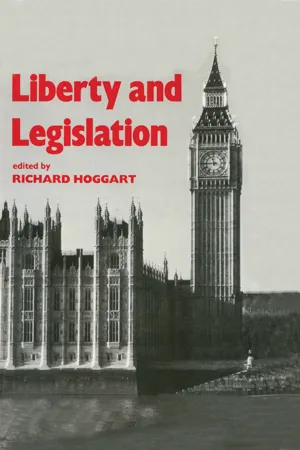
Liberty and Legislation
About this book
Has legislation over-reached itself? The contributors to this volume discuss whether the increase in legislative instruments of many kinds, often promoted with good intentions, may be progressively limiting both our individual and our communal freedoms. Contributors include Bernard Crick, Maurice Peston and James Ferman discuss this key idea in accessible and forthright style.
The Right to Protest
The rise and maintenance of liberal democracy in Britain owes much to protest, both lawful and unlawful. From Magna Carta, conceded in 1215 to protesting barons by a reluctant monarch, down to the present, the contribution of protest to the commonwealth provides a lengthy roll. As Sir John Harrington said in the sixteenth century:
Treason doth never prosper;
What’s the reason?
For if it prosper
none dare call it treason.
What’s the reason?
For if it prosper
none dare call it treason.
Equally it has to be acknowledged that misguided and failed protest has added to the sum of human misery.
The unredressed grievances and protests of the Commons against the King, the Civil War, the end of the divine right of kings, the Great Reform movement in the nineteenth century, the founding of the trades union movement, and the suffragette movement of later years, are amongst the salient protest movements of our democratic pedigree. The unwritten constitution and the established Church are amongst the progeny of protest. And the very word has named a whole religious movement. Not content with protest in the home-lands, the spirit spreads and joins similar movements worldwide, so that dissidents protesting against tyranny become our modern heroes and heroines.
This is the bright side of protest. The positive. And this is the side with which this essay is concerned.
The relationship between rights and power is worthy of note. Politics being concerned with the power to govern there is a constant tendency, a need perhaps, for governments to seek an accretion of power. This may in turn induce protest from subjects whose activation of any right or freedom to protest may make the task of governing more difficult. On the other hand rights or freedoms to assemble, to process, and to exercise freedom of speech offer a safety valve. This acts as an insurance against driving protest below the surface where it may take on more sinister forms. In seeking to acquire protection against arbitrary power and undue repression, subjects, particularly vulnerable minority groups, need to be constantly sensitive to the use of this and other rights.
In fact the great universal struggle for human rights is to be seen against the background of human suffering brought about by excessive state power, its abuses and corruption. The taming and harnessing of power is one of the tasks of protest. But reason requires that protest itself needs to spring from and to recognise a liberal sentiment, since romantic revivalist passion and the protest which its enthusiasm engenders can be inimical to both the interests of the individual and free social cooperation. In his book Power, written before the Second World War (1938), the late Bertrand Russell warned that “To admire collective enthusiasm is reckless and irresponsible, for its fruits are fierceness, war, death, and slavery.”
There are two ways in which consideration may be given to the question of the right to protest. When it be proved that there is no legal right to protest in Britain, for example, there still remains the need to consider the existence of a moral right to do so. To some there may be occasion to place a moral principle above a legal one. This of course is the stuff of which martyrs are made, leading to sacrifice for a cause or causes in both religious and secular society. Vladimir Bukovsky informs us in his book To Build a Castle (the story of his life as a dissenter) that for reading poems in Mayakovsky Square in Moscow, he and his friends were arrested by the KGB. “We perceived the Manifesto of Man as a summons to resistance,” he says. “I’ll go out on the square and into the city’s ear. I’ll hammer a cry of despair.”
His arrest was the beginning of his twelve years in prison, labour camp, and psychiatric hospital. The price of one man’s protest. Others of course fared worse.
In Western democracies such as Britain the protester may also be in conflict with the rule of law. This conflict is illustrated by the question of conscientious objection in war time. Pacifists of both religious and secular persuasions place their moral right to protest against the taking of life above their legal duty to wage war and to kill. The same moral principle and reasoning lie behind much of contemporary protest against the manufacture, possession and threatened use of nuclear weapons. Since some people regard them as the ultimate madness and evil they deem it to be their moral right to break laws, mostly in a non-violent manner, as a form of protest. It is even persuasively argued by people such as George Delft, in Humanising Hell, that the manufacture and possession of nuclear weapons is itself contrary to international law. If this be true, it is argued, then governments have compromised their own moral position and therefore are morally at least in no better position than protesters who contravene laws.
It is always a matter of surprise for people who belong to nations with written constitutions to discover than whilst the British enjoy many freedoms their constitution is not a written one. Where written constitutions speak of positive rights the British tradition is to speak in negative terms. For example, whilst there is an obligation in law on A not to interfere with B’s freedom to pass along the highway, this of itself does not confer a positive right on B, though the effect may be the same. Thus, a public assembly to protest, which on the face of it is lawful, becomes unlawful if it obstructs B’s so-called “right of way”.
That there are different ways of looking at such constitutional niceties is amusingly illustrated by a story S.E. Finer reports as once going the rounds of Soviet-controlled Eastern Europe:
In England everything that is not prohibited is permitted. In France everything that is prohibited is permitted. In Germany everything that is not permitted is prohibited. In the USSR everything that is permitted is prohibited.
Not only is there no guaranteed right in English law to protest but neither is there any guaranteed right to hold a public meeting. If we do not have such rights then, it may be asked, what do we have? It would be more accurate to say that although we do not have a right to such things we do have freedom to do them. We have that freedom because the law has not taken it away, though it does limit its exercise. As we shall see, meetings and processions are subject to restrictive laws and police powers.
From time to time our freedoms can be diminished, extinguished, or subjected to a variety of controls. This is particularly the case where freedom to protest in public places is concerned. Freedoms are not likely to be enlarged under the British tradition since from the outset it is the notion of complete freedom which the law seeks to modify. Even the famous Speaker’s Corner in Hyde Park in London is subject to ministerial regulation, and the same applies to Trafalgar Square, another well-known venue for popular protest. It is of interest to note that both venues were designated as public meeting places following outbreaks of public disorder and public clashes with the police when people were seeking to demonstrate and protest publicly in central London during the nineteenth century. Freedoms may also be suspended by Emergency Regulations promulgated by the Privy Council during a national emergency. Freedom of movement which may impede emergency operations may be suspended, property may be commandeered, and rationing of food, fuel and power may be imposed.
The law therefore does not confer an explicit right of protest but it circumscribes our freedom to do so, and what is left can be enjoyed. The notion of freedom may permit of degrees therefore; whereas right is a right or it is nothing.
It is in the exercise of freedoms that we become aware of attracting obligations.
When the law imposes obligations it does so by seeking to balance conflicting claims. Thus the freedom to act in a given way, e.g. to protest, attracts an obligation in doing so not to disproportionately interfere with other persons’ freedoms or with society’s interests. When, for example, in a trade dispute pickets seek to persuade fellow workers who are not on strike to join them they exercise a freedom; but should they obstruct the workers’ freedom to pass, the balance of the mutual exercise of freedoms is disturbed. That of course is to express what can be a complicated legal matter in a simple way, but in highly charged and volatile situations the maintenance of such a balance by the police and trades union officials is not always easy.
So far we have been concerned to consider the question of the right or the freedom to protest, but the question may be raised as to whether there is a duty to protest. Her Majesty’s Parliamentary Opposition have of course a duty to oppose the Government of the day as part of their constitutional function. But can it be said that such a duty lies on individuals and groups? There may not be a legal duty but what about a moral one? It is in this context that minorities who may feel that their causes are not adequately represented in Parliament wish to use their freedom of protest to draw attention to their plight. Civil rights protests of various kinds provide examples of this need. But is there a duty?
Consider what might happen if one lived in a society where through apathy nobody ever protested about anything no matter how obnoxious the laws became. Such a society might soon become an appalling one when judged against civilised standards. Equally if one lived in a society where everybody was constantly protesting against the smallest govermental peccadillo life would become intolerable. In other words if there be a moral burden to protest it should be well aimed, and be for proper reasons, difficult though this may be to define. But it can hardly be denied that there is a moral duty to protest when a society is governed unfairly, unjustly, or in a corrupt or slipshod manner. It may be argued that in parliamentary democracies the people can protest every five years or so by casting their votes in the election of a new government. In practice however it is possible to have a permanent majority which can deny the protest votes of minorities who are unable to bring about their desired changes. When this situation exists the freedom to protest outside the parliamentary system is of great importance to such minorities.
Many people consider that the failure adequately to protest at the rise of European Fascism in the 1920s and 1930s was a failure of moral duty, whilst others point out that protesting was a highly dangerous business which led to imprisonment, to torture, and to death. In the Epilogue to his great biography of Adolf Hitler, Alan Bullock comments: “The Germans, however, were not the only people who preferred in the 1930s not to know what was happening and refused to call evil things by their true names.” In various ways the British, French, Italians, the Poles and the Russians all failed when seeking “to buy Hitler off or use him to their own advantage”. This example of failure to protest may seem too vast in the context of life in Britain in the 1980s and the many smaller, separate issues which now generate domestic protest. Perhaps however it is only a matter of degree.
The Public Order Act of 1936 was passed by Parliament to control political rallies and marches by the British Union of Fascists and the counter-demonstrations which such rallies provoked. It was an historic statute since for the first time it provided a statutory power for the banning of marches and processions of protest and demonstration. The common law had largely been concerned with action to restore order after disorder had taken place. The new and controversial power was a preventive one. The police were empowered to direct and to route processions, but a ban could only come from the Home Secretary. Where a chief police officer believed that a march would cause serious disorder which would not be amenable to control he could seek a ban through the local authority to the Home Secretary. In London the Commissioner of Police applied directly to the Home Secretary. There was no power to require meetings and marches of protest to be notified to the police, though most organisers did so. During the 1970s and 1980s there were numerous protest marches which ended in widespread public disorder, and in two cases in fatal injuries. The police more often came under physical attack and began to respond with a steadily escalating counter-violence. It became necessary to review not only police training and equipment but also the law. Following disturbances in Southall, London, in April 1979, when Asian youths assembled to protest against a National Front political rally during the general election, and when a New Zealand demonstrator was killed, some alleged by a blow from a police officer, the Home Secretary set in motion a review of the law. Stimulated by a Green Paper(Cmd 7891) in 1980 and a White Paper (Cmd 9510) in 1985 the debate attracted considerable interest. Proposals were made to give new powers to the police to control protest, as well as other processions and assemblies, and for the first time to require organisers to inform the police of their intentions in advance.
In 1986 the new Public Order Act came into force. Protest movements had to face some reduction of their freedoms. As Professor D.G.T. Williams has pointed out, differing philosophies on this question of demonstration were expressed in debate. What he calls the “disruption” and the “safety valve” philosophies. Assemblies of protest, it was said in the House of Lords debate (Lord Beloff), should receive less support than in the past. Freedom for people to move around without interruption, it was said, was “of infinitely greater importance than guaranteeing the right to hold public meetings and to march in procession”. On the other hand the advocates of the “safety valve” view (Lord Scarman, and others) believed that
our society has become so complicated and our representative system of government so remote to many fellow citizens, that there has to be an alternative way of expressing dissent other than the constitutional way of doing it through representative government.
It may make for easier government and public convenience to restrict the tradition of marching and assembling for protest, but it would be a dangerous and a foolish idea to believe that public protest can somehow be laid aside as belonging to a bygone age. The scale of injustice, cruelty, and tyranny in the world in 1988 cries out for continuing protest of various forms including the democratic and peaceful marches and assemblies which in the 1960s helped to achieve greater civil rights in the USA and in many other nations, whilst the same phenomenon, sometimes more disorderly, hastened the end of U.S. participation in the Vietnam War. The duty to protest is as undeniable as the need.
Although there is no statutory right to protest by procession and assembly in their domestic law, the British have such a right under the European Convention on Human Rights.
Drawn up within the Council of Europe, the European Convention on Human Rights was signed on 4th November 1950 by the British and other member states and came into force on 3rd September 1953.
The Articles which are germane to the subject being discussed here are Articles 10 and 11. Article 10 holds that
Everyone has the right to freedom of expression. This right shall include freedom to hold opinions and to receive and impart information and ideas without interference by public authority and regardless of frontiers.
(Had this kind of European provision existed in the 1920s and 1930s it might and probably would have made it much more difficult for the Fascist and other extreme forms of government to take hold.) The second positive right in this context is that provided for by Article 11. It holds that
Everyone has the right to freedom of peaceful assembly and to freedom of association with others, including the right to join trade unions for the protection of his interests.
Of course the right is restricted to “freedom of peaceful assembly”, and further the rule of law must have its place as is enacted by paragraphs 2 of Articles 10 and 11.
Article 10(2) requires that “since it [freedom of expression] carries with it duties and responsibilities” it
may be subject to such formalities, conditions, restrictions or penalties as are prescribed by law in a democratic society in the interests of national security, territorial integrity or public safety, for the prevention of disorder or crime, for the protection of health or morals, for the protection of the reputation or rights of others, for preventing the disclosure of information received in confidence, or for maintaining the impartiality of the judiciary.
Article 11(2) carries a similar proviso.
It will be seen that under the European Convention an adequate balance is sought between the right to protest and the right to govern. Protesters who break the law for their cause have to accept their torment as good martyrs have always done! Another point of interest in both Articles is the reference in the sub-sections (2) to the question of the interests of national security and public safety, for this brings us to consider the question of “subversion” in due course.
It has been held by the European Court of Human Rights that freedom of expression (Article 10) constitutes one of the essential foundations of democratic society, one of the basic conditions for its progress and for the development of every man (judgment of the Court of 7 December 1976, Handyside Case, Series A, No.24). It is also held that freedom of expression is applicable not only to information or ideas favourably received but also to those that “offend, shock or disturb either the State or any sector of the population”. The European Commission on Human Rights was of the view that seeking to persuade members of the armed forces to disobey military orders which rendered a particular person liable to prosecution for “incitement to disaffection” properly justified a prosecution under Article 10, paragraph 2 of the Convention. In this case the person concerned was a pacifist, and pacifism as a philosophy fell within the ambit of freedom of thought and conscience protected by Article 9, but it was held that the prot...
Table of contents
- Cover
- Title
- Copyright
- Contents
- Preface
- SCREWING US INTO VIRTUE?
- HARDY PERENNIALS
- NEW POSSIBILITIES, NEW THREATS
- SO SHOULD WE HAVE WRITTEN CONSTITUTIONAL PROTECTION?
- INTERNATIONAL PERSPECTIVES
- THE FUTURE OF THE PROGRESSIVE CONSENSUS?
- Notes on Contributors
Trusted by 375,005 students
Access to over 1.5 million titles for a fair monthly price.
Study more efficiently using our study tools.
Frequently asked questions
Yes, you can cancel anytime from the Subscription tab in your account settings on the Perlego website. Your subscription will stay active until the end of your current billing period. Learn how to cancel your subscription
No, books cannot be downloaded as external files, such as PDFs, for use outside of Perlego. However, you can download books within the Perlego app for offline reading on mobile or tablet. Learn how to download books offline
Perlego offers two plans: Essential and Complete
- Essential is ideal for learners and professionals who enjoy exploring a wide range of subjects. Access the Essential Library with 800,000+ trusted titles and best-sellers across business, personal growth, and the humanities. Includes unlimited reading time and Standard Read Aloud voice.
- Complete: Perfect for advanced learners and researchers needing full, unrestricted access. Unlock 1.5M+ books across hundreds of subjects, including academic and specialized titles. The Complete Plan also includes advanced features like Premium Read Aloud and Research Assistant.
We are an online textbook subscription service, where you can get access to an entire online library for less than the price of a single book per month. With over 1.5 million books across 990+ topics, we’ve got you covered! Learn about our mission
Look out for the read-aloud symbol on your next book to see if you can listen to it. The read-aloud tool reads text aloud for you, highlighting the text as it is being read. You can pause it, speed it up and slow it down. Learn more about Read Aloud
Yes! You can use the Perlego app on both iOS and Android devices to read anytime, anywhere — even offline. Perfect for commutes or when you’re on the go.
Please note we cannot support devices running on iOS 13 and Android 7 or earlier. Learn more about using the app
Please note we cannot support devices running on iOS 13 and Android 7 or earlier. Learn more about using the app
Yes, you can access Liberty and Legislation by Richard Hoggart in PDF and/or ePUB format, as well as other popular books in Law & Civil Rights in Law. We have over 1.5 million books available in our catalogue for you to explore.