- 810 pages
- English
- ePUB (mobile friendly)
- Available on iOS & Android
eBook - ePub
About this book
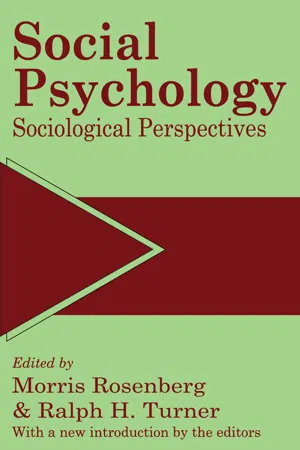
""A valuable compendium: broad In scope, rich In detail: It should be a most useful reference for students and teachers."" This is how Alex Inkeles of Stanford University described this text. It is made more so in this paperback edition aimed to reach a broad student population in sociology and psychology. The new Introduction written by Rosenberg and Turner brings the story of social psychology up to date by a rich and detailed examination of trends and tendencies of the 1980s.Although social psychology is a major area of specialization in sociology and psychology, this text Is the first comprehensive and authoritative work that looks at the subject from a sociological perspective. Edited by two of the foremost social psychologists in the United States, this book presents a synthesis of the major theoretical and empirical contributions of social psychology.They treat both traditional topics such as symbolic interaction, social exchange theory, small groups, social roles, and intergroup relations, and newer approaches such as socialization processes over the life cycle, sociology of the self, talk and social control, and the sociology of sentiments and emotions. The result is an absolutely Indispensable text for students and teachers who need a complete and ready reference to this burgeoning field.
Information
PART I
Theoretical Orientations
1 SHELDON STRYKER
Symbolic Interactionism: Themes and Variations
Introduction
Of the theoretical orientations underlying work in social psychology, it is symbolic interactionism that has had its major development among sociologists and that has had major appeal to sociologists. In part, this reflects particulars of the history of the orientation: its early elaboration took place at the University of Chicago during the time that institution played a dominant role in the production of sociologists. In part, however, the appeal of symbolic interactionism to sociologists reflects the fundamental compatibility of this social-psychological perspective with the structural concerns of sociology proper. A theme of this chapter is fit, sometimes neglected and only now being thoroughly exploited, between more general sociological theory and symbolic interactionism as social psychological theory.1
This theme is present particularly in a later section of the chapter, where the link being forged between traditional symbolic interactionism and role theory is emphasized and where it is argued that the concept of role serves as the point of articulation—the bridge—between theories that have to do, respectively, with the social structure and with the social person. It is present as well in the section of the chapter that treats a version of current symbolic interactionism that eschews role concepts as too static, non-processual, and insufficiently attuned to the constructed character of social life, and uses the concepts of negotiation and negotiated order to link person and social organization.
As the foregoing suggests, there is considerable internal variation in the content of symbolic interactionism. While there is a core set of theoretical assumptions and concepts which most, if not all, working within this framework accept and use, there are other theoretical ideas relatively peculiar to one or another version. This is equally—perhaps more—true of methodological ideas; the methodological stances of symbolic interactionists range from a thoroughgoing rejection of the ordinary conventions of science as commonly understood to a complete acceptance of these. Such internal variation is another theme of this discussion.
This chapter is concerned more with ongoing and future developments in symbolic interactionism than with history. Some critical sense of the history of this perspective is essential, however, if current emphases are to be understood; and sufficient history must be presented to permit that understanding. What follows this introduction is an abbreviated and selective history of symbolic interactionism that begins with the Scottish moral philosophers and carries the story to the very recent past.2 To the degree that symbolic interactionist theory in a technical sense exists,3 it does so in the form of small-scale explanations of relatively limited scope. Although a few such explanations will be briefly treated, the primary concern of this chapter is with symbolic interactionism as a theoretical orientation or as a conceptual framework. That is to say, this chapter is concerned with delineating an approach to the social-psychological world in general, a frame that suggests the terms of and the ways in which explanations of social-psychological events and processes can be formulated. The distinction between theory and theoretical orientation is fundamental; the latter can only be judged on the basis of logical coherence and fruitfulness in suggesting theories that withstand empirical test. Obviously, this assertion implies the belief that specification and test of theories are indispensable to continued adherence to and utilization of a framework or orientation. This chapter is written in the spirit of that belief.
Despite that belief, however, relatively little reference to concrete research will be made. In part, this is because a framework is logically prior to the formation of testable theory and thus to the research that tests theory. In part, it is because a choice had to be made: available space does not permit review and intensive critical evaluation of research; and to simply list researches or present findings uncritically does little justice to the complexities of relating findings of research of varying degrees of sophistication and relevance to theoretical issues. In part, it is because—although there is more good research done from a symbolic interactionist frame than its critics allow—a strong research tradition premised on a symbolic interactionist orientation is still emerging. Thus, the choice made was to concentrate on the framework itself. In the same vein, many of the applications of the symbolic interactionist framework have been in the substantive areas of deviance, of the family, of work (including the professions and occupations), and of collective behavior. Although brief recognition will be given such applications, by and large the focus of the chapter is on the framework abstracted from the substantive areas.
Some years ago, Mullins (1973) essentially wrote off symbolic interactionism as a viable perspective within sociology. His concern was with symbolic interactionism as broader, sociological theory, and he failed to appreciate the degree to which symbolic interactionist ideas have been absorbed into the sociological mainstream. Nevertheless, there have been periods in which symbolic interactionism has waxed, others when it has waned. It waned considerably during the ascendance of a “sociology as hard science” aspiration, doing so in an important degree because many of its most visible adherents were explicitly opposed to the development of rigorous methods espoused by the hard-science advocates. It waned during the period in which functionalism was both intellectually and politically dominant in American sociology.4 It is now waxing, sparked by the invigorating effects of current efforts to go beyond earlier concern with “proper” interpretations or transliterations of the “masters” and to go beyond sterile debates in which doctrinaire and stultifying positions were taken; by a new concern with theory construction and with test of theory abetted by new and successful attacks on difficult measurement problems; and by new forms of social organization.5
The Early Development of Symbolic Interactionism
The fixing of origins of any complex line of thought is arbitrary. Although the label, symbolic interactionism, is a relatively recent invention,6 the line of thought the term represents can conveniently be traced to the Scottish Moral Philosophers.7 These eighteenth-century thinkers, as Bryson (1945:1) notes, sought to provide an empirical basis for the study of man and society. While holding diverse views of what was fundamental about the human mind, they—Adam Smith, David Hume, Adam Ferguson, Frances Hutcheson, and others—argued in common that the facts of human association had to be taken into account if a science of man was to be achieved. They turned their attention to communication, sympathy, imitation, habit, and custom in their attempts to develop principles of human behavior. Thus, Adam Smith (1759) writes (discussing the consequences of isolation from others): “Bring him into society, and he is immediately provided with a mirror which he wanted before. It is placed in the countenance and behavior of those he lives with. This is the only looking glass by which we can, in some measure, with the eyes of other people, scrutinize the propriety of our own conduct.”8 David Hume—as well as Smith—saw in “sympathy” the principle through which humans develop their sense of membership in and benefits to be derived from society, and through which they come to be controlled by others. Sympathy, as these Scotsmen conceived it, allows persons to put themselves in the place of others, to see the world as these others do; and sympathy makes possible the communication that initially forms and subsequently reshapes (as we seek the approval of others) who and what we are. As this suggests, society is viewed as a network of interpersonal communication, connecting persons organically. In this manner, the Scottish moral philosophers foreshadowed the symbolic interactionist view of the basic nature of society and of the source of self in society. In addition, they collectively made viewing man as a natural object legitimate, and emphasized the scientific importance of everyday experience. Approaching human behavior from the standpoint of society rather than biology, they appreciated mind as instrumental in human adaptation, emphasized habit relative to instinct, and understood the relation of habit to custom.
The link from the Scottish moral philosophers to contemporary symbolic interactionism proceeds through the American pragmatic philosophers: C. S. Pierce, Josiah Royce, William James, John Dewey, and—of special import—George Herbert Mead. In general terms, pragmatism echoed and elaborated themes already reviewed; it viewed mind as an instrument for adaptation, treated mind and mental activities as natural objects (that is, as open to scientific investigation), saw the organized and internally dynamic character of the human mind, and emphasized the relevance of the natural (including social) world for the emergence of the individual.
More particularly, William James (1890) argues the importance of society as a source of constraints on behavior, doing so through the concept of habit. Particularly relevant to current theoretical extensions of symbolic interactionism, he develops a conception of “self” as both multifaceted and the product of relations with others; and his analyses of the character and sources of self-esteem anticipate current efforts to model the impact on person of society.
John Dewey (1940), by seeing personality organization as primarily a matter of habit and social organization as primarily a matter of custom defined as collective habit, insisted on the intimate relation of person and society. While noting that asserting the priority of society to individual is “nonsensical metaphysics,” he observed that nevertheless every person is born into a pre-existing association of human beings, and that habit will consequently reflect a prior social order. Custom and habit are the necessary bases for reflection, for thinking, and thinking occurs in the process of humans adjusting to their environment. Thinking is instrumental; it involves defining objects in one’s world in the context of activity and rehearsing possible lines of action in ways instrumental to adaptation. In another influential vein, Dewey rejected a monolithic view of society, instead seeing society as a set of many differential associations.9
Putting Mead aside for the moment, the ideas of the philosophers and psychologists reviewed enter sociology largely through Charles Horton Cooley. While Cooley’s somewhat more affective orientation has long been neglected by symbolic interactionists relative to Mead’s more cognitive emphasis, he still stands as a foremost contributor. Cooley (1902: 84-87) insisted upon the importance of the mental and the subjective in social life, going so far as to define society as a “relation among personal ideas,” and “the imaginations which people have of one another (as) the solid facts of society.” He called for “sympathetic introspection”—a process by which one uses sympathy to imagine things as others imagine them—as the prime method of discovering these solid facts of society and of other persons as well, since, for Cooley, the individual and society are simply two sides of the same coin: no individual exists apart from society, and there can be no “self” apart from “others.” In brief, for Cooley, there is no individuality outside of social order, personality develops from extant social life and the communication among those sharing that life, and others’ expectations are central to this development.
A second sociologist, William Isaac Thomas, shares with Cooley preeminence in the early development of symbolic interactionism. Thomas held that accounts of human behavior must incorporate both the subjective and the objective facts of human experience. The objective facts are constituted by situations, circumstances calling for some adjustive response on the part of persons or groups. Intervening between situations and adjustive responses, however, are definitions of the situation, in Thomas’s (1937:18) words, “an interpretation, or point of view, and eventually a policy and a behavior pattern.” It was Thomas who provided the simple and powerful rationale for the significance of the subjective in social life, and in so doing, provided symbolic interactionism with its prime methodological rule: “…if men define situations as real, they are real in their consequences” (Thomas and Thomas 1928:567).
But it is another philosopher, George Herbert Mead, who is the single most important influence shaping symbolic interactionism, in part because he gave more systematic treatment than did anyone preceding him to the ideas being reviewed. Mead’s basic social psychological dictum, growing out of evolutionary principles that see mind and symbolic communication among humans as permitting the cooperation essential for survival, is: start with the ongoing social process. From that process, mind, self, and society derive;10 and the relations among interaction (the ongoing social process), mind, self, and society become the subject matter of his social psychology.
With Dewey, Mead argues that persons initiate activity relating them to their environments, that is, they do not simply respond to “stimuli” existing apart from ongoing activity. Objects become stimuli as they function in the contexts of acts and come to be defined as relevant to completing the act; they acquire meaning in the course of activity. The same principle holds for acts implicating other humans in their completion. Such social acts are the source of personality and of organized social behavior, outgrowths of the social process made possible by communication through language.
Communication involves conversations of gestures, the use by participants in social acts of early stages of one another’s acts as indicators or predictors of later stages. From these gestures evolve significant symbols, gestures having the same meaning in the sense of indicating the same future phases of acting to participants. Meaning, for Mead, is thus behaviorally defined: “The meaning of what we are saying is the tendency to respond to it” (1934:67). Significant symbols make possible the anticipation of responses, one’s own and others, and adjustment of those responses on the basis of anticipation. We “take the role of the other” through the use of significant symbols and through this process engage in cooperative activity. We come to have minds, to think, through being part of a social process in which significant symbols emer...
Table of contents
- Cover
- Half Title
- Title Page
- Copyright Page
- Table of Contents
- Introduction to the Transaction Edition
- Preface
- Part 1. Theoretical Orientations
- Part 2. Socialization
- Part 3. Social Interaction
- Part 4. Society and Social Behavior
- Part 5. Society and Personality
- References
- Name Index
- Subject Index
Trusted by 375,005 students
Access to over 1.5 million titles for a fair monthly price.
Study more efficiently using our study tools.
Frequently asked questions
Yes, you can cancel anytime from the Subscription tab in your account settings on the Perlego website. Your subscription will stay active until the end of your current billing period. Learn how to cancel your subscription
No, books cannot be downloaded as external files, such as PDFs, for use outside of Perlego. However, you can download books within the Perlego app for offline reading on mobile or tablet. Learn how to download books offline
Perlego offers two plans: Essential and Complete
- Essential is ideal for learners and professionals who enjoy exploring a wide range of subjects. Access the Essential Library with 800,000+ trusted titles and best-sellers across business, personal growth, and the humanities. Includes unlimited reading time and Standard Read Aloud voice.
- Complete: Perfect for advanced learners and researchers needing full, unrestricted access. Unlock 1.5M+ books across hundreds of subjects, including academic and specialized titles. The Complete Plan also includes advanced features like Premium Read Aloud and Research Assistant.
We are an online textbook subscription service, where you can get access to an entire online library for less than the price of a single book per month. With over 1.5 million books across 990+ topics, we’ve got you covered! Learn about our mission
Look out for the read-aloud symbol on your next book to see if you can listen to it. The read-aloud tool reads text aloud for you, highlighting the text as it is being read. You can pause it, speed it up and slow it down. Learn more about Read Aloud
Yes! You can use the Perlego app on both iOS and Android devices to read anytime, anywhere — even offline. Perfect for commutes or when you’re on the go.
Please note we cannot support devices running on iOS 13 and Android 7 or earlier. Learn more about using the app
Please note we cannot support devices running on iOS 13 and Android 7 or earlier. Learn more about using the app
Yes, you can access Social Psychology by Ralph Turner in PDF and/or ePUB format, as well as other popular books in Psicologia & Storia e teoria della psicologia. We have over 1.5 million books available in our catalogue for you to explore.