This special issue focuses on the difficult problem of how observers and researchers can make sense of how collaborating participants develop a shared understanding both of their task and their own participation in it. Or stated in another way, how can we derive meaning from their emergent and situated meaning making? Meaning making has been studied under a variety of names, and can be conceptualized on different levels of abstraction and from a variety of perspectives. The goal is to attempt to tease apart some of these views, while at the same time seeking means to bring them together in order to provide a more fully elaborated picture. This issue comes with downloadable resources containing the brief video segment which all authors analyzed in the preparation of their contributions.
- 142 pages
- English
- ePUB (mobile friendly)
- Available on iOS & Android
eBook - ePub
About this book
Information
ANALYSES
Theory Presentation and Assessment in a Problem-Based Learning Group
Department of Speech Communication
Southern Illinois University
Southern Illinois University
Department of Medical Education
School of Medicine
Southern Illinois University
School of Medicine
Southern Illinois University
In this study, we apply the procedures and assumptions of ethnomethodological conversation analysis to analyze a segment of interaction in a problem-based learning (PBL) meeting. In the segment, one member of the group presents a theory pertaining to the case under study. Before it is accepted or rejected, the same speaker presents a second theory to which other group members react with objections and disaffiliative laughter. The presenter consequently rejects the second theory and uses this rejection as a basis for returning to and implicitly accepting the first. Theory presentation and assessment are an integral part of the PBL group process of moving discursively from case history and symptoms to diagnosis and treatment. We observe that the presentation of a theory makes relevant a variety of sequential activities through which participants in instructional activities of this sort come to accept or discard the theory. Implications for teaching and tutorial practice are presented.
One of the stated objectives of problem-based learning (PBL) is for students to practice and develop skills for reasoning in clinical settings, including the ability to formulate a theory (in medical contexts, a diagnosis) that accounts for the evidence (medical history and symptoms; Barrows, 1994; Koschmann, Kelson, Feltovich, & Barrows, 1996). This reasoning largely occurs in and through meetings conducted by the group to discuss clinical cases. Thus, examination of interactions within these meetings should provide a basis for describing and assessing the reasoning students use.
REASONING IN PBL MEETINGS
PBL is undertaken in a variety of ways at different institutions (Barrows, 1986). In this article, we examine an example of interaction within a particular methodological approach to PBL that has been described in greater detail elsewhere (Barrows, 1994; Koschmann et al., 1996).
Within this particular implementation, the exploration of a case proceeds through several phases, namely problem formulating, self-directed learning, knowledge applying, abstracting, and reflecting (Koschmann et al., 1996). In the problem-formulating phase, the group begins by making inquiries into a case and developing a set of hypotheses about the source of the patient’s problem. The case is then presented to the group in the form of a book designed to simulate the clinical interview and examination (Distlehorst & Barrows, 1982). During this phase, students may generate and, in some cases, defend theories about the patient’s underlying disorder.
As the students develop a more complete picture of the case under study, they compile a list of areas in which they consider their knowledge to be deficient (Barrows, 1994; Koschmann, Glenn, & Conlee, in press). When this list grows long, the group recesses to allow the students time to independently research these issues, thereby entering into the phase of self-directed learning.
After this phase of independent work, the group members reconvene and attempt to apply their newly acquired knowledge to the case under study; that is, they begin the phase of knowledge applying. Armed with new knowledge, the students may be stimulated to ask new questions about the case. This, in turn, may inspire them to propose new theories or critique previously proposed theories.
The group may repeat cycles of problem formulating, self-directed learning, and knowledge applying several times before leaving a case. At appropriate junctures, the members of the group pause to reflect on their methods and contributions (i.e., reflecting phase) and to make attempts to abstract what they have learned from this particular case (abstracting phase). Discussion of student theories may also take place in these latter two phases, as when students evaluate their own theory-making contributions or when they attempt to articulate what they have learned from a particular case.
This iterative process of making inquiries into the patient’s problem, proposing theories to account for this problem, and empirically testing these theories was designed to recapitulate the process used by skilled practitioners when problem solving in clinical practice (Barrows, 1990; Barrows & Feltovich, 1987). The faculty member’s role in this process is to model this reasoning strategy while simultaneously helping the students to recognize areas of incomplete understanding of the case.1
1 In medical education, the faculty member participating in a PBL group is referred to as the tutor. We have argued elsewhere (Koschmann et al., 1995) that this term may be somewhat misleading. In this article, therefore, we refer to the faculty member as the learning coach or simply the coach.
In this article, we analyze a segment of interaction that took place during a phase of knowledge applying subsequent to a period of self-directed learning. Within this segment, one of the students advances two theories to account for the patient’s problem. We describe how the theories are introduced and how the members of the group respond to these theories. Through this analysis, we hope to show some of the interactional sequences through which group members come to accept or reject theories.
APPLYING CONVERSATION ANALYSIS TO THE STUDY OF REASONING IN GROUPS
We treat reasoning as jointly constructed, grounded in and shaped by the sequential organization of interaction. Our approach reflects procedures and assumptions of ethnomethodological conversation analysis (CA; for discussions, see Atkinson & Heritage, 1984; Pomerantz & Fehr, 1997; Psathas, 1995). Briefly, CA methods emphasize close description of recordings of naturally occurring interactions with the aim of characterizing methods by which people organize their social worlds. CA researchers (a) create detailed transcripts noting speech, paralinguistic and visual behaviors, and aspects of timing and placement; (b) describe the ways people organize sequences of talk; and (c) generalizing from individual cases, derive inductive claims about recurrent features of social interaction. Analysis begins not with hypotheses but rather with open-ended description. The aim is to explicate how people produce interaction and what they accomplish in and through it. The emphasis is not on why things happen or people do what they do but on what they do and how they do it.
The analysis presented here arose from a research process involving the following steps. After viewing the videotaped group interaction, we selected the passage for analysis, drawn to it by Betty’s proclamation of "my theory" and the subsequent discussion. We viewed and listened to the segment repeatedly while preparing the detailed transcript. During several intensive discussions among the authors (plus other researchers in informal listening sessions), we generated descriptions of ways participants organized the interaction. During this process, we relied on terms and descriptions from previous CA research that provide "tools" to aid analysis. Noticing participant orientation to theory presentation and treatment, we chose that as the focus for this article.
When presented in a PBL group meeting, a theory may provide a focus for subsequent talk in which group members evaluate, modify, accept, or reject the theory. These actions are produced by assessing the theory, displaying agreement or disagreement, asking clarifying or critical questions, fitting evidence and reasoning to the theory, or producing alternative theories or accounts for data. In the segment of interaction under consideration here, the participants consider a theory presented by Betty, discuss the location of the hippocampus, entertain another theory from Betty, attempt to distinguish a stroke from a TIA (transient ischemic attack), and discuss the compatibility of symptoms with Betty’s explanations. Interestingly, the group members return to the first theory only after considering and rejecting the second. This suggests participant orientation to treating the two theories as part of a larger structure. How they do so, and what they might accomplish through such organization, are the focus of the remaining discussion.
PRESENTATION OF EVIDENCE, REASONING, AND THEORY: “MY THEORY”
Immediately prior to the start of this segment, the coach provides a formulation (Heritage & Watson, 1978), or summary of preceding talk, followed by a conclusion:
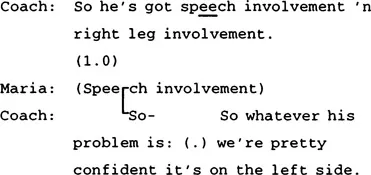
Formulations, by summarizing preceding talk, provide opportunity spaces for interactants to move on to new, possibly related matters. Following the coach’s formulation, one of the students, Betty, introduces information from a book lying in front of her:

The imperative "see" brings the attention of the other group members to Betty; "what it said in here" further places that focus on the book to which she refers. Both can be heard as preliminary to presenting information from that book. Having thus displayed that she is about to present some information, Betty abandons that course to announce a "theory":

Because she has not yet presented her theory, this phrase can serve to project that the theory is to follow. Betty has prefaced two actions, each of which could warrant an extended turn at talk: presenting information from a book and offering a theory. She does take an extended turn to do both. She reads from the book, and she offers a theory:
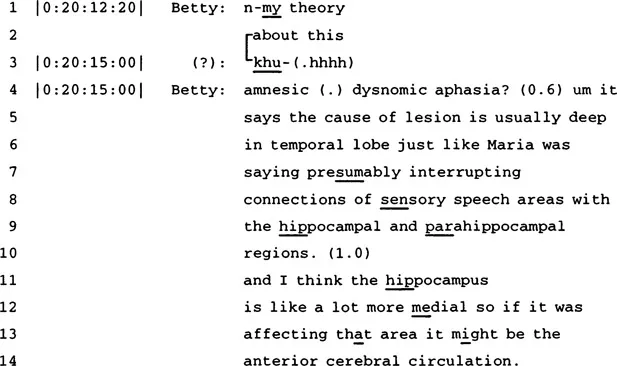
She marks a return to reading (lines 4–5) by the phrase "it says." After reading, she stops (lines 6–7) to indicate that Maria (one of the other students), too, had suggested what this book apparently now confirms. This acknowledgment may serve to bring both Maria and "the book" into support for Betty’s emerging theory. Betty quotes more from the book (lines 7–10), about the consequences of a lesion in the temporal lobe. She stops reading, and there is a 1-s pause (line 10). Under other circumstances, someone else might begin speaking at this moment. However, orienting to her announced-but-not-yet-presented theory, the others remain silent, granting her extended turn space. Betty now shows in at least two ways that she is no longer reading: She looks up to make eye contact with other group members, and by saying "I think," she marks what is to follow as her idea and as tentative (line 11). Her next statement concerns the location in the brain of the hippocampus, posited as a spatial comparison (line 12: "a lot more medial"). Thus, having presented evidence and reasoning, she offers as conclusion the theory (lines 12–14) that anterior cerebral circulation is the source of the problem for this patient.
Theory presentation is an integral part of theory construction. Betty’s theory presentation occurs through an interweaving of two sequential activities: reading aloud and presenting a theory. She provides book evidence, notes that it supports something another group member had said, provides reasoning, and ends her extended turn with an explanation that stands as a theory. This roughly inductive pattern (evidence + reasoning → conclusion) places the actual theory at the end of the turn. The silence of other group members during her talk orients to this structure.
RESPONSE TO THEORY: IMPLICIT ENDORSEMENT AND INFORMATION SEARCH
As Betty nears completion of her turn, Norman says the word "anterior" in unison with her. This bit of overlapping speech occurs at what elsewhere has been described as a "recognition point" (Jefferson, 1973, pp. 58–59), an earliest possible moment at which a coparticipant may show understanding of the utterance in progress and may anticipate the substance of utterance completion.

Norman shows that he follows Betty’s reasoning and that he, too, arrives—independently—at the same conclusion. This may also serve as a way to demonstrate alignment, if not outright agreement, with her theory.
The coach retrieves from Betty’s preceding information knowledge that she had marked as tentative (see lines 13–14) and packages it in a question:

This initiates an extended series of turns (not described here) devoted to identifying the hippocampus as depicted on flip charts of the brain. This activity is distinct from theory generation, though perhaps relevant to later theory evaluation. This segment terminates with Lill’s pointing (with directions from Norman) to one part of a picture and the coach confirming that the students have successfully located the hippocampus:
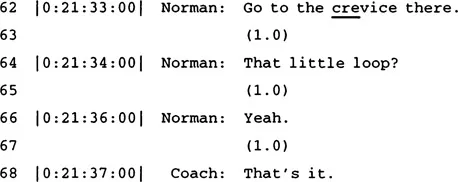
Although perhaps marking the end of the searching activity, the coach’s confirming "That’s it" does not project a next action or select any particular other speaker as next (for rules of speaker selection in conversation, see Sacks, Schegloff, & Jefferson, 1974). Betty takes this opportunity to return to theory presentation.
ALTERNATIVE THEORY WITH REASONING AND EVIDENCE: “MY OTHER THEORY”
Betty now presents a second theory. As with the previous one, she marks ownership of the theory via a possessive pronoun. This theory stands in contrast to her earlier one, offering "space occupying lesion" as an alternative explanation to "vascular lesion."
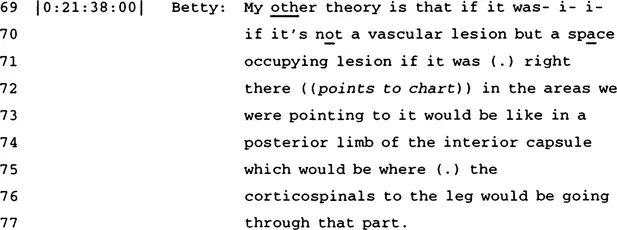
Betty attempts to fit evidence to this new explanatory frame. Specifically, she suggests localizing the problem in an area of the brain through which the nerve pathways that control the leg travel. Leg clumsiness is one reported symptom for this patient, and as such, it stands ...
Table of contents
- Cover
- Title Page
- Contents
- Copyright Page
- Editor’s Introduction
- Analyses
- Commentaries
Trusted by 375,005 students
Access to over 1.5 million titles for a fair monthly price.
Study more efficiently using our study tools.
Frequently asked questions
Yes, you can cancel anytime from the Subscription tab in your account settings on the Perlego website. Your subscription will stay active until the end of your current billing period. Learn how to cancel your subscription
No, books cannot be downloaded as external files, such as PDFs, for use outside of Perlego. However, you can download books within the Perlego app for offline reading on mobile or tablet. Learn how to download books offline
We are an online textbook subscription service, where you can get access to an entire online library for less than the price of a single book per month. With over 1.5 million books across 990+ topics, we’ve got you covered! Learn about our mission
Look out for the read-aloud symbol on your next book to see if you can listen to it. The read-aloud tool reads text aloud for you, highlighting the text as it is being read. You can pause it, speed it up and slow it down. Learn more about Read Aloud
Yes! You can use the Perlego app on both iOS and Android devices to read anytime, anywhere — even offline. Perfect for commutes or when you’re on the go.
Please note we cannot support devices running on iOS 13 and Android 7 or earlier. Learn more about using the app
Please note we cannot support devices running on iOS 13 and Android 7 or earlier. Learn more about using the app
Yes, you can access Meaning Making by Timothy Koschmann in PDF and/or ePUB format, as well as other popular books in Langues et linguistique & Linguistique. We have over 1.5 million books available in our catalogue for you to explore.