- 448 pages
- English
- ePUB (mobile friendly)
- Available on iOS & Android
eBook - ePub
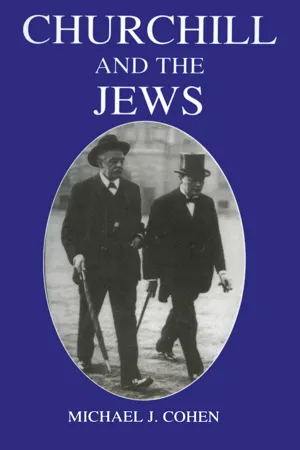
Churchill and the Jews, 1900-1948
About this book
Churchill's exalted position in the pantheon of Jewish and Zionist heroes has been almost taken for granted. This book looks beyond the myth and makes a sober reappraisal of the British statesman's attitudes and policies towards the Jews and to Zionism.
CHAPTER ONE
CHURCHILL THE MAN1
Churchill’s personal background, in particular the circumstances of his childhood, have been subjected to a penetrating, albeit not quite definitive psychiatric postmortem. The young Winston had to contend with emotional and physical handicaps which both moulded his character and prepared him for later vicissitudes. In part, his stormy political career may be interpreted as a struggle to overcome these initial disadvantages.2
Churchill seems to have inherited from his ancestors a tendency to recurring, prolonged fits of depression. That they were frequent, is indicated by the nickname Churchill gave them – ‘the Black Dog’. The phenomenon is well-known to the world of psychiatry. The reaction of the victim, in order to avert the total paralysis and despair to which the fits reduce him, is to force himself into frenetic activity, leading to achievements beyond those which most men are capable of.
In Churchill’s case, his prodigious energy was channelled into political and literary activity. His capacity for hard work was legendary. The legend grew during World War Two, when, at the age of 65, he drove himself to exhaustion and acute illness.
In 1940, Churchill attained ‘his first hour’, and experienced an exhilaration, perhaps even relief, that his appointment with destiny had finally arrived. But here again, his own experiences with despair proved good preparation for the desperate situation in which Britain found herself in that summer. As Anthony Storr has suggested: ‘had he been a stable and equable man, he could never have inspired the nation … only a man who had known and faced despair within himself could carry conviction at such a moment.’3
Churchill suffered from parental neglect, the fate of so many of the offspring of the British upper classes. His mother was too preoccupied with the social whirl of high society, and his father Randolph too involved in politics to devote much time to Winston. His father remained something of a cool stranger, though Churchill remained devoted to an idealistic image he created for himself, somewhat different from the real father who refused to share his life with him. They talked only rarely, and when Randolph wrote to his son, it was as often as not to reprove him. Randolph’s early death (when Winston was just twenty years old), of a venereal disease which brought on insanity, was a grievous blow to the devoted son. His posthumous devotion found outlet in the learning by heart of long extracts from his father’s speeches, and in the two-volume biography he published in 1906. Once more, his later aggressiveness might be explained by this unhappy aspect of his childhood. As Anthony Storr again suggests, Churchill ‘was deprived by parental neglect of that inner source of self-esteem upon which most predominantly happy persons rely’.4
Churchill’s physical courage too was exceptional, much more than might have been expected from a man of his physique. His repeated self-exposure to physical danger was again an effort to overcome disadvantage, in this case physical. In doing so, he was consciously ‘forcing himself to go against his own inner nature’.
Churchill was never a ‘natural’ public speaker. He had an imperfection of speech that was often painful to listen to, which he overcame gradually by prodigious effort. During his first years in Parliament, he literally learned entire speeches off by heart.5 But he proved unable to improvise when unanticipated questions or debate arose. On one occasion, he prompted the following dig from Arthur Balfour: ‘The Right Honourable Member’s artillery is very powerful. But it is not very mobile. It has continued firing away at a position which we have never occupied.’6 In April, 1904, in the Commons, he faltered in mid-speech, failed to recover and had to sit down amid confusion, mumbling an apology. Thereafter, though he continued to rehearse his speeches in advance, he always came equipped with notes.7
Churchill’s relentless drive and ambition, and the methods he used to further the causes he espoused, earned him almost universal animosity. Aggressive ambition in itself need not necessarily be an entirely negative quality, but in Churchill’s case, contemporaries often suspected that his adoption of, or opposition to particular causes was calculated to further his own career.8 The suspicion was of course greatest in that party which he forsook, especially when the new recruit was rewarded with ministerial office.
Churchill had a complex personality, comprising what would seem to be mutually-exclusive character-traits. In contrast to his aggressive ambition, there was his evident compassion for the underdog. He would not back down from a challenge, but he was characteristically magnanimous to a defeated enemy. It has been suggested that the ‘alternation between aggression and compassion is characteristic of persons with Churchill’s character-structure’.9 Clement Attlee, who had good reason to resent Churchill’s ‘mischief-making’ when India was evacuated in 1947, was impressed by Churchill’s ‘profound fund of humanity, benevolence, love …’10 During his first spell at the Colonial Office, Churchill checked the arbitrary behaviour of the officials towards black Africans. He uncovered what he considered to be ‘shocking’ violations of elementary principles of law and justice. He insisted that these principles be ‘rigidly, punctiliously and pedantically followed’.11
Churchill was easily and often moved to tears. One close associate, Victor Cazalet, thought that he overdid it: ‘The slightest exhibition of distress or sorrow elicits from him an amount of real sympathy totally disproportionate to the demand of the occasion’.12 There can be no doubt that the plight of the Jews during the 1930s genuinely upset him. Attlee has recalled how he met Churchill one day at the Commons, and the latter told him what was being done to the Jews of Germany, ‘with tears pouring down his cheeks’. Attlee has also testified that few men in public life ‘were less prone than Churchill to paying mere lip service to a humanitarian cause’.13 However, the moot question is just how much did Prime Minister Churchill translate his professed sympathies for the Jews into meaningful action? As we shall note below, Churchill’s reaction went little further than repeated references to the Final Solution being ‘the most horrible crime ever committed in history’. All appeals to Churchill to do something about it were deflected to Foreign Secretary Eden.
Lastly, in contrast to his generous warm-heartedness, there was Churchill’s indifference and insensitivity to the feelings of those closest to him. It reflected what has been called ‘an egotism that could see nothing outside the blinkers of his own imagination, which, if it was intense, was also surprisingly narrow and often superficial’.14 Lord Moran, who was arguably the most intimate associate of Churchill’s during World War Two, felt that the latter was so taken up with his own ideas that he was simply not interested in what other people thought. It was ‘as if he had lived for years in a foreign country without picking up the language’. Churchill’s own wife, Clemmie, fearing he would shout her down in any discussion, resorted to putting anything important into writing, in notes for him.15
Churchill was never subjected to the intellectual discipline of a University education, a fact which he came to regret deeply.16 During his early years, he made up for this by a prodigious industry. As one contemporary put it, Churchill had ‘the genius which consists of taking infinite pains’.17 He produced formidable, almost ‘academic’ state papers, and masterpiece orations for Parliament. By application, he developed his own technique, ‘the combination of great flights of oratory with sudden swoops into the intimate and conversational’.18 But his rhetoric, to which we shall refer in the next section, could arouse impatience, suspicion, and finally derision.
His historical forays have come in for much the same professional criticism as much of his spoken words. Although his prose won for him the Nobel Prize for Literature in 1953, Professor J.H. Plumb has pronounced his work anachronistic, ‘whiggish’, gentlemen’s history. Professor Plumb believed the fault lay with Churchill’s own superficial acquaintance with society in general, that Churchill ‘lacked a sense of the deeper motives that control human society and make it change, just as he lacked an interest in the deeper human motives’. Plumb thought that Churchill possessed ‘a naiveté of insight that borders on the ridiculous’, that his works revealed ‘a paucity of historical knowledge, lack of analytical power, and an ignorance of economic, social and intellectual history of staggering proportions’.19
Churchill’s lack of academic training, though compensated for by sheer industriousness, was perhaps responsible for his wild flights of fancy. His grasp of complicated issues was often superficial, and at times he was unable to distinguish the essential from the trivial. Churchill told Lord Moran that his reading had virtually ceased when he had entered politics. Churchill was not aware that the tank he himself had sponsored during the First World War was by the 1930s obsolete. Nor had he read De Gaulle’s manual on tank warfare, printed in 1938, the lessons of which were implemented by the Germans when invading France in 1940.20 Churchill had a tendency to oversimplify complex issues, and to improvise solutions for immediate problems, rather than plan for the future. As Lord Esher put it in 1917, in a much-quoted aphorism: ‘He [Churchill] deceives himself into the belief that he takes broad views, when his mind is fixed upon one comparatively small aspect of the question’.21
Lord Moran concluded that Churchill’s mind was open to ideas, but often closed to reason, ‘a mind not judicial in any sense, not logical, not analytical’.22 That Churchill had a brilliant, inventive brain cannot be doubted. But his was a genius that went off at tangents, that required frequent bridling. During World War Two, the cabinet was at times over-awed by the plethora of brainwaves generated by the Prime Minister. His colleagues were hard put to quash and abort a great many, to avert the inevitable catastrophes they would have caused.23

One commentator has suggested that ‘the pattern of rejection that Churchill experienced in his childhood and youth was to repeat itself consistently during his political life’.24 There is much to be said for this thesis.
From the very outset of his political career, Churchill demonstrated too much independence for the likes of his Conservative peers and, as noted by Rhodes James, ‘young men who lustily throw stones at their elders are not usually rewarded for their activity’.25
Churchill engaged in quite a feud with Prime Minister Balfour. The latter made him ‘the butt of a series of jokes and quips which finally exasperated the younger man’.26 Churchill took his revenge just one year after crossing the floor of the House to the Liberal benches. In a puckish display of flamboyant irreverence, Churchill baited Balfour: ‘He [Churchill] ventured to say that no Prime Minister, certainly not in recorded time, had ever before, in regard to matters of which he should be better informed than anybody, shown such a lamentable and extraordinary ignorance’.27
Even the Liberal Prime Minister, Henry Campbell-Bannerman, took good care to keep Churchill out of his cabinet. Churchill did obtain his first executive position when he crossed the floor of the House, as Under-Secretary of State for the Colonies. But it cost him the tag of being one of the most unpopular politicians in Britain. He had earned a reputation for ‘putting people’s backs up by an apparently gratuitous offensiveness of manner’.28 Even worse, many colleagues believed him to be ‘deficient in discrimination and loyalty … [and that he] loved the limelight too much … [and was] unduly obstinate and aggressive in argument … [and] not generally credited with acting from either conviction or loyalty’.29
More than one historian has noted the possible correlation between Churchill’s tempestuous early political career, and the fact that he was at the same time writing his father’s biography. Rhodes James has suggested that in his rebellion ‘against the tyranny of party’, and in his violent words and campaigns against his leaders, the younger Churchill was perhaps ‘intent upon re-creating his father’s career’.30
A more recent study of Lord Randolph has suggested that the converse may also be true, that the biography Churchill was writing may have been intended as ‘a vindication of the political somersaults being executed by the author at the time of writing it’. The biography and the change of political tack proceeded apace, and both reached their climax in January, 1906, in which month Churchill both published the two volumes, and won the North-West Manchester seat for the Liberal Party.31
Churchill’s relations with the Conservatives, to whose ranks he would return permanently in 1924, remained stormy throughout his political career. Between 1901 and 1904, he had been a disrespectful young rebel. Once he crossed the floor of the Commons in 1904, he spearheaded the Liberal attack on the Conservatives’ Aliens Bill. In 1915, the Conservative veto on his ...
Table of contents
- Cover
- Half Title
- Title Page
- Copyright Page
- Dedication
- CONTENTS
- List of Illustrations
- Foreword
- Introduction to the Second Edition
- Introduction to the First Edition
- Acknowlegements
- Chapter One: Churchill the Man
- Chapter Two: The Jewish Problem
- Chapter Three: The Middle East Imbroglio, 1919–1921
- Chapter Four: Crisis in Palestine, 1921
- Chapter Five: The 1922 White Paper
- Chapter Six: Churchill and Palestine, 1924–1939
- Chapter Seven: World War Two
- Chapter Eight: Churchill and the Holocaust
- Epilogue: Churchill in Opposition, 1945–1948
- Conclusion
- Afterword to the Second Edition
- Notes
- Select Bibliography to the Second Edition
- Bibliography
- Index
Trusted by 375,005 students
Access to over 1.5 million titles for a fair monthly price.
Study more efficiently using our study tools.
Frequently asked questions
Yes, you can cancel anytime from the Subscription tab in your account settings on the Perlego website. Your subscription will stay active until the end of your current billing period. Learn how to cancel your subscription
No, books cannot be downloaded as external files, such as PDFs, for use outside of Perlego. However, you can download books within the Perlego app for offline reading on mobile or tablet. Learn how to download books offline
Perlego offers two plans: Essential and Complete
- Essential is ideal for learners and professionals who enjoy exploring a wide range of subjects. Access the Essential Library with 800,000+ trusted titles and best-sellers across business, personal growth, and the humanities. Includes unlimited reading time and Standard Read Aloud voice.
- Complete: Perfect for advanced learners and researchers needing full, unrestricted access. Unlock 1.5M+ books across hundreds of subjects, including academic and specialized titles. The Complete Plan also includes advanced features like Premium Read Aloud and Research Assistant.
We are an online textbook subscription service, where you can get access to an entire online library for less than the price of a single book per month. With over 1.5 million books across 990+ topics, we’ve got you covered! Learn about our mission
Look out for the read-aloud symbol on your next book to see if you can listen to it. The read-aloud tool reads text aloud for you, highlighting the text as it is being read. You can pause it, speed it up and slow it down. Learn more about Read Aloud
Yes! You can use the Perlego app on both iOS and Android devices to read anytime, anywhere — even offline. Perfect for commutes or when you’re on the go.
Please note we cannot support devices running on iOS 13 and Android 7 or earlier. Learn more about using the app
Please note we cannot support devices running on iOS 13 and Android 7 or earlier. Learn more about using the app
Yes, you can access Churchill and the Jews, 1900-1948 by Michael J. Cohen in PDF and/or ePUB format, as well as other popular books in History & European History. We have over 1.5 million books available in our catalogue for you to explore.