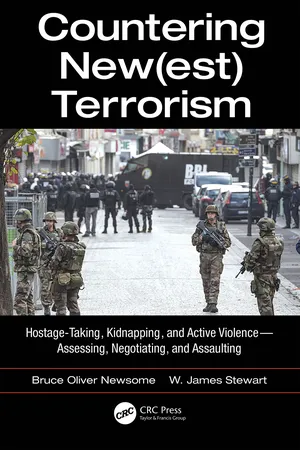
Countering New(est) Terrorism
eBook - ePub

Countering New(est) Terrorism

Hostage-Taking, Kidnapping, and Active Violence — Assessing, Negotiating, and Assaulting

  1. 381 pages
  2. English
  3. ePUB (mobile friendly)
  4. Available on iOS & Android
eBook - ePub

Countering New(est) Terrorism

Hostage-Taking, Kidnapping, and Active Violence — Assessing, Negotiating, and Assaulting

About this book

How should we analyze and assess new terrorist behaviors? What are the particular risks and challenges from new terrorism? Should we negotiate with terrorists, and, if so, how? When should we use force against terrorists? Countering New(est) Terrorism: Hostage-Taking, Kidnapping, and Active Violence—Assessing, Negotiating, and Assaulting improves our knowledge of new terrorist behaviors, and our skills in responding to such attacks.

The term "new terrorism" has been in circulation since the late 90's. This book analyzes the "newest terrorism" that has emerged in recent years—characterized by increased hostage-taking, kidnapping, and active violence—and develops best practices for countering these emerging threats. Along the way, it challenges fashionable wishful thinking that all terrorists are open to rational negotiation or de-radicalization, that military responses always reflect badly on the official side, and that terrorists are not constrained by their own doctrines.

The new terrorists are dramatically more ideological, murderous, and suicidal. They are generally less reconcilable, less trusting of official negotiators, less likely to release detainees, and more likely to kill detainees. They are less likely to demand ransoms yet more likely to release hostages in cases in which they do demand ransom. They are more informed about the official side's policies, tactics, techniques, and procedures. They are more likely to use new information and communication technologies against responding agencies and officials. They are more capable fighters—they kill more people despite deploying fewer fighters per hostage. Most disturbing is the fact that they take advantage of free-er societies to access easier targets.

Features:

  • Includes evidence-based definitions and descriptions of political, religious, Jihadi, and new terrorism
  • Presents the first large-n comparison of old and new terrorism, using an original extension of the Global Terrorism Database (GTD), with added codes for each of 10,735 hostage crises and more than 500,000 data points from 1970 through 2016
  • Details a further extension of the GTD covering all terrorist events from 2004 through 2016, roughly 5 million data points.
  • Offers prescriptive advice and visual decision trees on how to negotiate crises, assess the risk of terrorism, and how and when to assault terrorists
  • Reviews official practices, interviews with experienced officials, and real-world simulations of recent terrorist events and attacks

Countering New(est) Terrorism will be of interest to researchers, students enrolled in terrorism and Homeland Security programs, crisis negotiators, and police, security, intelligence, and military authorities tasked with counterterrorism and anti-terrorism efforts.

Trusted by 375,005 students

Access to over 1.5 million titles for a fair monthly price.

Study more efficiently using our study tools.

Information

Publisher
CRC Press
Year
2017
Print ISBN
9780367778972
9781138501591
Edition
1
eBook ISBN
9781351385701
1
Introduction
Objectives
How should we analyze and assess new terrorist behaviors? What are the particular risks and challenges from new terrorism? Should we negotiate with terrorists? How should we negotiate with terrorists procedurally? To what should we aim during these crises? How should we end such crises? When should we use force against terrorists?
These are some of the questions answered in this book, using a review of the specialist literature, an unprecedented analysis of the large-n data, qualitative exploration of key cases, interviews with experienced officials, and real-world simulations of new terrorist crises.
More than 20 years ago, a few scholars identified the rise of what they categorized as “new terrorism,” characterized mainly by increased lethality and religious motivations. This book takes an evidence-based approach to define and describe this new terrorism. Moreover, we show the acute adaptiveness and progressive developments of new terrorists, so that now, more than 20 years since new terrorism was identified, we should be thinking of the “newest terrorism” that has emerged in the last years, its form today, and its trends into the future.
New terrorists are increasingly risky. Terrorist hostage-takings, kidnappings, and active violence are increasingly frequent and deadly. Increasingly, these activities are used by terrorists as means to other ends—including, unfortunately, to lengthen publicity before mass killings.
This book seeks to improve our knowledge of new terrorist behaviors, and our skills in responding to new terrorist behaviors. Along the way, this book challenges some frequent myths about terrorist behaviors, such as incorrect characterizations of recent terrorist hostage-taking as being effectively the same as old terrorist hostage-taking (Dolnik and Fitzgerald, 2011, pp. 269–273).
Our new theories and data suggest that new terrorists are dramatically more ideological, murderous, and suicidal; they are generally less reconcilable, less trusting of official negotiators, less likely to release detainees, and more likely to kill detainees; they are less likely to demand ransoms, yet more likely to release hostages in cases in which they do demand ransom; they are more informed about the official side’s policies, tactics, techniques, and procedures; they make use of new information and communication technologies to communicate with suppliers, controllers, surveyors, the public, and officials; they are more capable fighters—they kill more people even though they deploy fewer fighters per hostage; and they make use of freer societies to access easier targets, while holding more complex interpretations of legitimate targets and legitimate handling of hostages.
Given our new theories and data, we give more informed advice about how to navigate such crises, but we also challenge fashionable, wishful thinking that all terrorists are open to rational negotiation or de-radicalization, and the reductionist thinking that military responses always reflect badly on the official side (Cole, 2009, p. 238; Stern, 2010; Dolnik and Fitzgerald, 2011, p. 272; Powell, 2014, 2015). In this book, our evidence proves a category of hostage-taking that we call irreconcilable hostage-taking, in which the hostage-takers are intent on killing all the hostages eventually, whatever alternative is offered to them.
Most books on hostage-takings include only negotiations as official responses, but we include assessments, negotiations, and assaults in the full spectrum of potential responses. The intent of this book is to help the official counterterrorist side to assess, negotiate, and (if necessary) assault terrorist hostage-takers, kidnappers, and active shooters. For instance, we identify ways to manipulate the religious obligations and other obligations on terrorists not to harm detainees.
Scope
The focus of this book is on terrorist hostage-takings, kidnappings, and active violence. The scope of this book extends to official responses with terrorists generally. For instance, our advice on negotiating with terrorist hostage-takers, kidnappers, and active shooters is applicable to negotiating with other terrorists for other purposes, such as to make peace, or to discover demands. The implications also extend to nonterrorist hostage-takings, kidnappings, and active shootings.
This book is both descriptive and prescriptive. We describe terrorist behaviors, using our own extension of the most useful large-n dataset (Global Terrorism Database), qualitative exploration of key cases, and an unprecedented review of the doctrine issued by new terrorists themselves.
We prescribe useful, practical, and effective responses to these terrorist behaviors by applying our new descriptive knowledge, review of official practices, interviews with experienced officials, and real-world simulations of new terrorist crises.
Justifications
This book is interesting for anyone studying terrorism, violent crime, or negotiations. It is important to the improvement of our preparedness to deal with the increased frequency and deadliness of new terrorism, which is differentiated by changes in behaviors, capabilities, and intents.
This book effectively fills a gap in our knowledge and skills. It fills a gap in our knowledge because it compares old and new terrorist hostage-taking for the first time through large-n analysis. The large-n dataset used here, and in most analyses of terrorism in recent years, has previously lacked any differentiation of new versus old terrorism, which this book provides for the first time.
This book fills a gap in our skills because it prescribes responses to new terrorism in particular. Little literature focuses on responding to new terrorists particularly, and most of the latter fails to separate new and old terrorism practically.
This book is focused on terrorist behaviors, yet the skills, lessons, advice, and data in this book are relevant to crisis negotiation in general, not just terrorist crises in particular. Indeed, the increasing frequency of self-barricades, suicidal confrontations with police, and hostage-takings, and the increasing likelihood of terrorism, suggest that the skills, lessons, advice, and data should be generalized to police everywhere. Currently, most police are not especially trained for such crises, not even in America or Britain, where the risks are unusually high. These issues are illustrated well by the recent experiences and reflections of a police constable in the Metropolitan Police of London:
As a newly qualified police officer, I arrived on scene at a two-storey house and was confronted by an extremely agitated man in an upstairs window. In one hand was a cigarette lighter, and in the other a knife held to the throat of his partner. He told me that no-one was taking him back to prison and any attempt by the Police to enter the building would be fatal. He cautioned that he had turned on all gas appliances in the house, and one flick of the lighter would cause a massive explosion. He asked for armed Police to attend and “end it all” and then I discovered that a negotiator wa...

Table of contents

  1. Cover
  2. Half Title
  3. Title Page
  4. Copyright Page
  5. Contents
  6. List of Figures
  7. List of Tables
  8. Acknowledgments
  9. Authors
  10. Disclosure
  11. Chapter 1: Introduction
  12. Chapter 2: Analyzing New Terrorist Behaviors
  13. Chapter 3: Assessing New Terrorist Risks
  14. Chapter 4: Should You Negotiate?
  15. Chapter 5: Immediate Management of the Incident
  16. Chapter 6: Develop a Relationship
  17. Chapter 7: Assess Their Psychology
  18. Chapter 8: Assess Their Motivations, Intentions, and Goals
  19. Chapter 9: Negotiating for Ransoms
  20. Chapter 10: Negotiating for Prisoners
  21. Chapter 11: Resolve the Negotiation
  22. Chapter 12: Should the Official Side Consider Violence?
  23. Chapter 13: Assaulting
  24. Appendix A: The Sects of Islam
  25. Appendix B: Public Responses to Active Attacks
  26. References
  27. Index

Frequently asked questions

Yes, you can cancel anytime from the Subscription tab in your account settings on the Perlego website. Your subscription will stay active until the end of your current billing period. Learn how to cancel your subscription
No, books cannot be downloaded as external files, such as PDFs, for use outside of Perlego. However, you can download books within the Perlego app for offline reading on mobile or tablet. Learn how to download books offline
Perlego offers two plans: Essential and Complete
  • Essential is ideal for learners and professionals who enjoy exploring a wide range of subjects. Access the Essential Library with 800,000+ trusted titles and best-sellers across business, personal growth, and the humanities. Includes unlimited reading time and Standard Read Aloud voice.
  • Complete: Perfect for advanced learners and researchers needing full, unrestricted access. Unlock 1.5M+ books across hundreds of subjects, including academic and specialized titles. The Complete Plan also includes advanced features like Premium Read Aloud and Research Assistant.
Both plans are available with monthly, semester, or annual billing cycles.
We are an online textbook subscription service, where you can get access to an entire online library for less than the price of a single book per month. With over 1.5 million books across 990+ topics, we’ve got you covered! Learn about our mission
Look out for the read-aloud symbol on your next book to see if you can listen to it. The read-aloud tool reads text aloud for you, highlighting the text as it is being read. You can pause it, speed it up and slow it down. Learn more about Read Aloud
Yes! You can use the Perlego app on both iOS and Android devices to read anytime, anywhere — even offline. Perfect for commutes or when you’re on the go.
Please note we cannot support devices running on iOS 13 and Android 7 or earlier. Learn more about using the app
Yes, you can access Countering New(est) Terrorism by Bruce Oliver Newsome,James W. Stewart,Aarefah Mosavi in PDF and/or ePUB format, as well as other popular books in Politics & International Relations & Cyber Security. We have over 1.5 million books available in our catalogue for you to explore.