This engaging volume explores and defends the claim that misanthropy is a justified attitude towards humankind in the light of how human beings both compare with and treat animals. Reflection on differences between humans and animals helps to confirm the misanthropic verdict, while reflection on the moral and other failings manifest in our treatment of animals illuminates what is wrong with this treatment. Human failings, it is argued, are too entrenched to permit optimism about the future of animals, but ways are proposed in which individual people may accommodate to the truth of misanthropy through cultivating mindful, humble and compassionate relationships to animals. Drawing on both Eastern and Western philosophical traditions David E. Cooper offers an original and challenging approach to the complex field of animal ethics.
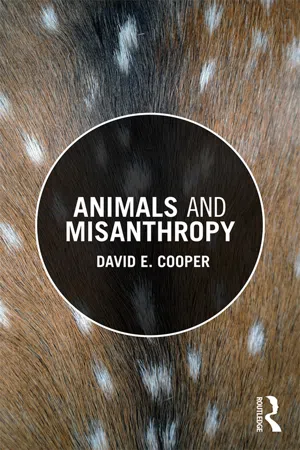
- 146 pages
- English
- ePUB (mobile friendly)
- Available on iOS & Android
eBook - ePub
Animals and Misanthropy
About this book
Information
1
Misanthropy
Prologue
Some months ago I was walking in the Cheviot hills of Northumberland, enjoying the heather, the gorse, the tumbling streams, and also the singing of birds, the scurrying of rabbits and the glimpse of a fox returning to its den. Even before I turned the bend on the track I was following, I knew my enjoyment was over, for I could hear ahead of me the merry shouting of a party of shooters as they were disgorged from their range rovers. I walked past these men while they collected their guns and game bags from the back of their vehicles.
I disliked these men, for what they were about to do to the pheasants or grouse that would soon be driven towards their guns, but also for how, to me, they looked, sounded and smelt – intoxicated, mindless, vulgar, swaggering and harsh.
My likes and dislikes, of course, are neither here nor there. More interesting, though, is a set of reflections that an encounter like mine in the Cheviots can inspire – reflections that could equally be prompted by, say, footage of an abattoir worker laughing as he clubs a pig to death, or of a laboratory assistant immune to the screams of the dogs to whom she periodically administers electric shocks.
The reflections my encounter prompted were on how relationships between human beings and animals should inform an assessment, an appraisal, of the human condition. By relationships, here, I don’t simply mean human attitudes towards and treatment of animals, but also our kinship (or lack of it) to animals, our similarities and dissimilarities to them. Someone who reflects on these matters may come to agree with Friedrich Nietzsche’s remark that not only does ‘man represent no progress over the animal’ but that he has become ‘decadent’.1 Or be inclined to endorse Milan Kundera’s judgement that in its ‘attitude towards those who are at its mercy’ – animals – ‘mankind has suffered a fundamental debacle’.2
To sympathise with such judgements is to be on the way, at least, to adopting a misanthropic attitude towards humankind. Reflections on our relationships to animals have the power, it seems, to reinforce or even inspire a dark vision and hostile appraisal of our species. There is really no need here for the words ‘it seems’, since it is clear that the negative assessments of the human condition made by many thinkers have indeed been strengthened by their perceptions of how people compare with or treat animals. Among these thinkers are Zhuangzi and Plutarch in the ancient world and, more recently, Michel de Montaigne, Jean-Jacques Rousseau, Arthur Schopenhauer and Walt Whitman. A contemporary instance is a 2008 book by a philosopher that describes his life with a pet wolf, Brenin. The author, Mark Rowlands, calls himself a ‘natural misanthrope’, someone who needs to ‘tune out human beings’. This need is due, not simply to recognising ‘the human evil’ manifested in people’s treatment of animals, but to appreciation as well of the freedom of wolves and other animals from the vices and failings that contaminate human life – cruelty, deception, ingratitude and the rest.3
I want to explore and defend the thought that reflections on our relationships to animals confirm a misanthropic view of humankind. Before I can embark on this, however, there are preliminary issues it is necessary to address. Not least of these, is the matter of how misanthropy should be understood.
Feelings and judgements
Alceste, the eponymous protagonist of Molière’s play The Misanthrope, declares that he ‘detests all men’.4 His succinct statement seems to confirm the familiar image of a misanthrope as someone who feels a certain way towards human beings: he or she hates, despises, detests or at the very least dislikes them. But Alceste did not just wake up one morning to find he had an aversion towards his species in the way he might have done to find that he now had an aversion to truffles. His hatred, rather, grew from his perception of his fellow men as ‘wicked and evil’. He becomes ‘melancholy and grieved’ because he ‘sees men behave as they do’.
The distinction, within misanthropy, between feelings and judgements was made explicit by Immanuel Kant. While he finds ‘contemptible’ a feeling of ‘anthrophobia’, he is able to respect ‘a misanthropy … in many right-minded men, that … [is] the result of long and sad experience’ of, amongst much else, the ‘falsehood, ingratitude, injustice [and] puerility’ that motivate ‘all imaginable evils’.5 For Kant, this latter kind of misanthropy – though he is reluctant to call it that – is a form of appraisal, a recognition of what he elsewhere called ‘the crooked timber of humanity’. Later philosophers have followed Kant: the misanthropy they defend or attack is not a feeling of hatred, but a verdict or judgement on humankind.
That said, it would be wrong to compartmentalise feeling and judgement. For one thing, feelings can influence, as well as arise from, judgements. Alceste’s melancholy was a response to everywhere finding ‘flattery, injustice and roguery’, but it then served to intensify his perception of ‘this bitter world’. Second, it is often artificial to split a denunciation into two components, feeling and judgement. Charles Baudelaire experienced ‘a shudder’ when reading in his newspaper about the ‘universal atrocity’ of human life, but the terms in which he condemns this life – ‘loathsome’, ‘disgusting’ – are ones that both register judgement and convey emotion.6
Philosophical misanthropes may well entertain feelings of gloom, anger, scorn or hatred, but their mission is to articulate and defend an appraisal of humankind, not to work themselves up into lather of emotion. Their model might be the Buddha. Despite its contemporary smiley image, Buddhism offers a bleak vision of human existence. ‘Monks’, the Buddha tells his followers, ‘all is burning … with fire of lust … hatred … delusion … with sorrow, dejection, and despair’.7 But Gautama himself was not a firebrand preacher: instead, he was coolly, even drily, analytical in his diagnosis of universal suffering as the product of people’s own craving and ignorance.
So, misanthropy is to be understood in terms of a certain kind of judgement or appraisal. But what kind? How close, for example, is misanthropy to ‘the wisdom of Silenus’? When King Midas pressed the god of wine, Dionysus’s companion, Silenus, to identify ‘the most desirable thing among mankind’, the reply came: ‘the best is not to be born at all’, and the next best ‘to die as soon as we can’.8 (Despite the association with Silenus, similar ancient proclamations are found in Ecclesiastes 4.3 and in Sophocles’s drama, Oedipus at Colonus.) A modern descendant of Silenus’s wisdom is the doctrine of anti-natalism.9 Better that human beings had never been at all, but given that they are, the next best thing is to ensure, by ceasing to procreate, that they will not be around in the future.
Misanthropes, even of the darkest hue, are not however committed to anti-natalism. That it would have been better if people had never drunk alcohol does not mean that, now that they do, prohibition is the best policy. Humankind is up and running, and even if this is regrettable, it is not self-evident that bringing its existence to an end is obligatory. Maybe the more advisable course is to make the best of a bad job, or to devote our energies to amelioration of the human condition. The Silenian or anti- natalist verdict should perhaps be regarded, not as equivalent to the misanthropic judgement, but as a dramatic, rhetorical way of voicing an especially intense version of misanthropy.
And how close, we can also ask, is misanthropy to another ‘-ism’ with which it is often associated: pessimism? The term was introduced in the eighteenth century as an antonym to ‘optimism’, the name Leibniz gave to his doctrine that our world, since it is the creation of a perfect God, is the best of all possible worlds. (If it wasn’t, then its Maker would not, after all, be perfect.) The term has, of course, altered in sense but, in philosophical literature at least, it remains the name of a negative judgement rather than, as in everyday talk, of a gloomy or despondent feeling.10 Schopenhauer, for example, is counted as a pessimist not because he felt depressed or hopeless but because he saw human life as oscillating between frustration and boredom. It was Eduard von Hartmann’s conclusion that happiness is impossible, not his personal disposition and moods, that made him a celebrated philosophical pessimist in the nineteenth century.
The pessimist, then, joins the misanthropist in a negative assessment of the human condition, but their respective emphases are different. The pessimist’s focus is on aspects of this condition – suffering, frustration, absurdity – that are destructive of the possibility of happiness and fulfilment. The misanthrope’s concern, by contrast, is with human failings, ingredients of life for which humankind is answerable and rightly held to account. For the pessimist, it is at least imaginable that universal suffering and unhappiness are, as it were, bad luck and due to nothing for which human beings are themselves responsible.
The contrast should not be overdone, however, for pessimism and misanthropy are typically found in harness. Schopenhauer, for example, inherited from the Buddha a pessimistic view of the world as an arena of suffering. But he explains that this ‘melancholy’ translates into misanthropy with the recognition that the human world is ‘a den of thieves’, a place of ‘boundless egoism’ and ‘moral depravity’.11 As this suggests, pessimism and misanthropy are not simply conjoined, but serve to reinforce one another. The vices exposed by the misanthrope – Schopenhauer’s list includes ‘greed, gluttony, lust, self-interest, avarice, hard-heartedness… [and] arrogance’ – help to explain the scale of the miseries attended to by the pessimist. Conversely, it is people’s unhappiness, frustration and boredom that fuels their ‘moral depravity’, meanness of spirit or gluttony.
So, pessimism and misanthropy typically endorse one another. But there is inflection here, as well. At any rate, a form of pessimism that is not informed by misanthropy is liable to seem shallow. The horror stories writer, Thomas Ligotti, is unusual in wanting to keep them entirely apart, holding that ‘man’s inhumanity to man’ is irrelevant to the author’s own pessimistic denial that ‘[b]eing alive is alright’.12 But this makes one wonder what he thinks a life that is ‘alright’ might be like. Not a life, it seems, that includes kindness, respect or charity. On a more orthodox understanding of a good life, these virtues do not simply contribute to happiness and fulfilment but are ingredients of them. Similarly, the suffering on which pessimists focus does not consist solely in the pain and distress that our failings result in: rather, as the Buddha emphasised, it is partly constituted by those failings, by our ‘taints’ and ‘cankers’. People consumed by hate, envy or greed are not happy or fulfilled: their lives are ones of dukkha – ‘suffering’, ‘unsatisfactoriness’. Or, as a contemporary author, Alain de Botton, observes, the ‘frailty and fragility’ of our lives to which a ‘pessimistic realist’ attends are not intelligible in isolation from the jealousy, infidelity and other failings that infect these lives.13 The jealous person, for instance, is always at risk, her fragile happiness dependent on the uncertain affections and loyalties of other people.
Misanthropy, then, is a critical judgement on human life, infused as it is by failings that are ubiquitous, pronounced and entrenched. But what failings? A tempting answer is that misanthropy is an exposé of our moral failings. Alceste’s misanthropy, after all, seemed to consist in a recognition that human beings are ‘wicked and evil’. But the term ‘moral’, even on a fairly expansive understanding of it, is too narrow to encompass all the failings on which the misanthrope’s case depends. In a famously misanthropic novel inspired by his experiences of the army, hospitals and slums, Louis-Ferdinand Céline calls his fellow men ‘devilish’, but he also calls them ‘obscene’, ‘putrescent’ and ‘packages of rotten tripe’ – words that register more an aesthetic than a moral revulsion.14 ‘Moral’ becomes still narrower in its compass when understood as it tends to be in contemporary Western moral philosophy, where moral concern is identified with concerns for rights, obligations, fairness and individual autonomy. On this understanding, racial prejudice and sexism will be moral failings, but not vulgarity, over-ambition, blindness to beauty, jealousy, gluttony, mindlessness, meanness and vanity.
These, however, were among the many failings that ancient philosophers – Chinese, Greek, Indian – rightly counted as destructive of the good life, as inimical to human flourishing. So, like those philosophers, the misanthrope is speaking not only of moral failings in today’s restricted sense, but of many others – of spiritual, aesthetic, intellectual, emotional traits that detract from the good life, from what human existence should be like.
‘Failing’ is a...
Table of contents
- Cover
- Title
- Copyright
- Contents
- Acknowledgements
- 1 Misanthropy
- 2 Introducing animals
- 3 Human and animal lives
- 4 Human failings
- 5 Animal vices and virtues
- 6 Treatment of animals
- 7 ‘A fundamental debacle’
- 8 Responding to misanthropy
- 9 Being with animals
- Index
Trusted by 375,005 students
Access to over 1.5 million titles for a fair monthly price.
Study more efficiently using our study tools.
Frequently asked questions
Yes, you can cancel anytime from the Subscription tab in your account settings on the Perlego website. Your subscription will stay active until the end of your current billing period. Learn how to cancel your subscription
No, books cannot be downloaded as external files, such as PDFs, for use outside of Perlego. However, you can download books within the Perlego app for offline reading on mobile or tablet. Learn how to download books offline
Perlego offers two plans: Essential and Complete
- Essential is ideal for learners and professionals who enjoy exploring a wide range of subjects. Access the Essential Library with 800,000+ trusted titles and best-sellers across business, personal growth, and the humanities. Includes unlimited reading time and Standard Read Aloud voice.
- Complete: Perfect for advanced learners and researchers needing full, unrestricted access. Unlock 1.5M+ books across hundreds of subjects, including academic and specialized titles. The Complete Plan also includes advanced features like Premium Read Aloud and Research Assistant.
We are an online textbook subscription service, where you can get access to an entire online library for less than the price of a single book per month. With over 1.5 million books across 990+ topics, we’ve got you covered! Learn about our mission
Look out for the read-aloud symbol on your next book to see if you can listen to it. The read-aloud tool reads text aloud for you, highlighting the text as it is being read. You can pause it, speed it up and slow it down. Learn more about Read Aloud
Yes! You can use the Perlego app on both iOS and Android devices to read anytime, anywhere — even offline. Perfect for commutes or when you’re on the go.
Please note we cannot support devices running on iOS 13 and Android 7 or earlier. Learn more about using the app
Please note we cannot support devices running on iOS 13 and Android 7 or earlier. Learn more about using the app
Yes, you can access Animals and Misanthropy by David Cooper,David E. Cooper in PDF and/or ePUB format, as well as other popular books in Philosophy & Ethics & Moral Philosophy. We have over 1.5 million books available in our catalogue for you to explore.