- 315 pages
- English
- ePUB (mobile friendly)
- Available on iOS & Android
eBook - ePub
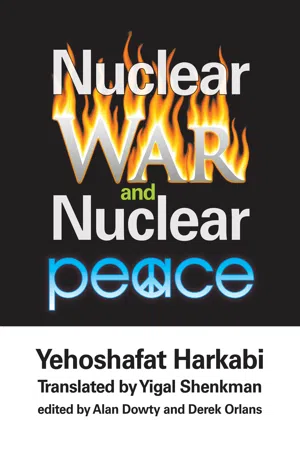
Nuclear War and Nuclear Peace
About this book
This book began as a personal effort to comprehend the effect of nuclear weapons on the current era and its international system. Nuclear weapons have not merely revolutionized the military sphere but havce also left their stamp on the world order. Knowledge of the basic principles of nuclear strategy has become a prerequisite to understanding world events. Consequently, no country can remain indifferent to nuclear strategy or can consider itself exempt from its implications. The very importance of the subject precludes the assumption of a narrow technical or military point of view. Political, historical, moral, and even religious implications must be considered.Nuclear War and Nuclear Peace serves as an introduction to the study of modern strategy within the framework of international relations, as well as a basic account for laymen to the intricacies of modern strategy and its ramifications. It deals with a wide range of problems: deterrence and its implications; surprise; and preemptive and preventative attack. The problems of quantities of nuclear weapons, limitations of war (conventional, tactical and strategic), and proliferation of nuclear weapons are also discussed. In the end Harkabi introduces alternate global approaches and the problem of coalitions in the nuclear era. By focusing on disarmament and arms control; peace in the shadow of terror; and stability of the international system and peace research he brings relevance to his study in terms of the current world climate.Many books and articles have been published on nuclear strategy. Most have been designed to formulate strategic policies to suit the needs of particular countries and influence their policy. Most books on nuclear strategy have appeared in the United States, with strategic prescriptions for the United States. This book will be of tremendous interest to anyone wishing to understand the major problems of our contemporary world from a global perspective.
Information
CHAPTER ONE
Nuclear Strategy
MILITARY strategy has always influenced the character of a period, and particularly the nature of its international relations. War, as it were, cast its shadow over the conventions of peace. This bond between strategy and the temper of the times has been strengthened in our days, as a fundamental change has transpired in the place of strategy and its function. In the past, the use of strategy has been primarily in time of war. Today it is employed principally in times of peace, its chief function being to keep the peace and to prevent war. In our time, therefore, strategy leaves its imprint not only on war but on peace as well.
Strategy has been transformed into the art of non-war, of the prevention of war. Formerly defined as the skillful use of violence, it has become the ‘skillful non-use of force.’1 Prevention of war is achieved by the threat of violence, that is, by the threat of retaliation in response to a provocation. Strategy has changed from the art of employing violence into the art of threatening violence, which is the art of deterrence. Deterrence is the exploitation of a threat without implementing it. In other words, deterrence is exploiting the very existence of weapons without activating them.
Deterrence as a human activity is as old as mankind. Its appearance is not limited to relations among states. We find it as a customary and normal activity within the state itself, and even in relations among friends and within the family circle. The state establishes fines and punishments for actions it wishes to prevent, in the hope that the punishment will deter the deed, while the individual tries to restrain the members of his household and others from actions he would like to prevent. Threats of retaliation and sanctions are common in international relations, often in the ‘subtle’ language of such declarations as, ‘we will not remain inactive’ or ‘we shall be unable to remain indifferent’; all this with the purpose of deterring.
Deterrence has long fulfilled a function in strategy and international relations. The primary purpose of armed forces has always been to deter potential aggressors from an attack on the state or its interest. The ancient Latin proverb, ‘civis pacem para bellum,’ is based on deterrence; i.e., the assumption or hope that the very fact of preparedness to respond to aggression will deter it. Surely many provocations have been deterred throughout the course of history, though it is easier to recognise those instances in which deterrence failed and war broke out.
Before the advent of the nuclear era, the employment of weapons did not involve such danger or the likelihood of such severe damage, to both deterrer and deterred, as at present. When the object of deterrence, embodied in the fact of preparedness and willingness to employ weapons, was not achieved, hostilities broke out and the weapons were employed as a matter of course. Deterrence was often the mid-way station on the road to war, for in the past there was much less hesitation to employ force or wage war than we see today. Nuclear war has become a destructive, cataclysmic terror for both sides, to the extent that all parties put their faith in a deterrence sufficient to prevent the outbreak of war.
Hence, though deterrence is age-old, it is clear why it has never been emphasized, and has never been a subject for study and research as today. In our time deterrence has become the central concept, the cornerstone and apex of strategy. It has achieved common linguistic currency as a word of magic qualities, as a type of ubiquitous catch-word. It would appear that if the institutions responsible for military affairs were to be established today, they would not be called ‘Defense Ministries’ but ‘Ministries of Deterrence.’
If in the past the threat to use arms—in other words, deterrence—was a corridor to war, today deterrence itself is the central factor. This is the Copernican revolution of contemporary strategy: it is no longer the actual use of weapons, but the threat to use them, that is of primary importance. Deterrence is not a secondary factor which turns upon the use of arms, but the use of arms turns upon deterrence. War-making potential is intended to validate deterrence.
This revolution must of necessity bring about a fundamental change in thinking. The transition from the conventional concepts of war—concepts of the use of forces and weapons—to concepts of the nuclear era—concepts of deterrence—is by no means simple. From time immemorial, mankind has been accustomed to conceiving weapons in terms of their use, that is in terms of war. All military attention and staff planning were directed towards the actual use of force and attendant problems. Armies were trained in the use of arms, in waging war. Deterrence, which grew out of the very existence of armies and weapons, did not particularly interest military circles, its proper place being on the entirely separate and far-removed level of policy-making, which has been the exclusive domain of heads of state. Deterrence was a political subject; strategy began where diplomacy ended. Today, therefore, nuclear arms have wrought a drastic transformation by promoting strategy to the policy level, the level of deterrence. No one thinking in terms of deterrence can any longer be satisfied with the military level of thought, but must ascend to the conceptual heights of policy makers. Moreover, since nuclear arms are as yet limited to the great powers, one who aspires to conceptualize nuclear deterrence is compelled to consider the matter from the lofty outlook of world leaders.
Strategy has, indeed, served foreign policy at all times, but never has the bond between policy and strategy been so intimate as in the nuclear era. Diplomacy and strategy have become mutually interdependent. As President Kennedy stated in his message to Congress of March 28, 1961, ‘Diplomacy and defense are no longer distinct alternatives, one to be used where the other fails—they must complement each other.’ Strategy is not implemented as in the past, after diplomatic efforts have failed, but its principal task is to stand behind diplomacy, to aid and support it. Strategy today is primarily an instrument of diplomacy in times of peace, and not only an instrument of war. The non-use of military force implies that its use lies mainly in diplomacy. At the same time, the importance of strategic considerations in policy-making has increased. National interests are considered, first and foremost, from a security standpoint. The rising importance of the strategic element in policy is reflected in the rising official status of Defense Ministries. Foreign Ministries are obliged to weigh security considerations, while Defense Ministries and General Staffs are compelled to a greater extent than in the past to think politically as well as militarily.
This proximity of strategy and diplomacy is also reflected in the influence of frequent technological changes in the means of warfare upon diplomacy. Innovations in weapons, their destructive power, ways of employing them and the advantages they afford are reflected both in changing doctrines of strategy and in new international situations which in turn create new problems for diplomacy. Technological changes and new inventions are not always dictated by the needs of strategy, policy and diplomacy, for technological development has its own momentum. Technology probably influences diplomacy more than diplomacy influences technology. Diplomacy must strive to keep pace with technological change, adjusting to it and utilizing it both for its general needs and in solving the problems created by technology itself.
The changed mode of thought derived from thinking in terms of deterrence is not a matter of abstract doctrine, but is likely to find concrete expression as, for example, in the calculation of force levels required for deterrence. This calculation diners from any previously accepted in conventional war. The guiding factor in estimating the required forces for employment in conventional war has been based on the enemy’s capability. The level of force required for deterrence is that level which will influence the enemy’s intentions. In the past, calculations were directed to maintaining strength sufficient to prevail over the power of the enemy. The objective in calculations of deterrence is maintaining a force capable of influencing the enemy’s aggressive intentions; in other words, a force whose dimensions will so impress the enemy as to discourage him and forestall a contest. The quantity and quality of these forces should even prevent the enemy, insofar as possible, from erring in his evaluation of his chances in the contest.
A state’s calculations in the past were guided by its own estimate of the force level sufficient to defeat an adversary, or at least to resist his forces successfully. In calculating the requirements of a deterrent force, we pass to an entirely different level, that of imagery. The force required depends not on what seems sufficient to us, but on what the enemy considers sufficient to restrain him from acting, that is, a force making aggression prohibitive in the aggressor’s judgment. In other words, the calculation of deterrent forces is based on our estimate of the enemy’s estimate of what will deter him. Force calculations are thus based on our effort to fathom the enemy’s ‘image’ of that magnitude of power that will deter him. We are involved here in an evaluation on two levels: our estimate of the other side’s estimate.
One difference between conventional and nuclear strategy lies in the changed relationship between deterrent forces and defense forces. In the past, identity prevailed, more or less, between them. Forces which served in peace time to deter an aggressor turned into the state’s defense forces if deterrence failed and war resulted.2 They insured as far as possible that damage should not be inflicted on the state, its territory or its population by interposing themselves between the enemy and his objective. Success consisted of halting the enemy, neutralizing his arms, and making his further advance impossible.
Concerning nuclear weapons, the balance between ‘offensive’ and ‘defensive’ capability has been drastically upset. Under present technological conditions the attacker has a decisive advantage. A bomber can be intercepted while on its mission, but bombers are being replaced by missiles and as yet there are no reliable means of intercepting and destroying all enemy missiles in flight. It has now become possible to destroy a state without first neutralizing its defense forces. Active defense is possible, principally by striking the enemy’s means of attack—his missile bases. Accordingly, of the three functions hitherto assigned to the armed forces, deterrence (in peace-time and war-time), defense and attack (in war-time), only two remain: deterrence and attack.
There are further differences between our era and the past. Formerly, hope of victory was conceivable, and this hope created a certain temptation to initiate war. Leaders gave in to this temptation countless times, and every war was promoted beforehand by various circles. Today, it is inconceivable that there will be a victor in a total nuclear war. The concept of victory has become meaningless, as both sides would emerge from such a war crushed and broken. It has been said that there is no victory in nuclear war, but only, at the very best, varying degrees of defeat. Occasionally we encounter the term ‘to prevail’ in place of the term ‘to win,’ generally without clarification of its meaning. It apparently signifies a difference in the degree of destruction among the warring states, one of them emerging from the war in better condition.
Because of the destruction wrought by nuclear weapons, war can no longer be considered, as in the famous dictum of Clausewitz, to be the continuation of policy by other means. Nuclear weapons have made nuclear war absurd.
War had aspects of an art in the past. Commanders took pride in their tactical skill, in the degree of imagination and ingenuity required to deploy their forces, in qualities of character, courage and daring, and in the capacity of leadership to implant confidence and enthusiasm in the troops. A man’s qualities and character found expression in battle. In all-out nuclear war, the human factor is disappearing and alienation between man and war has been created. This is machine warfare, increasingly transformed into a province of science and technology. All-out nuclear war is a war of covering targets by calculating probabilities of hits, a war of azimuths and computers. War is becoming mathematical, and from many standpoints simpler and more amenable to advance planning.
In conventional war, decision-making was apportioned among several levels, beginning with the political level, on which policy aims were determined, through the strategic level, and ending with the operational and tactical plane. In nuclear warfare, weapons have become a type of personal weapon in the hands of the head of state. Only he makes decisions, all others having far more technical and operational functions. In the past, the head of state decided on war, the commanders on the opening of fire. In all-out nuclear war, the head of state decides both on the war and on the opening of fire. Thus the head of state achieves his objectives directly without the need to pass through the operational or tactical levels. These circumstances necessitate greater understanding and knowledge of technical-scientific and strategic matters in policy-makers than ever before in history. The political authority has not only to direct war, but has to control its operations.
Our desire to emphasize and focus attention on the special character of nuclear war may lead to overstatement. As we shall yet see, nuclear powers must maintain forces not only for nuclear war but also for conventional warfare, the conditions of which remain essentially as in times past. Contemporary strategy has with one foot taken a stride into a new and revolutionary type of war, while the other foot remains planted in traditional forms of armed conflict. Strategy has become more diverse and embraces a greater number of patterns of warfare.
Viewed in terms of formal analysis, military doctrine lags behind weapon development by that period of time required for the mind to assimilate weapons innovations and envision their potentialities. The lag has increased with the appearance of nuclear weapons, which have wrought such a radical revolution in the conventions of war. The adaptation of strategy to nuclear weapons has made considerable headway, and it seems that the possibility for innovation in nuclear strategic doctrines has tapered off recently. However, existing doctrines cannot be considered final. The quickening pace of technological change will perpetuate the gap between the introduction of weapons and the elaboration of doctrines.
Another question asked is how a doctrine can be tested. The true test is war, as the value of exercises and maneuvers was limited even in the past. No matter how realistic the conditions, there was always an element of artificiality in them. Maneuvers, moreover, do not allow assessment of the true outcome. The possibility of testing doctrines of nuclear war has become even more remote; nuclear strategy will always bear the nature of conjecture without the possibility of actual corroboration.
In the past, strategy for the coming war was elaborated on the basis of historical experience derived from preceding conflicts and the accumulated wisdom of generations. The history of war and the deeds of great commanders served as an example and model, a subject for analysis and the derivation of conclusions. As the officer corps was more familiar with the problems of combat and had, moreover, gained experience in these problems and in commanding troops, it was natural that they should have an advantage in such studies. Nuclear war is a totally new phenomenon in which human experience lags behind technological progress. Due to the revolutionary change implicit in nuclear warfare, historical experience from previous wars has ceased serving as a guide for such a war. Military experience, therefore, no longer affords an advantage in analyzing the course and results of a future war, and the primacy of the officer corps has ended. Those divining the uncertainties of the next war are all ‘arm-chair strategists,’ without exception, and all are submerged in an area of guess-work and conjecture, whether they are military or civilian. No one possesses experience in the question of how man will behave in the nightmare conditions of nuclear war. Military experience is less helpful in dealing with these questions than some familiarity with scientific problems, an acquaintance with political and psychological reality, and the ability to weigh logical considerations.
In the United States, consequently, civilian academic circles have entered the field of nuclear strategy and are trying their hand in the elaboration of its problems. The complexities and implications of the concept of deterrence have fascinated the professors as a subject for deliberation, discourse, and disputation. Deterrence being a general human activity, and not necessarily military, analogies have been drawn and generalizations derived from the extensive and varied phenomena of every-day life. Academic circles view strategy as a composite discipline grounded, of necessity, in a broad combination of sciences, each making a unique contribution based on its own methods and approaches. It is an inter-disciplinary study, no longer limited to the experts of one science, to the military profession alone.
Strategy has become a subject for civilian academic study in universities and not necessarily in military institutions which anyhow dealt more with tactics and organization. Universities are founding departments for studies and research in strategy, and independent strategic research institutes are being established.
In developing the new strategy scholars had several advantages over the military. Their training in research afforded them tools for analyzing the basic abstract factors inherent in the conceptual framework of deterrence. As the components of strategy widened to embrace scientific, political and psychological factors, the civilian academicians were better equipped to analyze these ‘extraneous’ factors and to draw them together in one system. They were able to weather the revolutionary transition to thinking in terms of deterrence more easily than military men, who have been conditioned to thinking in terms of the actual application of force. Moreover, the military had become habituated to thinking about war in the framework of land, sea, or air warfare, depending on their particular service affiliation. These habits constituted a handicap in understanding nuclear war, which transcends these patterns of thought and cannot be compressed into the usual departmental categories. Academic researchers bore no such yoke, and were therefore better suited to assess the character and innovations of nuclear war.
Civilians have a further technical advantage, which for the sake of comprehensiveness should not be ignored. They are freer to publish their views than military men, who are subject to security regulations. It can be assumed, therefore, that the contribution of the military has been greater than meets the eye, and there is room to predict that in the future we will witness increasing contribution by the military profession to modern strategy.
Side by side with the growth of academic interest in world strategy, another field has attracted attention, namely, ways of ensuring the stability of peace, problems of disarmament, or, more precisely, ‘arms control.’ Arms control is a strategic study, directed toward description and analysis of strategic conditions most likely to ensure the preservation of peace. Again we are reminded that contemporary strategy embraces both peace and war. One gets the impression that the amount of publication in this field in the United States in recent years has surpassed that dealing with nuclear strategy from its ‘warlike’ aspect.
Scholars engaged in defense studies, or ‘defense intellectuals’ as they have been labelled in the United States, are subjected to fierce criticism from two principal quarters. On the one hand, this criticism comes from liberal circles, partly because of the interesting fact that the academic defense theoreticians made stringent military demands. This was a result of their presentation of problematical contingencies, which revealed additional threats to be met and gaps to be closed in the defense system. These demands were regarded by liberal circles as contributing to the intensification of the arms race. Their authors were accused of exaggerating the dangers to be expected from the enemy and seeing ‘the shadow of mountains as mountains,’ due to delusions of persecution or to casuistry. It has been claimed that the transfer from the cloistered groves of Academe to the world of action and influence intoxicated them to the point of making them the hired counsels of militaristic circles.
On the other hand, academic strategists are also showered with criticism from military circles. These attacks stem partly from the natural reservations of military men toward excessive intellectualization, but also from their sense of injury at the incursions and achievements of scholars in a nonacademic sphere. In the course of time, however, cooperation between scholars and soldiers is bound to create mutual recognition and esteem. The military recognize the advantag...
Table of contents
- Cover Page
- Title Page
- Copyright Page
- Table of Contents
- PUBLISHER’S NOTE
- INTRODUCTION
- CHAPTER ONE NUCLEAR STRATEGY
- CHAPTER TWO DETERRENCE
- CHAPTER THREE STRATEGIC CONCEPTS: SURPRISE, PREEMPTION AND STABILITY
- CHAPTER FOUR STRATEGIC DOCTRINES: THE SIZE OF FORCES REQUIRED
- CHAPTER FIVE STRATEGIC DOCTRINES: COMPOSITION OF FORCES
- CHAPTER SIX LIMITED WAR—CONVENTIONAL AND NUCLEAR
- CHAPTER SEVEN LIMITED STRATEGIC WAR—CONTROLLED NUCLEAR REPRISAL
- CHAPTER EIGHT THE UNIVERSE OF VIOLENCE
- CHAPTER NINE COMMUNICATION OF THE THREAT
- CHAPTER TEN ALLIANCE IN THE NUCLEAR ERA-NATO
- CHAPTER ELEVEN PROLIFERATION AND THE OUTBREAK OF WAR
- CHAPTER TWELVE DISARMAMENT AND ARMS CONTROL
- CHAPTER THIRTEEN COMPLEXITIES OF A NUCLEAR WORLD
- NOTES
- SELECTED BIBLIOGRAPHY
- QUESTIONS
- INDEX
Trusted by 375,005 students
Access to over 1.5 million titles for a fair monthly price.
Study more efficiently using our study tools.
Frequently asked questions
Yes, you can cancel anytime from the Subscription tab in your account settings on the Perlego website. Your subscription will stay active until the end of your current billing period. Learn how to cancel your subscription
No, books cannot be downloaded as external files, such as PDFs, for use outside of Perlego. However, you can download books within the Perlego app for offline reading on mobile or tablet. Learn how to download books offline
Perlego offers two plans: Essential and Complete
- Essential is ideal for learners and professionals who enjoy exploring a wide range of subjects. Access the Essential Library with 800,000+ trusted titles and best-sellers across business, personal growth, and the humanities. Includes unlimited reading time and Standard Read Aloud voice.
- Complete: Perfect for advanced learners and researchers needing full, unrestricted access. Unlock 1.5M+ books across hundreds of subjects, including academic and specialized titles. The Complete Plan also includes advanced features like Premium Read Aloud and Research Assistant.
We are an online textbook subscription service, where you can get access to an entire online library for less than the price of a single book per month. With over 1.5 million books across 990+ topics, we’ve got you covered! Learn about our mission
Look out for the read-aloud symbol on your next book to see if you can listen to it. The read-aloud tool reads text aloud for you, highlighting the text as it is being read. You can pause it, speed it up and slow it down. Learn more about Read Aloud
Yes! You can use the Perlego app on both iOS and Android devices to read anytime, anywhere — even offline. Perfect for commutes or when you’re on the go.
Please note we cannot support devices running on iOS 13 and Android 7 or earlier. Learn more about using the app
Please note we cannot support devices running on iOS 13 and Android 7 or earlier. Learn more about using the app
Yes, you can access Nuclear War and Nuclear Peace by Yehoshafat Harkabi in PDF and/or ePUB format, as well as other popular books in Politics & International Relations & Arms Control. We have over 1.5 million books available in our catalogue for you to explore.