- 240 pages
- English
- ePUB (mobile friendly)
- Available on iOS & Android
eBook - ePub
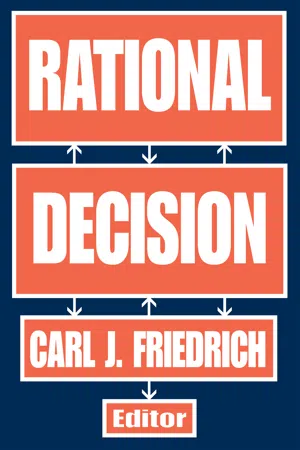
Rational Decision
About this book
To a historian the most interesting thing about decisions is the fact that everyone talks about them. No one interested in social ideas can fail to notice how large a part the word "decision" has come to play in the vocabulary of moral and political discourse. It meets one on every page. Inevitably one asks, "Why?" Why is there so much talk of decisions and of those who are said to make them? Are there any ideological reasons for it?
Information
JUDICIAL DECISIONS AND THEIR RATIONALITY
8
Rationality in Judicial Decisions
I
When James I royally maintained that he was perfectly competent to decide questions of law by the exercise of reason, Sir Edward Coke respectfully protested, if we can accept his account, that such decisions must be reached by the “artificial reason” of the law, which the King was scarcely qualified to pursue. There have been some who doubted the force of Coke’s rejoinder in the context of the common law. Max Weber, for example, regarded Anglo-American law as distinctly inferior in rationality to the systems derived from the Roman law.1 The common law, he argued, is too akin to the layman’s ideal of the practical, the expedient, the expectable, and rests too heavily on the charisma of the judges, while the continental systems are more truly rational in their relentless application of formulated rules to the facts of particular controversies. This is not the place to consider the verisimilitude of Weber’s picture of the two legal worlds, but one or two points can be made that will perhaps illuminate in a preliminary way the dimensions of the problem of rationality in judicial decisions.
Weber, as might be expected, denigrated the jury as an irrational intrusion. But it may well be that the rationality of a system as a whole is maintained by the deliberate employment of a less rigorous element at a chosen stage: for example, the assignment by lot of a particular judge to hear a case, the intervention of an executive pardon, or the informed hunch of a probation board. Weber, too, selected for illustrative praise the decision of a German court that, under a code provision punishing the larceny of a chattel, the stealing of electric power is not an offense; it was a case of an omitted class of acts that must be rectified by new legislation. One might agree with the conclusion, but for more expedient reasons: though the term “chattel” could be applied sensibly to electric power in some contexts (e.g., in a comprehensive constitutional grant of authority to the government to sell publicly owned chattels or real property), in the context of a criminal law a more restrictive meaning may be called for in the interest of a general policy that crimes shall be strictly defined.
What I have tried to suggest in this preliminary way is that rationality has some important relation to the context of a system and of a particular class of problems. I find it less helpful to essay a definition than to examine a process in operation. Nevertheless one should, I suppose, indicate broadly the nature of the concept under examination. Rationality, I take it, is a term of commendation, though not of ultimate praise; a decision may be rational and yet not command approval as a necessary truth or even as right. It is set off against nonrational modes like will, power, caprice, or emotion, against irrational modes, like recklessness of means or ends or their relation, against rapacity or opacity. It is a warrant not so much of the soundness of a decision as of the course pursued—that the course of inquiry has been kept open and operating in appropriate ways and within appropriate termini. A principal aim of this paper on judicial decisions is to stimulate comparisons with the ways and the termini of the rational process in political and scientific thinking.
II
A convenient framework is at hand in Cardozo’s analysis of the judicial process.2 There are, he suggested, four elements in judicial reasoning: logic, precedent, history, and social utility. It may be useful to consider these (taking the first two together) from the standpoint of rationality and the limitations on it.
First, then, is logic, which embraces the notions of generality, consistency, deduction, and induction.
Generality. In ethical reasoning (of which legal reasoning is essentially an instance, for judicial decisions are aimed at the norm of justice), it is often said that propositions should be general, should not contain proper names, or should be capable of universalization. In the law, at least, a maxim of this sort is little more than a restatement of problems. Consider the following series of statements beginning with the words “A judge always ought to”:
- (1) decide by whim
- (2) decide for the plaintiff in a negligence case
- (3) stretch a statute (Maitland’s self-professed rule as a member of the Senate of Cambridge University)
- (4) give preference to an injured child in a negligence case
- (5) give predominant weight to the welfare of a child in a custody case
- (6) uphold an agreement as a valid contract
- (7) uphold an agreement as a valid contract if it would be such by the law of any state having relation to the transaction
- (8) impose stricter procedural safeguards in capital than in noncapital cases.
The form of these statements is general throughout. Does not their rationality depend on the relevance of the proclaimed standards to the classes described? And does not this first depend on an understanding of the sectors of the law with which the statements are concerned? And does not an understanding involve a good deal of feel for the traditions, assumptions, and practices of the discipline?
Consistency or Transitivity. A rational decision, it may be suggested, will respect the principle that, if A is preferred to B and B to C, then A must be preferred to G. But this also tends to obscure the real problem, which is whether to view the choices as part of a single field or in pairs which may alter the relevant fields. Anatol Rapoport has put the case of a man faced with the choice of living with one of three women. He prefers A to B and B to C. Is it, then, irrational to prefer C to A? Not if C is insanely jealous of A, so that to live with A rather than C would provoke an overhanging threat of murder. The law can furnish less fanciful illustrations. A federal statute provides that a lien for federal taxes shall be subordinate only to a pre-existing lien of a mortgage. Thus if there are three claims, that of a prior mortgagee (M), of a tax due to the United States (U), and of a tax lien of a state (S), the priorities would seem to be M, U, S. But suppose the state has a statute, enacted within its acknowledged powers, giving priority to state tax claims over the claims of a mortgagee. To follow the state rule would produce the series S, M, U. There is circuity here which somehow has to be resolved. One way of doing so might be to interpret the federal rule as not applying where the claim of a mortgagee and of the state coexist. Another solution might be to preserve the place of the federal claim by giving first priority to the amount and only the amount of the mortgage, but subjecting that amount to the tax lien of the state.3 In any event, the analysis must go deeper than a principle of transitivity and must take account of policies made acutely relevant by what is on the surface a logical dilemma.
Deduction. One need not dwell on familiar logical troubles of deduction: what the tortoise said to Achilles in Lewis Carroll’s fable or how deduction from a rule involves the problem of sameness in classifying phenomena under a major premise. In the legal process the difficulties are compounded by virtue of the fact that premises tend to be not so much rules as principles or standards and by the correlative fact that there are commonly two or more such premises available arguably as starting points for reasoning. In this respect judicial decision tends to resemble efforts at decision by maxims: when we remember that the early bird catches the worm (a rule, to begin with, for the birds), we are at once reminded of the cognate truth that haste makes waste. I hope to illustrate what it means to “apply a rule” by the analysis of a case at the end of this paper.
Induction. One need not dwell here on induction as the “scandal of philosophy” nor on the general observation that inductive reasoning is not self-starting or self-limiting—that, as Charner Perry put it some years ago, in beings who act and know there is an irreducible element of chance or will, of intellectual violence in the process of decision.4 In the legal process induction proceeds from precedents and from facts of life. The use of precedents raises again the problem of sameness and also the problem of the range within which precedents should be re-examined. There is here a parallel with the method of science, since every experiment involves in principle a testing not only of the immediate hypothesis but also of the whole series of postulates of the system within which the experiment is performed. In the law the problem is complicated by the assignment of roles: a trial judge has much less freedom than an appellate judge to re-examine precedents, and there is a difference in role between judges and legislatures. The problem is further complicated by the relative importance of stability and justice (of which stability is, to be sure, an element) for different classes of legal transactions and events. A planned transaction, like a mortgage or a marriage, calls for more stability in the use of precedents than, say, a collision (though the making of settlements argues for some stability even here).
When one turns from precedents to facts of life as elements of induction, one must recognize that the facts are not given in a raw sense but are themselves part of a social system which makes them intelligible and which must itself be understood. Facts, to be sure, are rarely as raw as we carelessly assume. As recent studies by Jerome Bruner, George Miller, and others have shown, personal values or the norms of syntax and semantics affect the threshold of perception, and “concernedness” helps to define perception’s span.5 Social phenomena as the facts of law call for a special sensitivity and sophistication. Whether baptism and pagan initiation rites are viewed as parallel phenomena will depend on the orientation of the observer.6 Judicial review of state taxation in Australia and the United States will be best understood in the context of the whole federal system of each country. On a more elemental level, the claims with which the law deals are not raw demands, but demands that have been shaped by a legal system itself, not the raw appetites for goods or association, but the claims of legal personalities, of debtors and creditors, buyers and sellers, husbands and wives. In this respect the legal process resembles the social sciences and is marked with similar entanglements in building on empiric evidence.
Of history it may be said briefly that its usefulness varies inversely with the weight of the demands made on it. The judge can learn relevant things from a narrative (how habeas corpus began and the functions it served) and, with luck and discretion in interpreting social facts, some things from the history of institutions about the strengths and weaknesses of certain forms of order (arbitration, judicial review of legislation). When he looks to history for a scaling of values, he is confronted, besides all this, with the problem of differentiating history from the historians: in Yeats’s phrase, how to know the dancers from the dance; in Santayana’s, looking over a crowd to find one’s friends. Judges, said Holmes, are apt to be naïve, simple-minded men; they need a touch of Mephistopheles. In any search for objectivity through history, they need a touch—perhaps it is the same thing-—of philosophy.
Social utility, the fourth of Cardozo’s elements, is in a broad sense, as he acknowledged, an inclusive criterion, and it is of this that I want to speak more at length. In the law its limitations are near the surface. Law is a system for imposing a modicum of order on the disorder of human experience without disrespecting or suppressing a measure of spontaneity, diversity, and disarray. How and how much order to impose are questions that cannot always be answered by a utilitarian calculus. Order and freedom are mutually reinforcing to a degree, but at some point become incommensurables. Apparent allegiance to a common ideal of freedom may conceal deep divisions in the valuing of order and disorder: when Benjamin Franklin declared, “Where freedom is, there is my home,” Tom Paine answered, “Where freedom is not, there is mine.” Similarly with the sanctity of life and the preservation of lives. Is a man justified on utilitarian principles in killing an innocent person in order to save the lives of two others? Of course, utilitarian considerations of a long-run kind may enter into a rule; a legal justification in so plainly stated a case might encourage homicides in situations whose exigency is less clear, where a deterrent is wanted. But these long-run considerations can be tenuous at best, and a more intuitive basis for a rule in this case is probably more realistic.
We are concerned, however, with the judicial process rather than with law as a whole, and here the practices of the discipline afford some escape for the judge from the problems of valuation.
First, the judge may take refuge in a rule of more-or-less generality already formulated, either by his predecessors or by the legislature. The starting point or points, in other words, are not at large but are within limits determined. Some rules embody a resolution of values, as in the homicide case. Others are prophylactic in the sense of forestalling the resolution of wasteful and difficult controversies of fact. The inqui...
Table of contents
- Cover Page
- Title Page
- Copyright Page
- Contents
- Preface
- I GENERAL ISSUES OF RATIONAL DECISION
- II LAW AS DECISION-MAKING
- III JUDICIAL DECISIONS AND THEIR RATIONALITY
- IV HISTORICAL REFLECTIONS
Trusted by 375,005 students
Access to over 1.5 million titles for a fair monthly price.
Study more efficiently using our study tools.
Frequently asked questions
Yes, you can cancel anytime from the Subscription tab in your account settings on the Perlego website. Your subscription will stay active until the end of your current billing period. Learn how to cancel your subscription
No, books cannot be downloaded as external files, such as PDFs, for use outside of Perlego. However, you can download books within the Perlego app for offline reading on mobile or tablet. Learn how to download books offline
Perlego offers two plans: Essential and Complete
- Essential is ideal for learners and professionals who enjoy exploring a wide range of subjects. Access the Essential Library with 800,000+ trusted titles and best-sellers across business, personal growth, and the humanities. Includes unlimited reading time and Standard Read Aloud voice.
- Complete: Perfect for advanced learners and researchers needing full, unrestricted access. Unlock 1.5M+ books across hundreds of subjects, including academic and specialized titles. The Complete Plan also includes advanced features like Premium Read Aloud and Research Assistant.
We are an online textbook subscription service, where you can get access to an entire online library for less than the price of a single book per month. With over 1.5 million books across 990+ topics, we’ve got you covered! Learn about our mission
Look out for the read-aloud symbol on your next book to see if you can listen to it. The read-aloud tool reads text aloud for you, highlighting the text as it is being read. You can pause it, speed it up and slow it down. Learn more about Read Aloud
Yes! You can use the Perlego app on both iOS and Android devices to read anytime, anywhere — even offline. Perfect for commutes or when you’re on the go.
Please note we cannot support devices running on iOS 13 and Android 7 or earlier. Learn more about using the app
Please note we cannot support devices running on iOS 13 and Android 7 or earlier. Learn more about using the app
Yes, you can access Rational Decision by Carl Friedrich in PDF and/or ePUB format, as well as other popular books in Philosophy & Jurisprudence. We have over 1.5 million books available in our catalogue for you to explore.