- 180 pages
- English
- ePUB (mobile friendly)
- Available on iOS & Android
eBook - ePub
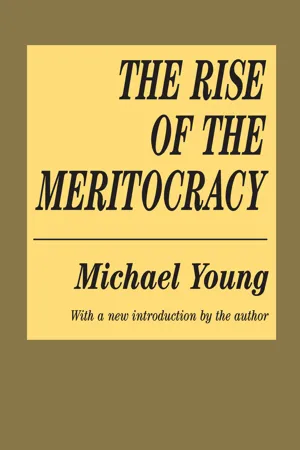
The Rise of the Meritocracy
About this book
Michael Young has christened the oligarchy of the future Meritocracy. Indeed, the word is now part of the English language. It would appear that the formula: IQ+Effort=Merit may well constitute the basic belief of the ruling class in the twenty-first century. Projecting himself into the year 2034, the author of this sociological satire shows how present decisions and practices may remold our society.It is widespread knowledge that it is insufficient to be somebody's nephew to obtain a responsible post in business, government, teaching, or science. Experts in education and selection apply scientific principles to sift out the leaders of tomorrow. You need intelligence rating, qualification, experience, application, and a certain caliber to achieve status. In a word, one must show merit to advance in the new society of tomorrow.In a new opening essay, Young reflects on the reception of his work, and its production, in a candid and lively way. Many of the critical ambiguities surrounding its original publication are now clarified and resolved. What we have is what the Guardian of London called A brilliant essay. and what Time and Tide described as a fountain gush of new ideas. Its wit and style make it compulsively enjoyable reading from cover to cover.
Information
Part One
Rise of the Élite
Chapter One
Clash of Social Forces
I. Civil Service Model
ΤHE 1870s have been called the beginning of the modern era not so much because of the Commune as because of Mr Forster. Education was then made compulsory in Britain, patronage at last abolished in the civil service and competitive entry made the rule. Merit became the arbiter, attainment the standard, for entry and advancement in a splendid profession,1 which was all the more an achievement because so many of our great-grandfathers were positively hostile to 'competition wallahs' in British government. Considering the opposition, it is remarkable that by 1944 the most brilliant young men from Cambridge and Oxford were already going into the administrative class, there to guide the destinies of the nation; outstanding young men from the provincial universities into the hardly less important scientific and technical grades; worthy young men and women from the grammar schools into the executive grades; the less outstanding joined the junior clerical grades; and the fine body of men and women who were the backbone of the service entered the manual and manipulative grades straight from the elementary (later called secondary modern) schools. Here was a model for any sensible organizer to emulate. It was copied a thousand times in commerce and industry, at first mainly by the large companies like Imperial Chemicals and Unilever, and later by the ever-proliferating public corporations.
The flaw in these otherwise admirable arrangements was, of course, that the rest of society, and in particular education, was not yet run on the civil-service principle. Education was very far from proportioned to merit. Some children of an ability which should have qualified them as assistant secretaries were forced to leave school at fifteen and become postmen. Assistant secretaries delivering letters! - it is almost incredible. Other children with poor ability but rich connexions, pressed through Eton and Balliol, eventually found themselves in mature years as high officers in the Foreign Service. Postmen delivering demarches! - what a tragic farce! The civil service, wrestling with an intractable problem, did something to make up for injustice in the larger society by enlarging opportunities for elevation within its own ranks. Particularly in wartime, it substituted late developers from the lower grades for early deterioraters who managed to pass their final examinations only to sink exhausted into the Treasury. Clever clerks could even in peacetime climb on to a quite different ladder; a few of them became executives, and in their later years a few of these broke into the lower ranks of the administrative class. The limits were the deficiencies of the general educational system. Only when the school did its job were the Civil Service Commissioners able to do theirs. When no more assistant secretaries had to leave school at fifteen, and no more postmen were sent to Balliol, the great reform begun in the 1870s could at last be completed.
The force of this example is difficult to over-estimate. The names in the Imperial Calendar a hundred years ago adorned a civil service renowned, for good reason, as the best in the world. How close the analogy with modern society! Today we have an élite selected according to brains and educated according to deserts, with a grounding in philosophy and administration as well as in the two S's of science and sociology. The administrative class in the old civil service was also picked for brains and given an education which was far more than vocational, and yet had a bearing (like the Roman and unlike that other great Imperial Civil Service, of China) upon the tasks they were later called upon to perform. Today we frankly recognize that democracy can be no more than aspiration, and have rule not so much by the people as by the cleverest people; not an aristocracy of birth, not a plutocracy of wealth, but a true meritocracy1 of talent. Likewise, the old civil service exercised, with skill and tact, a great deal more power than Parliament because it was so well chosen and well trained. Today each member of the meritocracy has an attested minimum rating of 125 (with the top posts for psychologists, sociologists, and Permanent Secretaries reserved since the Crawley-Jay award of 2018 for the over 160s): has not Tauber's retrospective method shown that a century ago the majority of the administrative class already had indices higher than 125? These were the rudiments of the modern system. If today intelligence reigns supreme and in three-quarters of the world unchallenged, a modest tribute must be paid to the far-sighted pioneers of the British civil service. It is an exaggeration, an excusable one, to say that our society is a memorial to them no less than to the early socialists.
2. All Things Bright and Beautiful
Until the civil service reforms the greater part of society was governed by nepotism. In the agricultural world which predominated until well on in the nineteenth century, status was not achievable by merit, but ascribed by birth. Class by class, status by status, occupation by occupation, sons followed faithfully in the footsteps of fathers, and fathers as faithfully behind grandfathers. People did not ask a boy what he was going to be when he grew up; they knew - he was going to work on the land like his ancestors before him. For the most part there was no selection for jobs; there was only inheritance. Rural society (and its religion) was family writ larger.
With the father at the head, the status of the other members of the family was graded in a hierarchy, with eldest son ranking before younger1 and sons before daughters. As in the family so in the village. The lord of the manor was the patriarch, and below him in their proper degrees were the farming population, the freeholders ranking above copyholders, copyholders above cottagers, cottagers above farm servants.
The rich man in his castle,
The poor man at his gate,
He made them high and lowly
And ordered their estate.
All things bright and beautiful, etc.
The poor man at his gate,
He made them high and lowly
And ordered their estate.
All things bright and beautiful, etc.
As in the village, so in the kingdom: the Royal Family, headed by the Father of his country, stood over the orders and estates of the realm. As in the kingdom on earth, so in the Kingdom of Heaven. The same man was always at the head of the table. Such a rule was hardly designed to encourage youthful ambition.
In holding a mirror to the past, even the historian can seldom escape the image of his own inquiring face, and it is practically impossible for any layman, taking for granted as he does the logic of human engineering, to understand the apparent folly of his ancestors. Of course there was tyranny, waste, and rigidity in the old system. But that was not all. Lord Salisbury once said he could not think of a logical defence of the hereditary principle and, for that reason, was disinclined to give it up. He was able to speak with such assurance because, to anyone whose roots were in the countryside,1 the justification for inheritance when agriculture was a family affair was almost self-evident. Agriculture demanded hard and unremitting exertion, and, in the prevailing mental climate, this was best secured when men knew they were working for children and grandchildren who would benefit from improvement as they would suffer from neglect. Agriculture demanded that the toilers should be attached to the soil, lest the always precarious supply of food should fail, and this attachment was best safeguarded when children were set to learn and love, at an age when they were at their most impressionable, the little peculiarities of the land they would one day inherit. Agriculture demanded that the fertility of the soil should be continuously nourished, not exploited for temporary gain; and the long view was instilled in people who had at heart the interests of posterity, as embodied in their own family. Inheritance at once prompted exertion, instilled responsibility, and preserved continuity.
The soil grows castes; the machine makes classes. The old system was good enough as long as England depended upon primitive agriculture, but as industry grew, feudalism was more and more of a restraint upon efficiency. It was not so much inheritance of property1 that mattered. Indeed, the more riches a father bequeathed, the more often his children did nothing apart from the labour of spending their money. When the family was pensioned off, the power descended from the fathers to paid managers selected for their ability, which was just as it should be. What mattered most was the number of children who inherited power and position as well as wealth. It is amazing how many doctors were the sons of doctors, how many lawyers the sons of lawyers - and likewise with professions of many kinds. In industry and commerce, many successful men preferred to send their children up the social ladder into the professions; even in business job succession was quite common enough to be a very serious impediment to productivity. Naturally enough, able fathers did bear able children - though less often before the spread of intelligenic marriages - who were doubly entitled to their power, by merit, as well as birth. But how sadly frequent was the opposite - the son who did not match his father, whose ability was perhaps of a different kind, whose leanings were to art or philosophy instead of business, or whose energy was curdled by the nearness of his parent - and yet down he sat at his father's desk and kept the seat warm for his own son. Many sons did their best, by training and application, to abide by Goethe's instruction:
Really to own what you inherit
Tou first must earn it by your merit.
Tou first must earn it by your merit.
But what was the use? There are limits to self-deception. Human tragedy was also social waste.1 Until the Butler Act began to take effect in the seventies and eighties, Britain was outstanding among industrial countries as the home and fount of nepotism in a hundred subtle forms.
Almost any intelligent observer could see how criminal this was. In the last century countless crises and disasters were caused by the wrong father's son or (sometimes) daughter lying in the wrong place at the wrong time. Why then did a system of inheritance suitable to agriculture survive for so long? Britain had been an industrial country for well over a century before it rooted out nepotism. Why such a gap between the end of dependence upon the soil and the end of dependence upon caste? One of the reasons is obvious enough. This island enjoyed a doubtful blessing: it was never invaded, never completely defeated in war, never shaken by political revolution. The country was, in short, never jolted into making a fresh start. As with all countries which decline slowly and steadily, decline, that is, in a stable way, today was never, after 1914, as brilliant as yesterday. Britain lived on ancestral capital, and the more it did so, the more it had to do so; the dimmer the present, the greater the justification for escaping from it. A strange doctrine, I know, for a modern sociologist, but I
Social Progress and Educational Waste, 1924. It was not until much later, however, that Professor Marlow was, on a body of cogent assumptions, able to estimate the wastage in the U.K. as having been equal to about thirty-eight megaunits per annum in the forties, falling to about thirty-three in the sixties, to about eighteen by the nineties and to 5-2 megas in the 2020s. This is said to be the irreducible minimum, or in technical terms the Marlow Line, beyond which social efficiency cannot further be improved. But after all that has happened in the past century, who can safely predict what further progress may still be possible? Nor is the basis of these calculations yet altogether satisfactory.
am not alone in saying that too many people had too sharp a sense of history, along with too dull a sense of what the future might be persuaded to yield. It was not like this in the nineteenth century, but by the middle of the twentieth, tradition was over-valued, continuity too much revered. For every change there had to be precedent. Britain, in other words, remained rural-minded long after eighty per cent of its population were collected together in towns - altogether as strange an example of cultural lag on a mass scale as China before the Mao Dynasty.
Ancestor-worship took the form of reverence for old houses and churches, the most amazing coinage, the quaintest weights and measures, Guards regiments, public houses, old cars, cricket, above all the hereditary monarchy and in a less obvious way the class around the monarchy, namely the aristocracy, which could trace its descent from a more splendid past. Even politicians, as Privy Councillors, borrowed some of the royal glamour; civil servants coyly called themselves HMG.1 The State itself had high prestige because it attracted some of the status of the aristocracy who used to govern the government. In the United States (without an aristocracy) it was for long assumed that all government was bad, whereas in Britain people were always indignant that governments were not better. Not only the government, all the most important institutions of the country, from the Universities to the Royal Society, from the Marylebone Cricket Club to the T.U.C., from the merchant marine to Fortnum & Mason, were at one time blessed by royal patronage, and there was hardly a leading company in any industry which could not boast of a peer on its board. The aristocracy was the father-figure in the collective unconscious; its influence so pervasive that brilliant people, successful in their own right, were sometimes ashamed of their lowly origins, instead of proud that they had risen above them. Of all their admired characteristics, the most widely emulated was the habit aristocrats were supposed to have of not working, or rather of exerting themselves only at work which was sanctified by being unpaid.1 In industry top management slavishly copied these drones. Contemporary accounts show in harrowing detail that as late as 1975 managers of important firms were still behaving (often without knowing why) as though they were 'gentlemen of independent means'. In the army they were not men but officers; in industry not men but gentlemen. They pretended, in a ritualistic way, that they did not have to earn their living at all - managers arrived at their jobs two or three hours after their manual employees; came dressed in a suit cut for the club rather than the factory; occupied an office which looked like a drawing-room, with not a sign to be seen of anything so vulgar as a digital computer; nourished themselves from a cocktail cabinet just like the one at home; ate at the firm's expense in a canteen laid out to look like a private drawing-room; and toiled on late into the evening in the hours for which they were not paid. They made work into hobby as much as they made hobby into work: the serious business of life began when they mimicked the sporting squire of old at the first tee.1 This elaborate pretence was naturally and disastrously imitated by subordinates at every level. Strikes beset the management who tried to stop the labourers from taking time off, at frequent intervals, for tea. The long arm of the aristocracy had productivity securely under arrest.
3. Family and Feudalism
Aristocratic influence would never have lasted so long, even in England, without the support of the family: feudalism and family go together. The family is always the pillar of inheritance. The ordinary parent (not unknown today, we must sorrowfully admit) wanted to hand on his money to his child rather than to outsiders or to the state; the child was part of himself and by bequeathing property to him the father assured a kind of immortality to himself: the hereditary father never died. If parents had a family business which in a sense embodied themselves, they were even more anxious to pass it on to someone of their own blood to manage. Parents, by controlling property, also controlled their children; a threat to cut a child out of a will was almost as effective an assertion of power in industrial as it had been in agricultural Britain. Even if they had no property, parents wanted their children to find, if not the same job, then a slightly better job than themselves. Study upon study has shown how impelling these drives were (and are) and how strong the motive possessed by parents to advance their children. To imagine merit where none existed was the sanctioned psychosis of a million homes.
For hundreds of years...
Table of contents
- Cover
- Half Title
- Title
- Copyright
- Contents
- Acknowledgements
- INTRODUCTION TO THE TRANSACTION EDITION
- INTRODUCTION
- PART ONE: RISE OF THE ÉLITE
- PART TWO: DECLINE OF THE LOWER CLASSES
Trusted by 375,005 students
Access to over 1.5 million titles for a fair monthly price.
Study more efficiently using our study tools.
Frequently asked questions
Yes, you can cancel anytime from the Subscription tab in your account settings on the Perlego website. Your subscription will stay active until the end of your current billing period. Learn how to cancel your subscription
No, books cannot be downloaded as external files, such as PDFs, for use outside of Perlego. However, you can download books within the Perlego app for offline reading on mobile or tablet. Learn how to download books offline
Perlego offers two plans: Essential and Complete
- Essential is ideal for learners and professionals who enjoy exploring a wide range of subjects. Access the Essential Library with 800,000+ trusted titles and best-sellers across business, personal growth, and the humanities. Includes unlimited reading time and Standard Read Aloud voice.
- Complete: Perfect for advanced learners and researchers needing full, unrestricted access. Unlock 1.5M+ books across hundreds of subjects, including academic and specialized titles. The Complete Plan also includes advanced features like Premium Read Aloud and Research Assistant.
We are an online textbook subscription service, where you can get access to an entire online library for less than the price of a single book per month. With over 1.5 million books across 990+ topics, we’ve got you covered! Learn about our mission
Look out for the read-aloud symbol on your next book to see if you can listen to it. The read-aloud tool reads text aloud for you, highlighting the text as it is being read. You can pause it, speed it up and slow it down. Learn more about Read Aloud
Yes! You can use the Perlego app on both iOS and Android devices to read anytime, anywhere — even offline. Perfect for commutes or when you’re on the go.
Please note we cannot support devices running on iOS 13 and Android 7 or earlier. Learn more about using the app
Please note we cannot support devices running on iOS 13 and Android 7 or earlier. Learn more about using the app
Yes, you can access The Rise of the Meritocracy by Michael Young in PDF and/or ePUB format, as well as other popular books in Social Sciences & Social Classes & Economic Disparity. We have over 1.5 million books available in our catalogue for you to explore.