- 526 pages
- English
- ePUB (mobile friendly)
- Available on iOS & Android
eBook - ePub
About this book
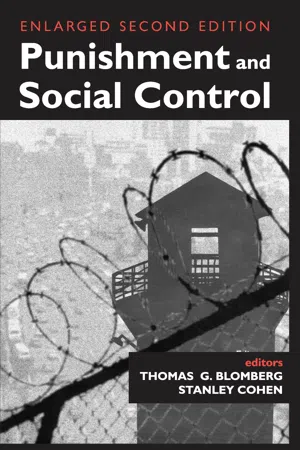
While crime, law, and punishment are subjects that have everyday meanings not very far from their academic representations, "social control" is one of those terms that appear in the sociological discourse without any corresponding everyday usage. This concept has a rather mixed lineage. "After September 11" has become a slogan that conveys all things to all people but carries some very specific implications on interrogation and civil liberties for the future of punishment and social control.The editors hold that the already pliable boundaries between ordinary and political crime will become more unstable; national and global considerations will come closer together; domestic crime control policies will be more influenced by interests of national security; measures to prevent and control international terrorism will cast their reach wider (to financial structures and ideological support); the movements of immigrants, refugees, and asylum seekers will be curtailed and criminalized; taken-for-granted human rights and civil liberties will be restricted. In the midst of these dramatic social changes, hardly anyone will notice the academic field of "punishment and social control" being drawn closer to political matters.Criminology is neither a "pure" academic discipline nor a profession that offers an applied body of knowledge to solve the crime problem. Its historical lineage has left an insistent tension between the drive to understand and the drive to be relevant. While the scope and orientation of this new second edition remain the same, in recognition of the continued growth and diversity of interest in punishment and social control, new chapters have been added and several original chapters have been updated and revised.
Information
I
Punishment and Social Control Theories and Trends
Introduction to Part I
Besides being wider in scope than traditional criminology or criminal justice studies, the subjects of “punishment” and “social control” are free of the constraints of immediate policy relevance. Very practical matters can be studied—how courts reach decisions, what goes on in prisons, how drug laws are enforced—but (1) through the lens of “theory,”(2) over a time span that moves in “trends,” and (3) always linked to “society.” These requirements are met exactly by the journal started in 1999, Punishment and Society (edited by David Garland until 2002, and now by Richard Sparks).
In Chapter 1, Sparks shows how the new sociology of punishment reflects the changes and uncertainties of a runaway world as well as the “primordial and unchanging” aspects of punishment. Garland, in Chapter 2, is also careful about identifying the “new.” He moves to a broader sociological canvas—the much-proclaimed era of postmodern society—only to find the residues of modernism in penal practice. Jonathan Simon and Malcolm Feeley (Chapter 3) summarize their 1992 paper and look back now on their unambiguous announcement that a “new penology” was emerging. They also discuss the lack of congruence between the internal professional-academic discourse and general public opinion.
Feminist theories and movements continue to make a major impact on law and the social sciences. In the control and punishment area, this work soon moved beyond showing the distorting results of leaving half the population out of the deviance-control equation. The next phase of work—in which Pat Carlen belongs—was to show how the social control of women points to more general issues. Her subject in Chapter 4 is the social control of women, but her object is the dichotomies that run through all strategies and meanings of social control: formal/informal, public/private, and exclusion/inclusion.
In a different way, Chapter 5 by David Matza and Patricia Morgan also moves from the specific to the general. The character and size of today’s correctional systems are impossible to explain without referring to the subject of drug control. We have numbly accepted these facts as normal: the massive government resources devoted to the “war against drugs;” its costs in human misery; its impact on the criminal justice system (accounting for some two-thirds of the entire prison population); and the brutal indices of failure. Is this all inevitable? The allusion to “prohibition” in Matza and Morgan’s subtitle is not just a historical reference to the failed American experiment with controlling alcohol use, but an invitation to think about the whole logic of all social control based on prohibition and “ban.”
1
State Punishment in Advanced Capitalist Countries
RICHARD SPARKS
Ariel Just as you left them; all prisoners, sir, ... They cannot budge till your release ... ... if you now beheld them, your affections Would become tender.
Prospero Dost thou think so, spirit?
Ariel I would sir, were I human.
—Shakespeare, The Tempest
Prologue
Punishment is among the most Janus-faced of our social practices. In some of its aspects punishment appears primordial and unchanging. It appeals to passions and intuitions in us that reach back into the remote past—the yearning for justice, the desire for retribution, the fear of chaos and disorder. In other respects punishment seems entirely contemporary. It is a quite technical matter, administered by professional people in settings (offices, hostels, day-centers, busy courthouses) that seem resolutely mundane, and whose activities are governed by volumes—frequently revised—of statutes, standing orders, circular instructions, rules for reporting, requisitioning and accounting, and so on that are essentially similar to those of almost any other administrative body. Lately, these institutions have in many cases increasingly adopted certain vocabularies and practices that are also current in other organizations both public and private. They begin to feature the language of auditing, operations research, and risk management. Certain of their functions and activities have in some countries, notably in the United States, the United Kingdom, and Australia, been delegated or “contracted out” to private sector businesses. In some places— most drastically and obviously in the case of the prison population in the United States, but not just in that respect and not just there—the scale of their operations would seem to have increased, sometimes abruptly so. But are these shifts primarily owing to a reawakening of the antique will to punish, or does their explanation rather lie mainly within the logics or “rationalities” of the contemporary institutions themselves?
I want here to begin to explore some of the implications of such paradoxes, and their consequences for the practitioners, recipients, and onlookers of contemporary penal processes. In exploring these we find ourselves facing some of the larger and more challenging questions that encircle our current systems and practices of punishment. What are the primary dimensions of those systems—their scope, scale, and ambitions? How have those ambitions extended or retrenched in recent times? Which of their features are common across Western societies and which variable or particular? How far, therefore, do they fall under willed political control? To the extent that they escape such control what are the sources of their intractability? How then do penal practices intersect with other spheres of the culture, politics, or economic structures of the social formations in which they arise? Is it fanciful to suggest that we can interpret some wider features of our contemporary social and political predicaments through the prism of the penal?
Yet much twentieth-century social science addressed problems of punishment in ways that tended to relegate such questions to the periphery of its concerns, or to treat them as altogether unanswerable—and hence in effect to suppress them. Conventionally much of criminology and penology only gestures at the political. Some decidedly thin and unilluminating conceptions of political “distortion” or “interference” (a skimpily drawn idea of “populism,” for example) are introduced when explanation fails. These notions are not themselves explanations—rather they are often little more than the groans of complaint that intellectuals make when penal politics appears to them to turn sour and irrational. Yet unless we make a serious attempt to understand how often and how powerfully this occurs, we are left tinkering at the edges of the topic. This essay will argue, conversely, that punishment is ineluctably both a political and a cultural matter. If we want to develop a tough-minded and critical approach to the ways of punishing that happen to be dominant now, we have to pose two distinct kinds of questions. The first is the kind that orthodox criminology and penology are quite good at. Does this work as it claims? Is it coherent? The second, which is more my topic here, is more demanding in terms of sociological and political insight. Where does this come from, and why now? Where does it lead, and do we wish to go there? What models of human motivation, state capacity and political community does it imply?
Two Faces of Punishment
I have spoken of punishment as Janus-faced in its capacity simultaneously to invoke antique forms of rage and desire and to spin novel techniques and managerial styles. Various contemporary penal innovations—electronic monitoring or “tagging” and random drug-testing perhaps par excellence—were undreamed of except as dystopian science fictions only twenty years ago. What currently fictive prospects, from fields such as genetic modification, will find practical realization in coming decades can only be guessed at (though one suspects, for reasons outlined below, that markets for such experimentation will readily be found). Yet such novelties neither displace nor in any practical sense contradict such equally contemporary phenomena as the persistence of capital punishment in the United States or the apparent vitality of prison populations across most of the advanced capitalist world. Sightings of this kind bear witness both to the scale and durability of the penal enterprise (an embedded feature in the governance of every modern nation-state of which we are aware) and to its mutability and inventiveness.
By the same token, punishment is both a severely practical matter and a thoroughly expressive one. It is used in attempts to intervene in and to control many forms of undesired behavior. In punishing we threaten, detain, deprive, immobilize, supervise, watch, guard, enjoin, entreat, cajole, and educate. Yet we also, in punishing, act out anger, voice pain, exclude, reject, tell stories, vindicate the authority of law, defend the state from external threat or internal subversion—real or imagined, invoke the divine, cherish, and occasionally forgive. It seems unwise now to suppose that one of these faces necessarily takes precedence over the other, or even that we can know with confidence how the tension between them will be resolved in any given place and time. Some theories of modernity have proposed teleologies that now seem suspect. For example, Emile Durkheim once suggested that restitution would at length supersede revenge. In the present it seems less tempting to view penal change as a one-way street. Instead we seem beset by variety, contradiction, and local circumstance. Even in the face of continual skeptical challenges, disproofs, and failures punishment cycles through its repertoire of golden oldies and one-hit wonders like an untended jukebox.
Let us now begin to impose some form on this confusing picture (albeit that coherence may be too much to seek). David Garland has argued that we are today living out the consequences of a “crisis of penal modernism.” Whereas some intellectuals and fonctionnaires have thought it possible to subject punishment entirely to the demands of rational administration, it has in part escaped such domestication. What results its a chronic tension. For Garland:
There are two contrasting visions at work in contemporary criminal justice— the passionate, morally-toned desire to punish and the administrative, rationalistic, normalizing concern to manage. These visions clash in many important respects, but both are deeply embedded within the [modern] social practice of punishing.
This seems a good starting point. It acknowledges what some critical perspectives too readily deny, namely that punishment really is practically involved, however failingly, in attempts to control crime and govern social existence. But at the same time Garland gives full recognition to the tendency of punishment to exceed the bounds of the practical and to become enmeshed in the flux of culture and politics, including sometimes in the most exorbitantly emotive forms of demagogic posturing. Such a position suggests the possibility at least of unpicking some important puzzles. Principal among these is that while in broad terms all advanced capitalist countries (including that outlier of penal severity the United States) have developed recognizably similar arrays of penal measures and techniques, they differ markedly in terms of penal range (a term that I explore further below) and in the centrality of questions of punishment to their electoral politics and cultural conflicts. If we begin to examine such questions empirically we may thereby start to clarify a central paradox, namely that whereas some features of the penal realm seem both rather durable and quite widely diffused across national boundaries, others are currently highly unstable and prone to sudden and often quite jagged changes of direction. Garland again anticipates this issue pointedly when he distinguishes between the “relatively fixed infrastructure of penal techniques and apparatuses” on the one hand and on the other those “mobile strategies that determine aims and priorities.”
In the remainder of this essay I will set out some of the main ways in which students of contemporary penal systems and institutions try to make sense of the continuities and changes in state punishment in the advanced capitalist countries. Throughout, the ambiguity implied in the image of the two faces of punishment is a besetting issue. If punishment is a matter both of government (in the sense of the regulation and ordering of activity) and of the passions (in the sense of the mobilization of anger or fear that may underpin demands for penal stringency) then its political importance is likely to consist in the interaction between these properties. I will attempt to clarify this conjunction, and its particular manifestations in the often febrile penal politics of the advanced capitalist societies today, in the following way;
Changes in the “Mode of Calculation”
Here we encounter debates about risk and prediction, and the uses of cost-benefit arithmetic to argue the utility of particular penal strategies.One important possibility is that the current prominence of incapacitation as a rationale for imprisonment in the advanced liberal societies (and for more intensive forms of noncustodial supervision) stems rather directly from the invention of new techniques for calculating the frequency and prevalence of offending. The implication is that the penal system is entirely a regulatory instrument—a kind of social sluice gate whose optimal rate of flow can in principle be rationally determined. This perspective has certainly had its influential intellectual proponents in recent years. A related question concerns how the state itself has shifted its posture with respect to punishment. Is it the case that the state has on the one hand divested itself of some of its former obligations toward its offending citizens (specifically the expectation that it will “treat,” “rehabilitate,” or “resettle”) and on the other undertaken an enhanced role in the management of the risks presented by that fraction of its subjects regarded as inherently and incorrigibly troublesome? If so, in what sense do these shifts flow from larger changes in the dominant economic and political principles of those societies?
Changes in the “Mode of Representation”
How and why, in some countries much more than in others, is punishment invoked in response to allegations of social crisis or emergency? Under what conditions does it take a central position in political rhetoric, and what kinds of rhetorics are these? Are there special moments (when certain kinds of anxiety or resentment are felt especially acutely, or the tolerance of the public is especially strained) when the time is ripe for politicians and demagogues to turn the penal question to their own advantage?
Although these two sets of issues look very distinct they are rarely encountered separately in empirical reality. Rather they are two aspects of a complex formation—a duality rather than a dualism. Thus, for example, even if a certain set of bloodless and dispassionate calculations in some sense underpins the increasing frequency and length of prison sentences for drug offenses in several Western countries in recent years, it is also true that in its public aspect that strategy comes vested in all the ancient, drastic, and dramatic language of warfare—the “war on drugs.” If we wish to understand precisely why the attempt to intervene in illegal drug markets so often, and increasingly, terminates in imprisonment rather than in other varieties of risk management or “harm reduction” then it would seem important to grasp what it means to be at war—wars are special times and they call for special measures.
In other words, even if risk calculations become predominant within the procedures and decisions of the agents of the penal apparatus, there is no morally neutral or politically anodyne position from which to begin. Disputes between antiqui and moderni have been fought and refought many times in the development of our ways of punishing but never decisively resolved. Today those battles take place predominantly on the terrain of risk. In looking more closely at the ambiguities implied in that term we edge closer again to the central perplexities of the contemporary penal realm. First, however, we need some sense of the scale of that domain and of the historical and international dimensions on which it has varied. Only then can we begin to reach toward explanation (what features of the contemporary scene seem to produce penal populations and regimes of these kinds?) or intervention (are we fated to go on in this way or can we plausibly imagine and create other futures for punishment?). Can we indeed envision a society in which punishment as we now know it ceased to be necessary to us and in which the prison, the probation hostel, and the electric chair could be consigned to the museum of antique curiosities alongside the ducking stool and the executioner’s axe?
A Note on Comparative Penology
It is commonly agreed in the social sciences that thinking comparatively about problems is a good thing. There is rather less agreement about how to go about it or indeed about precisely what comparison is for. (There are even fe...
Table of contents
- Cover Page
- Title Page
- Copyright Page
- Contents
- Introduction
- Part I Punishment And Social Control: Theories And Trends
- Part II Policing And Surveillance
- Part III Punishment: Measuring And Justifying
- Part IV The Expanding Prison: Life Inside, Policy, And Reform
- Contributors
- Index
Trusted by 375,005 students
Access to over 1.5 million titles for a fair monthly price.
Study more efficiently using our study tools.
Frequently asked questions
Yes, you can cancel anytime from the Subscription tab in your account settings on the Perlego website. Your subscription will stay active until the end of your current billing period. Learn how to cancel your subscription
No, books cannot be downloaded as external files, such as PDFs, for use outside of Perlego. However, you can download books within the Perlego app for offline reading on mobile or tablet. Learn how to download books offline
Perlego offers two plans: Essential and Complete
- Essential is ideal for learners and professionals who enjoy exploring a wide range of subjects. Access the Essential Library with 800,000+ trusted titles and best-sellers across business, personal growth, and the humanities. Includes unlimited reading time and Standard Read Aloud voice.
- Complete: Perfect for advanced learners and researchers needing full, unrestricted access. Unlock 1.5M+ books across hundreds of subjects, including academic and specialized titles. The Complete Plan also includes advanced features like Premium Read Aloud and Research Assistant.
We are an online textbook subscription service, where you can get access to an entire online library for less than the price of a single book per month. With over 1.5 million books across 990+ topics, we’ve got you covered! Learn about our mission
Look out for the read-aloud symbol on your next book to see if you can listen to it. The read-aloud tool reads text aloud for you, highlighting the text as it is being read. You can pause it, speed it up and slow it down. Learn more about Read Aloud
Yes! You can use the Perlego app on both iOS and Android devices to read anytime, anywhere — even offline. Perfect for commutes or when you’re on the go.
Please note we cannot support devices running on iOS 13 and Android 7 or earlier. Learn more about using the app
Please note we cannot support devices running on iOS 13 and Android 7 or earlier. Learn more about using the app
Yes, you can access Punishment and Social Control by Stanley Cohen in PDF and/or ePUB format, as well as other popular books in Social Sciences & Criminology. We have over 1.5 million books available in our catalogue for you to explore.