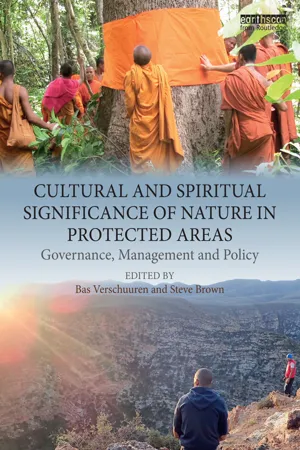
Cultural and spiritual bonds with 'nature' are among the strongest motivators for nature conservation; yet they are seldom taken into account in the governance and management of protected and conserved areas. The starting point of this book is that to be sustainable, effective, and equitable, approaches to the management and governance of these areas need to engage with people's deeply held cultural, spiritual, personal, and community values, alongside inspiring action to conserve biological, geological, and cultural diversity.
Since protected area management and governance have traditionally been based on scientific research, a combination of science and spirituality can engage and empower a variety of stakeholders from different cultural and religious backgrounds. As evidenced in this volume, stakeholders range from indigenous peoples and local communities to those following mainstream religions and those representing the wider public. The authors argue that the scope of protected area management and governance needs to be extended to acknowledge the rights, responsibilities, obligations, and aspirations of stakeholder groups and to recognise the cultural and spiritual significance that 'nature' holds for people.
The book also has direct practical applications. These follow the IUCN Best Practice Guidelines for protected and conserved area managers and present a wide range of case studies from around the world, including Africa, Asia, Australia, Europe, and the Americas.
1 CULTURAL AND SPIRITUAL SIGNIFICANCE OF NATURE IN PROTECTED AND CONSERVED AREAS
The ‘deeply seated bond’
Steve Brown and Bas Verschuuren
Introduction: The ‘deeply seated bond’
In a world where we tend to draw a sharp line between the sciences and the arts, between the subjective and the objective, Humboldt’s insight that we can only truly understand nature by using our imagination makes him a visionary. This connection between knowledge, art and poetry, between science and emotions—the ‘deeply-seated bond’, as Humboldt called it—is more important than ever before. Humboldt was driven by a sense of wonder for the natural world—a sense of wonder that might help us today realise that we only protect what we love.
(Wulf 2015: p. 336)
Alexander von Humboldt (1769–1859), according to his biographer Andrea Wulf, is known for his worldview. He “viewed nature as a global force” and “saw the earth as one great living organism where everything was connected”, a perspective captured in his phrase ‘the web of life’ (ibid.: pp. 2, 5). On 23 June 1802, when Humboldt climbed partway up Chimborazo, an inactive Andean volcano, his experience seeded the idea that vegetation and climate zones encircle the globe. He also recognised that when nature is perceived as a web, its vulnerability becomes obvious—evidenced at Lake Valencia, Venezuela, for example, where in 1800, Humboldt saw the devastating environmental impacts of colonial plantations. Humboldt’s extensive writings were marked by an intertwining of scientific knowledge and sensuous experience, most evident in Views of Nature (1808), “a book that combined lively prose and rich landscape descriptions with scientific observation”, and which was “unembarrassed by lyricism” (Wulf 2015: p. 132).
We commence this opening chapter by referencing the work of Alexander von Humboldt because he was one of the first Western scholars to propose ideas of interconnectedness and wholeness, a holistic interplay of phenomena inclusive of the interrelationships between people and their environments (their ‘natures’) and between nature and politics. Like Humboldt, we, the volume editors, continue to grapple with ideas of nature and culture, objective and subjective, and science and imagination, as well as having a concern for the interplays between matter and meaning (cf. Barad 2007) and human-nature relationships in today’s Anthropocene (cf. Lorimer 2015). Indeed, there is much in a Humboldtian perspective that remains significant and relevant today, but things have also changed considerably in the 200 years or so since Humboldt’s work. Population growth, global warming, and unprecedented urbanisation, for example, have had profound impacts on the ways in which protected and conserved landscapes are conceptualised, valued, and cared for.
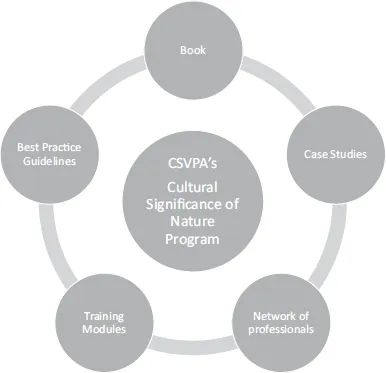
These concerns are key issues that background this introductory chapter. It is relevant to note, before continuing, that this edited volume is one component of five interrelated outputs (Figure 1.1). First and foremost, the volume extends on and is a scholarly supplement to the IUCN Best Practice Guidelines on the Cultural and Spiritual Significance of Nature in the Governance and Management of Protected Areas (Best Practice Guidelines; IUCN 2018). The edited volume does this through a series of related chapters informed by research-based thinking and experiences drawn from practice-based learning. Second, both the Best Practice Guidelines and this volume are supported by case study examples that are freely available on the website of the IUCN World Commission on Protected Area’s (WCPA) Specialist Group on the Cultural and Spiritual Values of Nature (CSVPA 2018). Two such case studies are summaries of material presented in this volume (Elkin et al., Ch. 14 and Mallarach et al., Ch. 13). Third, the contents of the volume will inform training modules—currently being developed—for protected area and conservation professionals to support implementation of the Best Practice Guidelines. Fourth, the materials outlined above are being developed through a growing network of professionals—a community of practitioners represented through Cultural and Spiritual Values of Protected Areas (CSVPA). Together, these five components work to present research and thinking on concepts of the ‘cultural and spiritual significance of nature’ (this edited volume), provide guidance to protected area managers (the IUCN Best Practice Guidelines), and illustrate real-world opportunities and challenges in governance and management (the web-based case examples).
FIGURE 1.1 The edited volume/book is one component of five outputs of CSVPA’s program on the cultural and spiritual significance of nature.
‘Cultural and spiritual values’: An IUCN construct
We begin by examining the origins and usage of the phrases ‘cultural and spiritual values’ and ‘cultural and spiritual significance of nature’. These phrases are a central part of the work of IUCN in recognising the role of, and engaging with, people in the governance and management of protected and conserved areas. As these phrases are used throughout this edited volume, it is incumbent upon us to background their use and explicitly recognise their disciplinary and intellectual specificity in the work of IUCN’s nature conservation program. We also recognise the limitations of these phrases when they are subject to interrogation by alternate disciplines (critical heritage studies, anthropology, religious studies, and political ecology, for example) and when subject to critiques of scholars (Byrne & Goodall 2013, for example) and by indigenous and local communities, as well as by many Western and non-Western protected area management authorities. Nevertheless, we argue that it can be more useful to accept terminology and constructs in full recognition of critiques and perceived shortcomings rather than necessarily starting over with new conceptual and descriptive expressions that have not been subject to the same or similar degree or rigour of interrogation and that lack a process of uptake in professional and policy circles.
For IUCN, the phrase ‘cultural and spiritual values’ has its antecedents in 1998 with the establishment of the Task Force on Non-Material Values of Protected Areas: a group formed within IUCN’s WCPA. In September 2003, the Task Force changed its name to Cultural and Spiritual Values of Protected Areas (CSVPA) and thus acknowledged that the distinction between material (or tangible) and intangible values can be problematic in many cultural contexts. This name change is linked to IUCN’s fifth World Parks Congress held in Durban, South Africa, and in particular with the adoption of Recommendation V.13. This Recommendation was drafted primarily by the Task Force, and it called for a wide range of actions by protected area agencies to “recognise and incorporate spiritual values of protected areas and culture-based approaches to conservation” (IUCN 2003a). While the Recommendation focused almost exclusively on the inclusion of indigenous and traditional peoples and their “sacred places, heritage, objects, and remains”, it also called more generally for protected area systems to “give balanced attention to the full spectrum of cultural and spiritual values” (ibid., our emphasis), and it applied to both tangible and intangible heritage.
The importance of the topic for IUCN was further affirmed—and examined—in a complementary, peer-reviewed edited volume titled The Full Value of Parks: From Economics to the Intangible (Harmon and Putney 2003), which was produced by the Task Force on CSVPA. In this book, Harmon and Putney (2003) define the primary challenge to conservationists in the 21st century to be concerned with finding ways of integrating all types of protected areas into the wider matrix of semi-natural, agricultural, and urban lands. His point here is to “extend the ethic of caring that many people feel about parks to the places where they earn a living”, and to do this, “conservation authorities need to grasp the depth and significance of the intangible, non-economic values associated with protected areas, for it is here that the ultimate motivation for caring will be found” (ibid.: p. 13).
The use of the phrase ‘cultural and spiritual values’ within IUCN can be considered an output of the ‘historical moment’ of the IUCN 2003 World Parks Congress. The phrase was constructed through a series of complex interactions between participants, the IUCN Secretariat, and the Task Force. The phrase ‘cultural and spiritual values’ as adopted in World Parks Congress Recommendation V.13—along with the re-naming of the Task Force (which became a more permanent IUCN ‘Specialist Group’ in 2009)—was created with specific reference to the values held by indigenous and traditional peoples and specifically those values relating to their sacred natural sites. As part of his account of the World Parks Congress, cultural geographer and anthropologist Stan Stevens (2014), who had devoted much of his career to supporting conservation by indigenous and local communities, writes:
Indigenous peoples and advocates of new protected area policies used the world stage of the World Parks Congress to condemn past practices and to challenge the IUCN to require that protected areas recognise and respect Indigenous peoples’ rights, responsibilities, and conservation contributions.
(p. 54)
Many of the participants of the World Parks Congress who were working on recognising the concept of ‘sacred natural sites’—and drafting the recommendations on cultural and spiritual values of protected areas—had taken part in a dedicated ceremony led by indigenous peoples during the Congress. This ceremony, along with the series of discussions and interactions during the Congress, led IUCN to call for the inclusion of the intangible and spiritual attributes and values associated with sacred places and worldviews or cosmologies.
Besides the more obvious importance of material culture attributes of indigenous heritage (objects, structures, places, modified landscapes, for example), the ‘cultural and spiritual’ were intended to incorporate both its material and immaterial dimensions. From an historical perspective, it is relevant to note that in October 2003, less than a month after the World Parks Congress, the UNESCO General Assembly, at its 32nd meeting in Paris, adopted the Convention for the Safeguarding of the Intangible Cultural Heritage (UNESCO 2003). In this Convention, “knowledge and practices concerning nature and the universe” is included as one of five domains in which intangible cultural heritage may be expressed (ibid.: Article 2–2(d)). The 2003 World Parks Congress and UNESCO Convention were precursors to IUCN broadening its definition of protected areas to include reference to ‘culture’ and explicitly recognise sacred natural sites within all of the IUCN protected area categories (Dudley 2008; Verschuuren et al. 2007). At the same time, the IUCN-UNESCO Best Practice Guidelines on Sacred Natural Sites (Wild and McLeod 2008) were published. However, a separate and cross-cutting protected area category for sacred natural sites and places of spiritual significance—a category many participants at the 2003 World Parks Congress participants had lobbied for—has not eventuated.
A second matter that appears to have shaped the phrase ‘cultural and spiritual values’ lies in the context of IUCN itself. IUCN has traditionally been an organisation driven by an evidence-based approach associated with Western science, where the disciplines of ecology, biology, zoology, geology, geomorphology, and hydrology have been privileged over disciplines within the social sciences and humanities (including religious studies, for example). At the 2003 World Parks Congress in Durban, the presence of more than 120 indigenous and local community representatives challenged IUCN’s privileged position on Western science by calling for indigenous traditional knowledge and management systems to be recognised alongside ‘pure’ nature conservation (Brosius 2004). This call was recognised in the outputs of the Congress and specifically The Durban Action Plan (IUCN 2003b: p. 23), The Durban Accord (IUCN 2003c: pp. 2–4), and Message to the Convention on Biological Diversity (IUCN 2003d: pp. 2–4). The role of mainstream faiths and the spiritual values of religiously important natural places had also been introduced into the Congress’ deliberations, but they were not included in its recommendations or other outputs. This situation reflected the contested discussions on the role of religion in conservation, which had brought to light historic discords between mainstream faiths and indigenous peoples.
Despite its initial meaning and usage, restricted mostly to indigenous peoples, the phrase ‘cultural and spiritual values’ has, since 2003, come to take on broader meanings and application—from application solely to the indigenous realm to also being applied to ‘local communities’ and ‘mainstream faiths’ (Mallarach 2008). This is also evidenced in various IUCN resolutions including, for example, one at the IUCN 2008 World Conservation Congress in Barcelona, Spain, which called for the ‘recognition of the diversity of concepts and values of nature’ (IUCN 2008). It contains the position that the “Cartesian distinction between material and spiritual does not exist in most cultures, where people consider that spiritual realities permeate everything” (ibid.). This perspective is discussed, contextualised, and expanded in many of the chapters in this volume (Mallarach et al., Ch. 13, for example). These chapters recognise that many cultures do not have a concept or word equivalent to the Western construct of ‘nature’ (Flexner et al., Ch. 17, this volume), and many do not recognise distinctions between material and spiritual realms in their worldviews (Coggins et l., Ch. 17; Mallarach et al., Ch. 2; Medard et al. Ch. 16; and Studley and Horsley, Ch. 5, this volume).
The nature of values: A cultural heritage perspective
From cultural heritage management and heritage studies perspectives, cultural value is typically used as an overarching expression for a range of different values—aesthetic, historic, scientific, social, or spiritual value as applied in the Australia ICOMOS Burra Charter, for example (Australia ICOMOS 2013; for discussions on different cultural value sets, see: De la Torre 2002; Fredheim and Khalaf 2016; Jones 2017). That is, ‘spiritual value’ is recognised as a part of the broader ‘cultural value’ of a place, area, or property. Consequently, the IUCN phrase ‘cultural and spiritual value’ appears to be at odds with the ways in which cultural heritage practitioners conceptualise the relationships between different value sets. This is because IUCN presents ‘cultural and spiritual values’ as if they are of the same order, and consequently, ‘spiritua...
Table of contents
Cover
Half Title
Title Page
Copyright Page
Table of Contents
Preface
List of acronyms
Notes on editors and contributors
1 Cultural and spiritual significance of nature in protected and conserved areas: The ‘deeply seated bond’
Part I Concepts
Part II Policy and practice
Part III Case studies
Index
Trusted by 375,005 students
Access to over 1.5 million titles for a fair monthly price.
Study more efficiently using our study tools.
Frequently asked questions
Yes, you can cancel anytime from the Subscription tab in your account settings on the Perlego website. Your subscription will stay active until the end of your current billing period. Learn how to cancel your subscription
No, books cannot be downloaded as external files, such as PDFs, for use outside of Perlego. However, you can download books within the Perlego app for offline reading on mobile or tablet. Learn how to download books offline
Perlego offers two plans: Essential and Complete
Essential is ideal for learners and professionals who enjoy exploring a wide range of subjects. Access the Essential Library with 800,000+ trusted titles and best-sellers across business, personal growth, and the humanities. Includes unlimited reading time and Standard Read Aloud voice.
Complete: Perfect for advanced learners and researchers needing full, unrestricted access. Unlock 1.5M+ books across hundreds of subjects, including academic and specialized titles. The Complete Plan also includes advanced features like Premium Read Aloud and Research Assistant.
Both plans are available with monthly, semester, or annual billing cycles.
We are an online textbook subscription service, where you can get access to an entire online library for less than the price of a single book per month. With over 1.5 million books across 990+ topics, we’ve got you covered! Learn about our mission
Look out for the read-aloud symbol on your next book to see if you can listen to it. The read-aloud tool reads text aloud for you, highlighting the text as it is being read. You can pause it, speed it up and slow it down. Learn more about Read Aloud
Yes! You can use the Perlego app on both iOS and Android devices to read anytime, anywhere — even offline. Perfect for commutes or when you’re on the go. Please note we cannot support devices running on iOS 13 and Android 7 or earlier. Learn more about using the app
Yes, you can access Cultural and Spiritual Significance of Nature in Protected Areas by Bas Verschuuren, Steve Brown, Bas Verschuuren,Steve Brown in PDF and/or ePUB format, as well as other popular books in Social Sciences & Ecology. We have over 1.5 million books available in our catalogue for you to explore.