- 437 pages
- English
- ePUB (mobile friendly)
- Available on iOS & Android
eBook - ePub
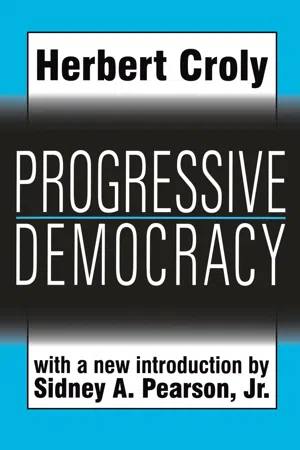
Progressive Democracy
About this book
Croly explains the requirements for a genuinely popular system of representative government providing progressive liberalism with both a philosophical critique of the founding fathers' political outlook, and a political strategy for replacing it with something more in keeping with a new epoch. Although it was written in 1914, the intellectual structure remains largely intact within the liberal-progressive tradition.
Information
CHAPTER I
The People and the Law
As in the case of every great political edifice, the materials composing the American system are derived from many different sources, and are characterized by unequal values, both as to endurance and as to latent possibilities. The appearance of definiteness and finality which it derives from its embodiment in specific constitutional documents and other authoritative words is to a large extent illusory. Its real origin and meaning are very much more doubtful and complex than these words intimate. Historians are no more agreed as to the former than political theorists are to the latter. An inquirer who is seeking some light as to its meaning by way of an examination of its origin, is obliged in both cases to push into disputed territory; but if he can obtain any foothold in one part of the field, he is much more likely to hold his own in another part.
Both historically and theoretically the American system is based upon an affirmation of popular political authority. When the colonists proclaimed their independence of the British Crown and Parliament, the repudiated sovereign had to be replaced with a capable substitute; and this substitute could consist under the circumstances only of the supposed makers of the Revolution — the American people as a whole. After the Declaration of Independence, the people, whoever they were and however their power was to be organized and expressed, became the only source of righteous political authority in the emancipated nation.
Not unnaturally the new sovereign encountered many difficulties in finding proper instruments for the effective and beneficial exercise of his authority. He had assumed the throne during the distractions and commotions of a Revolutionary War. In organizing his government he had either hastily to improvise the immediately necessary mechanism, or else seize already existing instruments, however poorly they served his needs. He could not even affirm the reality of his own sovereign power. Its effective exercise was divided among thirteen separate governments, so independent of one another that thirteen partial sovereigns instead of one whole sovereign had been created. In almost all of these states the new sovereigns were delegating instead of exercising their own authority. The executive power having fallen into disrepute because of its association with the English Crown, the only effective instrument of government consisted of a representative assembly, which assumed control of practically the entire machinery of the state. Popular sovereignty became in its actual exercise the granting of technical omnipotence to a group of petty parliaments.
Such a system was as ill suited to the imperative political and social needs of the American people as it was to their political traditions and theories. They had been accustomed to a government separated into specific powers, no one of which had been entirely trusted. Their representative assemblies had naturally been trusted more than had an alien executive; but even these assemblies had neither won nor enjoyed a good chance of winning their whole confidence. The evidence and technical source of political authority had consisted in royal charters, which defined and secured the rights of citizens and organized the several branches of the government. Political bodies which had become habituated to the assurance, the precision and the guidance of written and comparatively permanent instruments of government, began to be uneasy as soon as its future welfare was placed largely at the mercy of a legislative assembly. To be sure, state constitutions had usually superseded the old charters, but these constitutions were made by the legislatures and could be unmade and remade by them. What the people naturally craved was a type of state constitution which should affirm the reality of popular sovereignty, limit the power of the separate departments of government, and give both to the individual citizen and to society effective guarantees of stability and security.
Even before independence had been established, this demand was successfully asserted in two of the states of New England. Towards the end of the war, Massachusetts and New Hampshire having been emancipated for some years from the actual presence of the enemy on their soil, their citizens began to consider seriously the problem of permanent political organization. As in other states, proposals were made which looked in the direction of intrusting the framing of the constitutions to the existing assemblies or some similarly elected body; but the people of these states rejected the plan of bestowing constituent powers on their legislatures. The towns stubbornly insisted that, considering the real source of righteous political authority, the new law would be no law unless it were framed by a convention expressly elected for that purpose and unless the proposed constitution were expressly approved by a popular vote. They carried their point. Their new constitutions conformed to the conditions imposed by popular opinion, and contained the assertion that the “people alone have an incontestable, inalienable and indefeasible right to institute government, and to reform, alter or totally change the same when their protection, safety, prosperity and happiness require it.” The example proved to be contagious. The great majority of the states followed in the footsteps of these democratic pioneers, whose innovation became decisive in the development of American constitutional practice.
The importance of this assertion by the people of New England of the reality of ultimate popular political responsibility can scarcely be overestimated. Thereafter democracy obtained a new meaning and a new dignity. Here on American soil, for the first time since the birth of representative institutions, and among a people who had been accustomed to representative government, the custom of merely consulting public opinion about political essentials was converted into direct popular control. Law was being made, not only by trusted popular agents for the benefit of the people and with their consent, but in one essential respect by the people themselves. They were to elect representatives to initiate the work, but the representatives had to be expressly chosen for the purpose and their work had to be expressly approved. The most radical and convinced democrat could not ask for any more definite and unqualified recognition of the right and ability of the people to determine their own political organization, behavior and destiny. Neither is the meaning and importance of this assertion of democracy diminished by the fact that the electorate which insisted on having these constitutions authorized by direct popular action was not, according to modern standards, a really or sufficiently democratic electorate. Enough that it spoke in the name of the people and that its self-assertion was considered to be a veritable act of popular sovereign authority.
Emphatic, however, as was this assertion of its direct control over its own political institutions by the primitive American democracy, its willingness to restrict its own effective political power was no less definite and insistent. It did not show the slightest disposition to translate this supposedly effective popular control over the institutes of government into active popular control over governmental behavior. The democracy abdicated the continuing active exercise of effective power in the very act of affirming the reality of its own ultimate legal authority. “The great object of terror and suspicion,” says Mr. Henry Adams, “to the people of the thirteen provinces was power; not merely power in the hands of a president or a prince, of one assembly or several, of many citizens or few, but power in the abstract, wherever it existed and under whatever form it was known.” This dread of political power was, of course, derived from the spectacle which its unrestrained exercise had presented practically throughout the entire history of mankind. The colonists identified political power with the military power by virtue of which it had made its commands effective. They attached to the active exercise of such power by a democracy the same liability to organized violence which had been exhibited by monarchies and aristocracies. They did not and could not be expected to understand that the growth of democracy would emasculate much of the brute force which the older governments had behind them. To leave political power of any kind legally unchained was from their point of view merely to invite its abuse. The very assertion of express popular control over the fundamental law was associated with the renunciation of its effective exercise in other respects.
This self-denying ordinance of the primitive American democracy was as significant and as unprecedented as was its assertion of its own ultimate popular political responsibility. Modern democrats tend to attribute it to the machinations of the educated propertied classes, who were afraid of their new sovereign and proposed to tie his hands; but that is not the whole story. As Mr. Henry Adams says, all classes of colonists shared this fear of discretionary political power; and associated with this fear was a new ideal, which men were for the first time attempting to make paramount in political organization. Popular political power, it was believed, must be virtuously exercised. As Montesquieu had said, the principle of democracy was virtue. Monarchies and aristocracies need not be destroyed by the arbitrary and violent exercise of the sovereign authority, because these forms of political organization rested on the forcible domination of the many by the few. But an unjust and despotic democracy was a suicidal contradiction. Such a democracy would soon be divided against itself into hostile factions. The conquering faction would necessarily rest its authority on the effective exercise of military force. It was, consequently, essential to a democracy that its organization should expressly provide for the subordination of political power in all its forms to some code of political righteousness.
These early American democratic law-givers had no misgivings as to their own ability to draw up such a code. Both the political experience of their own forbears and a radical analysis of the origin and meaning of society demonstrated the existence of certain individual rights as incontestable, indefeasible and inalienable as the right of the people to institute and alter their form of government. A monarchy which refrained from violating these rights would be contributing to the welfare of its citizens; but a democracy must recognize them or perish. A democracy differs from other forms of government in that it does not and cannot distinguish the welfare of the state from the welfare of its individual citizens. Thus the definition and fortification of a bill of civil rights constituted the core of any stable and fruitful system of popular government. The sacred words must be deposited in the ark of the covenant, there to remain inviolate as long as the commonwealth shall endure.
As these bills of rights were formulated in the state constitutions, they combined, however, two very different strains of political tradition and theory. The idea of the paramount authority in nature and reason of certain inalienable individual rights, and of the ability of statesmen to define in advance the essential rules of righteous political behavior was, of course, derived from the prevailing political philosophy. All government had originated in a contract, whereby certain indefeasible liberties had been guaranteed to individuals, and any violation of these liberties emancipated citizens from their allegiance and justified revolution. This general theory had been very serviceable to a people who were practical and successful revolutionists, and who had rebelled against the authority of the British Parliament expressly on the ground, not merely that their traditional rights as British subjects had been violated, but also those fundamental rights deducible from the very nature of just political association. When, however, they came to phrase these indefeasible rights, they were found to be identical with the rights which Englishmen enjoyed under the Common Law and as the result of their rebellions against the abuse of the royal prerogative. The bills of rights did no more in appearance than to forbid the active government from interfering with American citizens in certain specified ways, which need not be enumerated here, but which corresponded to the traditional liberties of an English citizen.
In their new legal and political framework, however, the traditional English liberties came to possess a wholly new emphasis. The constitutions in which they were embodied were considered to be a legal version of the social contract itself; and they acquired from this association a peculiarly sacred and exalted character. In the old country they had been cherished as a priceless political heritage, but they had not for that reason been placed beyond modification or even abrogation by the ordinary lawmaking authority. In our American states they were transformed into a Higher Law, which derived its authority directly from the people, and over which the active government had no authority. Of course the popular sovereign, which possessed the equally indefeasible right to institute and alter governments, had the legal power to abrogate these individual rights; but at this point the inalienable right of the people to institute governments began to conflict with the equally inalienable liberties of the individual. The people had a right to institute an unrighteous government, but the injured individuals had an equal right to protest and rebel against it. The violation of these individual rights broke the contract upon which society was based and justified revolution. The Higher Law, consequently, was not dependent on the popular will, no matter how deliberately and lawfully expressed, for its sanction. Its ultimate justification was its inherent righteousness, and its effective authority could always be protected by a threatened recourse to the revolutionary alternative.
If these early American law-givers had been sensitive to theoretical difficulties, they might have been troubled by the contradictions indicated in the preceding paragraph. The indefeasible popular political rights were contradicted by the equally indefeasible popular civil rights. The reasons which made it necessary to subordinate the legislature to a Higher Law made it equally desirable to subordinate the people, as constitution makers, to a Higher Law — which was done so far as possible by placing the Higher Law under the protection of the permanent possibility of revolution. Thus the rational state was based ultimately on an appeal to violence. The arbitrary political or military power which they dreaded and which had been ostentatiously kicked out of the front door, was surreptitiously brought back again by the rear entrance. Neither were these difficulties merely dialectical. The ground was prepared for the violent assertion, which subsequently took place, of individual and local liberties against what was believed to be an unjust exercise of popular political authority. The real problem of rationalizing the exercise of popular political power was evaded rather than faced by the early American law-givers. The way to rationalize political power is not to confine its exercise within the limits defined by certain rules, but frankly to accept the danger of violence and reorganize the state so that popular reasonableness will be developed from within rather than imposed from without.
Nevertheless the early American law-givers, by expressly associating the organization of popular political authority with what was believed to be the reign of justice, made a unique contribution to the democratic government. They headed democracy towards Zion. Somehow and to some extent democracy, in case it is to survive, must combine the two ends which seemed so essential to the framers of the constitution of Massachusetts. Popular political authority must be made effective and it must be made righteous. The degree of success which the American democracy may obtain will depend on its ability to make popular political authority practically effective without any ultimate sacrifice of righteousness, and sufficiently righteous without any sacrifice of ultimate effectiveness. In this sense the American democracy must always derive its vitality from the ideals of the fathers of the Republic — undemocratic in spirit though many of them were.
Our doubts concern, not the validity of the ideal, which did so much to mould constitutions such as that of Massachusetts, but the means which were taken to legalize and organize it. By attempting to define a code of righteous political behavior, which could be enforced as law and which should be morally and legally binding on the people, the constitution makers were by way of depriving the sovereign of his own ultimate and necessary discretionary power. They did not merely associate popular political authority with the ideal law, but they tended to subordinate popular authority to an actual law. It was the Law which bound the popular will under the threat of revolutionary violence, rather than the popular will which was freely to accept and patiently to realize the righteous ideal. The human will in its collective aspect was made subservient to the mechanism of a legal system.
This source of weakness introduced into the foundations of the state had its consequences upon the organization of the government. If the people are to be divided against themselves in order that righteousness may rule, still more must the government be divided against itself. It must be separated into departments each one of which must act independently of the others. “In the government of this commonwealth the legislative department shall never exercise the executive and judicial powers or either of them, the executive shall never exercise the legislative and judicial powers or either of them; the judicial shall never exercise the legislative or executive powers or either of them; to the end that it may be a government of laws and not of men.” The government was prevented from doing harm, but in order that it might not do harm it was deliberately and effectively weakened. The people were protected from the government; but quite as much was the government protected from the people. In dividing the government against itself by such high and rigid barriers, an equally substantial barrier was raised against the exercise by the people of any easy and sufficient control over their government. It was only a very strong and persistent popular majority which could make its will prevail, and if the rule of a majority was discouraged, the rule of a minority was equally encouraged. But the rulers, whether representing a majority or a minority, could not and were not supposed to accomplish much. It was an organization of obstacles and precautions — based at bottom on a profound suspicion of human nature.
Thus was instituted a system of representation by Law. Inasmuch as the ultimate popular political power was trustworthy only in case it were exercised, not merely through the medium of regular forms, but under rigid and effective limitations, the trustworthy agents of that power were not representative men exercising discretionary power, but principles of right which subordinated all officials to definite and binding restrictions. When the sovereign itself has implicitly surrendered its discretion to the Law, the personal agents of the sovereign can scarcely expect to retain theirs. The domination of the Law came to mean in practice a system in which the discretionary discriminating purposive action of the human will in politics, whether collective or individual, was suspect and should be reduced to the lowest practicable terms. The active government was divided, weakened, confined and deprived of integrity and effective responsibility, in order that a preëstablished and authoritative Law might be exalted, confirmed and placed beyond the reach of danger.
While the essential legal and moral aspects of the traditional system were revealed by the constitutions of Massachusetts and New Hampshire, the system only reached its full development in the Federal Constitution and government. The adoption of that Constitution was the first affirmation of the popular political authority of the whole American people — of popular authority in its full national integrity. But just because it sought to organize a complete sovereign power and tended to identify popular with national sovereignty, it was the object of suspicion by the friends of local interests and rights as well as of individual interests and rights. Thus the government established by the new instrument became essentially and unequivocally one of limited powers. In the case of the state constitutions, the law-making power could and did claim to fall heir to a kind of residuary sovereignty, which gave to it large discretionary authority within the limits imposed by the state constitutions — although as soon as this claim began to be admitted it was emasculated in practice by a strengthening of the executive and judicial vetoes. But in the case of Congress, there was far less ground for ambiguity. Nothing but specific powers was granted to the new government; and all powers not granted were reserved to the states or to the people. There were three parties to this constitutional arrangement instead of two. The scruples of the states had to be satisfied as well as the needs of the general government and the demands of the people. The necessity of arranging a balance between popular authority, national authority and state authority strengthened the formal legal element in the system. The control which the people might exercise over the Constitution was diminished and the intricacy of the constitutional mechanism increased, in order that the states might be independent of the general government and the general government independent of the states. The restrictions imposed upon the exercise of popular authority had to be tightened, in order that that popular authority might not be used inimically to the desirable balance of the whole system.
Thus the fundamental Law to which the American people intrusted their ultimate sovereign power unfortunately-tended to become more than usually inaccessible. The positively democratic element in the organization of the states consisted in the reality of the popular control over the enactment and amendment of the state constitutions. Even though the actual machinery of amendment was unnecessarily slow and difficult, as it undoubtedly was in...
Table of contents
- Cover Page
- Title Page
- Copyright Page
- Table of Contents
- Introduction to the Transaction Edition
- Introduction
- 1 The People and the Law
- 2 The Pioneer Democracy and the Constitution
- 3 Aggressive and Triumphant Democracy
- 4 The Old Economic Nationalism
- 5 The New Economic Nationalism
- 6 The Law and its Benevolent Administration
- 7 The Law and Its Reaction
- 8 The Law and the Faith
- 9 The Individual and Society
- 10 The Ideal and the Program
- 11 Popular Sovereignty
- 12 The Advent of Direct Government
- 13 Direct versus Representative Government
- 14 Visions of a New State
- 15 Majority Rule and Public Opinion
- 16 Executive versus Partisan Responsibility
- 17 The Administration as an Agent of Democracy
- 18 Industrial Democracy
- 19 Social Education
- Index
Trusted by 375,005 students
Access to over 1.5 million titles for a fair monthly price.
Study more efficiently using our study tools.
Frequently asked questions
Yes, you can cancel anytime from the Subscription tab in your account settings on the Perlego website. Your subscription will stay active until the end of your current billing period. Learn how to cancel your subscription
No, books cannot be downloaded as external files, such as PDFs, for use outside of Perlego. However, you can download books within the Perlego app for offline reading on mobile or tablet. Learn how to download books offline
Perlego offers two plans: Essential and Complete
- Essential is ideal for learners and professionals who enjoy exploring a wide range of subjects. Access the Essential Library with 800,000+ trusted titles and best-sellers across business, personal growth, and the humanities. Includes unlimited reading time and Standard Read Aloud voice.
- Complete: Perfect for advanced learners and researchers needing full, unrestricted access. Unlock 1.5M+ books across hundreds of subjects, including academic and specialized titles. The Complete Plan also includes advanced features like Premium Read Aloud and Research Assistant.
We are an online textbook subscription service, where you can get access to an entire online library for less than the price of a single book per month. With over 1.5 million books across 990+ topics, we’ve got you covered! Learn about our mission
Look out for the read-aloud symbol on your next book to see if you can listen to it. The read-aloud tool reads text aloud for you, highlighting the text as it is being read. You can pause it, speed it up and slow it down. Learn more about Read Aloud
Yes! You can use the Perlego app on both iOS and Android devices to read anytime, anywhere — even offline. Perfect for commutes or when you’re on the go.
Please note we cannot support devices running on iOS 13 and Android 7 or earlier. Learn more about using the app
Please note we cannot support devices running on iOS 13 and Android 7 or earlier. Learn more about using the app
Yes, you can access Progressive Democracy by Herbert Croly in PDF and/or ePUB format, as well as other popular books in Politics & International Relations & Constitutions. We have over 1.5 million books available in our catalogue for you to explore.