
- 188 pages
- English
- ePUB (mobile friendly)
- Available on iOS & Android
eBook - ePub
Continuous Quantum Measurements and Path Integrals
About this book
Advances in technology are taking the accuracy of macroscopic as well as microscopic measurements close to the quantum limit, for example, in the attempts to detect gravitational waves. Interest in continuous quantum measurements has therefore grown considerably in recent years. Continuous Quantum Measurements and Path Integrals examines these measurements using Feynman path integrals. The path integral theory is developed to provide formulae for concrete physical effects. The main conclusion drawn from the theory is that an uncertainty principle exists for processes, in addition to the familiar one for states. This implies that a continuous measurement has an optimal accuracy-a balance between inefficient error and large quantum fluctuations (quantum noise). A well-known expert in the field, the author concentrates on the physical and conceptual side of the subject rather than the mathematical.
Tools to learn more effectively

Saving Books

Keyword Search

Annotating Text

Listen to it instead
Information
1
Introduction to Continuous Quantum Measurements
The main topic of this book is the path-integral theory of continuous quantum measurements. In this introductory chapter we shall expose the principal ideas of this theory on a qualitative level with a minimum of mathematical apparatus.
All physical systems are in fact quantum, but in certain circumstances some of them may approximately be described as classical. This depends on the error with which the action of the system is known (section 1.1). If the system should be considered as a quantum one, then a specific quantum description is necessary and specific quantum features in the behaviour of the system arise. The main distinction in the description of a quantum system is the concept of a probability amplitude (section 1.2), and the principal feature of the quantum system is an uncertainty principle.
A detailed analysis of the concept of an amplitude in the situation when the system undergoes some measurement allows one to obtain a theory of quantum measurement even if the measurement is continuous (prolonged in time). In the latter case, the different paths the system moves along should be considered as alternatives for the motion and characterized by amplitudes (section 1.3).
The uncertainty principle in its well known form ΔqΔp≳ℏ is appropriate to instantaneous measurements. For continuous measurements a modified uncertainty principle can be formulated in terms of the action (section 1.4). According to this principle (in its simplest but weak form) a continuous measurement produces information such that the uncertainty in the action is not less than the quantum of action δS≳ℏ.
The reader may skip Chapters 2 and 3, and go directly from this chapter to Chapter 4 without any detriment to understanding of the main points of the theory. Chapter 2 is necessary only for those who have special interest in the link between von Neumann’s theory of instantaneous quantum measurements and the path-integral theory of continuous quantum measurements (though the latter can and will be developed quite independently). Chapter 3 will be useful for a deeper study of the mathematical formalism of path integrals than the level used in Chapter 4.
1.1 QUANTUM AND CLASSICAL SYSTEMS
Quantum mechanics appeared as a theory of microscopic bodies when it had been proved that the motion of microscopic systems cannot be described in the framework of classical physics. However, quantum effects may be important even for macroscopic bodies. The main criterion is in fact inaccuracy in the value of the action S typical for description of the motion in the framework of the given approximation.
The action S is a functional characterizing the dynamics of a system:
Here L is the Lagrangian of the system, which in the simple case of a one-dimensional mechanical system takes the form
and
is a path (a trajectory) of the system. It is important that the action functional S[q] may be evaluated not only for the actual path the classical system takes but also for an arbitrary path in the configuration space of the system. In fact, nonclassical paths play a key role in quantum mechanics and specifically in the theory of continuous measurements.
To judge whether the system is quantum or not it is necessary to compare its action with the Planck constant, or the quantum of action, ℏ = 1.055 × 10⁻²⁷ erg s.
Let us make this more precise. Any system is in fact a quantum one. However, in an approximate description the quantum features of a certain system may turn out to be negligible. Then this system in this approximation may be considered to be a classical one.
The action of the system provides a quantitative criterion for this. If the errors, characteristic of the given approximation, lead to an indeterminacy ΔS in the action S[q] large compared with the quantum of action, ΔS ≫ ℏ, then the system may be considered to be classical. If the action S[q] is given with a rather small error, ΔS≲ℏ, then the system needs to be treated as a quantum one.
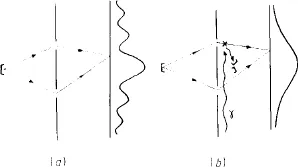
Figure 1.1: The two-slit experiment leads to an interference pattern if it is not known which slit the particle has passed through (a), but it gives no interference if an additional observation shows which slit was used (b).
1.2 AMPLITUDES AND ALTERNATIVES
From a certain point of view the main object in quantum mechanics is a probability amplitude because it expresses the principal difference between quantum and cla...
Table of contents
- Cover
- Half Title
- Title Page
- Copyright Page
- Dedication
- Table of Contents
- Preface
- Ch.1 Introduction to Continuous Quantum Measurements
- Ch.2 Instantaneous and Sequential Measurements
- Ch.3 Technique of Path Integrals
- Ch.4 Continuous Measurement and Evolution of the Measured System
- Ch.5 Continuous Measurements of Oscillators
- Ch.6 Continuous Quantum Nondemolition Measurements
- Ch.7 Measurement of an Electromagnetic Field
- Ch.8 Time in Quantum Cosmology
- Ch.9 The Action Uncertainty Principle
- Ch.10 Group-Theoretical Structure of Quantum Continuous Measurements
- Ch.11 Paths and Measurements: Further Development
- References
- Index
Frequently asked questions
Yes, you can cancel anytime from the Subscription tab in your account settings on the Perlego website. Your subscription will stay active until the end of your current billing period. Learn how to cancel your subscription
No, books cannot be downloaded as external files, such as PDFs, for use outside of Perlego. However, you can download books within the Perlego app for offline reading on mobile or tablet. Learn how to download books offline
Perlego offers two plans: Essential and Complete
- Essential is ideal for learners and professionals who enjoy exploring a wide range of subjects. Access the Essential Library with 800,000+ trusted titles and best-sellers across business, personal growth, and the humanities. Includes unlimited reading time and Standard Read Aloud voice.
- Complete: Perfect for advanced learners and researchers needing full, unrestricted access. Unlock 1.4M+ books across hundreds of subjects, including academic and specialized titles. The Complete Plan also includes advanced features like Premium Read Aloud and Research Assistant.
We are an online textbook subscription service, where you can get access to an entire online library for less than the price of a single book per month. With over 1 million books across 990+ topics, we’ve got you covered! Learn about our mission
Look out for the read-aloud symbol on your next book to see if you can listen to it. The read-aloud tool reads text aloud for you, highlighting the text as it is being read. You can pause it, speed it up and slow it down. Learn more about Read Aloud
Yes! You can use the Perlego app on both iOS and Android devices to read anytime, anywhere — even offline. Perfect for commutes or when you’re on the go.
Please note we cannot support devices running on iOS 13 and Android 7 or earlier. Learn more about using the app
Please note we cannot support devices running on iOS 13 and Android 7 or earlier. Learn more about using the app
Yes, you can access Continuous Quantum Measurements and Path Integrals by M.B Mensky in PDF and/or ePUB format, as well as other popular books in Physical Sciences & Physics. We have over one million books available in our catalogue for you to explore.