- 265 pages
- English
- ePUB (mobile friendly)
- Available on iOS & Android
eBook - ePub
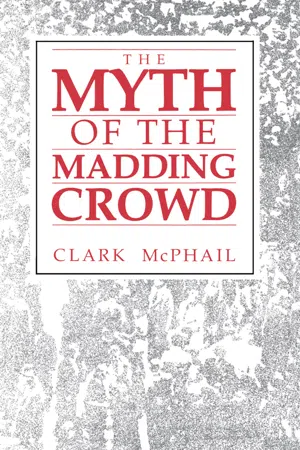
The Myth of the Madding Crowd
About this book
Crowd behavior is one of the most colorful but least understood forms of human social behavior. This volume is a major contribution to the field of collective behavior, with implications for social movement analysis.McPhail's critical assessment of the major theories of crowd behavior establishes that, whatever their particular limitations and strengths, all share a general and serious flaw: their explanations were developed without prior examination of the behaviors to be explained. Drawing on a wide range of empirical studies that include his own careful field work, the author offers a new characterization of temporary gatherings. He presents a life cycle of gatherings and a taxonomy of forms of collective behavior within gatherings, as well as combinations of these forms and gatherings into larger events, campaigns and waves. McPhail also develops a new explanation for various ways in which purposive actors construct collective actions.
Information
1
Creating the Myth: LeBon; Park; Blumer
Introduction
The idea of the madding crowd was born of social, economic, and political challenges to the status quo in Europe during the eighteenth and nineteenth centuries. These challenges were accelerated in France during the middle third of the nineteenth century and gave rise to the development of a school of “collective psychology,” which offered an explanation for the madding crowd, the transformation of individual participants, and their extraordinary behavior that was believed to result from that transformation. The principal though not necessarily the first architect of those ideas was Gustave LeBon. His views of the crowd were transported to the United States by students pursuing advanced degrees in Europe and then returning to the professoriat at American universities. Foremost among these was Robert E. Park, who perpetuated the idea of the madding crowd at the University of Chicago for more than two decades. One of his students, Herbert Blumer, systematically elaborated those ideas and extended their longevity well beyond mid-century.
In this chapter I trace the development of a transformation explanation of collective behavior from LeBon’s theory of crowd mind, through Park’s dissertation on rational critical discussion in publics vs. psychic reciprocity in crowds, to Blumer’s distinction between symbolic interaction in routine social life and circular reaction in collective behavior. The LeBon-Park-Blumer hypothesis holds that crowds transform individuals, diminishing or eliminating their ability to control their behavior rationally. I close with a review of the accumulated logical arguments and empirical evidence against the transformation hypothesis, and note some theoretical and methodological paradoxes in Blumer’s adoption of Park’s rather than George Herbert Mead’s explanation for human behavior in problematic situation.
Gustave LeBon (1841-1931)
European Origins of Collective Psychology
The social, economic, and political turmoil of urban Europe throughout the last half of the nineteenth century made crowds a formidable problem for the stability of the political status quo, not to mention social order in public places. Various explanations were advanced (Moscovici 1985). One held that crowd members were mad or insane, akin to folklore explanations for the dancing frenzies of the middle ages (cf. Rosen 1968). Anyone engaging in extraordinary collective activity was thought demon possessed or mentally deranged.
A second explanation was that status quo-challenging crowds were composed of the riffraff of society, “an accumulation of disintegrated social elements, human waste swept out of society and hence hostile to it” (Moscovici 1985:71). Thus, crowds were viewed as by-products, not the producers of social change.
A third explanation argued that crowd members were criminals. Lombroso believed some individuals were born with criminal tendencies, that crowds violating person or property were composed or led by criminals. Lombroso and colleagues developed the Italian school of “collective psychology.”1 Scipio Sighele’s book The Criminal Crowd (1894) set forth many of the arguments later stated in Gustav LeBon’s (1895) The Psychology of the Crowd.2
It may have been LeBons “stroke of genius” (Moscovici 1985:74) to dismiss all three of these explanations for the crowd. He argued, to the contrary, that crowds were composed of normal folks who, by virtue of their participation, were transformed by some unique, collective psychological processes in the crowd. Before reviewing LeBons analysis, I briefly outline a sequence of events that may have contributed to its development.
LeBon, the son of a middle-class Burgundy bureaucrat, arrived in Paris in 1860 to study medicine. Six years later he completed his internship and was licensed to practice. He decided against a medical career, electing to pursue broader interests by writing popular accounts of others’ scientific work. LeBon spent most of the next 50 years in Paris, writing and publishing prolifically.
Between 1869 and 1871 there were massive violent strikes throughout France, but particularly in Paris, ending with the violent suppression of the Paris Commune in 1871. The latter events were few in number but involved many participants and consisted of “day after day of violent encounters instead of the intense but more scattered conflicts of 1848 or 1934” (Tilly, Tilly, and Tilly 1975:60).
LeBon witnessed many of these disorderly gatherings between 1869 and 1871, particularly those involving the Paris Commune and their subsequent repression by national forces. LeBon was alarmed and disturbed by what he saw and heard. He feared the crowd; he feared the impact of a popularly based democracy on the future of France. Given these considerations, LeBon believed it essential to develop and apply scientific knowledge of collective psychology so that politicians could be taught how better to lead crowds and governments how better to control them. “LeBon’s burning ambition for his new science was that it would provide a method and a solution for the problem of governing mass societies” (Moscovici 1985:80).
LeBon was but one of many scholars and writers attempting to make sense of the crowds of the time. The sociologist Gabriel Tarde, LeBon’s close friend, had already published The Laws of Imitation (1890), and had written two important papers on the crowd (1892, 1893).3 I noted the work by Italian criminologists on the collective psychology of crowds. Nye (1975) suggests LeBon’s talents were those of synthesis and popularization rather than creativity and systematization. Sighele, of course, thought those talents better described as plagiarism. Whether synthesis or plagiarism, LeBon’s (1895) statement of nineteenth-century collective psychology—Psychologie des Foules—was both enduring and influential. It is now in its forty-seventh French edition and has been translated into at least 16 languages (Nye 1975). Freud (1921) devoted more than one-third of his Group Psychology and Analysis of the Ego to an enthusiastic synopsis, analysis, and elaboration of LeBon’s book. Gordon Allport (1954) proclaimed LeBon’s book the most influential work in the first half-century of social psychology.
LeBon’s basic argument is summarized in the following:
Whoever be the individuals that compose it, however like or unlike be their mode of life, their occupations, their character, or their intelligence, the fact that they have been transformed into a crowd puts them in possession of a sort of collective mind which makes them feel, think and act in a manner quite different from that in which each individual of them would feel think and act were he in a state of isolation. (1895:27; emphasis added)
The transformation was said to develop under specific conditions and in several steps.4 Those conditions were the crowd’s anonymity, the resulting belief of individual unaccountability for behavior within the crowd, and a cumulative sense of invincibility on the part of the crowd. LeBon believed these conditions gave rise to the “disappearance of the conscious personality.’’ By this LeBon referred to the individual’s capacity for critical reasoning, plus all innate and acquired traits, habits, beliefs, and “phenotypic characteristics” that would normally differentiate one person from another. LeBon believed the “unconscious personality emerged” into this vacuum, dominated by “genotypic characteristics”—instincts, traits, primitive beliefs—shared by all individuals, by all members of a nation or a race.5 He wrote:
Our savage, destructive instincts are the inheritance left dormant in all of us from the primitive ages. In the life of the isolated individual it would be dangerous for him to gratify these instincts, while his absorption in an irresponsible crowd, in which in consequence he is assured of impunity, gives him entire liberty to follow them. (1895:57)
LeBon called this state of affairs “the collective mind,” more specifically, “the law of mental unity.” He never defined this law, but it was central to his entire argument since he believed its most direct consequence to be increased suggestibility. He characterized this as:
impulsiveness, irritability, incapacity to reason, the absence of judgments and of the critical spirit, the exaggeration of the sentiments, and others besides— which are almost always observed in beings belonging to inferior forms of evolution—in women, savages, and in children, for instance. (1895:36)
It is important to recognize that LeBon’s explanation for crowds was developed at a time when hypnosis had only recently been introduced to treat psychiatric patients. Moscovici (1985:94) suggests LeBon merely applied to crowds conclusions drawn from observing individuals undergo hypnosis in hospitals.6 LeBon wrote:
An individual immersed for some length of time in a crowd in action soon finds himself—either in consequence of the magnetic influence given out by the crowd, or from some other cause of which we are ignorant—in a special state which much resembles the state of fascination in which the hypnotised individual finds himself in the hands of the hypnotiser. (1895:31)
LeBon further believed that, just as patients would not do everything suggested by a hypnotist, crowds would not do everything suggested by a leader. He argued that suggestions would more likely be carried out if consistent with the “genotypic primitive beliefs” shared by the leader and the crowd.7 Even so, LeBon did not overlook some Aristotelian rhetorical principles practiced by successful orators of his day and in our own: suggestions are more effective if stated simply, positively, and repeatedly.
LeBon characterized the next stage of crowd development as contagion, a condition he believed was “neither more nor less than the effect of suggestibility” (1895:31). He defined contagion as a form of collective hypnosis. He argued that contagion yielded uncritical and immediate implementation of the leader’s suggestions by crowd members. He wrote:
We see, then, that the disappearance of the conscious personality, the predominance of the unconscious personality, the turning by means of suggestion and contagion of feelings and ideas in an identical direction, the tendency to immediately transform the suggested ideas into acts; these, we see, are the principal characteristics of the individual forming part of a crowd. He is no longer himself but has become an automaton who has ceased to be guided by his will. (1895:32; emphasis added)
The consequence of the preceding developments, according to LeBon, is “extraordinary behavior” by crowd members (1895:27).
The fact that they have been transformed into a crowd puts them in possession of a sort of collective mind which makes them feel, think, and act in a manner quite different from that in which each individual of them would feel, think and act were he in a state of isolation. (1895:27; emphasis added)
LeBon may have rejected the explanation that crowds are composed of persons who were mad, but his own theory set forth an explanation for how the crowd seized control of, transformed, and made the individual behave in extraordinary ways.
LeBon’s (1895) explanation for the crowd was widely circulated, widely read, and widely accepted in lay circles, and it was featured in the first social psychology textbooks published in England (McDougall 1908) and in the United States (Ross 1908).8 But perhaps the most consequential means by which LeBon’s ideas were carried to and spread in the United States were the writings and lectures of Robert E. Park at the University of Chicago from 1916 until 1933.
Robert Ezra Park (1864-1944)
Crowd; Public; Collective Behavior
Park studied philosophy with John Dewey at the University of Michigan (B.A., 1887), briefly taught school in Minnesota, then worked as a newspaper reporter in Minneapolis, Detroit, Denver, and New York. He entered graduate school at Harvard in 1898 to investigate the impact of the newspaper on its readers and society. After studying philosophy with James and Royce, and psychology with Munsterberg, Park received a master’s degree in 1899. He went to Germany, attended Simmel’s lectures in Berlin in 1899, and enrolled at Strassburg in 1900 to study philosophy with Windelband. In 1903 he followed Windelband to Heidelberg and began work on a dissertation, The Crowd and The Public (Masse und Publikum), which was completed and published in 1904. He returned to the United States to teach at Harvard and then to work in 1906 as secretary to Booker T. Washington at the Tuskegee Institute, enabling him to study the American Negro in the South for the next seven years. He joined the University of Chicago faculty in 1916 and taught there until retirement in 1933 (Turner 1967; Faris 1972; Eisner 1972).
Although Park was better known for his scholarship on race relations and on urban life, he retained an interest in his dissertation topic, frequently teaching his course, “The Crowd and the Public.” In his dissertation, and in all his subsequent writings on the crowd, Park addressed three themes. First, sociology is concerned with all collective and group life, and “every significant advance in sociology must, in the last analysis, proceed with research like that begun in the field of crowd psychology, that is, the description and explanation of the activities of human groups” (Park 1904:6). He also expressed intrigue with Rossi’s (1904) analysis of “progressive social differentiation and increasingly stable forms of social life.” Later, in their classic textbook, Introduction to the Science of Society, Park and Ernest W. Burgess defined sociology as “the science of collective behavior” (1921:42) and subsequently referred to collective behavior as a continuum along which a variety of increasingly complex forms of social life could be placed: social unrest, the crowd, the gang, the public, the political party, the social movement, and the state, respectively ...
Table of contents
- Cover
- Half Title
- Title Page
- Copyright Page
- Table of Contents
- Acknowledgments
- Foreword by John D. McCarthy
- Prologue
- Chapter 1. Creating the Myth: LeBon; Park; Blumer
- Chapter 2. Perpetuating the Myth: Allport; Miller and Dollard
- Chapter 3. Challenging the Myth: Sherif; Turner and Killian
- Chapter 4. Moving Beyond the Myth: Couch; Berk; Tilly; and Lofland
- Chapter 5. What Phenomena Are to be Explained?
- Chapter 6. Elements of an Explanation
- Epilogue
- References
- Author Index
- Subject Index
Trusted by 375,005 students
Access to over 1.5 million titles for a fair monthly price.
Study more efficiently using our study tools.
Frequently asked questions
Yes, you can cancel anytime from the Subscription tab in your account settings on the Perlego website. Your subscription will stay active until the end of your current billing period. Learn how to cancel your subscription
No, books cannot be downloaded as external files, such as PDFs, for use outside of Perlego. However, you can download books within the Perlego app for offline reading on mobile or tablet. Learn how to download books offline
Perlego offers two plans: Essential and Complete
- Essential is ideal for learners and professionals who enjoy exploring a wide range of subjects. Access the Essential Library with 800,000+ trusted titles and best-sellers across business, personal growth, and the humanities. Includes unlimited reading time and Standard Read Aloud voice.
- Complete: Perfect for advanced learners and researchers needing full, unrestricted access. Unlock 1.5M+ books across hundreds of subjects, including academic and specialized titles. The Complete Plan also includes advanced features like Premium Read Aloud and Research Assistant.
We are an online textbook subscription service, where you can get access to an entire online library for less than the price of a single book per month. With over 1.5 million books across 990+ topics, we’ve got you covered! Learn about our mission
Look out for the read-aloud symbol on your next book to see if you can listen to it. The read-aloud tool reads text aloud for you, highlighting the text as it is being read. You can pause it, speed it up and slow it down. Learn more about Read Aloud
Yes! You can use the Perlego app on both iOS and Android devices to read anytime, anywhere — even offline. Perfect for commutes or when you’re on the go.
Please note we cannot support devices running on iOS 13 and Android 7 or earlier. Learn more about using the app
Please note we cannot support devices running on iOS 13 and Android 7 or earlier. Learn more about using the app
Yes, you can access The Myth of the Madding Crowd by Clark McPhail in PDF and/or ePUB format, as well as other popular books in Social Sciences & Social Psychology. We have over 1.5 million books available in our catalogue for you to explore.