The aim of this practical and user-friendly A to Z handbook is to enable the interested reader to gain quick and easy access to entries relating to or associated with emotional and behavioral difficulties. It focuses on adult problems as well as those of children and adolescents.
The entries clearly and succinctly define and explain emotional behavioral terms and some of the different ways in which emotional and behavioral problems can be approached or treated. Where appropriate, entries are accompanied by a brief bibliography. Useful addresses and contact phone numbers are also provided where appropriate.
This guide is useful for all teachers, mentors, social workers, educational social workers, educational psychologists, counselors, care workers, students and other professionals and voluntary workers in allied fields. It will also be of interest to parents and carers.
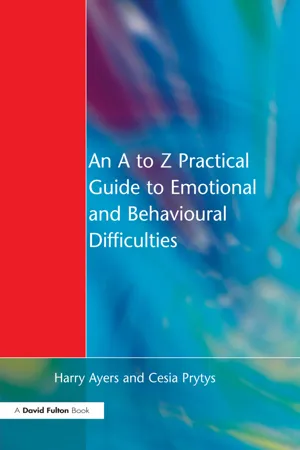
eBook - ePub
An A to Z Practical Guide to Emotional and Behavioural Difficulties
- 244 pages
- English
- ePUB (mobile friendly)
- Available on iOS & Android
eBook - ePub
An A to Z Practical Guide to Emotional and Behavioural Difficulties
About this book
Information
Publisher
David Fulton PublishersYear
2013Print ISBN
9781853467783
9781138160088
Edition
1eBook ISBN
9781134135059
A
ABC (Behavioural)
The ABC is a means of recording specific, overt and observable behaviour. It forms the basis of a functional analysis of behaviour. It is behavioural in that it focuses on specific, overt and observable behaviours.
A = antecedents, i.e. events that are observed to precede an overt behaviour.
B = the observed behaviour.
C = the observed consequences or events that follow the observed behaviour.
B = the observed behaviour.
C = the observed consequences or events that follow the observed behaviour.
| Antecedents | Behaviour | Consequences |
| Teacher asks student to work | Child out of seat | Child interferes with others |
Herbert, M. (1998) Clinical Social Psychology, 2nd edn. Chichester, Wiley.
Sturmey, P. (1966) Functional Analysis in Clinical Psychology. Chichester, Wiley.
ABC (Cognitive)
The ABC is a way of analysing emotional and behavioural problems devised by A. Ellis in 1977. It is cognitive in that it acknowledges the influence of cognition on emotion and behaviour.
- A = an activating event stands for a person’s perceptions and inferences regarding events that influence him or her.
- B = rational and irrational beliefs about activating events.
- C = emotional and behavioural consequences of subscribing to rational and irrational beliefs.
| Activating event | Belief | Consequences |
| Person fails to get a job | Person believes he is worthless | Depression |
This model is not simply linear but interactional in that it recognises activating events, beliefs and consequences as influencing each other.
Ellis, A. (1977) ‘The basic clinical theory of rational-emotive therapy *, in A. Ellis and R. Grieger (eds), Handbook of Rational-Emotive Therapy. New York, Springer.
Abreaction
Abreaction is a psychoanalytic term. It refers to the release of emotional energy that occurs when a repressed memory enters consciousness. It can occur as a part of psychotherapy or spontaneously. Initially abreaction was thought to be therapeutic in that the repressed experience could be relived and thereby controlled.
Absolute thinking
A term used in Rational Emotive Behavioural Therapy (REBT). It refers to thinking about experiences in terms of absolute demands such as ‘shoulds’, ‘musts’, ‘have to’s’ and ‘ought to’s’. Absolute thinking is seen as an aspect of holding irrational beliefs that lead to irrational conclusions such as ‘awfulising’, ‘I-can’t-stand-it-itis’ and ‘damnation’. Absolute thinking can lead to emotional and behavioural problems.
Ellis, A. (1984) ‘Foreword: Cognitive, affective, and behavioural aspects of rational-emotive therapy’, in W. Dryden, Rational-Emotive Therapy: Fundamentals and Innovations. London, Croom Helm.
Abstinence rule
The rule of abstinence is a psychoanalytic term. Psychoanalysis is arranged so that it does not provide relief or satisfaction of a client’s needs that are symptoms external to the therapeutic situation. The analyst presents as it were a blank screen to the patient so that the analyst does not satisfy the patient’s unconscious needs thereby enabling the patient’s unconscious conflicts to be fully disclosed for analysis.
Acting out
This psychoanalytic term refers to the re-enactment of past events, particularly aggressive and impulsive acts. By extension it refers to individuals who act on impulses without thinking or reflecting either on their feelings, the consequences of their actions or on their behaviour. The individual is unwilling or unable to inhibit their actions or behaviour. Acting out behaviour prevents or impedes the development of self-control. Cognitive-behavioural interventions are used to increase self-reflection in impulsive individuals.
Activating event
An activating event is a component of Ellis’s ABC model that is used for describing the development of emotional and behavioural problems. ‘A’ stands for an activating event. Activating events are those events that people believe have occurred, are occurring or might occur. These activating events can trigger irrational beliefs that lead to emotional and behavioural problems. Beliefs and their consequences can in turn influence or even produce activating events.
Actor-observer difference or effect
In attribution theory a bias whereby people attribute their behaviour to situational influences but observers perceiving the same behaviour attribute it to those people’s personal dispositions. This bias exists due to the salience of the situation for the actor and the salience of the person for the observer but also due to the different types of information available to the actor and the observer. The bias is said to have only a modest effect.
Adaptation
Behavioural adaptation is a process whereby behaviour conforms to or fits a particular environment or context. This process of behavioural adaptation may occur through choice, coercion or persuasion. Coercion might not be effective and as a consequence lead to resistance or indifference. Resistance might take the form of sabotage, protest or rejection. In school terms resistance might manifest itself as disruptive behaviour, vandalism, arson, graffiti and truancy. An inclusive or incorporative ethos and a balance of rewards as well as sanctions assist in the process of behavioural adaptation to school.
Children with emotional and behavioural difficulties may have negative experiences of schools whether mainstream or special and as a result find it difficult to adapt to school routines. They may experience negative relationships with other pupils as well as school staff. Mainstream teachers may have negative attitudes towards EBD pupils who may be perceived as poorly motivated, difficult to teach and disruptive in the classroom. Other pupils in mainstream schools may reject EBD pupils.
Mainstream schools are sometimes reluctant to admit EBD pupils due to fears of adverse effects on league tables, demands on staff time, negative effects on other pupils and negative staff reaction. Such pupils are often at risk of fixed term and permanent exclusion and even other forms of exclusion e.g. internal exclusion, extended study leave, simply being asked to remain at home and encouraging parents/carers to seek admission to another school.
It may take a while before permanently excluded EBD pupils are admitted into a new school during which time they are at risk of falling behind with school work and of delinquency. Children who have been permanently excluded from one mainstream school are sometimes successfully reintegrated into another mainstream school.
Children in special schools can have a higher rate of exclusion than children do in mainstream and it is relatively rare for them to be reintegrated into mainstream schools. It may be the case that EBD children who are educated alongside other children with EBD have their difficulties reinforced through observational learning of negative role models. Other children who may have associated emotional and/or behavioural difficulties and who may find it difficult to adapt to school life include children in public care (‘looked after’), children with disabilities, traveller children and refugee children. This may not be due to any problems they may have but rather on their reception in the receiving school.
Blyth, E. and Milner, J. (1997) Social Work with Children: The Educational Perspective. Harlow, Addison Wesley Longman.
Juvonen, J. and Wentzel, K.R. (eds) (1996) Social Motivation: Understanding Children’s School Adjustment. Cambridge, Cambridge University Press.
Sanders, D. and Hendry, L.B. (1997) New Perspectives on Disaffection. London, Cassell.
Addiction (substance abuse)
This term refers to any physical or psychological dependence on a drug. Drugs are taken to enhance mood, i.e. to achieve a state of elation or euphoria. There are various levels of drug use: experimental use, social use, habitual use and abusive use. Experimentation with drugs is common, however only a minority of adolescents move on to substance abuse. Substance abuse in adolescents is correlated with higher rates of suicide, violence, accidental death, arrest, educational failure, unstable relationships, unprotected sex, teenage pregnancy, physical and mental health problems and reduced career prospects.
Generally speaking stimulant and hallucinogenic drugs are associated with increases in heartbeat and changes in blood pressure, in extreme cases disturbances in heart rhythm and heart function may occur. The use of alcohol, sedatives, solvents and opiates can lead to drowsiness and in extreme cases stupor and coma. Withdrawal from stimulants can lead to sleep disturbance and increased appetite and withdrawal from opiates can lead to nausea, vomiting and diarrhoea. Other complications are associated with substance abuse, namely liver and kidney damage, hepatitis and HIV. Accidental death is also possible through overdose and drug impurities. Negative mood states such as anxiety, depression and anger can often be the consequence of substance abuse. Flashbacks and hallucinations can also be the result of taking hallucinogenic drugs and in extreme cases psychotic states may ensue.
Perspectives on substance abuse
The main perspectives are biological, psychogenic, behavioural, systems theory and sociological.
- The biological perspective sees genetic predisposition and physiology as important factors in influencing the development of substance abuse. It also sees a difficult temperament as an important factor in terms of leading individuals to engage in risk-taking activities that are associated with substance abuse. Certain drugs lead to tolerance, dependence and unpleasant withdrawal symptoms. These withdrawal symptoms lead to further substance abuse.
- The psychodynamic perspective sees substance abuse as a means of coping with stress and negative emotional states particularly in relation to loss, separation and bereavement. Psychoanalytic approaches regard insecure attachment as an important factor in leading vulnerable individuals to use drugs to counteract negative moods. Sexual and physical abuse and other traumatic events are also seen as predisposing individuals to substance abuse. Another theory sees the adolescent search for identity and autonomy as leading sometimes to immersion in a drug taking subculture.
- The behavioural perspective sees substance abuse as being maintained by positive reinforcement through drug induced mood enhancement and by negative reinforcement when drugs alleviate withdrawal symptoms. Specific environmental cues are seen as eliciting withdrawal symptoms.
- The systems perspective sees negative parental influence and negative family relationships as contributing to substance abuse. Parental substance abuse is seen as having a modelling effect on their children. The lack of parenting skills is also seen as influential. Some parents fail to lay down and enforce rules about drug use and do not adequately supervise their children. Substance abuse is also seen as being in part the result of family conflicts.
- The sociological perspective sees social deprivation and social alienation as important factors in contributing to substance abuse. Socially deprived neighbourhoods form a context where substance abuse thrives. Substance abuse is seen as socially approved and provides an escape valve from the multiple stresses of the social and economic environment. Adolescents are also seen as alienated from society, this being reflected in a weak attachment to parents, rejection of authority in terms of school and the police and delinquency.
Risk factors
Predisposing risk factors are both personal and situational. Personal factors include preexisting emotional and behavioural problems, learning difficulties, school failure, risk taking activities and positive attitudes towards drug taking. Other personal factors are low self-esteem and an external locus of control. Situational factors are conflicts with parents, insecure attachment, inadequate parental supervision, parental substance abuse and family disorganisation.
Precipitating factors include drug availability, the wish to experiment, peer pressure, participation in a deviant subculture and the desire to alleviate negative moods. Negative moods may occur through abuse, bullying, loss, separation and bereavement.
Maintaining factors include physical and psychological dependence. Depression and anxiety can encourage continuing substance abuse. Parental modelling and positive parental attitudes towards drug taking also contribute to continuing abuse.
Protective factors
Protective factors contribute to the prevention and treatment of substance abuse. These factors include high ability, high self-esteem, an internal locus of control, high self-efficacy, a positive attributional style and positive relationships with non-deviant peers. Secure attachments with parents alongside parental supervision are also protective factors. The lack of availability of drugs and the presence of social support networks also protect.
Carr; A. (1999) The Handbook of Child and Adolescent Psychology: A Contextual Approach. London, Routledge.
Davison, G.C. and Neale, J.M. (2001) Abnormal Psychology, 8th edn. New York, Wiley.
Heaven, P.C.L. (1996) Adolescent Health: The Role of Individual Differences. London, Routledge.
Contacts
Adfam Helpline 020 7928 8900 (help for families who have a member misusing drugs).
Families Anonymous Helpline 020 7498 4680.
NATIONAL DRUGS Help...
Table of contents
- Cover
- Title
- Copyright
- Contents
- Preface
- A
- B
- C
- D
- E
- F
- G
- H
- I
- L
- M
- N
- O
- P
- R
- S
- T
- U
- V
- W
- X
- Y
- Bibliography
Trusted by 375,005 students
Access to over 1.5 million titles for a fair monthly price.
Study more efficiently using our study tools.
Frequently asked questions
Yes, you can cancel anytime from the Subscription tab in your account settings on the Perlego website. Your subscription will stay active until the end of your current billing period. Learn how to cancel your subscription
No, books cannot be downloaded as external files, such as PDFs, for use outside of Perlego. However, you can download books within the Perlego app for offline reading on mobile or tablet. Learn how to download books offline
Perlego offers two plans: Essential and Complete
- Essential is ideal for learners and professionals who enjoy exploring a wide range of subjects. Access the Essential Library with 800,000+ trusted titles and best-sellers across business, personal growth, and the humanities. Includes unlimited reading time and Standard Read Aloud voice.
- Complete: Perfect for advanced learners and researchers needing full, unrestricted access. Unlock 1.5M+ books across hundreds of subjects, including academic and specialized titles. The Complete Plan also includes advanced features like Premium Read Aloud and Research Assistant.
We are an online textbook subscription service, where you can get access to an entire online library for less than the price of a single book per month. With over 1.5 million books across 990+ topics, we’ve got you covered! Learn about our mission
Look out for the read-aloud symbol on your next book to see if you can listen to it. The read-aloud tool reads text aloud for you, highlighting the text as it is being read. You can pause it, speed it up and slow it down. Learn more about Read Aloud
Yes! You can use the Perlego app on both iOS and Android devices to read anytime, anywhere — even offline. Perfect for commutes or when you’re on the go.
Please note we cannot support devices running on iOS 13 and Android 7 or earlier. Learn more about using the app
Please note we cannot support devices running on iOS 13 and Android 7 or earlier. Learn more about using the app
Yes, you can access An A to Z Practical Guide to Emotional and Behavioural Difficulties by Harry Ayers,Cesia Prytys in PDF and/or ePUB format, as well as other popular books in Psychology & Education General. We have over 1.5 million books available in our catalogue for you to explore.