eBook - ePub
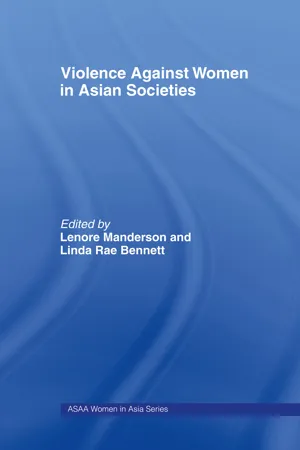
Violence Against Women in Asian Societies
Gender Inequality and Technologies of Violence
- 208 pages
- English
- ePUB (mobile friendly)
- Available on iOS & Android
eBook - ePub
Violence Against Women in Asian Societies
Gender Inequality and Technologies of Violence
About this book
Violence against women is a violation of women's human rights and a priority public health issue. It is endemic worldwide. While much has been written about it in industrialized societies, there has been relatively little attention given to such violence in Asian societies. This book addresses the structural and interpersonal violences to which women are subject, both under conditions of conflict and disruption, and where civil society is relatively ordered. It explores sexual violence and coercion, domestic violence, and violence within the broader community and the state, avoiding sensationalised accounts of so-called cultural' practices in favour of nuanced explorations of violences as experienced in Cambodia, Thailand, Burma, Indonesia, Malaysia, the Philippines, Bangladesh, and India.
Information
| 1 | Introduction: gender inequality and technologies of violence |
At the heart of violence lies the abuse of power in the maintenance or creation of inequality. In the case of violence against women, also referred to as gender-based violence, power is wielded via a myriad of violent technologies to reinforce women's subordination. At its most basic level, violence against women is both symptomatic of, and active in, sustaining gender inequality. However, the everyday violences to which women are subjected simultaneously reflect overlapping social hierarchies that are based not only on gender, but also on women's age, marital status, class, race, religion and ethnicity. Thus, violence against women routinely functions to sustain multiple inequalities, reinforcing women's subordination within complex hierarchies of oppression. Broad social injustices, such as economic and political inequalities, are also gendered and regularly manifest as systematic patterns of structural violence against women. The complexity and prevalence of gender-based violence can only be comprehended when the interaction of multiple violences is adequately considered. Yet, common to all forms of patriarchal violence is the centrality of hierarchical power relations, and the gendered nature of ideological inequalities that justify the use of violence in the pursuit of domination (Galtung 1995). In this volume we explore violence against women in the wider context of patriarchal violence, seeking to tease out the ways in which violence acts to perpetuate not only gender inequality, but also broader social, economic and political injustices that deny women's and men's human rights.
In recent decades there has been growing public recognition that sexual and domestic violence overlap and are interrelated, and that rape and other forms of sexual assault are routine aspects of domestic violence (Heise et al. 1995). This political awareness of violence against women, encompassing sexual and other physical violence, as well as economic and psychological violence, has resulted in the development of intervention programs and in refinements of government policies and legislation, primarily in well-resourced countries. Non-government organizations (NGOs) have developed to provide practical support to women affected by such acts of violence. Their role has been critical, especially in poorer nations and communities where few government resources have been dedicated to addressing the prevention or consequences of violence against women. Public awareness of violence against women has risen in many societies with continuous media attention, as national presses have shown increased willingness to write about sexual assault and gender-based violence in the contexts of war and terror, as well as its everyday manifestations.
By the turn of the 21st century, civil and other kinds of local wars had become unimaginably prevalent, and in that context, so too had the especial brutalities directed at women and girls. An expanded research agenda has added to our understanding of the etiology, context, prevalence and outcomes of violence, although there are as many questions to be posed and explored as there are now questions answered. The expansion of research on violence has led to a growing understanding of how physical violence against women occurs within enabling structural, economic and political contexts. Our attention has turned to include forms of structural violence such as female poverty, trafficking in women and slave prostitution, early, unplanned and unspaced pregnancies and births, alarming maternal and infant mortality rates, dangerous abortions in unsanitary circumstances, and women's poor or non-existent access to appropriate health care in many countries.
Activists, researchers, survivors, health professionals and sympathetic politicians now possess a rich vocabulary and improved theoretical understandings with which to discuss gender-based violence and agitate for change. In this volume, we address each of the interconnected categories of direct, indirect and structural violence. The authors incorporate research on forms of direct violence including domestic violence, marital rape, acquaintance rape, stranger rape and other forms of sexual violence such as incest, sexual harassment, sexual assault and forced sexual initiation. The direct violence of verbal, emotional and psychological abuse is also addressed in the contexts of everyday domestic violence and the torture of women. Murder and the infliction of acute physical injury are addressed in discussions of acid attacks against Bangladeshi women, of honour killings in the Philippines and Indonesia, and in relation to murders committed in the context of political violence in Burma, Cambodia and the Indonesian province of Aceh. However, we have not extended the scope of the volume to issues that have already received considerable attention and visibility such as trafficking in women and female genital mutilation (but see Skrobanek et al. 1997; Toubia and Izett 1998).
Discussions of indirect violence include the functioning of fear and its control of women in the context of domestic violence and sexual coercion, the impact of social violence against women routinely manifested as gossip and social exclusion, and the dramatic effects of terror and political surveillance sustained by the military and state apparatus. Fear of politically motivated violence is particularly salient in the chapters referring to violence in Burma, Cambodia, Malaysia, and Aceh. Structural violence is also central to the contributors' approaches to violence against women in this volume. The ensuing chapters consider inequality from various standpoints, pointing out the layers of disadvantage women experience as a result of their gender, age, poverty and ethnicity. The authors identify how different forms of structural violence result from vast inequalities, and are also discussed in terms of women's subsequent vulnerability to other forms of direct and indirect violence.
Violence against women in South and Southeast Asia
In Asia, the task of naming, describing and responding to violence against women has been complicated. Histories and ethnographies of the region have established locality, but often through sensational and stereotypic accounts of both the dramatic and routine violence perpetrated against women. Widow burning (suttee), foot-binding, child marriage, forced marriages and the suicides of reluctant brides, the institution of mui tsai (child-bride domestic servants), female infanticide, polygamous unions without consent, genital mutilation and corporeal punishment from harridan mothers-in-law pepper ethnographies, travelogues and mythologies of the region. Too often accounts of such violence come to stand for the whole, a synecdoche of ethnicity and religion. In the popular imagination Hinduism is reduced to widow-burning; China contracted to foot-binding; Islam analogous with polygamy and genital mutilation.
For feminist and postcolonial researchers there has been a need to avoid the stereotype and to negotiate the fraught politics of cultural relativism and universalism, whilst representing Asian women's identities, rights and experiences of violence in ways that expose gender inequality and condemn violence against women. Consequently, for some researchers it has been difficult to write of such violence at all, other than to bracket it as the exception not the rule: poor families—most of them—in China could not afford to bind the feet of their daughters; “trafficking” was a characterisation of prostitution that overlooked the complexities of economic need, social change and agency. The chapters in this volume dedicate considerable space to mapping out the specific historical, political and cultural contexts of violence against women. They investigate the complexities of a wide range of violences to which women are subject, and in doing so they illustrate what is both common and distinct among different forms of violence in particular locations. The detail with which the authors treat their descriptions, and their analyses of the etiology and cultures of violence, makes this volume unique in its attempt to tease out the ambiguity of violence against women in the impossibly broad social, economic and political mix of the Asian region.1
The literature on violence against women has expanded steadily over recent decades, but mostly notably by researchers and activists in and about North America, and to a lesser extent, in other highly industrialised settings. Access to research findings in Asia is limited also by the tendency not to publish, due to a lack of resources and internal political pressure upon researchers not to make their findings public. The risk of stigmatising or re-victimising women, or the threat of retaliation from angered perpetrators and communities, has restricted the circulation of relevant information and sustained the silence surrounding violence against women in many Asian communities. The chapters in this collection have thus drawn not only upon ethnographic research, but also on a body of unpublished or grey literature largely derived from NGO and consultancy reports, not widely circulated or easily accessible to researchers or students of countries in the region.
In this collection, we include papers, predominantly by anthropologists, describing and analysing violence against women in various ethnographic and cultural settings in South and Southeast Asia. We have refined our geographical focus within Asia both because of the near impossible task of establishing commonality were it wider, but also because of the comparative lack of research on violence in East and Central Asia. While contemporary research has expanded, concurrent with the development of activism and NGO support for women, the expansion largely reflects the degree to which countries have been willing to nurture open research and interventions. As we describe later, much of the recently published work on sexual and domestic violence, for example, derives from India and Bangladesh, suggesting possible links between democratic systems of government and the encouragement of discourse related to sexual, reproductive and human rights.
The pervasiveness of violence against women in Asia is difficult to capture without apparent reversion to sensationalism and stereotype. As we have already suggested, some of the violences associated with some parts of the region are particular to time and place, and can be treated parenthetically. Yet, they are also indicative of how women are idealised and how gender inequality lies at the heart of social organization. Other kinds of mundane violence are just as endemic and pervasive now as in the past. While the structural determinants of gender based violence often correlate with varying levels of development, the cultural, religious and institutional factors that promote or condone violence against women can remain unchallenged despite progress in terms of economic development. In recent years, women's position in the most industrialised countries in the region has improved dramatically, with increasing numbers enjoying education at the same level as their brothers, working under favourable conditions, and marrying by choice as mature women. In Malaysia, female enrolments in tertiary education now outnumber male (Anwar 2001). Yet the employment opportunities available to female graduates, and the salaries they are likely to earn, continue to fall far short of their male peers. Less educated women also face constant discrimination in employment. For instance, female factory workers in newly industrialised Asian nations are too often paid below subsistence level, and typically at lower rates than men, perpetuating the structural violence of female poverty (Ong 1987).
The Asian region has as many poor—“least developed”—countries, as it has newly industrialised countries, and there, the structural as well as interpersonal determinants of violence against women continue. In the poorest countries, women leave school early, are married with limited or no say in the matter, and have poor access to family planning or other reproductive health services. Even in relatively industrialised countries of the region, the number of early marriages for women remains high. The percentage of women between the ages of 15 and 19 who are married in Thailand is 14.2%, in the Philippines is 7.9% and in Malaysia is 7.4%, which contrasts sharply with the 1.5% of Australian and 1.1% of New Zealander women who are married in their teens (ARROW 1998). Early marriage remains problematic, an indicator of low status and a predictor of violence against women due to their lack of marital choice. This volume highlights the harmful consequences of early marriage including forced sexual initiation, early child bearing, high maternal morbidity and mortality, and high child mortality.
Estimates of maternal mortality vary widely across the region, and also vary substantially within countries due to regional differences in income and access to health care. While Malaysia's maternal mortality rate (MMR) is estimated to be as low as 39 deaths per 100,000 live births, its near neighbour Indonesia has an alarmingly high rate of 450 deaths per 100,000 live births with regional variations of up to 650 in parts of Eastern Indonesia (World Bank 2001). In Burma even conservative estimates cite MMR to be as high as 580 deaths per 100,000 live births (UNICEF 2000) and South Asian countries also suffer inflated MMR rates of 850 for Bangladesh and 570 for India (WHO 2000). The tragedy of maternal deaths in the region is an indicator not only of poverty, but also of government policy, and of women's poor social status that relegates their health to a low position within their families' hierarchy of needs. Female mortality also regularly occurs via other technologies of violence practiced in the region such as female infanticide, suicide and homicide. As is the case for most societies, Asian women are twice as likely to die at the hands of their partners or another intimate, as they are as a result of violence perpetrated by strangers (Heise 1994).
Links between unsafe abortion and high rates of maternal mortality are also prominent in the region. In Indonesia, unofficial estimates of the Ministry of Health attribute up to 15% of maternal mortality to the fatal consequences of unsafe abortion, which remains illegal unless a woman can prove that her life is at risk due to the pregnancy (Bennett 2001a). In Myanmar, between 33% and 60% of maternal mortality is directly attributed to unsafe illegal abortions (Skidmore this volume). The lack of access to safe abortions is in itself a form of violence that leads many women to risk further violence, too often resulting in death, infertility and other permanent injuries, all avoidable were comprehensive legal abortion services made available. Denial of women's right to reproductive autonomy also manifests in the violence of forced abortion, still occurring with unknown frequency in China (Hesketh 1997).
Other key indicators of development in the region, such as school enrolments and adult literacy rates, show significant discrepancies by gender, further illustrating the systemic nature of gender bias against women. In Cambodia, male secondary school enrolment is at 34.7% and female enrolments lag behind at 20.3% (WHO 2000). Sex differences in adult literacy are most marked in India where 66% of adult men are literate as compared to only 38% of adult women. Furthermore, the recent Asian economic crisis has resulted in drastic declines in disposable income in many Asian societies, and the education of women and girls has typically suffered ahead of that of their brothers.
Asian women routinely work as domestic servants and are often paid little more than their keep to work under appalling conditions. The low status and social isolation many women experience as domestic servants, especially when they work abroad, leaves them highly vulnerable to physical violence and sexual exploitation. While many women have a choice between sex work and other ways of earning an income, not all do; and many women and girls who work as prostitutes do so in conditions of near slavery. The prevalence of sexual coercion in Asian societies also compounds the risk of sexual assault for female sex workers, and thus their vulnerability to the indirect violence of unwanted pregnancy and sexually transmitted diseases including HIV/AIDS. As the primary mode of HIV transmission in South and Southeast Asia is heterosexual sex, the potential impact of sexual violence against women is one that affects the entire population. Forms of violence such as rape, poverty, abandonment, polygamy, forced prostitution, and lack of access to contraception all compound women's vulnerability to life-threatening health risks, of which HIV/AIDS has been the most publicised in recent years.
While women in Southeast Asia have historically enjoyed a measure of economic autonomy and personal mobility, women in South Asia are largely as constrained now as in the past. The constraints on their movement, their limited access to education and work, and the absence of their rights as human rights, inhibit also their ability to name and to escape violence, domestic or public. As we have already noted, the literature on South and Southeast Asia has tended to overemphasise “cultural” practices such as suttee, while disregarding routine sexual and other violence that women in the region share with women worldwide. However, in the past decade there has been a notable expansion of research on violence against women in South Asia that has focused on domestic violence and sexual coercion within marriage. In the 1990s, numerous studies established the high prevalence of domestic and sexual violence in intimate partnerships in India and Bangladesh. For example, research conducted in India in 1993–1994 with 1800 married rural women found that 40% of women had been physically assaulted by their current partner (Jejeebhoy 1997). In 1996, a study in the Indian state of Uttar Pradesh found that 28% of a sample of nearly 7000 married women reported having experienced forced sex within marriage (Narayana 1996).
More recent and inclusive research, involving a household survey on violence against women in the marital home and conducted in seven Indian cities from 1997 to 1999, confirms earlier estimates of the prevalence and severity of marital violence against Indian women (Duvvury 2000). Almost 10,000 women were included in the survey across three socio-economic strata, which were rural, urban slum and urban non-slum. The key finding of this survey was that marital violence against Indian women was pervasive across regions and socioeconomic groups. The findings indicated that 70% of women had experienced at least two forms of physical abuse and 50% had experienced all forms of abuse, both sexual and non-sexual, that were identified in the survey. While socioeconomic class did not prove to be related to the incidence of violence, marriages in which women or men had ten or more years of education were found to be less prone to violence. However, women in paid employment did not experience lower levels of violence due to their economic independence; on the contrary, rates of violence were higher among those women working for pay. While contradictions and intricacies in the patterns of marital violence against Indian women were highlighted by this research, the etiology of those patterns can only be unravelled by complementary qualitative research that investigates the various meanings and functions of violence in women's everyday lives.
In Bangladesh, a 1992 national survey with a sample size of 12,000 village women found that 19% of married women had been physically assaulted by their partners in the proceeding twelve months and 47% had been assaulted at some time during current relationships (Schuler 1996). Again these findings are corroborated by more recent research, conducted from 1998–1999 and involving 199 married Bangladeshi women from eight rural villages. In this multi-site study, 72% of women reported incidents of marital violence in the proceeding twelve months (Khan 2000). The most common forms of violence experie...
Table of contents
- Cover
- Half Title
- Asian Studies Association of Australia
- Title Page
- Copyright Page
- Table of Contents
- Notes on contributors
- List of tables and figures
- Series Editor's Foreword
- Acknowledgements
- 1. Introduction: gender inequality and technologies of violence
- 2. Violence against Maranao Muslim women in the Philippines
- 3. Presumed consent: marital violence in Bugis society
- 4. Loss of face: violence against women in South Asia
- 5. Behind bamboo fences: forms of violence against women in Myanmar
- 6. Rape and sexual transgression in Cambodian society
- 7. Sexual coercion amongst adolescents in an urban slum in India
- 8. Violence against women: the challenges for Malaysian women
- 9. Notes of an out-of-place widow
- 10. Whose honour, whose shame? Gender-based violence, rights and health
- Bibliography
- Index
Trusted by 375,005 students
Access to over 1.5 million titles for a fair monthly price.
Study more efficiently using our study tools.
Frequently asked questions
Yes, you can cancel anytime from the Subscription tab in your account settings on the Perlego website. Your subscription will stay active until the end of your current billing period. Learn how to cancel your subscription
No, books cannot be downloaded as external files, such as PDFs, for use outside of Perlego. However, you can download books within the Perlego app for offline reading on mobile or tablet. Learn how to download books offline
Perlego offers two plans: Essential and Complete
- Essential is ideal for learners and professionals who enjoy exploring a wide range of subjects. Access the Essential Library with 800,000+ trusted titles and best-sellers across business, personal growth, and the humanities. Includes unlimited reading time and Standard Read Aloud voice.
- Complete: Perfect for advanced learners and researchers needing full, unrestricted access. Unlock 1.5M+ books across hundreds of subjects, including academic and specialized titles. The Complete Plan also includes advanced features like Premium Read Aloud and Research Assistant.
We are an online textbook subscription service, where you can get access to an entire online library for less than the price of a single book per month. With over 1.5 million books across 990+ topics, we’ve got you covered! Learn about our mission
Look out for the read-aloud symbol on your next book to see if you can listen to it. The read-aloud tool reads text aloud for you, highlighting the text as it is being read. You can pause it, speed it up and slow it down. Learn more about Read Aloud
Yes! You can use the Perlego app on both iOS and Android devices to read anytime, anywhere — even offline. Perfect for commutes or when you’re on the go.
Please note we cannot support devices running on iOS 13 and Android 7 or earlier. Learn more about using the app
Please note we cannot support devices running on iOS 13 and Android 7 or earlier. Learn more about using the app
Yes, you can access Violence Against Women in Asian Societies by Linda Rae Bennett,Lenore Manderson in PDF and/or ePUB format, as well as other popular books in Social Sciences & Ethnic Studies. We have over 1.5 million books available in our catalogue for you to explore.