The wind power business has grown from a niche sector within the energy industry to a global industry that attracts substantial investment. In Europe wind has become the biggest source of new power generation capacity, while also successfully competing with the gas, coal and nuclear sectors in China and the US.
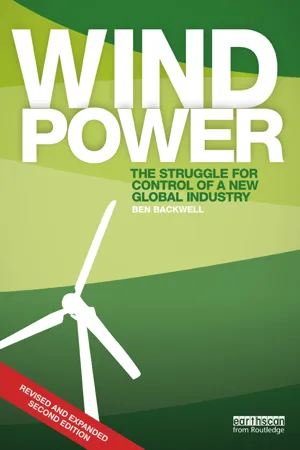
Wind Power looks at the nations, companies and people fighting for control of one of the world's fastest growing new industries and how we can harness one of the planet's most powerful energy resources. The book examines the challenges the sector faces as it competes for influence and investment with the fossil fuel industry across the globe. Over the course of this volume, Backwell analyses the industry climbers, the investment trends and the technological advancements that will define the future of wind energy. This second edition is revised throughout and contains new material on frontier wind markets and industry consolidation, as well as the cost reductions and market gains that led to 2015 being a landmark year for the big wind turbine companies.
This is an important resource for professionals working in wind and wider renewable industries, energy finance, conventional energy companies and government as well as researchers, students, journalists and the general public.
On September 27, 2013, at simultaneous early-morning press conferences in Copenhagen and Tokyo, officials from Vestas, the world’s largest wind-turbine manufacturer, and Mitsubishi Heavy Industries (MHI), one of the world’s biggest industrial conglomerates, announced a ground-breaking joint venture.
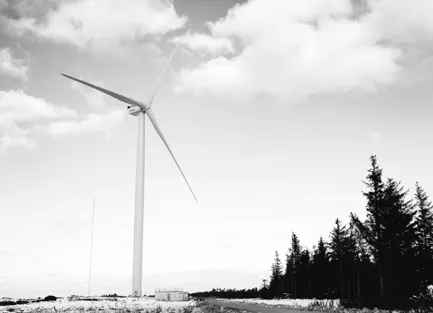
The joint venture, officials announced, was to be based around Vestas’ planned V164 offshore wind turbine. With an 8MW capacity, the wind-turbine’s rotor diameter is bigger than the London Eye at 164m, while its height at 187m is taller than the Gherkin building in the same city. The turbine is designed to be installed in the harsh conditions of the North Sea in water depths of up to 70–80 metres and to operate for 25 years continuously.
The offshore wind business is still relatively young and there are many uncertainties. Project developers and investors prefer to deal with companies that have the financial strength to see through their warranties in case of any large-scale equipment failure. By teaming up with MHI, Vestas was bringing in a partner with a huge balance sheet – MHI revenues were over Y3trn (US$0.5trn) in 2012 – that would put it on a par (at least financially) with the undisputed market leader in offshore wind power, Siemens. MHI also brought to the table expertise and industrial capacity in areas from shipbuilding to aerospace and space technology to power plants. The joint venture virtually guaranteed that the V164 would be built and deployed on a large scale, following two years in which Vestas’ capacity to bring the machine to market had looked in doubt.
The deal was something of a turning point for the Danish company – the traditional front-runner in the wind industry – and a recognition of new realities. The company had been struggling to go it alone with the development of a new offshore mega-machine, while a bumpy financial performance had led to rumours that the company was about to be sold to a an industrial conglomerate, with Chinese companies being the most mentioned. A few weeks before the Mitsubishi announcement, Vestas had dismissed its controversial Chief Executive Ditlev Engel and replaced him with Anders Runevad, a Swedish telecommunications executive – the first time that Vestas had had a non-Danish CEO. Runevad had come, in the words of Chairman Bert Nordberg – also a Swede and also a telecoms executive – to guarantee ‘a future without surprises’ for Vestas.
The deal with MHI was the latest chapter in a remarkable story that has seen a group of small, mainly Danish companies sell the wind-power concept to the world and turn it into a mainstream energy source and multi-billion-dollar industry.
From Tvindkraft to the California Wind Rush
In 1972, a group of radical teachers set up a collective and base on a plot of farmland called Tvind in the small Western Jutland town of Ulfborg, around 100km away from the then headquarters of a small agricultural equipment manufacturer called Vestas. Influenced by Maoism and the current debates around radical pedagogy, its charismatic and undisputed leader was Mogens Amdi Petersen. The group began to set up a number of Tvind schools across Denmark, which were supported by Denmark’s liberal public subsidies.
In 1975, the Energy Crisis had led Denmark’s government to consider a large-scale nuclear programme, and political support was growing for the idea, even though public opinion was largely hostile. Next door to Denmark, Sweden was about to commence production of power from its Barsebäck nuclear plant.
Petersen and his group decided that the best way to mobilise public support against nuclear was not by protesting, but by showing that a practical alternative existed in Denmark’s strong winds, and the Tvindkraft project was born. Tvindkraft foresaw the construction of a 2MW wind turbine, a size which was far bigger than anything that had been built before. The project mobilised volunteer labour and input from Danish universities.
Surprisingly the project was a big success. Up to 100,000 people visited Tvindkraft during the three-year building work, and when it was finished in 1978, the turbine worked. The design and construction of the turbine led to a number of technical advances which influenced the future development of the industry and had a big influence on some individuals who went on to become key figures in the modern wind industry.
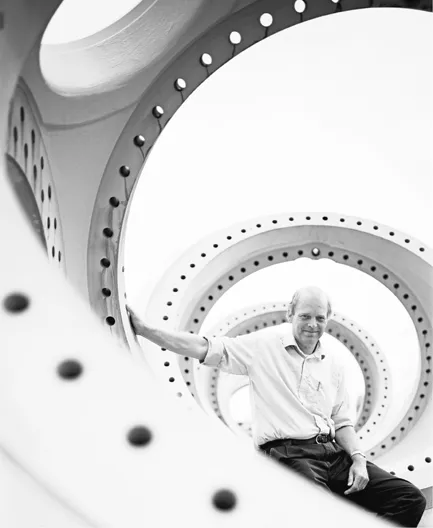
Henrik Stiesdal, who went on to design Vestas first commercial turbine, built the first offshore wind project with fellow Danish company Bonus and became CTO of Siemens Wind, one of the world’s biggest turbine OEMs (original equipment manufacturers); he was one of the people who visited Tvind. Stiesdal says,
During Christmas 1976 my father and I therefore went to Tvind for the first time, and like everyone else were fascinated by this group of obvious amateurs, who from something that appeared to be absolutely square one, were building the world’s biggest wind turbine.
(Renewable Energy in Denmark 2000)
He said of his visit:
The effect of the Tvind turbine as a source of inspiration cannot be overstated. A large number of the pioneers became hooked, like me, on the possibilities and practical challenges of wind power when they visited Tvind. The almost nonchalant self-confidence with which the so-called ‘Mill Team’ built something no one had ever done before was very contagious.
(Stiesdal, Personal communication)
Figure 1.3Siemens Wind’s CTO, Henrik Stiesdal, one of the pioneers of the modern wind industry (Source: Siemens).
Stiesdal points out that some of the tools later commonly used in the wind industry, such as blade moulds and measuring tools, were developed at Tvind. It is significant that, in keeping with the Tvind group’s political philosophy, the technology for the turbine and its blade was made publicly available – making it the first ‘open-source’ blade design long before the term came into use.
Among others who were influenced by Tvindkraft were the young engineers at the Risø DTU National Laboratory, which was originally set up by physicist Niels Bohr to study nuclear power and would go on to be a key institution in developing Danish wind-power technology and spreading it across the globe.
Before we move on, it is worth noting that the Tvind turbine is still producing power at the time of writing. The Barsebäck nuclear plant was shut down completely in 2005.
Vestas steps in
Henrik Stiesdal and blacksmith Karl Erik Jørgensen built a 10-metre diameter turbine in 1979 through a company called Herborg Vind Kraft or HVK. After a series of experiences with storms and lost blades, they, together with blade manufacturer Erik Grove Nielsen, developed a machine with pitchable blade tips to protect the turbine from reaching too high speeds. Meanwhile Danish agricultural machinery company, Vestas, had been experimenting with wind tech nology – mainly in secret – since 1971, with Birger Madsen in charge of engineering.
In 1979, HVK concluded that life as a stand-alone wind-turbine manufacturer was not a realistic option. At the same time Vestas’ latest turbine idea – a vertical access ‘whisk’-like machine, had resulted in failure, convincing Madsen that a new approach was needed. Stiesdal and his partner agreed to license their turbine design. This move resulted in the Vestas V10 and then the 55kW V15 turbine, which became its first truly commercial machine.
Planet Zond calling Denmark
Meanwhile, on the other side of the Atlantic, the threat to the US economy from the Arab oil embargoes had led President Jimmy Carter to create the US Department of Energy in 1977, and the government began to look at ways to develop wind and solar energy.
Federally funded R&D programmes aimed at getting big defence contractors to develop wind technology were largely unsuccessful, but federal and state regulatory policies and tax credits – such as the Public Utilities Regulatory Policies Act (PURPA) – which required utilities to take power from small non-utility generators, had a huge effect on the development of wind power.
California’s Governor Jerry Brown implemented a state PURPA that ensured generous payment for power for wind developers, and developers also received a generous tax break through accelerated depreciation of their assets. The policies led to the California Wind Rush. Energy writer and analyst Daniel Yergin describes it in the following way: ‘Committed wind advocates, serious developers, skilled engineers and practical visionaries were joined by flimflam promoters, tax shelter salesmen and quick-buck artists. Thus was the modern wind industry born’ (Yergin 2011: 595).
Developers began setting up clusters of hundreds of machines in three giant wind-rich areas – the Altamont Pass, the Tehachapi Pass and the San Gorgonio pass – only to find that they were woefully ill-equipped to stand up to the wind they found there. Many of the turbines were destroyed soon after being installed, with blades flying off and towers collapsing; and most produced far less electricity than they were expected to. Many of the windfarm clusters became little more than eyesores.
One of the entrepreneurs most committed to wind power was James Dehlsen, who had founded Zond in 1980. Dehlsen spent New Year’s Eve that year trying to install wind turbines in a blizzard in the Tehachapi pass in order to qualify for tax credits before they expired at midnight – something which as we shall see still sounds worrying familiar in the US wind...
Table of contents
Cover
Half Title
Title Page
Copyright Page
Table of Contents
List of Illustrations
Foreword
Acknowledgements
Introduction
1 From Maoism to Learjets
2 Big industry moves in
3 China shakes the wind industry
4 Emerging powers
5 The offshore frontier
6 After Copenhagen
7 Turbine manufacturers in trouble
8 The wind industry bounces back
9 Tipping point: Windpower’s iPhone moment
10 Challenges for the wind-turbine industry
Conclusion: Who will reap the wind?
References
Index
Trusted by 375,005 students
Access to over 1.5 million titles for a fair monthly price.
Study more efficiently using our study tools.
Frequently asked questions
Yes, you can cancel anytime from the Subscription tab in your account settings on the Perlego website. Your subscription will stay active until the end of your current billing period. Learn how to cancel your subscription
No, books cannot be downloaded as external files, such as PDFs, for use outside of Perlego. However, you can download books within the Perlego app for offline reading on mobile or tablet. Learn how to download books offline
Perlego offers two plans: Essential and Complete
Essential is ideal for learners and professionals who enjoy exploring a wide range of subjects. Access the Essential Library with 800,000+ trusted titles and best-sellers across business, personal growth, and the humanities. Includes unlimited reading time and Standard Read Aloud voice.
Complete: Perfect for advanced learners and researchers needing full, unrestricted access. Unlock 1.5M+ books across hundreds of subjects, including academic and specialized titles. The Complete Plan also includes advanced features like Premium Read Aloud and Research Assistant.
Both plans are available with monthly, semester, or annual billing cycles.
We are an online textbook subscription service, where you can get access to an entire online library for less than the price of a single book per month. With over 1.5 million books across 990+ topics, we’ve got you covered! Learn about our mission
Look out for the read-aloud symbol on your next book to see if you can listen to it. The read-aloud tool reads text aloud for you, highlighting the text as it is being read. You can pause it, speed it up and slow it down. Learn more about Read Aloud
Yes! You can use the Perlego app on both iOS and Android devices to read anytime, anywhere — even offline. Perfect for commutes or when you’re on the go. Please note we cannot support devices running on iOS 13 and Android 7 or earlier. Learn more about using the app
Yes, you can access Wind Power by Ben Backwell in PDF and/or ePUB format, as well as other popular books in Business & Energy Industry. We have over 1.5 million books available in our catalogue for you to explore.