![]()
1
What are Dilapidations and Service Charge Disputes?
An introduction to dilapidations
A common question for the newcomer to the subject is “what are dilapidations?” A straightforward answer is not easy to offer. The concept is borne out of statute, common law and accepted procedure, formed over hundreds of years of such claims in England and Wales.
The nature of the legal system and the historical basis of property ownership in England and Wales over the centuries meant that the landlord’s property asset was traditionally considered sacrosanct. Landlords leased property on terms designed to safeguard the property from any asset depreciation that would be caused by disrepair arising during the lease term.
Over the last 150 years or so, the emphasis placed on the landlord’s rights has been eroded to such an extent that the concept of natural justice has flavoured statute and case law, to restore the balance or rights and liabilities between landlord and tenant.
The concept of dilapidations
There have been several attempts in the past to provide a succinct definition of dilapidations as a starting point for addressing the issue in its practical context.
The Property Litigation Association (PLA) Dilapidations Protocol (version 3, 2008) describes dilapidations as being “a claim for all breaches of covenant or obligation relating to the physical state of a demised property at the end of the lease”.
However, this definition does not cover the broader range of issues present in many dilapidations disputes.
For example, the PLA description does not cover the common situation where there are reasonable grounds to commence a claim pre-lease end. In addition, the PLA’s definition does not cover claims for damages under the law of waste, ie where there is no lease in place; where there are obligations to repair; and where the state of repair is in dispute between owner and occupier.
Perhaps due to the potential breadth of the topic, the latest Royal Institution of Chartered Surveyors (RICS) Dilapidations Guidance Note (5th ed, 2008) does not contain a simple definition of “dilapidations”.
The definition of “dilapidations” used within this book is:
A civil claim between landlord and tenant made under contract law and/or the law of waste where the claim is commenced during or at the end of the tenant’s interest and where one party seeks a civil remedy and/or restitution from the other in respect of physical damage, deterioration or waste occasioned to or within the subject property that is alleged to be directly attributable to an act (or omission) by the other party.
The above definition is independent from the nature of the tenancy; applies during the term and at lease end; and does not restrict the concept to contract law.
What is a dilapidations dispute?
Dilapidations disputes have been described by some as a “black art” or as being the “sting in the tail” of commercial property leases. They are one of the few current forms of civil dispute where lawyers are not normally the principal professional advisors during the key pre-litigation stages of a claim.
In its most simple and common form, the dispute will be based on a schedule of dilapidations in which a claim for breach of the contract (ie breach of the lease) is prepared and then served by the landlord on the tenant.
The aim of the schedule is to document the individual breaches and to set out works required to remedy each breach, together with associated costs. The tenant is required to either carry out the work or pay damages for the breaches at lease end.
The calculation of any damages due to the landlord is the most contested area of any dilapidations dispute. To resolve disputes effectively, technical and legal considerations must be factored in to clearly quantify the liability or “loss” suffered by the landlord.
Dilapidations disputes are thus a rare hybrid of surveying and legal issues, where the lawyer must take a keen interest in the role of the surveyor and vice versa. This is where the chartered building surveyor, the valuer and the property lawyer earn their keep.
Why dilapidations disputes occur
There are a multitude of reasons why dilapidations and service charge disputes arise between landlord and tenant parties:
• It may be as simple as one of the parties having been naive in agreeing lease terms and, as a consequence, not having taken appropriate advice on their future liabilities before committing to the lease.
• There may be financial difficulties that would make it problematic for a party to honour tenancy obligations.
• It could be that allowing disrepair to occur is part of a deliberate property management strategy that arises from a tenant’s cost-to-risk appraisal.
• It could be that there has been an unfortunate breakdown in relations and/or communication between the parties.
The possible causes of dilapidations and service charge disputes are extensive. Wherever disputes arise there will be a dispute resolution role for surveyors and other advisers. This may require the surveyors and other advisers to first review, determine or clarify their client’s position; and then to act to resolve the dispute while safeguarding their clients’ interests to the best of their ability, without acting unreasonably or even unlawfully in the process. There are a multitude of reasons why dilapidations and service charge disputes arise between landlord and tenant parties.
Statute and common law influences
Dilapidations disputes sit within the legal framework of statute and common law. Basic knowledge of both areas of law is required in order to accurately resolve claims.
Statutes are acts of Parliament that may date back centuries. There are many examples of statutes relevant to dilapidations and examples of key current legislation include: the Law of Property Act 1925; the Landlord and Tenant Acts of 1927 and 1954; the Leasehold Property (Repairs) Act 1938; and the Defective Premises Act 1972.
Detailed interpretation of statutes relating to dilapidations is provided by “common law”, ie legal opinion embodied in a judicial decision. Dilapidations common law also stretches back hundreds of years, providing a valuable insight into the equitable remedies imposed by the courts for a wide variety of commonly encountered claims and disputes.
Perhaps the most well known dilapidations case is Proudfoot v Hart (1890) LR 25 QBD 42 that clarifies the nature of the tenant’s obligation to repair. The judgment in this case set down that the determination of whether a building is in actionable disrepair at lease end has to take into consideration the age, character, and location of the premises and whether it would be “reasonably fit for the occupation of a reasonably minded tenant of the class who could be expected to take it at the start of the lease”. This case remains relevant today and is widely quoted.
Common types of schedule
Interim schedule
An “interim schedule” is the term commonly used by surveyors and solicitors to signify that a schedule of dilapidations that is served during the currency of a lease where there is three years or more remaining in the lease term.
The origins of the “more than three years to go” timeframe can be found in the Leasehold Property (Repairs) Act 1938 (LP(R)A 1938) that entitles qualifying tenants to claim the benefit of the act and gain relief from forfeiture or re-entry proceedings commenced under section 146 of the Law of Property Act 1925 (LPA 1925).
The LP(R)A 1938 may apply if there are three or more years to run in a lease term and so interim schedules evolved to distinguish them from schedules and claims made in the last three years of a lease where the LP(R)A 1938 does not apply.
Terminal schedules
A “terminal schedule” is the term commonly used by surveyors and solicitors to signify a schedule served during the last three years of the currency of a lease; or at the end of the lease (see also final or lease end schedules).
The origins of the “last three years of the term” timeframe is again associated with the LP(R)A 1938. Tenants in the last three years of a lease will not have any right to seek relief from forfeiture or re-entry proceedings under section 146 of the LPA 1925.
Lease end or final schedules
Some surveyors use terms such as “lease end” or “final” schedules as a means of distinguishing schedules prepared after a lease has irrevocably determined from a “terminal schedule” previously served during the currency of the lease.
The choice of label for post lease end schedules is a matter of semantics and personal preference. However, the use of the word “final” in schedule descriptions can cause confusion if a final schedule is subsequently revised and re-issued (possibly more than once).
Format of the schedule of dilapidations
With a schedule, the typical claim is broken down into sections or areas of claim covering different types of breaches of the lease, such as wants of repair; redecoration; reinstatement of alterations, etc. The claim may also set out claims for consequential losses arising from the breaches, such as loss of rent, fees, VAT, etc.
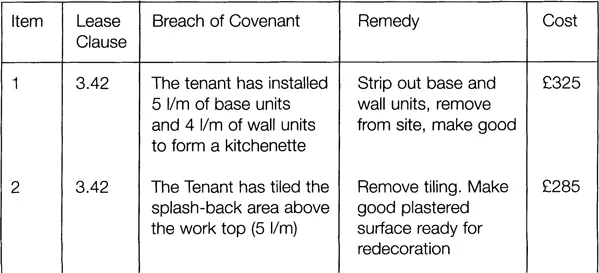
A basic lease end schedule will, typically, be similar in format to the following example.
Typical lease end schedule
However, it is becoming increasingly common for schedules to be prepared and served from the outset in a “Scott” schedule” format (see Chapter 11).
Which type of schedule of dilapidations to serve?
The choice of the type of schedule will depend on the nature of the remedy being sought and the length of unexpired term of the tenancy. Commonly encountered schedules include:
• Interim or terminal schedules — or service under cover of a LPA 1925 s146 notice.
• Interim or terminal schedules — for service under cover of a “notice to repair”.
• Terminal or “lease end” schedules — for service seeking damages following the end of a lease or tenancy.
• Lease “break option” schedules.
• Lease assignment schedule.
Life cycle of a typical claim
Increasingly, landlords and tenants of commercial property are aware of their contractual rights and potential defences. It is therefore unsurprising that the typical commercial landlord and tenant will view such a liability as a contentious matter. Dilapidations claims generally take the following course:
1. Preparation of a schedule by the landlord’s appointed surveyor.
2. Service by a lawyer.
3. The tenant’s response in a “Scott” schedule format.
4. (a) Tenant does the work before the end of the lease; or
(b) negotiates and pays damages (where applicable).
(c) Litigation — if steps 4a or ...