eBook - ePub
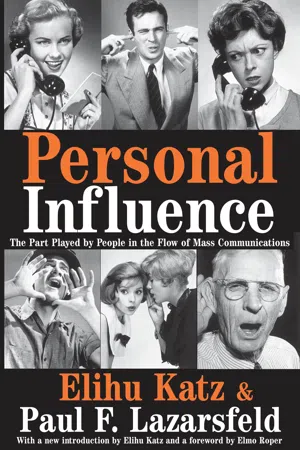
Personal Influence
The Part Played by People in the Flow of Mass Communications
- 434 pages
- English
- ePUB (mobile friendly)
- Available on iOS & Android
eBook - ePub
Personal Influence
The Part Played by People in the Flow of Mass Communications
About this book
First published in 1955, "Personal Influence" reports the results of a pioneering study conducted in Decatur, Illinois, validating Paul Lazarsfeld's serendipitous discovery that messages from the media may be further mediated by informal "opinion leaders" who intercept, interpret, and diffuse what they see and hear to the personal networks in which they are embedded. This classic volume set the stage for all subsequent studies of the interaction of mass media and interpersonal influence in the making of everyday decisions in public affairs, fashion, movie-going, and consumer behavior. The contextualizing essay in Part One dwells on the surprising relevance of primary groups to the flow of mass communication. Peter Simonson of the University of Pittsburgh has written that "Personal Influence was perhaps the most influential book in mass communication research of the postwar era, and it remains a signal text with historic significance and ongoing reverberations...more than any other single work, it solidified what came to be known as the dominant paradigm in the field, which later researchers were compelled either to cast off or build upon." In his introduction to this fiftieth-anniversary edition, Elihu Katz discusses the theory and methodology that underlie the Decatur study and evaluates the legacy of his coauthor and mentor, Paul F. Lazarsfeld.
Information
Part One
The Part Played by People: A New Focus
for the Study of Mass Media Effects
Section One:
IMAGES OF THE MASS
COMMUNICATIONS PROCESS
Chapter I
Between Media
and Mass
WHEN PEOPLE first began to speculate about the effects of the mass media, they showed two opposite inclinations. Some social commentators thought the mass media would do nothing less than recreate the kind of informed public opinion which characterized the “town meeting,” in the sense that citizens would once again have equal access to an intimate, almost first-hand account of those matters which required their decision. People had lost contact with the ever-growing world, went this argument, and the mass media would put it back within reach.1
Others saw something quite different. In their view, the mass media loomed as agents of evil aiming at the total destruction of democratic society. First the newspaper, and later the radio, were feared as powerful weapons able to rubber-stamp ideas upon the minds of defenseless readers and listeners. In the 1920’s, it was widely held that the newspapers and their propaganda “got us into the war,” while in the 1930’s, many saw in the Roosevelt campaign “proof” that a “golden voice” on the radio could sway men in any direction.2
From one point of view, these two conceptions of the function of the mass media appear widely opposed. From another viewpoint, however, it can be shown that they are not far apart at all. That is to say, those who saw the emergence of the mass media as a new dawn for democracy and those who saw the media as instruments of evil design had very much the same picture of the process of mass communications in their minds. Their image, first of all, was of an atomistic mass of millions of readers, listeners and movie-goers prepared to receive the Message; and secondly, they pictured every Message as a direct and powerful stimulus to action which would elicit immediate response. In short, the media of communication were looked upon as a new kind of unifying force—a simple kind of nervous system—reaching out to every eye and ear, in a society characterized by an amorphous social organization and a paucity of interpersonal relations.3
This was the “model”—of society and of the processes of communication—which mass media research seems to have had in mind when it first began, shortly after the introduction of radio, in the 1920’s. Partly, the “model” developed from an image of the potency of the mass media which was in the popular mind. At the same time, it also found support in the thought of certain schools of social and psychological theory. Thus, classical sociology of the late 19th century European schools emphasized the breakdown of interpersonal relations in urban, industrial society and the emergence of new forms of remote, impersonal social control.4 Later, random sampling methods, opinion and attitude testing techniques, and a discipline based on an approach to “representative” individuals lifted from the context of their associations link the beginnings of communications research to applied psychology.
Mass Media Research: The Study of “Campaigns”
These were some of the ideas with which mass media research began. And as it proceeded, it became traditional to divide the field of communications research into three major divisions. Audience research—the study of how many of what kinds of people attend to a given communications message or medium—is, historically, the earliest of the divisions, and still the most prolific. The second division is that of content analysis, comprising the study of the language, the logic and the layout of communications messages. And finally, there is what has been called effect analysis or the study of the impact of mass communications.
For some purposes, this three-way division is useful For other purposes, however-and, notably, for the purpose at hand-it is misleading because it obscures the fact that, fundamentally, all of communications research aims at the study of effect. From the earliest theorizing on this subject to the most contemporary empirical research, there is, essentially, only one underlying problem—though it may not always be explicit -and that is, “what can the media ‘do’?” Just as the “model” we have examined poses this question, so too, do the “clients” of mass media research. Consider the advertiser, or the radio executive, or the propagandist or the educator. These sponsors of research are interested, simply, in the effect of their message on the public. And if we find that they commission studies of the characteristics of their audience, or of the content of their message, clearly we have a right to assume that these aspects are connected, somehow, with effects.
Moreover, if we reflect on these patrons of research and their motivations for a moment longer, we can sharpen this notion of effect. We have been talking as if effect were a simple concept when, in fact, there are a variety of possible effects that the mass media may have upon society, and several different dimensions along which effects may be classified.5 Now of all the different types of effects which have ever been speculated about or categorized, it is safe to say that these sponsors of research—whose goals underlie so much of mass media research—have selected, by and large, just one kind of effect for almost exclusive attention. We are suggesting that the overriding interest of mass media research is in the study of the effectiveness of mass media attempts to influence—usually, to change—opinions and attitudes in the very short run. Perhaps this is best described as an interest in the effects of mass media “campaigns’—campaigns to influence votes, to sell soap, to reduce prejudice. Noting only that there are a variety of other mass media consequences which surely merit research attention but have not received it,6 let us proceed with this more circumspect definition clearly in mind; Mass media research has aimed at an understanding of how, and under what conditions, mass media “campaigns” (rather specific, short-run efforts) succeed in influencing opinions and attitudes.
Intervening Variables and the Study of Effect
If it is agreed that the focus of mass media research has been the study of campaigns, it can readily be demonstrated that the several subdivisions of research—audience research, content analysis, etc.—are not autonomous at all but, in fact, merely subordinate aspects of this dominant concern. What we mean can be readily illustrated. Consider, for example, audience research—the most prolific branch of mass media research. One way of looking at audience research is to see it only as an autonomous research arena, concerned with what has been called fact-gathering or bookkeeping operations. We are suggesting, however, that audience research may be viewed more appropriately as an aspect of the study of effect, in the sense that counting up the audience and examining its characteristics and its likes and dislikes is a first step toward specifying what the potential effect is for a given medium or message. In other words, if we do not lose sight of the end problem which is clearly central to this field, audience research falls right into place as an intermediate step.
And so, it turns out, do each of the other major branches of mass media research. One might say that the intellectual history of mass media research may, perhaps, be seen best in terms of the successive introduction of research concerns-such as audience, content, and the like—which are basically attempts to impute effects by means of an analysis of some more readily accessible intermediate factors with which effects are associated.
However, these factors serve not only as a basis for the indirect measurement or imputing of effects: they also begin to specify some of the complexities of the mass communications process. That is to say, the study of intermediate steps has led to a better understanding of what goes on in a mass media campaign—or, in other words, to an understanding of the sequence of events and the variety of factors which “intervene” between the mass media stimulus and the individual’s response. Thus, each new aspect introduced has contributed to the gradual pulling apart of the scheme with which research began: that of the omnipotent media, on one hand, sending forth the message, and the atomized masses, on the other, waiting to receive it—and nothing in-between.
Now let us turn to document these assertions somewhat more carefully. A brief view will be taken of each of four factors that come in between—or, as we shall say, that “intervene” —between the media and the masses to modify the anticipated effects of communications. We shall consider four such intervening variables: exposure, medium, content, and predispositions. Each of these has become one of the central foci of research attention (audience research, media comparison studies, content analysis, and the study of attitudes). Each contributes to our understanding of the complexity of mass persuasion campaigns. Treating these factors will set the stage for the introduction of another (the most recently introduced) of these intervening variables, that of interpersonal relations, with which we shall be particularly concerned.
Four Intervening Variables in the Mass Communication Process
The four variables we shall consider contribute, under some conditions, to facilitating the flow of communications between media and masses and, under other conditions, to blocking the flow of communications. It is in this sense, therefore, that we call them intervening.7
First, there is the variable of “exposure” (or “access,” or “attention”) which derives, of course, from audience research.8 Audience research has shown that the original mass communications “model” is not adequate, for the very simple reason that people are not exposed to specific mass media stimuli as much, as easily, or as randomly as had been supposed. Exposure or non-exposure may be a product of technological factors (as is the case in many pre-industrial countries),9 political factors (as in the case of totalitarian countries), economic factors (as in the case of not being able to afford a TV set), and especially of voluntary factors—that is, simply not tuning in. In the United States, it is, typically, this voluntary factor that is most likely to account for who is in the audience for a particular communication message. Perhaps the most important generalization in this area—at least as far as an understanding of the process of effective persuasion is concerned—is that those groups which are most hopefully regarded as the target of a communication are often least likely to be in the audience. Thus, educational programs, it has been found, are very unlikely to reach the uneducated; and goodwill programs are least likely to reach those who are prejudiced against another group; and so on.10 It is in this sense that we consider the mere fact of exposure itself a major intervening variable in the mass communications process.
A second focus of mass media research which developed very early was the differential character of the media themselves. The research which falls into this category asks the general question: What is the difference in the effect of Message X if it is transmitted via Medium A, B or C? The appearance of Cantril and Allport’s (1935) book, The Psychology of Radio, called attention to a whole set of these “media comparison” experiments. Here, type-of-medium is the intervening variable insofar as the findings of these studies imply that the process of persuasion is modified by the channel which delivers the message.11
Content—in the sense of form, presentation, language, etc.— is the third of the intervening variables on our list. And while it is true that the analysis of communications content is carried out for a variety of reasons, by and large, the predominant interest of mass media research in this area relates to the attempt to explain or predict differences in effect based on differences in content. To be more precise, most of the work in this field imputes differences in intervening psychological processes—and thus, differences in effects—from observed differences in content.12 Content analysis informs us, for example, of the psychological techniques that are likely to be most effective (e.g., repetition, appeal to authority, band-wagon, etc.); the greater sway of “facts” and “events” as compared with “opinions”; the cardinal rule of “don’t argue”; the case for and against presenting “one side” rather than “both sides” of controversial material; the “documentary” vs. the “commentator” presentation; the damaging effect of a script at “cross-purposes” with itself; etc. Important techniques have been developed for use in this field, and the controlled experiment has also been widely adopted for the purpose of observing directly the effect of the varieties of communications presentation and content. The characteristic quality of these techniques is evident: they concentrate on the “stimulus,” judging its effectiveness by referring either to more or less imputed psychological variables which are associated with effects or to the actual “responses” of those who have been exposed to controlled variations in presentation.
A fourth set of mediating factors, or intervening variables, emerges from study of the attitudes and psychological predispositions of members of the audience, insofar as these are associated with successful and unsuccessful campaigns. In this area, mass media research has established very persuasively what social psychologists have confirmed in their laboratories—that an individual’s attitudes or predispositions can modify, or sometimes completely distort, the meaning of a given message. For example, a prejudiced person whose attitude toward an out-group is strongly entrenched may actively resist a message of tolerance in such a way that the message may even be perceived as a defense of prejudice...
Table of contents
- Cover Page
- Title Page
- Copyright Page
- Contents
- Acknowledgments
- Introduction to the Transaction Edition
- Foreword, by Elmo Roper
- Part One The Part Played by People: A New Focus for the Study of Mass Media Effects
- Part 2 The Flow of Everyday Influence in a Midwestern Community
- Bibliography
- Index
Trusted by 375,005 students
Access to over 1.5 million titles for a fair monthly price.
Study more efficiently using our study tools.
Frequently asked questions
Yes, you can cancel anytime from the Subscription tab in your account settings on the Perlego website. Your subscription will stay active until the end of your current billing period. Learn how to cancel your subscription
No, books cannot be downloaded as external files, such as PDFs, for use outside of Perlego. However, you can download books within the Perlego app for offline reading on mobile or tablet. Learn how to download books offline
We are an online textbook subscription service, where you can get access to an entire online library for less than the price of a single book per month. With over 1.5 million books across 990+ topics, we’ve got you covered! Learn about our mission
Look out for the read-aloud symbol on your next book to see if you can listen to it. The read-aloud tool reads text aloud for you, highlighting the text as it is being read. You can pause it, speed it up and slow it down. Learn more about Read Aloud
Yes! You can use the Perlego app on both iOS and Android devices to read anytime, anywhere — even offline. Perfect for commutes or when you’re on the go.
Please note we cannot support devices running on iOS 13 and Android 7 or earlier. Learn more about using the app
Please note we cannot support devices running on iOS 13 and Android 7 or earlier. Learn more about using the app
Yes, you can access Personal Influence by Elihu Katz,Paul F. Lazarsfeld,Elmo Roper in PDF and/or ePUB format, as well as other popular books in Social Sciences & Media Studies. We have over 1.5 million books available in our catalogue for you to explore.