eBook - ePub
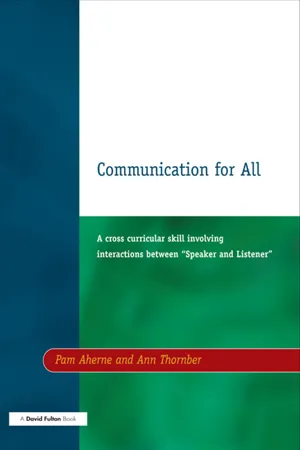
Communication for All
A Cross Curricular Skill Involving Interaction Between "Speaker and Listener"
- 48 pages
- English
- ePUB (mobile friendly)
- Available on iOS & Android
eBook - ePub
Communication for All
A Cross Curricular Skill Involving Interaction Between "Speaker and Listener"
About this book
Discusses the meaning of a broad, balanced and relevant curriculum for pupils with severe and complex learning difficulties and uses three case studies to illustrate this in practice. This working document has been produced by special school teachers from Manchester Education Committee.
Information
Section 1:
Foundations of Communication
Over the past twenty years there have been exciting developments in our understanding of how children communicate and our approach to teaching spoken language is changing. The reasons for this may be summarised as follows.
- There has been a growing understanding of how children learn. Learning occurs through all of the interactions between the child and his/her social and physical environment. For the child, areas of learning are interrelated rather than compartmentalised into subject headings.
- The traditional emphasis on language development as a growing collection of words and grammatical forms, has changed. We are now much more concerned with how children use language and what they are communicating about.
- The evidence of research into the way children learn to communicate has given rise to new approaches. In short, children learn to communicate by participating in the communication process with others. To do so, they need a reason to communicate, someone to communicate with and a means of expressing themselves. Learning depends on the quality of the interactions in which they are involved.
All these issues are well documented and are as relevant for students with severe and profound learning difficulties as for other learners. In this introductory section, some of the implications for practice in the context of the National Curriculum are considered.
(Adapted from Aherne 1990.)
The Function and Nature of Communication
Halliday (1973) suggested that children know what language is because they know what language does and that it is essential to discover:
‘the purposes language serves for us … how we achieve these purposes through speaking and listening, reading and writing….. and how language itself has been shaped by use.’
He stresses childrens’ use of language to express their understanding of the world and its meaning for them, as well as expressing needs, feelings etc. The context for this is grounded in the child’s own direct experience, and the function of language is fundamentally a social need to communicate. Thus both the intellectual and the social bases of communication are identified. Intellectual understanding influences the content and meaning and social relationships influence its use and effectiveness. Two new theoretical approaches which have arisen from numerous studies are known as the psycholinguistic and the sociolinguistic approach. (See Goldbart 1988a for a more detailed account.)
As evolving theories show, the linguistic, intellectual and social aspects of the situation in which children acquire language are dependent upon each other, and evolve in a mutually supportive way. Hence the skills or attainment targets to be identified in the development of the process of communication, including speaking and listening, should have three main components: intellectual, linguistic and social.
Kiernan, Reid and Goldbart (1987) define communication as:
‘responses which a person makes intentionally in order to affect the behaviour of another person and with the expectation that the other person will receive and act on that message.’
These responses include speaking, listening and using language as a system of words and rules. However they also include the use of non verbal elements of communication such as gesture, expression and body language. The latter reflect social or ‘pragmatic’ aspects such as the act a speaker intends to carry out with a sentence or word, for example commanding, questioning. The speaker presupposes that the listener shares their understanding between what is communicated and the situation. For example, a glance at a friend in a group situation can mean any thing from ‘its time to go’ or ‘don’t say any more about that’.
Current studies focus upon the social ‘rules’ and use of communication. The importance of these pragmatic aspects of communication with their roots in social interaction has been highlighted by McLean and Snyder-McLean (1985). This perspective has been expanded upon and developed for all children including those with severe learning difficulties.
The use of tone, facial expression and body language may convey as much or more than spoken words. We can, and indeed all do, communicate non-verbally both in socially understood ways and in ways which are more personal and most fully understood by family and friends.
Early Development Within Level 1 of The National C...
Table of contents
- Cover
- Title
- Copyright
- Contents
- Acknowledgements
- Introduction
- SECTION 1: Foundations of Communication
- SECTION 2: Process of Communication in Practice
- Conclusion
- Appendices
- Bibliography
Trusted by 375,005 students
Access to over 1.5 million titles for a fair monthly price.
Study more efficiently using our study tools.
Frequently asked questions
Yes, you can cancel anytime from the Subscription tab in your account settings on the Perlego website. Your subscription will stay active until the end of your current billing period. Learn how to cancel your subscription
No, books cannot be downloaded as external files, such as PDFs, for use outside of Perlego. However, you can download books within the Perlego app for offline reading on mobile or tablet. Learn how to download books offline
Perlego offers two plans: Essential and Complete
- Essential is ideal for learners and professionals who enjoy exploring a wide range of subjects. Access the Essential Library with 800,000+ trusted titles and best-sellers across business, personal growth, and the humanities. Includes unlimited reading time and Standard Read Aloud voice.
- Complete: Perfect for advanced learners and researchers needing full, unrestricted access. Unlock 1.5M+ books across hundreds of subjects, including academic and specialized titles. The Complete Plan also includes advanced features like Premium Read Aloud and Research Assistant.
We are an online textbook subscription service, where you can get access to an entire online library for less than the price of a single book per month. With over 1.5 million books across 990+ topics, we’ve got you covered! Learn about our mission
Look out for the read-aloud symbol on your next book to see if you can listen to it. The read-aloud tool reads text aloud for you, highlighting the text as it is being read. You can pause it, speed it up and slow it down. Learn more about Read Aloud
Yes! You can use the Perlego app on both iOS and Android devices to read anytime, anywhere — even offline. Perfect for commutes or when you’re on the go.
Please note we cannot support devices running on iOS 13 and Android 7 or earlier. Learn more about using the app
Please note we cannot support devices running on iOS 13 and Android 7 or earlier. Learn more about using the app
Yes, you can access Communication for All by Pam Aherne,Ann Thornber in PDF and/or ePUB format, as well as other popular books in Didattica & Didattica generale. We have over 1.5 million books available in our catalogue for you to explore.