- 182 pages
- English
- ePUB (mobile friendly)
- Available on iOS & Android
eBook - ePub
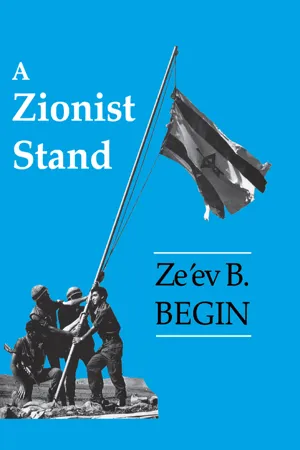
A Zionist Stand
About this book
A member of the Knesset, Dr Begin here reflects upon the mainstream political thought of the Likud Party which came to power in 1977. This book analyzes the basic factors relevant to the Israeli position in the Middle East, providing a different outlook on the complexities of the region.
Information
How difficult is it to predict the future?
IT HAS BEEN said that ‘it is difficult to predict, and especially the future’. Let’s examine the validity of this observation.
Seventy years ago, on 4 October 1917, the British War Cabinet discussed the possibility of issuing a declaration favouring the return of the Jews to Eretz Yisrael, also known as Palestine. One of the participants urged objections, as recorded in the minutes:
Lord Curzon [Lord President of the Council] urged strong objections upon practical grounds. He stated, from his recollection of Palestine, that the country was, for the most part, barren and desolate; there being but sparse cultivation on the terraced slopes, the valleys and streams being few, and large centres of population scarce. A less propitious seat for the future Jewish race could not be imagined. How was it proposed to get rid of the existing majority of Mussulman inhabitants and to introduce the Jews in their place? How many would be willing to return and on what pursuits would they engage?
To secure for the Jews already in Palestine equal civil and religious rights seemd to him a better policy than to aim at repatriation on a large scale. He regarded the latter as sentimental idealism, which would never be realised, and that His Majesty’s Government should have nothing to do with it.
So, indeed, it is difficult to predict, and especially the future.
On 2 November 1917 Mr Balfour, then the British Secretary of State for Foreign Affairs, sent a letter whose contents became known as the Balfour Declaration, beginning with the words:
Dear Lord Rothschild, I have much pleasure in conveying to you, on behalf of His Majesty’s Government, the following declaration of sympathy with the Jewish Zionist aspirations, which has been submitted to and approved of by the Cabinet.
And five years later, it was declared in the Council of the League of Nations assembled in London, on 24 July 1922:
Whereas the Principal Allied Powers have also agreed that the Mandatory should be responsible for putting into effect the declaration originally made on 2 November 1917 by the Government of His Britannic Majesty, and adopted by the said Powers, in favour of the establishment in Palestine of a national home for the Jewish people, recognition has thereby been given to the historical connexion of the Jewish people with Palestine and to the grounds for reconstituting their national home in that country.
It was a great triumph for historic justice.
The idea that the Jewish State should be reconstituted in Eretz Yisrael, the notion that the land of Israel belongs as of right to the Jewish people, found its clear expression in 1948, in the Declaration of the establishment of our State:
We, Members of the People’s council, representatives of the Jewish community of Eretz Yisrael and of the Zionist Movement, are here assembled on the day of the termination of the British mandate over Eretz Yisrael, and by virtue of our natural and historic right and on the strength of the resolution of the United Nations General Assembly, hereby declare the establishment of a Jewish State in Eretz Yisrael, to be known as the State of Israel.
No borders were determined by the State of Israel at its inception. After a prolonged war with our Arab neighbours, the tortuous ‘Green Line’ of armistice was demarcated. It has no historic or moral significance whatsoever – it is nothing but the line of battle fatigue. At any rate, with the Arab aggression in June 1967 it was politically buried, despite recurring attempts on the part of our enemies as well as some friends to revive it.
In the next 25 years the Balfour Declaration would turn into a series of disappointments. One of these was the Palestine Royal Commission, chaired by the Right Honourable Earl Peel, which in 1937 recommended a new partition of Palestine west of the Jordan River.
Almost exactly 50 years ago, on 11 February 1937, a great Zionist, Ze’ev Jabotinsky, testified before the Peel Commission saying:
I am going to make a ‘terrible’ confession. Our demand for a Jewish majority is not our maximum – it is our minimum, it is just an inevitable stage if only we are allowed to go on salvaging our people. The point when the Jews will reach in that country a majority will not be the point of saturation yet – because with 1,000,000 more Jews in Palestine today you could already have a Jewish majority, but there are certainly 3,000,000 or 4,000,000 in the East who are virtually knocking at the door asking for admission, which means for salvation.
We have known for the last 48 years that it meant exactly that – Salvation with a capital S. Some people, then, can predict.
Five months later, after that Royal Commission published its recommendations regarding partition, Ze’ev Jabotinsky addressed Members of Parliament in this very building, saying:
But what the Royal Commission proposes is quite different. On the one hand the Jewish ‘State’ is to be reduced to this dwarfish proportion – a district so small that its Jewish defenders will always remain a handful. It almost looks like a lonely villa on the seashore: a villa belonging to a rival race, and a villa so poorly protected.
On the other hand, both the Royal Commission and the Government clearly encourage the proposed Arab State to join a future Arab Federation, so that the little villa is to be surrounded by a more or less united mass of covetous appetites about ten million strong. I said ‘united’: they may differ on many things, but they can be confidently expected to agree on this one point, that Naboth’s vineyard must be captured.
Strategically, how can this ‘Pale’ be defended against any serious aggression? Most of it is lowland, whereas the Arab reserve is all hills. Guns can be placed on the Arab hills within 15 miles of Tel-Aviv and 20 miles of Haifa; in a few hours these towns can be destroyed, the harbours made useless, and most of the plains overrun whatever the valour of their defenders.
Ten years after Jabotinsky’s address in this building, Egypt, Saudi Arabia, Iraq, Syria and the Hashemite Kingdom of Jordan, united their covetous appetites in an attempt to smother the baby State of Israel. The result was an unlawful occupation of the Gaza area by Egypt, and an unlawful occupation of Judaea and Samaria by the Hashemites. Up to 6 June 1967 the ten-mile-wide Israel faced a very real threat of being overrun within a few hours, as foreseen by Jabotinsky.
Some people, obviously, can predict, and even the future.
In 1967 we witnessed an attempt at a rerun. Again the rival Arab states united against Israel, with Hussein unable to resist the temptation, to restrain his appetite, joining Syria and Egypt in an attempt to push us into the Mediterranean. However, this time, as a result of repelling this joint aggression, Judaea and Samaria lawfully came under the control of Israel.
Let us note that even those who would like to see Israel ultimately relinquishing Judaea and Samaria to the Hashemite Kingdom of Jordan should remember that resolutions of various United Nations organs calling on Israel to unilaterally withdraw its forces from these areas do not have any basis in international law. Let us also note that even those who view Judaea and Samaria as occupied areas should bear in mind that the Supreme Court of Israel, sitting as a High Court of Justice has assumed jurisdiction over the military commanders in these areas, and that this is the first occasion in the history of military occupation that citizens of an occupied territory have been allowed a direct appeal to the high court of the occupying power.
There is, therefore, nothing unlawful, nothing immoral in Israel’s control of Judaea and Samaria. And let me be very specific: There is nothing immoral, despite the opinion that found favour in some quarters, in our total objection to the idea of the establishment of yet another Palestinian Arab state in Judaea and Samaria, namely, a PLO, pro-Soviet terrorist base.
We are sometimes preached to on the basis of the alleged necessity to apply the right of self-determination to the Arab inhabitants of Judaea and Samaria. Sometimes this is coupled with an attempt to convince us that this should be the political solution on practical grounds.
Practical arguments are sometimes called for by some of our friends who try to persuade us that it is not worthwhile for us to keep our control of Judaea and Samaria. To test the validity of these arguments let us play a game: I shall read a part of an editorial which appeared in the prestigious London Times of 7 September. It will be your role to guess what is wrong in this quotation.
In that case it might be worthwhile for the Israeli Government to consider whether they should exclude altogether the project, which has found favour in some quarters, of making Israel a more homogeneous State by the secession of that fringe of alien population who are contiguous to the nation with which they are united by race … In any case, the wishes of the population concerned would seem to be a decisively important element in any solution that can hope to be regarded as permanent, and the advantages to Israel of becoming a homogeneous State might conceivably outweigh the obvious disadvantages of losing the Judaea and Samaria districts of the borderland.
The solution to this riddle is simple. The editorial appeared with a change of but a few names, on 7 September 1938, a short while before Chamberlain went to Munich. The Germans interpreted it correctly: it reflected the mood of the British government, which, in addition to pseudo-moral arguments, resorted to pseudo-practical ones in order to twist the Czech arm on the issue of the Sudeten Hills, that strategic buffer zone between Germany and Czechoslovakia. The original reads as follows:
In that case it might be worthwhile for the Czechoslovak Government to consider whether they should exclude altogether the project, which has found favour in some quarters, of making Czechoslovakia a more homogeneous State by the secession of that fringe of alien populations who are contiguous to the nation with which they are united by race… The advantages to Czechoslovakia of becoming a homogeneous State might conceivably outweigh the obvious disadvantages of losing the Sudeten German districts of the borderland.
It is, I believe, an interesting exercise. I propose that the analogy is valid, and I think the moral is useful: do not hasten to advise a friend if he is to bear the harsh consequences of your advice.
We do seek peace with our neighbouring states. The only way to reach peace with our neighbours – anchored in peace treaties – is to conduct direct negotiations, within the framework of the Camp David accords, as stated in the guiding principles of the Government of Israel. But peace must be based on security, otherwise peace is a meaningless word. We must be able to defend such a treaty that we hope to sign. The hills of Judaea and Samaria are a decisive factor in our ability to retain stability in our part of the Middle East.
***
Elaborating now on the issue of the national will to resist a threat, let us turn to the prelude to war of 1939, namely to the Munich Agreement, in reference to which the British historian, A. J. P. Taylor, wrote in his book The Origins of the Second World War:
British policy over Czechoslovakia originated in the belief that Germany had a moral right to the Sudeten German territory on grounds of national principle; and it drew the further corollary that this victory for self determination would provide a stabler, more permanent peace in Europe …
… It was triumph for all that was best and most enlightened in British life, a triumph for those who had preached equal justice between peoples …
… with skill and persistence, Chamberlain brought first the French and then the Czechs to follow the moral line …
What folly!
William Shirer, in his book The Dreadful Years, also described the mood:
‘My good friends!’ exclaimed Chamberlain on his return from Munich, This is the second time in our history that there has come back from Germany to Downing Street peace with honour. I believe it is peace in our time.’
Yes, it is difficult to predict, and especially the future.
The British press, Parliament and the people were jubilant, hailing the returning Prime Minister as a hero. The Times wrote that ‘no conqueror returning from the battlefield has come adorned with nobler laurels’. Only Duff Cooper, the First Lord of the Admiralty, resigned from the Cabinet in protest. And when in the ensuing House of Commons debate Churchill rose to brand Munich ‘as a total, unmitigated defeat’, he was forced to pause until a storm of hostile shouting had subsided.
‘You were given the choice between war and dishonour,’ Churchill said. ‘You chose dishonour and you will have war.’
Some people, obviously, can predict, and even the future, but not quite: when Great Britain went to war – bitter, cruel, demanding blood, tears, toil and sweat – the Jewish people went to the slaughterhouse.
It is apparently not too difficult to deceive the moral senses of a civilized person. The Munich case is an extraordinarily useful example of the abuse of the concept of the right to self determination. This concept, as you know, has been abused by the PLO since its establishment in 1964, three years before Judaea and Samaria came under Israeli control in a war of selfdefence. This idea cannot be applied to the Arab inhabitants of Judaea, Samaria and the Gaza District, as can be learned even from the PLO charter itself:
Article 1: Palestine is the homeland of the Arab Palestinian people; it is an indivisible part of the Arab homeland, and the Palestinian people are an integral part of the Arab Nation.
The Arab nation enjoys, in the fullest possible way, its right to self-determination. It finds its expression in 21 independent states. No other nation on earth enjoys such an expression of its national aspirations. To play on the linguistic difference between a nation and a people is ridiculous. If this distinction is valid, it would allow the Jews in Brooklyn, New York, to declare the independent Jewish State of Brooklyn, being the ‘separate American Jewish People’, an ‘integral part’ of the Jewish nation. This is a cynical attempt to exploit the good will and naive approach of citizens of the free world. Fifty years after Munich, no decent person with eyes in his head should fall into the political trap of the alleged Palestinian Arabs’ right to self-determination. To be blunt – as sometimes bluntness is needed – it is a bluff.
The ‘Final Political Statement of the Fourth Convention of the Fatah Organization’, issued in Damascus on 31 May 1980 stated in Article 8 that the aim of the Fatah movement is ‘the liquidation of the Zionist entity – politically, economically, militarily, culturally and ideologically’ and that ‘the establishment of a democratic Palestinian state on all of the Palestinian land will assure the legitimate rights of all its inhabitants and it will be able to actively participate in the realization of the goals of the Arab nation in the liberation of its countries and the establishment of a united progressive Arab society’.
The infamous Palestinian Covenant, the PLO charter, issued in 1964, states in its Article 19 that the establishment of the State of Israel is ‘entirely illegal, regardless of the passage of time’. Article 20 says: ‘The Balfour Declaration, the Mandate for Palestine and everything that has been based upon them, are deemed null and void’. Article 22 states: ‘The liberation of Palestine will destroy the Zionist and imperialist presence …’.
In other words, this is an excuse for terrorism, and a poor one. In his article, ‘The Cancer of Terrorism’, Paul Johnson wrote last year:
Modern terrorism dates from the middle 1960s, when the PLO formally adopted terror and mass murder as its primary policy. Terrorism was t...
Table of contents
- Cover
- Half Title
- Title Page
- Copyright Page
- Contents
- An Introduction to a Zionist Stand
- On Zionism and Fairness
- Zionism and Morality – The Triple Test
- A Perennial Stream
- How Difficult is it to Predict the Future?
- The Importance of Drawing Conclusions
- Fifty Years Ago
- Jerusalem, Babylon and New York
- Jerusalem Still Under Siege
- Back to the High Road
- The Only Game in Town
- Jerusalem, Early Thursday Morning
- The Camp David Formula Awaits Rediscovery
- The Eighth Option
- Light at the End of the Cloud
- US Clarifications to the PLO
- The Art of Non-Start
- European Talks on Conventional Arms Limitations and their Ramifications for the Middle East
- The Water Divide
- The US Position towards the PLO
- US Hesitations to Halt Talks with the PLO
- Extending a Hand
- Retaining Israel’s Qualitative Edge
- A Brave New Diplomacy
- Strategic Depth Still Counts
- Transforming Chaos into Order
- Aiming Low
- The Territorial Pretence
- Alice in the Middle East
- Supply and Demand in the Middle East Arms Race
- Guarded Optimism in the Middle East
- No Linkage between Loan Guarantees and Diplomacy
- Back to Camp David
- Diplomacy of Contradictions
- The Camp David Framework Applied
- Israel’s Contributions to the Cause of Peace
Trusted by 375,005 students
Access to over 1.5 million titles for a fair monthly price.
Study more efficiently using our study tools.
Frequently asked questions
Yes, you can cancel anytime from the Subscription tab in your account settings on the Perlego website. Your subscription will stay active until the end of your current billing period. Learn how to cancel your subscription
No, books cannot be downloaded as external files, such as PDFs, for use outside of Perlego. However, you can download books within the Perlego app for offline reading on mobile or tablet. Learn how to download books offline
Perlego offers two plans: Essential and Complete
- Essential is ideal for learners and professionals who enjoy exploring a wide range of subjects. Access the Essential Library with 800,000+ trusted titles and best-sellers across business, personal growth, and the humanities. Includes unlimited reading time and Standard Read Aloud voice.
- Complete: Perfect for advanced learners and researchers needing full, unrestricted access. Unlock 1.5M+ books across hundreds of subjects, including academic and specialized titles. The Complete Plan also includes advanced features like Premium Read Aloud and Research Assistant.
We are an online textbook subscription service, where you can get access to an entire online library for less than the price of a single book per month. With over 1.5 million books across 990+ topics, we’ve got you covered! Learn about our mission
Look out for the read-aloud symbol on your next book to see if you can listen to it. The read-aloud tool reads text aloud for you, highlighting the text as it is being read. You can pause it, speed it up and slow it down. Learn more about Read Aloud
Yes! You can use the Perlego app on both iOS and Android devices to read anytime, anywhere — even offline. Perfect for commutes or when you’re on the go.
Please note we cannot support devices running on iOS 13 and Android 7 or earlier. Learn more about using the app
Please note we cannot support devices running on iOS 13 and Android 7 or earlier. Learn more about using the app
Yes, you can access A Zionist Stand by Ze'ev B. Begin in PDF and/or ePUB format, as well as other popular books in Politics & International Relations & Middle Eastern History. We have over 1.5 million books available in our catalogue for you to explore.