- 361 pages
- English
- ePUB (mobile friendly)
- Available on iOS & Android
eBook - ePub
About this book
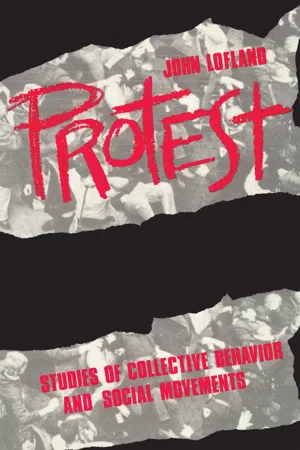
This volume addresses three major issues: What are the circumstances in which people elect to protest; what are the forms of such action; and how do people organize to do so? Phrased differently, what are the contexts of protest (collective behavior), personal readiness for protest (conversion), and finally joining together for protest in movement organizations and movement strategies.The key to the book's value is its theoretical sophistication. These studies address in a systematic way fundamental alternatives to organizing protests and outline in detail options for structuring units of social movement. The author deals especially with movement organization locals, including "corps" and "cells." Such units are examined in terms of how they coexist and how they exist sequentially through time. Several case studies of movement organization are included, such as the Unification Church and Mankind United.The work places a heavy emphasis on protest action or strategy. In the final section four chapters examine the entire gamut of strategic possibilities, ranging from polite politics to violent action. Protest is a distinctive and complex strategy. The work carefully evaluates varieties of protest that have become significant in the 1980s. In each section of the book Lofland draws out underlying themes and issues that interrelate the studies and places protest in the larger context of political and social change and theories to date.
Information
Part One
COLLECTIVE BEHAVIOR: CONTEXTS OF PROTEST
INTRODUCTION
The chapters of part 1 address relations between collective behavior and protest, and collective behavior per se.
COLLECTIVE BEHAVIOR AND PROTEST
Protest as an act, gathering, event, or whatever is a type of collective behavior (CB), is facilitated or inhibited by various contexts of collective behavior, and is caused or prevented by other forms of collective behavior.
PROTEST AS A TYPE OF COLLECTIVE BEHAVIOR
In chapter 1, collective behavior is conceived as a circumstance of collective, emotional arousal and nonroutine action in a situation defined as “something unusual happening” and as a variable, as something that is more or less present in specific instances. Protest, therefore, as a form of collective behavior, varies in the degree to which it is such. One well-known and basic dynamic is the fact that any specific type of protest act, gathering, campaign, etc. that is repeated frequently loses its interest—its features as collective behavior—prompting searches for fresh possibilities—for “additions to the repertoire” (the title of Bert Useem’s column in Critical Mass Bulletin, 1983:27).
Conceiving collective behavior as variable also alerts us to what is perhaps most unique about protest. At its most effective, it dances on the margin of the routine, taken-for-granted world of predictability and security and the fearsome unpredictability of strongly collective behavior situations, particularly those that are violent. Eisinger (1973:14) captures this uniqueness well by calling attention to protest as implic itly threatening, stopping short of the explicit threat of violence:
The implicit-explicit dividing line is crucial. Protest harnesses aggressive impulses by controlling and, to some extent, masking them, while violence gives free reign to these impulses.
Protest . . . is a device by which groups of people manipulate fear of disorder and violence while at the same time they protect themselves from paying the potentially extreme costs of acknowledging such a strategy.
COLLECTIVE BEHAVIOR SITUATIONS AS CONTEXTS FOR PROTEST
There are myriad elementary forms or situations of collective behavior, and I strive to inventory many of them in chapters 1 and 2. The term elementary needs to be stressed because an array of complex forms into which the elementary ones can be subsumed is not discussed in those two chapters but needs to be recognized. Under some conditions of major macrostructural shifts and changes in central institutions, elementary forms of collective behavior increase in frequency and variety and form waves or cycles to which analysts begin to apply more macrosoclal labels. The nomenclature for these concatenations is contested by analysts but includes peasant revolts, rebellions, Jacqueries, uprisings, civil wars, insurgencies, civil disturbances, insurrections, unrest, turmoil, genocide, revolutionary situations, protest movements, and revivalist movements.
Such generalized or widespread collective behavior periods themselves constitute contexts fostering innovations in forms of protest and the adoption of such innovations by segments of the population not previously participants in protest (Tarrow 1983 a, b). Chapter 3, on the youth ghetto, is a case study of one important kind of context of collective behavior (including protest within the yet larger context of the collective behavior wave/cycle that took place in the American sixties). In addition to emerging macrostructural situations fostering collective behavior cycles, these cycles are facilitated by particular kinds of local circumstances of ghettoization, be these based on race, ethnicity, gender, or almost whatever. Chapter 3 suggests how ghettoization can be based on age and how this operated in the ghettoization of youth around large universities in the sixties, thereby creating geographic centers of potential and actual protest, as well as collective behavior of the many other kinds surveyed in chapters I and 2.
PROTESTS AS CAUSES OF OTHER COLLECTIVE BEHAVIOR FORMS
Although not addressed in this volume, it needs to be noted that often the effects of protest include diverse forms of responsive collective behavior on the part of new segments of the population “drawn into the action.” Among the richer studies of this is David Garrow’s (1978) detailed rendering of the various forms of collective behavior flowing from the Southern Christian Leadership Conference’s protest campaign in Selma, Alabama in 1965 and their both local and national collective behavior reverberations, including their impact on the passage of the Voting Rights Act of that year.
Most protests likely stimulate collective behavior that is hostile (those are the forms largely documented by Garrow, for example), but we need also to be alert to patterns of collective joy (described in chapter 2) that can be both incorporated into protest or follow in its wake. Or, more broadly, there may be senses in which protest waves (or lesser scales of protest) stimulate other—likely joyful collective behavior forms—as competing alternatives to the “contentiousness” of protest involvements.
ANALYZING COLLECTIVE BEHAVIOR
FROM CROWDS TO GATHERINGS IN THE STUDY OF COLLECTIVE BEHAVIOR
Scholars of collective behavior are on the verge of a significant breakthrough in the clarity of their conception of what they are studying and, therefore, in the acuity of their analyses. I like to believe that the materials presented in chapters 1 and 2 contribute to this new understanding even if they do not themselves yet achieve it.
The transition aborning involves sharpening our perception of some basic units of human association or organization, irrespective of, initially, their relevance to collective behavior. A signal crystallizing step in this process is Erving Goffman’s (1983) masterful synthesis of his life work titled “The Interaction Order.” In it he identifies features and units of “the interaction order” with a clarity not heretofore achieved and decisively opens the way to importing his specifications into the study of collective behavior.
Among other things, he speaks of five basic units of the interaction order: “ambulatory units, contacts, conventional encounters, formal meetings, platform performances, and social occasions” (Goffman 1983:7). The exact features of this formulation are less relevant here than is the step taken by the notion of “collected” behavior. A great part of what we call “collective behavior” is “collected behavior”— the occasion of a number of people being in the same place at the same time acting together under some encompassing definition of the situation. Following Clark McPhail (another architect of this transition, who follows Goffman), these are, generically, gatherings (McPhail and Wohlstein 1983:58).
To use the at once obvious and obscure notion of the “gathering” as one key starting point is to achieve several things. One, no distinction between “institutional” and “emergent” behavior or forms is initially drawn. That remains a distinction subsequently to be recognized within the domain of study rather than a bifurcation that puts aside “institutional gatherings” and fails seriously to return to them, as has been the debilitating error of collective behavior studies over several decades. Put differently, a critical class of contrast cases—institutionalized/ ordinary gatherings—have been improperly excluded from collective behavior analysis.
Two, again following McPhail, the concept of the “crowd” drops out for several reasons. (1) It is too general, abstract, and vague to serve as a unit of human association. (2) It carries too much excess conceptual baggage, such as “the illusion of unanimity” (McPhail and Wohlstein 1983:38). (3) Most important, it is the central concept of the classic “collective behaviorist” tradition descended from LeBon’s (1960) The Crowd, with all the emotional baggage of irrationality, irritability, excess, fickleness, and violence.
Three, conjoining the definition of collective behavior as a certain kind of variable (discussed in chapter 1) with the concept of human gatherings, facilitates seeing that many conventional and planned gatherings are “conventional collective behavior” in the sense that unusual actions, emotional arousal, and a perception of the extraordinary are planned features of such gatherings. Collective behavior can be not only emergent or extra-institutional behavior (the rough definition with which chapter 1 opens), but part and parcel of institutionalized life. A central question about gatherings becomes, then, to what degree and in what ways are they “collective behavior” and not merely “collected behavior”?
The aborning shift I have described is one of the more recent and technical-scholarly manifestations of the larger and longer-term trend in collective behavior which stresses its similarity to ordinary life along such dimensions as viewing its participants as rational rather than irrational, acting in solidarity rather than in atomized disorganization (a “build-up” versus “break down” stress), obeying (emergent) norms rather than breaking out of the bonds of control, creating new organization rather than reacting to its lack, pursuing goals and policies rather than goalless tension-release and expressive emotionality.
However, the shift to which I call attention here is also different from these others in that it continues to view collective behavior as a distinctive phenomenon, unlike the view taken by some other analysts. The shift from “crowds” to “gatherings” partakes of the larger “similarity trend” only in the special sense of highlighting the ubiquity of collective behavior and its appearance in mild forms in the midst of ordinary life and as an integral part of it,
HAZARDS OF FORECASTING COLLECTIVE BEHAVIOR WAVES: REFLECTIONS ON “THE YOUTH GHETTO”
Chapter 3, on the youth ghetto, is one of several ventures I have made into a variety of “predictive sociology,” the effort to be severely analytic about a rapidly changing and current collective behavior circumstance. Five of the analyses in this volume so venture (chs. 3, 10, 13, 14, 15), but only one—the youth ghetto—gets quite so “carried away” with the form.
The underlying structure of the form exhibited by the youth ghetto (and to a lesser degree the other chapters mentioned) is an interweaving of an effort to forecast the direction of a set of social forces with a dispassionate analytic conception of how the forces fit together and operate. In its own way, this is an applied sociology: The best things one can say sociologically are marshalled for a diagnostic and predictive task at hand.
Such efforts have their severe hazards, however, and the youth ghetto shows them starkly. First, immediate diagnosis and prediction requires detailed use of currently available data, and such data “dates” the effort quickly. The youth ghetto analysis thus reeks of 1967—the year of its composition. Because the essay also contains a time-transcendent analysis, I was tempted in preparing it for inclusion here to delete or update the time-place “dating” features, but soon decided that such an act was decidedly improper because those time-place framing features are an integral part of the analysis.
Second, many of the predictions I made in the youth ghetto have not come true. Age-grade segregation continues to exist, but has not proceeded as I forecast. Youth ghetto cultural distinctiveness has declined and dramatic age-grade confrontations have vanished. (Anyone can now invoke many plausible factors to account for these shifts, including, especially, the end of the Vietnam War and a broad front of adult efforts to mollify and coopt youth.)
Despite such hazards, there are good reasons to risk being wrong in these fashions. First, efforts to meld transcendent theory and current turmoil do appear to help people achieve helpful distance on turmoil, to foster a calmer frame of mind and therefore more considered action. That was a major reason for writing the article in the first place, as its opening paragraphs indicate. Second, application of general principles to an emerging case constitutes a kind of test of their range and robustness. The general principles at issue in the youth ghetto are a phase of the general theory of social conflict and taken specifically from the work of Gerald Suttles (1968) on inner city slums. I simply extracted salient features of the model Suttles propounds for the ethnic ghetto and tried to see how much of it we also found in the youth ghetto. Conceived more broadly, this was an instance of what Kenneth Burke long ago called “perspective by incongruity,” a procedure widely and effectively employed in social science (Burke 1936; Lofland and Lofland 1984, ch. 8). In doing this I was also greatly helped by a knowledge of the work of Max Heirich (1968) on a series of protests at Berkeley.
Although the data and the predictions are “dated,” the principles of conflict employed nonetheless hold and remain some of our best and most enduring insights, an assertion I can make with modesty because I only applied those principles to a new setting rather than having originally formulated them. 1 urge, therefore, that the youth ghetto be read with these two vantage points—generic theory versus specific data and predictions—in mind. By so doing one can avoid fruitless embroilment in the particulars and predictions of the late sixties and attend directly to the generic social processes of conflict seen in operation.
1
ELEMENTARY FORMS OF COLLECTIVE BEHAVIOR (1981)
INTRODUCTION
QUESTIONS AND EMPHASIS
As used by sociologists, the term collective behavior refers (roughly) to “emergent and extra-institutional social forms and behavior” (the phrasing employed in the bylaws of the American Sociological Association’s section on collective behavior and social movements)—panic-stricken, riotous, and ecstatic crowds being among the more dramatic of its myriad expressions.
In a manner logically identical to that in other fields of inquiry, students of this subject seek to isolate forms and causes of collective behavior; processes of its operation; the functions it performs or the consequences it has for other social forms and for participants; and strategies people employ toward and in the context of it, among other concerns.
Each of these and still other foci are valid and indispensable moments in the full round of analysis in all fields of inquiry. But for reasons we may reserve for the scrutiny of the sociologists of knowledge and science, not all are accorded equal attention by investigators at each point in the history of a specialty, and such an imbalance is particularly noticeable in the field of collective behavior. Specifically, in more recent decades, collective behaviorists have displayed a marked preoccupation with questions of causes and some aspects of questions of process to the relative neglect of other questions, especially the question of form (Marx and Wood 1975; Aguirre and Quaran-telli 1980; Marx 1979). This pronounced neglect of forms is having a critically retarding effect on the development of the field of collective behavior, and I attempt in this analysis to begin to redress the imbalance.
One could challenge the assertion that lack of attention to forms critically retards the study of collective behavior. In its favor, let me point to several matters. First, without articulate taxonomy, there is little guidance for cumulating relevant empirical inquiries. Important studies suffer inattention because no scheme, by its logic, directs attention to them. Among other forms described below, I refer, for example, to lynching and the more abstract pattern it exemplifies, one that goes virtually unconsidered in recent treatments of collective behavior. An important mission of this and the following chapter is generic rescue, an effort to save the varieties of collective behavior from death by citation neglect in the midst of publication overkill. I try to construct a metaphorical Noah’s ark in which to keep the creatures safe in an ocean of informational glut swept by waves of selective attention. Second, without a strong sense of context provided by articulate taxonomy, study of process becomes highly indefinite and prone to loggerheaded and even sterile debate. I fear this has happened, specifically, in debates over the relative merits of the contagion, convergence, emergent norm, and rational calculus views of processes in crowd behavior (Turner 1964; Perry and Pugh 1978; Tierney 1980). The next large step in that debate will take the form of specifying the taxonomical (and temporal) location of the operation of each of those four processes. The traditional topics of milling and rumor are also likely to advance in that manner. Third, I expect that a more complex and variegated rendering of forms will also have a salubrious effect on the study of causes. Undisciplined by taxonomy, causal statements tend either to be extremely general and virtually vacuous or, on the other side, situationally idiosyncratic (“historistic”). Stronger efforts at mid-range types and causal treatments so geared are likely to stimulate attention to new kinds of variables. I think, in particular, of Albert Bergesen’s (1976, 1980) excellent work on “official riots” and his attendant innovations in causal thinking (see below). (It is for such contextualizing purposes that 1, in what follows, sometimes depart from a strict form-focus, especially as regards study of process.)
For these reasons, my treatment is selective and somewhat different from most recent efforts. Because it is, I fear that many scholars of collective behavior who have focused on other questions, and who have made outstanding contributions to answering those questions, will be offended by my relative neglect of their achievements. I want to stress that my admitted neglect in this chapter proceeds not from ignorance or cavalier dismissal, but from a belief that expanding initiatives are in order. Expanding initiatives are not necessarily incompatible with existing concerns—at least not in this case—and my larger aim is to enrich the study of collective behavior rather than displace or ignore what exists. My selectivity arises, instead, from the constraints of space and time and an assessment of priorities within such limits.
NATURE OF COLLECTIVE BEHAVIOR
The most basic question of “form” is that of collective behavior itself as a form relative to other social forms. Employing the ideal type or idealization (Lopreato and Alston 1970) strategy of theorizing, it is helpful to conceive the pure case of collective behavior as a limiting instance. Such a case may never (or rarely) be encountered in the empirical world, but the ideal-typical model provides a benchmark in terms of which we can gauge the empirical cases we do see. In ideal-type logic, the features of the model are in fact variables—aspects that are more or less present in...
Table of contents
- Cover Page
- Title Page
- Copy Right Page
- Content Page
- List of Figures
- Preface and Acknowledgments
- Introduction Protest and the Public Arena
- Part One Collective Behavior: Contexts of Protest
- Part Two Conversion: Readiness for Protest
- Part Three Movement Organization: Associating for Protest
- Part Four Movement Action: Doing Protest
- Bibliography
- Index
Trusted by 375,005 students
Access to over 1.5 million titles for a fair monthly price.
Study more efficiently using our study tools.
Frequently asked questions
Yes, you can cancel anytime from the Subscription tab in your account settings on the Perlego website. Your subscription will stay active until the end of your current billing period. Learn how to cancel your subscription
No, books cannot be downloaded as external files, such as PDFs, for use outside of Perlego. However, you can download books within the Perlego app for offline reading on mobile or tablet. Learn how to download books offline
Perlego offers two plans: Essential and Complete
- Essential is ideal for learners and professionals who enjoy exploring a wide range of subjects. Access the Essential Library with 800,000+ trusted titles and best-sellers across business, personal growth, and the humanities. Includes unlimited reading time and Standard Read Aloud voice.
- Complete: Perfect for advanced learners and researchers needing full, unrestricted access. Unlock 1.5M+ books across hundreds of subjects, including academic and specialized titles. The Complete Plan also includes advanced features like Premium Read Aloud and Research Assistant.
We are an online textbook subscription service, where you can get access to an entire online library for less than the price of a single book per month. With over 1.5 million books across 990+ topics, we’ve got you covered! Learn about our mission
Look out for the read-aloud symbol on your next book to see if you can listen to it. The read-aloud tool reads text aloud for you, highlighting the text as it is being read. You can pause it, speed it up and slow it down. Learn more about Read Aloud
Yes! You can use the Perlego app on both iOS and Android devices to read anytime, anywhere — even offline. Perfect for commutes or when you’re on the go.
Please note we cannot support devices running on iOS 13 and Android 7 or earlier. Learn more about using the app
Please note we cannot support devices running on iOS 13 and Android 7 or earlier. Learn more about using the app
Yes, you can access Protest by John Lofland in PDF and/or ePUB format, as well as other popular books in Social Sciences & Political Advocacy. We have over 1.5 million books available in our catalogue for you to explore.