eBook - ePub
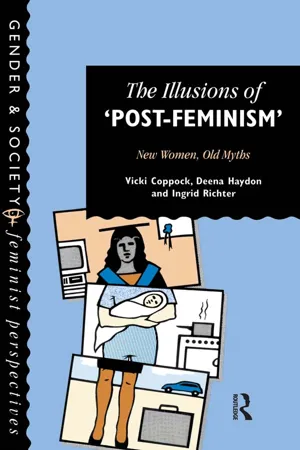
The Illusions Of Post-Feminism
New Women, Old Myths
- 224 pages
- English
- ePUB (mobile friendly)
- Available on iOS & Android
eBook - ePub
About this book
First Published in 1995. As feminists reflect on the impact of the 'second wave' of feminism, and assess the gains of the last thirty years, invariably they have questioned whether claims that women have achieved equality are justified. In the late 1980s, there was a proliferation of popular imagery of 'new' men and 'post-feminist' women, with the concept of 'post-feminism' reinforcing and emphasizing the differences between independent, upwardly-mobile, career orientated women, and those women who 'choose' the more 'natural' role of wife and mother. The Illusions of'Post-Feminism':New Women, Old Myths maintains that 'post-feminism' is a myth. Through in-depth interviews with women about four major areas of their lives: education, work, the media and the family, the authors challenge and expose the myths implicit in the concept of 'post-feminism'. The research illustrates that women's discontent continues, despite the assumption that gender equality would result from equal opportunities legislation. The chapters highlight the ineffective nature of liberal reformism and demonstrate how power relations still lie at the root of the oppression of women. With its provoking and challenging analysis, this revealing book breaks the silence of women's real experiences by showing the actuality of women's lives today.
Information
Part One
Chapter 1
Introduction: Locating ‘Post-Feminism’, Exploring the Myths
The Concept of ‘Post-Feminism’
‘Post-feminism’ happened without warning. It seemed to arrive from nowhere. One minute there were feminisms, identified by their diverse political standpoints and their contrasting campaign strategies, the next … it was all over. The change, mysteriously, had happened: interpersonal relationships and institutional arrangements had stepped beyond feminism. Features writers, arts broadcasters, television presenters, their subjects ranging from work to play, from fashion to music, grabbed the concept as one of common-sense: ‘In this post-feminist period’; ‘now we are in the era of post-feminism’; ‘the post-feminist woman’; ‘the post-feminist man’; ‘post-feminist style’; and so on. Whatever was meant by ‘post-feminism’, whatever was being claimed for the concept, one thing was certain – it had arrived.
It was no coincidence that ‘post-feminism’ emerged as initiatives in government and industry were announced promoting the 1990s as the decade of gender equality. This was premissed on the assumed fact that two decades of social policy and legal reform, informed by equal opportunities initiatives, had provided the foundations for measurable social change and institutional advancement. Comment in the media, in politics and in industry became scattered with references to the 1990s as an ‘enlightened’ and ‘post-feminist’ period. Now, it was argued, all had been achieved, in fact over-achieved, to the point that many men were left confused, their identities shattered, and many women struggled with over-expectancy. The irony is, however, that the proclamation of ‘post-feminism’ has occurred at precisely the same moment as acclaimed feminist studies demonstrate that not only have women’s real advancements been limited, but also that there has been a backlash against feminism of international significance. Could it be that ‘post-feminism’ as a concept is derived somewhere within the backlash? For despite its wide-ranging currency on dust-jackets, on late night talk-shows and in ‘serious’ features articles, ‘post-feminism’ has rarely been defined. It remains the product of assumption.
Perhaps it was inevitable that once sex discrimination/equal pay legislation was in place and ‘equal opportunities’ policies were adopted by government agencies and influential corporations, a new ‘post-feminist’ dawn would be celebrated. Such baseline objectives and their achievement were not the only dynamic in the ‘post-feminist’ lobby. An early reference was made by Susan Bolotin in an article entitled ‘Voices from the postfeminist generation’ (New York Times Magazine, 17 October 1982). Interviewing a range of 18 to 25-year-old women, she found that ‘feminism’ was, in their view, a discredited politics. Despite their experiences showing that women did not receive equal pay, and endured harassment and other forms of discrimination, they condemned feminism and denounced its potential for effectively challenging inequality. Beyond this, they considered that feminism undermined heterosexual relationships. The young women were keen to reinforce institutionalised notions of heterosexuality, marriage and the family and rejected feminists as unhappy, embittered, man-hating women. Bolotin’s thesis was that it was the rejection of feminist theory and politics by this new generation of women that affirmed the arrival of ‘postfeminism’.
More than a decade after Bolotin’s article was published, the powerful, yet contradictory, messages concerning the ‘new dawn’ of equality persist. If the claim to a ‘post-feminist’ society is underpinned by any one principle it is that women have ‘made it’, or they have the opportunity to ‘make it’. The proposition that women can decide on their priorities and ‘go for them’ – career, motherhood, world traveller, etc. – is at the heart of the imagemakers’ construction of the ‘superwoman’. Features writers continually focus on women like Laura Noel, a successful health service manager working until she went into labour and back at her desk doing a 55 hour week four months after giving birth (W. Moore, 1992). The career-mother epitomises the new era in which it is assumed that social change and political reform provides her with the non-discriminatory, open access and fully protected context in which both roles can flourish. Qualifications, access, promotion and job security are assumed to have been accepted and established principles of equality, prevailing in all organisations and their management structures.
Alongside the imagery of the ‘superwoman’ is the imagery of a ‘new man’. The product of the late 1980s, he has learned the lessons of feminism, accepts joint responsibility for domestic labour and child-rearing, and recognises the objective of gender equality (Leston, 1990). Consequently feminist theory and politics is viewed as passé, its relevance surpassed by real advances. Moreover it is often proposed that the pendulum has swung the other way with women being favoured (Quest, 1992). A highly contentious consequence of this line of reasoning is that women have only themselves to blame if equality is not achieved in their personal lives. Through their relationships with their mothers and their idealisation of men it has been argued that they collude with men in reproducing and maintaining traditional roles and expectations (Coward, 1992).
A further claim is that women are desperately unhappy with their newly established status and that feminism is the culprit. It is a theme which has preoccupied social policy commentators (Quest, 1994, 1992) and popular journalists. Women fiction writers such as Maeve Haran (Having It All, 1992) set out to demonstrate that women cannot have success in paid work, their relationships and as mothers. The upshot of this is that independence and career success is incompatible with true happiness found within the ‘natural roles’ of wife and mother. Supported by ‘pop psychology’ this position has contributed to what Shere Hite has termed the ‘psychological battering’ and ‘emotional terrorism’ endured by women (Briscoe, 1992 p. 30).
Geneva Overholser (New York Times, 19 September 1986, p. 30) identified two groups of women who now denounce the ‘achievements’ of feminist struggle. The first are those who tried to combine work and domesticity but feel that both love and their families have suffered ‘because they set too high a priority on self-satisfaction’. The second group consists of women who decided to follow the career path ‘only to discover that work wasn’t so great after all’. While some women called for equality at work these women rejected it. Like many others, both sets of women realised that ‘No women, even “superwomen”, can indefinitely do all that they have been doing at home plus all that men have been doing at work. Since women are at work, something has to give’. But the suggested response is that women should give. Overholser points out that this argument is ‘distinctly pre-feminist’ ! The limited changes of the last twenty years, and the persistent demand for further change, are disliked, feared and resented by many men and women who advocate a return to ‘traditional’ roles and attitudes. Women, and men, calling for a resurgence of ‘old values’ propose rigidly defined roles for females and males in which the public and private realms are distinctly segregated. Thus, men enter the workforce to earn the ‘family’ wage and provide for their wives and children while women cook, clean, support and service their husbands and children in the home. As Overholser concludes, ‘to call that post-feminism is only to give sexism a subtler name’ (ibid.).
Similarly, criticising feminism for oppressing men has become positively fashionable. Camille Paglia has established an international reputation in dismissing contemporary feminists as whiners and ‘namby-pamby, wishy-washy little twits’ (S. Moore, 1992). She is probably most notorious for her statement that ‘if civilisation had been left in female hands we would still be living in grass huts’ (Heller, 1992 p. 3).
In this she has much in common with men like Robert Bly (1990), David Thomas (in Bedell, 1992) and Neil Lyndon (1992) each of whom has bemoaned their emasculation at the hands of feminism. Bly attributes this emasculation to overexposure to strong and angry women, particularly mothers. Consequently these men have taken a ‘female view’ of men and their own masculinity. Basically, men have gone ‘soft’. Bly’s remedy is a male separatist movement – New Age masculinism – where men can rediscover ‘the beast within’ on wilderness weekend retreats. Thomas (1992) also wants to ‘open the window on the pain a lot of men are suffering’ because of ‘totalitarian’ feminism. Lyndon argues that the claims for patriarchal dominance cannot be sustained since it is men who are secondclass citizens. As evidence for this he cites the denial of paternity rights for unmarried men, discrimination against men in divorce courts and ‘unfair’ maintenance arrangements. Moreover, he challenges the validity of feminist claims regarding the nature and extent of rape and domestic violence.
These discrepant, often bewildering, themes of ‘post-feminist’ discourse have provoked a fierce debate in contemporary feminist theory and politics. Far from accepting that feminism has ‘failed’ women (and men), or that feminism is passé, American journalist Susan Faludi (1992, p. 14) contends that feminism has not gone far enough. In this Faludi claims that there has been an ‘undeclared war against women’ – a ‘backlash’.
Central to the ‘backlash’ argument is the assertion that whenever feminism has appeared to be gaining ground a whole series of repressive political, social, economic and ideological forces are mobilised in direct response. Marilyn French’s The War Against Women (1992, p. 11) charts the global history of patriarchal oppression and how ‘in reaction to women’s movements across the world’ it is now ‘taking on a new ferocity’. It is suggested that as well as the tangible evidence of a backlash, a more subliminal, multi-layered system of oppression is operating. This tightens once women are seen to be making gains and stepping out of place. Historically, then, the pursuit of equality by women has been responded to by a backlash against it.
Feminism, along with other liberationist movements, has been rocked by the force of the political shift to the right since the 1980s. Moreover, it could be argued that the women’s movement has been ill-prepared to meet this challenge, apparently beset by internal dissent and disunity. Younger generations of women have related their feelings of alienation from feminism. Some of the young women in Bolotin’s study were sympathetic to feminism, but disillusioned. They considered that their youth denied them the experience of direct involvement in the active feminist struggles characteristic of their ‘older’ sisters of the ‘second wave’. ‘Third wave’ feminists have inherited institutions which profess to have adopted equal opportunities policies but which intrinsically have not changed. In real terms these women do not directly experience the successes that have been expected from the struggles and consequent reforms of the 1960s and 1970s. Many of these young women feel, and have been, castigated by older feminists for not doing enough to challenge the structures which perpetuate and reinforce inequality. At the same time they are pressurised by popular discourses which tell them the world is their oyster. The implication is that if they do not know what they want, or cannot achieve it, individual lack of purpose or ability must be the cause of failure.
Other disillusioned young women have been drawn towards the ‘newer’ political movements of the 1980s (Seager, 1993). New Age and environmentalist movements have occupied the space created by the lack of viable socialist, left politics. While the appeal of such alternatives lies in a seemingly more holistic and humanistic politics, existing patriarchal structures and relations are rarely challenged.
Mary Smeeth (1990, p. 31) suggests that ‘second wave’ feminism was ‘based on the false premise that differences between women were less important than what united them: men as the common enemy’. This led to the exclusion of many women whose oppression was denied by others not oppressed in the same way. The consequence was a split in the women’s movement as differences between women, involving class, ‘race’, mobility and sexuality, were recognised and gained importance. The impact of postmodernism and post-structuralism on feminist theory has accentuated this emphasis on ‘difference’ (MacCannell, 1991; Hekman, 1990). The antiessentialist works of writers such as Lacan, Althusser, Derrida and Foucault have formed the basis of contemporary ‘French’ and ‘post-modern’ feminisms (Kristeva, 1981; Irigaray, 1981; Cixous, 1981). In these analyses notions of identity and ‘the subject’ have been disputed. Gender and sexual difference have, in some sense, become arbitrary. Deconstruction of the category ‘woman’ has had a resonance with feminist analyses which challenge the social construction of ‘womanhood’. However, taken to its logical conclusion the post-structuralist position renders all feminisms meaningless because it is said to be impossible to make any generalisations about, or political claims on behalf of, a group called ‘women’ (Modleski, 1992; Walby, 1992).
The construction of ‘post-feminism’ has led to, and emphasised, differences between women. It has also directed the focus away from the real advances, such as increased appreciation of diversity and experience, and shared frustration or disillusionment leading to collective resistance. Instead women are blamed, or blame themselves and one another, for their feelings of dissatisfaction and the underlying causes remain ignored or refuted. The majority of women seek to make sense of their lives and accommodate the often conflicting desires of autonomy and alliance. If women feel they are to be judged, or placed on a hierarchy of oppression by other women, they will cease to express their views or discuss the significant and inherent contradictions in their lives.
‘Post-feminist’ ideology, fuelled by the political arguments of the New Right, has been given credence through the development of artificial divisions and categories of feminism. Implicitly this has placed each cohesive and identifiable strand of feminist thought in a position of competition and conflict with others in a bid to assert the primacy of a specific issue or standpoint. Ultimately, this leaves feminist positions falsely strait-jacketed and divided within the analysis. It has also contributed to the anti-feminist backlash in which feminists collectively are blamed for the dilemmas facing contemporary women. Looking beyond the rhetoric of conflict surrounding feminism, it is clear that existing divisions are rooted primarily in political action. This has both resulted from and encouraged differences in theoretical emphasis.
Central to what follows is an acknowledgement that all feminist contributions to the theoretical and political debates have validity. While the emergence of ‘post-feminism’ has brought into question the issues and debates fundamental to feminist analyses and critiques, the important claim to be answered is that women’s subordination and oppression has been resolved through equal opportunities initiatives and sex discrimination legislation. By focusing on the lives and experiences of over fifty women, and considering in depth their perceptions of education, work, the media and interpersonal relationships, this claim can be contested. For if the claims of ‘post-feminism’ are to be substantiated it has to be in the lives of contemporary women and their daily personal, ideological and institutional experiences and encounters.
The Historical Context: The Legacy of Liberalism
The three projects discussed above reflect a commitment to the theoretical and analytical priorities of contemporary feminism. They reject the longestablished construction of ‘value-freedom’ as an attainable objective, arguing that all theory and methodology is grounded within politics and motive. What this work also rejects is the idea that the deficiencies of established academic work can be corrected by simply ‘adding on’ research by women about women. Alongside many other feminist studies, it sets out to question the foundations of established knowledge as being in part the product of patriarchal priorities and demands. How history has been conceptualised and written forms a crucial part of such academic knowledge and discourses. It is essential here to trace the historical legacy of feminist theory, emphasising the liberal tradition of the ‘first wave’ and the influence of reformism as contemporary feminism advanced its agenda.
Historically, the aims of feminist analysis, writing and action have responded to those issues central to the maintenance and reproduction of women’s oppression. While this work has been wide-ranging, concerning all aspects of women’s lives and experiences, the dominant politics within feminism has emerged from the liberal-democratic tradition with an emphasis on marginal reform rather than fundamental change. The primary objective is ‘equality of opportunity’, in which personal advancement is prioritised over fundamental changes in the structural organisation of society. This classical liberal democratic position suggests that state intervention focuses on achieving a balance between individual freedom and community welfare; that it serves to mediate between competing interests. Liberal feminism, then, is committed to achieving greater gender equality through legislative and policy reform. Its concern is to construct and pursue ‘implementary’ strategies for change; achieving equality for women through adjustment within the political processes and social policies of liberal democracy.
In the late eighteenth century Mary Wollstonecraft (1792) argued that enforced self-indulgence and restricted physical activity damaged the health of middle-class women, while dependency, over-protection and isolation curtailed their personal liberty and limited their powers of reasoning. She considered that women had an equal right to self-determination and that education would enhance their rational and moral capacities, giving ascendency to ‘reason’ and ‘rationality’ over ‘emotion’. Both Harriet Taylor Mill (1851) and John Stuart Mill (1869) pursued the concern of equality. They believed that ‘gender justice’ could be achieved through equality of opportunity in education, economics and civil liberties. Sexual equality would then provide the basis for a more complete form of personal happiness. J. S. Mill argued that through ‘male’ education and work opportunities women could achieve liberation from their dependent and secondary status, although marriage and motherhood would remain their primary concern.
For Mill, if women were to contribute to the advancement of society and gain independent citizenship, their right to vote should be recognised. By contrast, Taylor Mill wanted women to be represented at all levels of education, industry, municipal politics and central government. Such massive change would encourage women to develop identities beyond marriage and motherhood. This could only be secured through economic independence and a challenge to the division of labour within the middle-class family in which men were the sole earners and dispensers of family income.
The struggle for the vote remained the central issue in the fight for personal liberty, public recognition and equal rights (Levine, 1987; Banks, 1986; Vicinus, 1985; Hollis, 1979; Strachey, 1928; Reid, 1843). However, women differed in their campaign strategies. Some were committed solely to constitutional means for winning the vote (the suffragists of the National Union of Women’s Suffrage Societies). Others, the so-called ‘militant suffragettes’ of the Women’s Social and Political Union, founded by Mrs Pankhurst in 1903, advocated any means, lawful or otherwis...
Table of contents
- Cover
- Half Title
- Title Page
- Copyright Page
- Table of Contents
- Preface
- Acknowledgements
- Part One
- Part Two
- Bibliography
- Index
Trusted by 375,005 students
Access to over 1.5 million titles for a fair monthly price.
Study more efficiently using our study tools.
Frequently asked questions
Yes, you can cancel anytime from the Subscription tab in your account settings on the Perlego website. Your subscription will stay active until the end of your current billing period. Learn how to cancel your subscription
No, books cannot be downloaded as external files, such as PDFs, for use outside of Perlego. However, you can download books within the Perlego app for offline reading on mobile or tablet. Learn how to download books offline
Perlego offers two plans: Essential and Complete
- Essential is ideal for learners and professionals who enjoy exploring a wide range of subjects. Access the Essential Library with 800,000+ trusted titles and best-sellers across business, personal growth, and the humanities. Includes unlimited reading time and Standard Read Aloud voice.
- Complete: Perfect for advanced learners and researchers needing full, unrestricted access. Unlock 1.5M+ books across hundreds of subjects, including academic and specialized titles. The Complete Plan also includes advanced features like Premium Read Aloud and Research Assistant.
We are an online textbook subscription service, where you can get access to an entire online library for less than the price of a single book per month. With over 1.5 million books across 990+ topics, we’ve got you covered! Learn about our mission
Look out for the read-aloud symbol on your next book to see if you can listen to it. The read-aloud tool reads text aloud for you, highlighting the text as it is being read. You can pause it, speed it up and slow it down. Learn more about Read Aloud
Yes! You can use the Perlego app on both iOS and Android devices to read anytime, anywhere — even offline. Perfect for commutes or when you’re on the go.
Please note we cannot support devices running on iOS 13 and Android 7 or earlier. Learn more about using the app
Please note we cannot support devices running on iOS 13 and Android 7 or earlier. Learn more about using the app
Yes, you can access The Illusions Of Post-Feminism by Vicki Coppock,Deena Haydon,Ingrid Richter in PDF and/or ePUB format, as well as other popular books in Social Sciences & Sociology. We have over 1.5 million books available in our catalogue for you to explore.