- 349 pages
- English
- ePUB (mobile friendly)
- Available on iOS & Android
eBook - ePub
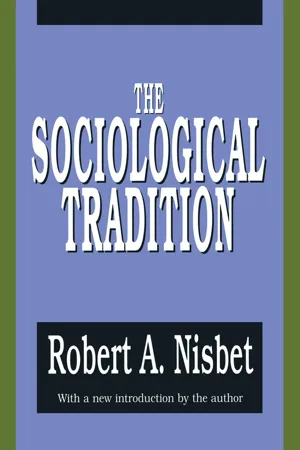
The Sociological Tradition
About this book
When first published, The Sociological Tradition had a profound and positive impact on sociology, providing a rich sense of intellectual background to a relatively new discipline in America. Robert Nisbet describes what he considers the golden age of sociology, 1830-1900, outlining five major themes of nineteenth-century sociologists: community, authority, status, the sacred, and alienation. Nisbet focuses on sociology's European heritage, delineating the arguments of Tocqueville, Marx, Durkheim, and Weber in new and revealing ways.When the book initially appeared, the Times Literary Supplement noted that this thoughtful and lucid guide shows more clearly than any previous book on social thought the common threads in the sociological tradition and the reasons why so many of its central concepts have stood the test of time. And Lewis Coser, writing in the New York Times Book Review, claimed that this lucidly written and elegantly argued volume should go a long way toward laying to rest the still prevalent idea that sociology is an upstart discipline, unconcerned with, and alien to, the major intellectual currents of the modern world.Its clear and comprehensive analysis of the origins of this discipline ensures The Sociological Tradition a permanent place in the literature on sociology and its origins. It will be of interest to those interested in sociological theory, the history of social thought, and the history of ideas. Indeed, as Alasdair Maclntyre observed: We are unlikely to be given a better book to explain to us the inheritance of sociology from the conservative tradition.
Information
Part One
Ideas and Contexts
1 The Unit-Ideas of Sociology
Ideas and Antitheses
The history of thought is commonly dealt with in one of two ways. The first, and oldest, is to begin with the dramatis personae, the thinkers themselves, whose writings furnish the bibliographic substance of the history of thought. There is much to be said for this way. It is indispensable if what we desire is understanding of the motive forces of intellectual history: the perceptions, insights, and discoveries that come only from individuals. Nevertheless, this approach has its disadvantages. Chief among them is the ease with which the history of thought becomes merely the biography of thought. Ideas are treated as extensions or shadows of single individuals rather than as the distinguishable structures of meaning, perspective, and allegiance that major ideas so plainly are in the history of civilization. Like institutions, ideas have independent relationships and continuities, and it is only too easy to lose sight of these when we focus attention on biographies.
A second approach directs itself not to the man, but to the system, the school, or the ism. Not the Benthams and the Mills but utilitarianism, not the Hegels and the Bradleys but idealism, not the Marxes and the Proudhons but socialism is here the prime object of attention. This approach is valuable; the history of thought is indubitably a history of systems: as true of sociology as of metaphysics. Presuppositions, ideas, and corollaries congeal into systems which often develop the same power over their followers that religions do. Systems can be likened to the psychologist's Gestalten; we acquire ideas and facts, not atomistically, but within the patterns of thought that form so large a part of our environment. But the pitfalls of this approach are well known. Too often systems are taken as irreducible rather than as the constellations of distinguishable, even separable, assumptions and ideas that they are in fact: all decomposable, all capable of being regrouped into different systems. Systems moreover tend to become lifeless; what excites one generation or century becomes only antiquarian in the next. One need think only of socialism, pragmatism, utilitarianism, and, long before them, nominalism and realism. Yet each of these systems has component elements that are as viable today, though in different ways, as when these systems were being formed. To lose sight of the elements would be unfortunate.
This leads us to a third approach, one that begins with neither the man nor the system, but with the ideas which are the elements of systems. No one has more lucidly or authoritatively described this approach than the late Arthur O. Lovejoy, and I cannot do better than quote the passage in which he introduces it.
"By the history of ideas," wrote Lovejoy, "I mean something at once more specific and less restricted than the history of philosophy. It is differentiated primarily by the character of the units with which it concerns itself. Though it deals in great part with the same material as the other branches of the history of thought and depends greatly upon their prior labors, it divides the materials in a special way, brings the parts of it into new groupings and relations, reviews it from the standpoint of a distinctive purpose. Its initial procedure may be said—though the parallel has its dangers—to be somewhat analogous to that of analytical chemistry. In dealing with the history of philosophical doctrines, for example, it cuts into the hard-and-fast individual systems, and, for its own purposes, breaks them up into their component elements, into what may be called their unit-ideas." 1
In Lovejoy's The Great Chain of Being we see how it is possible to cut into systems as complex and unlike one another as Platonic idealism, medieval scholasticism, secular rationalism, and romanticism, and to lay bare such powerful, wide-ranging unit-ideas as continuity and plenitude, and to do this in such a way as to throw new light on the systems and also on the philosophers, from Plato to the Enlightenment, who produced the systems. We see not only the component elements, the unit ideas, but also new groupings and relationships of men and ideas; we see affinities, but also oppositions, that we should not have supposed to exist.
The canvas of my own book is, of course, a much smaller one than Professor Lovejoy's and I cannot claim, in any event, to have followed his approach in all its brilliant suggestiveness. But like Lovejoy's, this book is concerned with unit-ideas: specifically, with certain unit-ideas of European sociology in its great formative period, 1830–1900, when the foundations of contemporary sociological thought were being laid by such men as Tocqueville, Marx, Weber, and Durkheim.
I stress this, for the reader should be clearly warned of what he may, and may not, expect to find in this book. He will find, for example, no effort to unfold the meaning of Marx, the essence of Tocqueville, or the unity of Durkheim. Such a task, invaluable though it be, is left to others. Nor is there effort to deal here with any of the overt systems that may be found in the writings of nineteenth-century sociologists: dialectical materialism, functionalism, or utilitarianism. Our concern will be with unit-ideas which seem to me to provide fundamental, constitutive substance to sociology amid all the manifest differences among its authors, ideas which persist throughout the classical age of modern sociology, extending indeed to the present moment.
And the present is our point of departure. History, it has been well said, yields her secrets only to those who begin with the present. The present is, in Alfred North Whitehead's phrase, holy ground. All of the unit-ideas considered in this book are as visible and as directive of intellectual effort today as they were when the works of Tocqueville, Weber, Durkheim, and Simmel made these ideas the foundation stones of modern sociology. We live, and we should not forget it, in a late phase of the classical age of sociology. Strip from present-day sociology the perspectives and frameworks provided by men like Weber and Durkheim, and little would be left but lifeless heaps of data and stray hypotheses.
What are the criteria by which we select the unit-ideas of an intellectual discipline? Four, at least, are governing. Such ideas must have generality: that is, all must be discernible in the works of a considerable number of the towering minds of an age, not be limited to the works of a single individual or coterie. Second, they must have continuity: they must be observable in the early as well as late phases of the period, as relevant indeed to present as to past. Third, such ideas must be distinctive: they must participate in what it is that makes a discipline significantly different from other disciplines. Ideas like "individual," "society," "order" are useless here—however valuable they may be in more general contexts—for these are elements of all the disciplines of social thought. Fourth, they must be ideas in the full sense: that is, more than wraithlike "influences," more than peripheral aspects of methodology. They must be ideas in the ancient and lasting Western sense of the word, a sense, indeed, in which Plato and John Dewey could find common meaning. An idea is a perspective, a framework, a category (in the Kantian sense) within which vision and fact unite, within which insight and observation are brought together. An idea is, in Whitehead's word, a searchlight; it lights up a part of the landscape, leaving other parts in shadow or darkness. It does not matter whether our ultimate conception of idea is Platonist or pragmatist, for idea, in the sense in which I shall use the word in this book, may be described as either archetype or plan of action.
What are the essential unit-ideas of sociology, those which, above any others, give distinctiveness to sociology in its juxtaposition to the other social sciences? There are, I believe, five: community, authority, status, the sacred, and alienation. Detailed exposition of these ideas is, of course, the subject of the chapters which follow. All that is necessary here is their brief identification. Community includes but goes beyond local community to encompass religion, work, family, and culture; it refers to social bonds characterized by emotional cohesion, depth, continuity, and fullness. Authority is the structure or the inner order of an association, whether this be political, religious, or cultural, and is given legitimacy by its roots in social function, tradition, or allegiance. Status is the individual's position in the hierarchy of prestige and influence that characterizes every community or association. The sacred includes the mores, the non-rational, the religious and ritualistic ways of behavior that are valued beyond whatever utility they may possess. Alienation is a historical perspective within which man is seen as estranged, anomic, and rootless when cut off from the ties of community and moral purpose.
Each of these ideas is commonly linked to a conceptual opposite, to a kind of antithesis, from which it derives much of its continuing meaning in the sociological tradition. Thus, opposed to the idea of community is the idea of society (Gesellschaft, in Tönnies' usage) in which reference is to the large-scale, impersonal, contractual ties that were proliferating in the modern age, often, as it seemed, at the expense of community. The conceptual opposite of authority in sociological thought is power, which is commonly identified with military or political force or with administrative bureaucracy and which, unlike the authority that arises directly from social function and association, raises the problem of legitimacy. Status has for its conceptual opposite in sociology not the popular idea of equality but the novel and sophisticated idea of class, at once more specialized and collective. The opposite of the idea of the sacred is the utilitarian, the profane (in Durkheim's momentous wording), or the secular. And, finally, alienation—considered at least as a sociological perspective—is best seen as an inversion of progress. From precisely the same assumptions regarding the nature of historical development in modern Europe—industrialization, secularization, equality, popular democracy, and so on—such minds as Tocqueville and Weber drew, not the conclusion of social and moral progress, but the more morbid conclusion of man's alienation from man, from values, and from self; an alienation caused by the very forces that others in the century were hailing as progressive.
Community-society, authority-power, status-class, sacred-secular, alienation-progress: these are rich themes in nineteenth-century thought. Considered as linked antitheses, they form the very warp of the sociological tradition. Quite apart from their conceptual significance in sociology, they may be regarded as epitomizations of the conflict between tradition and modernism, between the old order, made moribund by the industrial and democratic revolutions, and the new order, its outlines still unclear and as often the cause of anxiety as of elation or hope.
The Revolt Against Individualism
Obviously, these ideas and antitheses did not arise in the first instance in the nineteenth century. In one form or another they are old. They may be seen in the ancient world: in, for example, Plato's Athens, when Greece, like Europe two thousand years later, was searching for new foundations of order to replace those that had seemingly been destroyed by the ravages of war, revolution, and stasis. Plato's concern with community, alienation, authority, hierarchy, the sacred, and with social generation and degeneration is, of course, profound, and it is hardly extreme to say that all the essential elements of subsequent Western social thought are to be found in, first, Plato's development of these ideas and, second, in Aristotle's responses to them. The same ideas are to be seen, though in modified form, in the writings of the Roman moral philosophers in the first century B.C. when once again a traditional social order appeared doomed, the consequence of prolonged war, of social revolution, of moral decay, and, spectacularly, by the overthrow of the Republic and its replacement by the military imperium of Augustus. We see these ideas again, four centuries later, in the works of the Christian philosophers, who were preoccupied, as were so many of their pagan contemporaries, by man's alienation, man's search for the blessed community, for sanctity of authority, and by his proper place in the hierarchical chain of being that culminated in the City of God.
But while these ideas are indeed timeless and universal, they have, like all major ideas of man and society, their periods of ebb as well as flow, of dearth as well as abundance. There are other ages in which these ideas have only small significance, ages when they are placed in the shadow of strikingly different ideas and attitudes regarding man's fate and man's hope. Thus, none of the ideas we are concerned with in this book was especially notable in the Age of Reason that so brilliantly lighted up the seventeenth and eighteenth centuries, reaching its high point in the Enlightenment in France and England.
Then, a different set of words and ideas encompassed moral and political aspiration: ideas like individual, progress, contract, nature, reason. The dominant objectives of the whole age, from Bacon's Novum Organum to Condorcet's Sketch of a Historical Picture of the Human Mind, were those of release: release of the individual from ancient social ties and of the mind from fettering traditions. Towering over the whole period was the universally held belief in the natural individual—in his reason, his innate character, and self-sustaining stability.
The ideas and values of seventeenth-and eighteenth-century individualistic rationalism did not, of course, disappear with the coming of the nineteenth century. Far from it. In critical rationalism, in philosophic liberalism, in classical economics, and in utilitarian politics, the ethos of individualism is continued—together with the vision of a social order founded on rational interest.
But despite a once common and widely expressed point of view among historians of the age, individualism is far from the whole story of nineteenth-century thought. There is much reason indeed for regarding it as the fading, if still rosy, blush of an individualism that had attained its true zenith in the preceding century. And, as we have come only slowly to realize in our histories, what is distinctive and intellectually most fertile in nineteenth-century thought is not individualism but the reaction to individualism: a reaction expressed in no way more strikingly than by the ideas that form the central subject of this book.
These ideas—community, authority, status, the sacred, and alienation—taken together constitute a reorientation of European thought quite as momentous, I believe, as that very different, even opposite, reorientation of thought that had marked the waning of the Middle Ages three centuries earlier and the rise of the Age of Reason. Then it had been individualistic rationalism asserting itself against medieval corporatism and authority. Now, in the early nineteenth century, it is the reverse: the reaction of traditionalism against analytic reason; of communalism against individualism; and of the non-rational against the purely rational.
The reaction is widespread; it is to be found in literature, in philosophy and theology, as well as in jurisprudence, historiography, and, most systematically, in sociology. In widening areas of thought in the nineteenth century we see rationalist individualism (kept alive, of course, most impressively by the utilitarians, whose doctrines provide negative relief for so many sociological concepts) assailed by theories resting upon a reassertion of tradition, theories that would have been as repugnant to a Descartes or a Bacon as to a Locke or a Rousseau. We see the historic premise of the innate stability of the individual challenged by a new social psychology that derived personality from the close contexts of society and that made alienation the price of man's release from these contexts. Instead of the Age of Reason's cherished natural order, it is now the institutional order—community, kinship, social class—that forms the point of departure for social philosophers as widely separated in their views as Coleridge, Marx, and Tocqueville. From the eighteenth century's generally optimistic vision of popular sovereignty we pass to nineteenth-century premonitions of the tyranny that may lie in popular democracy when its institutional and traditional limits are broken through. And, finally, even the idea of progress is given a new statement: one resting not upon release from community and tradition but upon a kind of craving for new forms of moral and social community.
Liberalism, Radicalism, Conservatism
This reorientation of social thought, of which the rise of sociology is so important a phase, is not, let us emphasize, the result of purely intellectual, much less "scientific," currents in the age. As Sir Isaiah Berlin has stated, and as his own historical studies so superbly illustrate, ideas never beget ideas as butterflies beget butterflies. The genetic fallacy has too often made histories of thought into abstracted sequences of "begats." Especially in political and social thought do we need constantly to see the ideas of each age as responses to crises of events and to the challenges formed by major changes in the social order.
The ideas we are concerned with are incomprehensible save in terms of the ideological contexts in which they first arose. The major sociologists of the century, from Comte and Tocqueville to Weber and Durkheim, were caught up in the currents of the three great ideologies of the nineteenth and early twentieth centuries: liberalism, radicalism, and conservatism. In the next chapter we shall deal with the two revolutions —idustrial and democratic——hat shaped the ideologies and also the fundamental ideas of sociology. Here it is important, first, to identify the three ideologies.
The hallmark of liberalism is devotion to the individual; especially to his political, civil, and then, increasingly, his social rights. What tradition is to the conservative and use of power is to the radical, individual autonomy is to the liberal. There are, to be sure, striking differences between the liberals of Manchester, for whom freedom meant chiefly release of economic productivity from the fetters of law and custom, and the liberals of Paris in 1830, for whom liberation of thought from clericalism loomed up as the major objective. But granted the differences, what liberals had in common was, first, acceptance of the basic structure of state and economy (they did not, like the radicals, see revoluti...
Table of contents
- Cover
- Half Title
- Title
- Copyright
- Dedication
- Contents
- Introduction to the Transaction Edition
- Preface
- PART ONE Ideas and Contexts
- PART TWO The Unit-Ideas of Sociology
- PART THREE Epilogue
- Notes
- Acknowledgments
- Index
Trusted by 375,005 students
Access to over 1.5 million titles for a fair monthly price.
Study more efficiently using our study tools.
Frequently asked questions
Yes, you can cancel anytime from the Subscription tab in your account settings on the Perlego website. Your subscription will stay active until the end of your current billing period. Learn how to cancel your subscription
No, books cannot be downloaded as external files, such as PDFs, for use outside of Perlego. However, you can download books within the Perlego app for offline reading on mobile or tablet. Learn how to download books offline
Perlego offers two plans: Essential and Complete
- Essential is ideal for learners and professionals who enjoy exploring a wide range of subjects. Access the Essential Library with 800,000+ trusted titles and best-sellers across business, personal growth, and the humanities. Includes unlimited reading time and Standard Read Aloud voice.
- Complete: Perfect for advanced learners and researchers needing full, unrestricted access. Unlock 1.5M+ books across hundreds of subjects, including academic and specialized titles. The Complete Plan also includes advanced features like Premium Read Aloud and Research Assistant.
We are an online textbook subscription service, where you can get access to an entire online library for less than the price of a single book per month. With over 1.5 million books across 990+ topics, we’ve got you covered! Learn about our mission
Look out for the read-aloud symbol on your next book to see if you can listen to it. The read-aloud tool reads text aloud for you, highlighting the text as it is being read. You can pause it, speed it up and slow it down. Learn more about Read Aloud
Yes! You can use the Perlego app on both iOS and Android devices to read anytime, anywhere — even offline. Perfect for commutes or when you’re on the go.
Please note we cannot support devices running on iOS 13 and Android 7 or earlier. Learn more about using the app
Please note we cannot support devices running on iOS 13 and Android 7 or earlier. Learn more about using the app
Yes, you can access The Sociological Tradition by Peretz Bernstein,Robert Nisbet in PDF and/or ePUB format, as well as other popular books in Social Sciences & Historiography. We have over 1.5 million books available in our catalogue for you to explore.