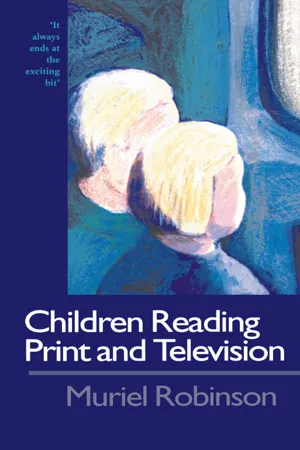
eBook - ePub
Children Reading Print and Television Narrative
It Always Ends At The Exciting Bit
- 208 pages
- English
- ePUB (mobile friendly)
- Available on iOS & Android
eBook - ePub
Children Reading Print and Television Narrative
It Always Ends At The Exciting Bit
About this book
Contrary to the popular assumption that television viewing is a very different process from book reading and inhibits reading in a variety of ways, the author argues that in fact the two activities can be mutually supportive and involve many of the same strategies. It may have implications for teachers as the book offers a research-based view and calls for a new emphasis in school practice which will include television as text and which supports children's developing abilities to make meaning from a range of texts. The author highlights the need for teachers to consider television in the same way as print media.
Information
Chapter 1
Everyday Discourses about Children, Television and Reading
I have been an avid reader of stories in books and comics for almost as long as I can remember. Although I derive great pleasure from finding new authors and encountering their stories for the first time, I also have a core of well-loved books to which I return on a regular basis. Here the pleasure comes not so much from predicting the outcome but from seeing a familiar pattern unfold or from having time to enjoy the way the book is written. In the past, apart from occasional repeat showings, the only way to re-experience stories which I encountered first on television was through book versions of the story. When the television version had been taken from the book, this was usually a satisfying experience; when the book came from the television script, it was usually a disappointment. I think I assumed that this was inevitable; how could a television script have sufficient depth to generate a complex polysemic written text? Had we not acquired a video recorder, I might well have carried on believing this to be the case.
With the arrival of our video, however, came the possibility of re-viewing certain programmes. When John Byrne’s drama series Tutti Frutti was shown for a second time, we decided to record it, and found ourselves watching it almost compulsively. In the first few weeks during and immediately after transmission we watched it repeatedly, almost to the exclusion of any other television. This experience led me to reconsider my earlier views about narrative and to speculate about the different possibilities available to televisual and printed stories. I could see that in my re-watchings of Tutti Frutti I was deriving the same satisfactions as in my re-readings of favourite novels; I could watch the interweavings of the various storylines, appreciate the way in which characters were presented, and savour the distinctive language patterns. Moreover, whereas in printed fiction the author/narrator might reveal the thought processes of all or some of the characters, here I had to work much harder to decide for myself the stances of the characters towards each other, towards the specific events of the series and towards life in general. There was an added dimension of visual and aural information alongside the words, giving extra possibilities for the creation of a secondary world. In other words, although the discourse might be televisual rather than written, there was still a complex story to be told and the story was told in such a way as to create what was for me a very satisfying, complex narrative.
Talking about this with colleagues, I began to speculate about the ways in which children might learn to make sense of narrative in the different discourses they encounter. Might there be ways in which their understandings of narrative in general were enhanced by all their encounters with narrative in whatever form? For many of my generation, television arrived in our homes when we were already at school and either reading or learning to read, but for almost all children today television is among their earliest experiences and provides some of their first encounters with narrative, long before formal schooling: one survey for the Radio Times found that almost a third of children begin to watch regularly before their first birthday (Daily Telegraph, 28 August 1991). Might early experiences of television actually support later encounters with stories in books?
This book is an attempt to answer some of the questions that I found myself asking as a result of my encounter with Tutti Frutti. The ideas explored here come from the research I undertook for my PhD, and so at times I shall be considering the theoretical frames available to us from the wider research tradition. Before looking at these, though, it is important to explore more fully the everyday, ‘common sense’ attitudes to television and to reading which are prevalent in Western society, and so the next section of this chapter does just that.
(As I wrote this book, I considered updating the examples drawn from the media which illustrate my arguments. However, since any set of examples would be history by the time of publication, let alone by the time of reading, this seemed to be of little value. What I would recommend is that readers of this book look for themselves at what the papers are currently saying about reading and television, not so much to see how far attitudes have changed but to see whether what I say here about the logic underlying attitudes is still dependent on ‘common sense’ beliefs about the world.)
Everyday Opinions: Common Sense or Cultural Construct?
Even for those of us engaged in research, everyday opinions as expressed in the media play a key role in influencing our view of the world. We may reject the opinions or attitudes we find expressed or we may agree with them, but we are unlikely to ignore them, especially if they are to do with anything which is a part of our daily experience. Many of these views that we encounter in the national newspapers and in books written for the lay person take certain key cultural concepts as ‘given’ common sense, beyond question. But what do we mean by ‘common sense’? Where does it come from? Is it the same in all cultures?
These questions have been explored by Barthes (1973a) in his examination of myth as a depoliticizer and naturalizer of our view of the world. For Barthes, everyday attitudes are part of our semiological system; he suggests that they are really myths created by each society. Through his investigation of the ways in which aspects of everyday life such as wrestling, children or new cars are given symbolic meaning by their representations in our lives, he suggests that what these myths do is to naturalize history. By naturalizing the history or intentions behind the sign, its constructed nature becomes hidden and its power is increased:
What the world supplies to myth is an historical reality, defined, even if this goes back quite a while, by the way in which men have produced or used it; and what myth gives in return is a natural image of this reality. (Barthes, 1973a, p. 142)
Thus myth has a depoliticizing action, which acts to suggest that concepts such as family values or the work ethic are universally held and natural, rather than created by a particular culture at a particular time and consequently capable of challenge and change.
Barthes shows how, as a result of this depoliticization, the concept of the bourgeoisie, for example, has become so unproblematic as to be ‘exnominated’. It is no longer named but is taken as a natural state so that bourgeois values are seen as normal values:
The whole of France is steeped in this anonymous ideology … everything, in everyday life, is dependent on the representation which the bourgeoisie has and makes us have of the relations between man and the world. These ‘normalized’ forms attract little attention, by the very fact of their extension, in which their origin is easily lost. (Barthes, 1973a, p. 140)
In the same way, many of the often very problematic concepts to do with popular culture could be seen as exnominated by the way in which they are taken as natural. As a result, these concepts are kept outside the debate, which then operates as though there were universal agreement about such matters as the role of the family, the value of tradition, of the responsibility of parents to be involved in their children’s education, and of the cultural importance of reading. This changes the nature of the argument or opinion built on the exnominated concept, giving it a false authority. When we engage in the debate, unless we consider the basis of the exnominated concepts, we are still arguing from false premises, even if we are contradicting the original opinion which began the debate.
Barthes’ recasting of common sense as myth does much to emphasize the ways in which our common-sense views are part of our semiological system, reconstructed as fact rather than values. It is not that the exnomination resulting from myth prevents our discussing these matters. Rather, it changes the nature of the discussion:
Myth does not deny things, on the contrary, its function is to talk about them; simply, it purifies them, it makes them innocent, it gives them a clarity which is not that of an explanation but that of a statement of fact. (Barthes, 1973a, p. 143)
Thus the ways in which people writing about television and reading bring common-sense views into the debate gives these views power as fact rather than as opinion for their audience.
Of course I too start from a position in which my everyday beliefs are to a large extent bound up in a culturally constructed common-sense system, and to ignore this would be to fail to look sufficiently at the context of my own work; moreover, the possibility exists that these beliefs, even though based not on universal truths (assuming such things exist) but on less scientific grounds, may still have something of value to offer. The anthropologist Clifford Geertz, who has shown how what we take as common sense in our culture may be very different from common-sense views in a different culture, emphasizes this possibility when he discusses the beliefs of Australian aboriginals about the ways in which their land took on its physical characteristics. He shows how the aboriginal belief that a particular creek was formed, for example, by a primordial kangaroo’s tail or snake’s belly, does not stop the creek from possessing certain natural characteristics. Whether we believe this or have a different view, in both cases the creek will still operate according to some of the forces of nature: ‘water runs downhill in both of them’ (Geertz, 1983, p. 86). In other words, I may feel that some views about television and reading are based on theories at least as hard for me to believe in as those about Australia in the dreamtime, but that is not to say that there is no truth in their utterances. When we work out a calculation, there may be times when we use the wrong formula but still end up by chance with the right answer. My aim in this research is not to refute the claims of those whose views are presented below but to go beyond the ‘thinness’ of everyday life in which ‘the world is what the wideawake, uncomplicated person takes it to be’ (Geertz, 1983, p. 89) to explore in more depth what actually happens when children are watching television or reading and to examine the relationship between these two activities.
What I wish to do here is to explore everyday attitudes to children, television and books, both to record the key attitudes expressed in the national and local press and in books which have been written for parents or for a general audience, and to begin to uncover those concepts that are taken as beyond question by the key protagonists in the debate. At the same time, I shall be looking at the ways in which opinions are presented to see what counts as evidence and who claims the right to speak authoritatively. By doing this, I hope to establish which ideas are central to my own investigations and which need exploring in a more academic and systematic way.
Television and Reading
Arguments seeking to draw comparisons between television and reading draw on many exnominated ideas about family, about culture and about learning. The arguments themselves tend to revolve around starkly expressed oppositions to do with high and popular culture, active and passive learning and verbal and visual experiences, with television on the less favoured side of the equation.
One opinion to the forefront in popular debate about the interrelationship of television and books is that books are intrinsically better than television because reading is a more worthwhile activity. Books are seen as part of a cultural heritage, which it is automatically important to pass on to the next generation, whilst television viewing is seen as trivial: the foundations for such views are not explored but remain part of the exnominated ideology of those commenting.
For former Education Minister, Michael Fallon, this means an assumption that it is better for his young son to experience books than television:
I discourage Peter who is 2½ from watching any TV. When I am home, I read to him. (The Sun, 14 May 1991)
For some, the emphasis is on television as a barrier to reading, taking up time that could be more profitably spent, with parents at least partly to blame for allowing children to spend too much time watching television and for setting a bad example by watching television themselves instead of reading. Typical of many comments in this vein is A.N. Wilson’s claim that:
There are now far too many lazy parents who do not read themselves and who find it easier to plonk their children in front of a television set as a way of shutting them up, than to read to them before bedtime. (Daily Mail, 8 January 1991)
This not only again relies on a shared, unquestioned understanding of the superiority of reading as a cultural experience but also makes many assumptions about parenting and childcare, which again are part of Wilson’s ideological stance rather than naturalized ‘truths’.
One of television’s sternest critics, Marie Winn, extends this view beyond the cultural debate to argue that television is not only culturally less significant, but that it can take us away from our daily responsibilities (though there is no mention of the rights that might normally accompany such responsibilities, nor any acknowledgment that there may be different interpretations of such a concept as responsibility):
In this comparison of reading and television viewing a picture begins to emerge that quite confirms the commonly held notion that reading is somehow ‘better’ than television viewing. Reading involves a complex form of mental activity, trains the mind in concentration skills, develops the powers of imagination and inner visualization; the flexibility of its pace lends itself to a better and deeper comprehension of the material communicated. Reading engrosses, but does not hypnotize or seduce the reader from his human responsibilities. Reading is a two-way process: the reader can also write; television viewing is a one-way street: the viewer cannot create television images. And books are ever available, ever controllable. Television controls. (Winn, 1985, p. 66)
This image of television as dominating lives at the expense of other activities is also a key part of Jim Trelease’s case for banning or severely limiting children’s viewing. Although Trelease’s main concern is with the effects on reading, he also picks up the notion of responsibilities: thus we learn that one of the benefits of his own family ban on television was that household chores were now don...
Table of contents
- Cover
- Half Title
- Dedication
- Title Page
- Copyright Page
- Table of Contents
- List of Transcription Symbols
- Preface
- Chapter 1 Everyday Discourses about Children, Television and Reading
- Chapter 2 How Do We Read?
- Chapter 3 Language, Thought, Culture and Narrative
- Chapter 4 Making Sense of the Text in the World
- Chapter 5 The Expectations Children Have when Reading
- Chapter 6 Personal Response to the Texts
- Chapter 7 The Text as a Source of Meaning
- Chapter 8 Using Information from Outside the Text
- Chapter 9 Children Reading Print and Television
- Bibliography
- Appendix — List of Transcripts
- Index
Trusted by 375,005 students
Access to over 1.5 million titles for a fair monthly price.
Study more efficiently using our study tools.
Frequently asked questions
Yes, you can cancel anytime from the Subscription tab in your account settings on the Perlego website. Your subscription will stay active until the end of your current billing period. Learn how to cancel your subscription
No, books cannot be downloaded as external files, such as PDFs, for use outside of Perlego. However, you can download books within the Perlego app for offline reading on mobile or tablet. Learn how to download books offline
Perlego offers two plans: Essential and Complete
- Essential is ideal for learners and professionals who enjoy exploring a wide range of subjects. Access the Essential Library with 800,000+ trusted titles and best-sellers across business, personal growth, and the humanities. Includes unlimited reading time and Standard Read Aloud voice.
- Complete: Perfect for advanced learners and researchers needing full, unrestricted access. Unlock 1.5M+ books across hundreds of subjects, including academic and specialized titles. The Complete Plan also includes advanced features like Premium Read Aloud and Research Assistant.
We are an online textbook subscription service, where you can get access to an entire online library for less than the price of a single book per month. With over 1.5 million books across 990+ topics, we’ve got you covered! Learn about our mission
Look out for the read-aloud symbol on your next book to see if you can listen to it. The read-aloud tool reads text aloud for you, highlighting the text as it is being read. You can pause it, speed it up and slow it down. Learn more about Read Aloud
Yes! You can use the Perlego app on both iOS and Android devices to read anytime, anywhere — even offline. Perfect for commutes or when you’re on the go.
Please note we cannot support devices running on iOS 13 and Android 7 or earlier. Learn more about using the app
Please note we cannot support devices running on iOS 13 and Android 7 or earlier. Learn more about using the app
Yes, you can access Children Reading Print and Television Narrative by Dr Muriel Robinson,Muriel Robinson in PDF and/or ePUB format, as well as other popular books in Education & Education General. We have over 1.5 million books available in our catalogue for you to explore.