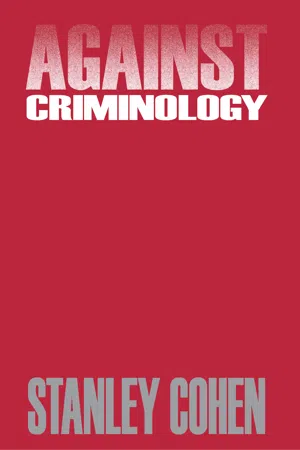
During the 1960s, traditional thinking about crime and its punishment, deviance and its control, came under radical attack. The discipline of criminology split into feuding factions, and various schools of thought emerged, each with quite different ideas about the nature of the crime problem and its solutions. These differences often took political form, with conservative, liberal, and radical supporters, and the resulting controversies continue to reverberate throughout the fields of criminology and sociology, as well as related areas such as social work, social policy, psychiatry, and law. Stanley Cohen has been at the center of these debates in Britain and the United States. This volume is a selection of his essays, written over the past fifteen years, which contribute to and comment upon the major theoretical conflicts in criminology during this period. Though associated with the "new" or radical criminology, Cohen has always been the first to point out its limitations particularly in translating its theoretical claims into real world applications. His essays cove a wide range of topics-political crime, the nature of individual responsibility, the implications of new theories for social work practice, models of crime used in the Third World, banditry and rebellion, and the decentralization of social control. Also included is a previously unpublished paper on how radical social movements such as feminism deal with criminal law. Many criminology textbooks present particular theories or research findings. This book uniquely reviews the main debates of the last two decades about just what the role and scope of the subject should be.
- 322 pages
- English
- ePUB (mobile friendly)
- Available on iOS & Android
eBook - ePub
Against Criminology
About this book
Information
Part One
Introduction
1
Criminology*
There are two scriptural beginnings to the history of criminology, each marking out a somewhat different fate for the study of crime and its control. The first dates from the mid-eighteenth century and tells of the revolutionary contribution of Enlightenment thinkers like Beccaria (1738-1794) and Bentham (1748-1832) in breaking with a previously “archaic,” “barbaric,” “repressive,” or “arbitrary” system of criminal law. This was the classical school. For these reformers, legal philosophers, and political theorists, the crime question was dominantly the punishment question. Their program was to prevent punishment from being, in Beccaria’s words, “an act of violence of one or many against a private citizen”; instead, it should be “essentially public, prompt, necessary, the least possible in given circumstances, proportionate to the crime, dictated by laws.” Classicism presented a model of rationality: on the one side, the free “sovereign” individual acting according to the dictates of reason and self-interest; on the other, the limited liberal state, contracted to grant rights and liberties, to prescribe duties, and to impose the fair and just punishment that must result from the knowing infliction of social harm.
This immaculate-conception account of the birth of classicism has been challenged by revisionist histories of law and the state. Dates, concepts, and subjects have been reordered. Classicism is now to be understood in terms of the broader rationalization of crime control associated with the emergence of the free market and the new capitalist order. But the preoccupations of classicism— whether they appear in utilitarianism, Kantianism, liberalism, anarchism, or indeed any political philosophy at all—have remained a constant thread in criminology. This is where the subject overlaps with politics, jurisprudence, and the history and sociology of the law.
A century after classicism, though, criminology was to claim for itself another beginning and another set of influences. This was the positivist revolu-tion, dated in comic book intellectual history with the publication in 1876 of Lombroso’s (1836-1909) Delinquent Man. This was a “positivism” that shared the more general social scientific connotations of the term (the notion, that is, of the unity of the scientific method) but that acquired in criminology a more specific meaning. As David Matza suggests in his standard sociologies of criminological knowledge,1 criminological positivism managed the astonishing feat of separating the study of crime from the contemplation of the state. Classicism was dismissed as mere metaphysical speculation. The new program was to focus not on the crime (the act) but the criminal (the actor); it was to assume not rationality, free will, and choice but determinism (biological, psychic, or social). At the center of the criminological enterprise now was the notion of causality. No longer a sovereign being, subject to more or less the same pulls and pushes as his fellow citizens, the criminal was now a special person or member of a special class.
The whole of the past century of criminology can be understood as a series of creative, even brilliant, yet eventually repetitive variations on these late-nineteenth-century themes. The particular image conjured by Lombroso’s criminal type—the atavistic genetic throwback – faded away, but the subsequent structure and logic of criminological explanation remained largely within the positivist paradigm. Whether the level of explanation was biological, psychological, sociological, or a combination of these (“multifactorial,” as some versions were dignified), the Holy Grail was a general causal theory: Why do people commit crime? This quest gave the subject its collective self-definition: “the scientific study of the causes of crime.”
At each stage of this search criminology strengthened its claim to. exist as an autonomous, multidisciplinary subject. Somewhat like a parasite, crimi-nology attached itself to its host subjects (notably, law, psychology, psychiatry, and sociology) and drew from them methods, theories, and academic credibility. At the same time, somewhat like a colonial power landing on new territory, each of these disciplines descended on the eternally fascinating subjects of crime and punishment and claimed them as its own. In this fashion criminological theories and methods draw on Freudianism, behaviorism, the Chicago school of sociology, functionalism, anomie theory, interactionism, Marxism, and much else. Each of these traces can be found in any current criminology textbook; it would be difficult to think of a major system of thought in the social sciences that would not be so represented.
All the time this positivist trajectory was being established, criminologists retained their interest in the question of punishment. If, in a sense, all crimi-nology became positivist, then also all criminology remained concerned with “classical” matters. But instead of speculation about the limits and nature of the criminal sanction, this side of criminology (sometimes called “penology”) took this sanction as politically given. True, there was (and still is) an impor-tant debate about whether the subject matter of criminology should be confined to conventional legal definitions of crime or shifted to include all forms of socially injurious conduct. The punishment question, however, was largely resolved in empirical terms: describing, analyzing; and evaluating the workings of the criminal justice system. Research findings were built up about the police, courts, prisons, and various other agencies devoted to the prevention, control, deterrence, or treatment of crime. This remains today the major part of the criminological enterprise.
Little of this, however, was “pure” empiricism. The classical tradition was. alive in another sense: modern criminologists became the heirs of the Enlightenment beliefs in rationality and progress. Their scientific task was carried along by a sense of faith: the business of crime and delinquency control could be made not only more efficient but also more humane. As reformers, advisers, and consultants, criminologists claim for themselves not merely an autonomous body of knowledge but also the status of an applied science or even a profession.
It is this simultaneous claim to knowledge and power that links the two sides of criminology: causation and control In positivism this is an organic link: to know the cause is to know the right policy. Recently, however, this link and its justification in the immaculate-conception history of positivism have been questioned. Histories of the emergence of the prison during the late eighteenth century and early nineteenth century have shown the dependence of control systems on theories of rehabilitation, behavior modification, and anomie well before their supposed “discovery” by scientific criminology. To critics like Fou-cault,2 criminological knowledge has always been wholly utilitarian: an elaborate alibi to justify the exercise of power.
In the general climate of radical self-scrutiny that descended on the social sciences in the 1960s, criminology, too, began to fragment a little. There were three major attacks against the positivist hegemony, each in its peculiar and distinct way representing a return to classical questions.
First, labeling theory—a loose body of ideas derived from symbolic interactionism—restated some simple sociological truths about the relative nature of social rules and the normative boundaries that they mark. Crime was one form ofthat wider category of social action, deviance; criminology should be absorbed into the sociology of deviance. Beyond such conceptual and disciplinary boundary disputes, the very nature of the conventional quest for causality was regarded with skepticism. In addition to the standard behavioral question (Why do some people do these bad things?) there was a series of definitional questions: Why are certain actions defined as rule breaking? How are these rules applied? What are the consequences of this application? At times these definitional questions seemed to attain causal primacy; it was not that controlled to deviance, but deviance to control Social control agencies – with their organized systems of labeling, stigmatizing* and isolation – were meddlesome busybodies, making matters worse for society and its underdogs and outsiders. And behind the pretensions of scientific criminology was a simpleminded identification with middle-class values.
This liberal criticism of liberalism was to become harder and tighter in the second onslaught on mainstream criminology. This came from what has been labeled variously as “conflict,” “new,” “critical,” “radical,” or “Marxist” criminology. Drawing initially on some strands of labeling theory and conlict sociology and then on classical Marxist writing about law, class, and the state, these theories moved even further from the agenda of positivism. Traditional causal questions were either dismissed or made subservient to the assumed criminogenic features of capitalism. Legalistic definitions were either expanded to include crimes of the powerful (those social harms that the state licenses itself to commit) or else subjected to historicist and materialist inquiry. Labeling theory’s wider notion of deviance was abandoned. Law was the only important mode of control, and the focus of criminology had to be shifted to the power of the state to criminalize certain actions rather than others. The analytical task was to construct a political economy of crime and its control. The normative task (that is, the solution to the crime problem) was to eliminate those economic and political systems of exploitation that gave rise to crime. The goal was a crime-free society, possible only under a different social order and impossible with the conceptual tools of bourgeois criminology.
The third critique of the positivist enterprise came from a quite different theoretical and political direction. Impressed by the apparent failure of the causal quest and of progressive policies such as treatment, rehabilitation, and social reform, a loose coalition of intellectuals appeared under such rallying calls as “realism,” “back to justice,” and “neo-classicism.” Some of them are neo-liberals – and theirs is a note of sad disenchantment with the ideas and policies of progressive criminology. Some of them are conservatives (or neo-conservatives) – and theirs is a note of satisfaction about the supposed failures of liberalism. Both these wings harken back to classical questions; the notion of justice (or “just deserts”) allows liberals to talk of rights, equity, and fairness, while it allows conservatives to talk about law and order, social defense, deterrence, and the protection of society. In neither case – but particularly for conservatives – is there much interest in traditional questions of causation.
Criminology is a subject with a complicated past and polemical present. Most criminologists are employed at the core of the enterprise, busy either describing, classifying, and explaining crime or else analyzing, evaluating, and advocating policy. At the periphery are various fascinating intellectual disputes about the subject’s true content and justification. As Jock Young has recently shown,3 the major schools of criminoiogicai thought are divided on quite basic issues: the image of human nature, the basis of social order, the nature and extent of crime, the relationship between theory and policy. And if we move out of the Anglo-American cultures in which contemporary criminology has mainly flourished, even more fundamental differences appear, (A major and belated recent development has been the serious comparative analysis of crime and its control.)
But whether positivist or neo-classical, radical or conservative, detached intellectuals or disguised policemen, criminologists confront the same questions. All this diversity is a manifestation of a single tension: crime is behavior, but it is behavior that the state is organized to punish.
Notes
* “Criminology” from The Social Science Encyclopedia (London: Routledge, 1985), pp. 173-175.
1. David Matza, Delinquency and Drift (New York: Wiley, 1964); and Becoming Deviant (Englewood Cliffs, N.J.: Prentice-Hall, 1969).
2. Michel Foucault, Discipline and Punish (London: Allen Lane, 1977).
3. Jock Young, “Thinking Seriously about Crime,” in Crime and Society, ed. M. Fitzgerald et al. (London: Routledge & Kegan Paul, 1981).
2
Against Criminology
My relationship with criminology is, I suppose, some variety of what used to be called “repressive tolerance.” Every attempt I have ever made to distance myself from the subject, to criticize it, even to question its very right to exist, has only got me more involved in its inner life. This is, of course, not just a personal experience but the shared fate of most of us who some twenty years ago embarked on a collective project of—no less – constructing an alternative to criminology. The more successful our attack on the old regime, the more we received Ph.D.’s, tenure, publishers’ contracts, and research funds, appeared on booklists and examination questions, and even became directors of institutes of criminology and received awards from professional associations.
Again, all this was not peculiar to the anti-criminology enterprise. The Mar cusean notion of repressive tolerance tells us of the extraordinary powers of modern capitalism to absorb, co-opt, and neutralize even the most radical attacks against it. This is the same point made (more forcibly and persuasively) in the theory of “recuperation,” produced by the International Situationists in that most far-reaching of all critiques ever made of modern culture.
In retrospect, especially the retrospect allowed us by Foucault’s rewriting of the history of the social sciences, all this was inevitable enough. Unlike in certain areas of natural sciences, it is impossible to construct a model that so fundamentally undermines all previous assumptions as to create a completely new discipline. With the exception perhaps of abolitionism, nothing produced by anti-criminology, neither the discovery of any new facts nor the creation of a new mode of understanding the old facts, came remotely near this type of paradigmatic or disciplinary revolution. The special history of the criminolog-ical discourse—the deep interpénétration between knowledge and power—makes this prospect even more unlikely than in any other branch, of the social sciences. To be against criminology, it seems, one has to be part of it. Indeed, as we shall see, some inluential members of the original anti-criminology cohort have now decided to make a virtue of this apparent necessity, abandoning as wholly misconceived the attempt to construct an alternative discourse and returning instead to the citadels of the old criminology.
Whatever the justifications for this particular move, it must surely be true that the intellectual distance that is needed to comprehend the subject can be achieved only by a real immersion in its inner life. Thus, Adorno: “One must belong to a tradition to hate it properly.” Hate, no doubt, is too strong a word, but distance, detachment, marginality, and ambivalence all convey closely enough the stance that some of us tried (or pretended) to cultivate toward the criminological tradition. At best, this stance was no more than the type of sociological perspective required to study any institution seriously, whether law, religion, medicine, or art. Sociologists “of” these areas are not lawyers, priests, doctors, or artists. At worst, though, this distancing led to a self-indulgent irresponsibility in which the internal problems, the “stuff” of criminology, were denied an existence at all – as if to say that people are not moved by religion or are not really sick.
The stuff of criminology consists of only three questions: Why are laws made? Why are they broken? What do we do or what should we do about this? To demonstrate that these questions are so often posed in the wrong way called for (and still calls for) an intellectual perspective that lies outside the ideology and interests of those who run the crime-control system and the academics they hire to help them. To explain away the significance of these questions, however, is not only to deny their perpetual intrinsic interest but also to forget what the crime problem means in modern societies such as Britain and the United States: the massive resources invested in crime control; the depths of insecurity, denial, and irrationality in “thinking about crime”; the awful costs and waste of human life that crime means to its perpetrators and victims.
The new criminologies of the past twenty years promised to combine both these interests: to be reflexive and critical, but also to answer questions of substance. The subsequent tensions between the new and the old (and then within the new) criminologies is as much a tension between these outsider and insider int...
Table of contents
- Cover Page
- Title Page
- Copyright Page
- Contents
- Preface
- Part One Introduction
- 1 Criminology
- 2 Against Criminology
- Part Two Redefining the Field
- 3 “Images of Deviance”
- 4 The Failures of Criminology
- 5 Protest, Unrest, and Delinquency: Convergences in Labels and Behavior
- 6 Footprints In the Sand: A Further Report on Criminology and the Sociology of Deviance In Britain
- Part Three The Twists of the Discourse
- 7 It’s All Right for You to Talk: Political and Sociological Manifestos for Social Work Action
- 8 Guilt, Justice, and Tolerance: Some Old Concepts for a New Criminology
- 9 Symbols of Trouble
- 10 Western Crime Control Models in the Third World: Benign or Malignant?
- 11 The Deeper Structures of the Law, or “Beware the Rulers Bearing Justice”
- 12 Taking Decentralization Seriously: Values, Visions, and Policies
- 13 The Object of Criminology: Reflections on the New Criminalization
- 14 Bandits, Rebels, or Criminals: African History and Western Criminology
- Part Four Conclusion
- 15 The Last Seminar
Trusted by 375,005 students
Access to over 1.5 million titles for a fair monthly price.
Study more efficiently using our study tools.
Frequently asked questions
Yes, you can cancel anytime from the Subscription tab in your account settings on the Perlego website. Your subscription will stay active until the end of your current billing period. Learn how to cancel your subscription
No, books cannot be downloaded as external files, such as PDFs, for use outside of Perlego. However, you can download books within the Perlego app for offline reading on mobile or tablet. Learn how to download books offline
Perlego offers two plans: Essential and Complete
- Essential is ideal for learners and professionals who enjoy exploring a wide range of subjects. Access the Essential Library with 800,000+ trusted titles and best-sellers across business, personal growth, and the humanities. Includes unlimited reading time and Standard Read Aloud voice.
- Complete: Perfect for advanced learners and researchers needing full, unrestricted access. Unlock 1.5M+ books across hundreds of subjects, including academic and specialized titles. The Complete Plan also includes advanced features like Premium Read Aloud and Research Assistant.
We are an online textbook subscription service, where you can get access to an entire online library for less than the price of a single book per month. With over 1.5 million books across 990+ topics, we’ve got you covered! Learn about our mission
Look out for the read-aloud symbol on your next book to see if you can listen to it. The read-aloud tool reads text aloud for you, highlighting the text as it is being read. You can pause it, speed it up and slow it down. Learn more about Read Aloud
Yes! You can use the Perlego app on both iOS and Android devices to read anytime, anywhere — even offline. Perfect for commutes or when you’re on the go.
Please note we cannot support devices running on iOS 13 and Android 7 or earlier. Learn more about using the app
Please note we cannot support devices running on iOS 13 and Android 7 or earlier. Learn more about using the app
Yes, you can access Against Criminology by Stanley Cohen in PDF and/or ePUB format, as well as other popular books in Social Sciences & Criminology. We have over 1.5 million books available in our catalogue for you to explore.