- 88 pages
- English
- ePUB (mobile friendly)
- Available on iOS & Android
eBook - ePub
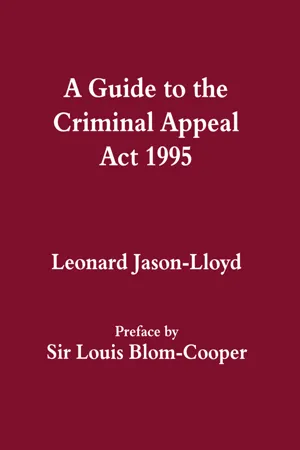
A Guide to the Criminal Appeal Act 1995
About this book
The Criminal Appeal Act 1995 has significantly changed the way in which criminal appeals will be dealt with in England, Wales and Northern Ireland. Providing a brief guide to the provisions of the Act, this is a quick reference for practitioners and students on degree and equivalent courses.
Information
Part I
The Court of Appeal
Leave to Appeal
1.1 Section 1(1) of the Criminal Appeal Act 1995 (‘the 1995 Act’) substitutes a new s. 1(2) into the Criminal Appeal Act 1968 (‘the 1968 Act’), which now provides that an appeal to the Court of Appeal (Criminal Division) against a conviction for an offence tried on indictment, may only be made if the trial judge grants a certificate that the case is fit for appeal, or with the leave of the Court of Appeal. The original s. 1(2) (a) of the 1968 Act gave an automatic right of appeal on any ground which involved a question of law alone but this no longer applies.
1.2 The new provisions therefore require that leave is obtained from the Court of Appeal or a certificate obtained from the trial judge in respect of all appeals regardless of whether they are based upon a question of law, fact, mixed law and fact, or any other ground.
1.3 The same principles under s. 1(1) as explained in 1.1 and 1.2 above, apply to subsections (2) to (6) below which amend the earlier provisions where shown in brackets:
(2) The Criminal Appeal (Northern Ireland) Act 1980 (‘the 1980 Act’) s. 1 (appeal against conviction in Northern Ireland).
(3) Section 12 of the 1968 Act (appeal against insanity verdict).
(4) Section 12(1) of the 1980 Act (appeal against insanity verdict in Northern Ireland).
(5) Section 15(2) of the 1968 Act (appeal against finding of disability [ie unfitness to plead]).
(6) Section 13A(2) of the 1980 Act (appeal in Northern Ireland against finding of unfitness to be tried).
Grounds for Allowing and Dismissing Appeals
2.1 Section 2(1) of the 1995 Act substitutes a new s. 2(1) into the 1968 Act by providing that the Court of Appeal shall either allow an appeal against conviction if they think that the conviction is unsafe or shall dismiss the appeal in any other case. In the past, convictions were quashed on the grounds that the original conviction was considered to be unsafe and unsatisfactory. The omission of the word ‘unsatisfactory’ is probably because it is considered superfluous. According to Professor Zander (Cases and Materials on the English Legal System (6th ed., Butterworths), 1993), during the final appeal of the Birmingham Six it was submitted that convictions could be safe even if they were unsatisfactory, thereby subscribing that the two words had different meanings. This argument was rejected by the Court of Appeal which took the view that they both had the same meaning. It would therefore seem that the 1995 Act has omitted the word ‘unsatisfactory’ for the avoidance of doubt.
2.2 The same principles under s. 2(1), as explained in 2.1 above, apply to subsections (2) to (6) below which amend the earlier provisions where shown in brackets:
(2) Section 2(1) of the 1980 Act (disposal of appeal against conviction in Northern Ireland).
(3) Section 13(1) and (2) of the 1968 Act (disposal of appeal against insanity verdict).
(4) Section 12(2) and (3) of the 1980 Act (appeal against insanity verdict in Northern Ireland).
(5) Section 16(1) of the 1968 Act (disposal of appeal against finding of disability).
(6) Section 13A(3) and (4) of the 1980 Act (appeal in Northern Ireland against finding of unfitness to be tried).
Abolition of References by the Home Secretary
3.1 Section 3 of the 1995 Act repeals s. 17 of the 1968 Act and s. 14 of the 1980 Act, whereby the Home Secretary had the power to refer a case to the Court of Appeal following a conviction on indictment or a finding of insanity or unfitness to plead, or to seek an opinion from the Court of Appeal. However, provision is made under the 1995 Act for the new Criminal Cases Review Commission to perform this task in future (see Part II below).
Evidence
4.1 Section 4 of the 1995 Act substitutes a number of new provisions under s. 23 of the 1968 Act and s. 25 of the 1980 Act. Section 4(1) (a) substitutes a new paragraph (c) under s. 23 subsection (1) of the 1968 Act (power to receive evidence etc). This means that the Court of Appeal may receive any evidence which was not adduced in the earlier proceedings whereas the earlier provision generally allowed it to receive the evidence of any witness.
4.2 Section 4(1) (b) replaces subsection (2) under s.23 (duty to receive evidence in certain circumstances), so that the Court of Appeal shall have regard to the following when considering whether to receive any evidence:
- (a) whether the evidence appears to be ‘capable of belief (the earlier provision used the wording ‘likely to be credible’).
- (b) whether it appears that the evidence may give any ground for allowing the appeal.
- (c) whether the evidence on an issue which is the subject of the appeal would have been admissible in the earlier proceedings, and
- (d) whether the failure to adduce the evidence in the earlier proceedings can be reasonably explained.
4.3 Section 4(1) (c) amends subsection (3) under s. 23 which now means that the Court of Appeal may receive any evidence that was not adduced in the earlier proceedings (see 4.1 above), and this applies to any evidence of a witness (including the appellant) who is competent but not compellable. This also applies to the appellant’s spouse where the appellant makes an application for that purpose and the evidence could not have been given in the earlier proceedings without that application.
4.4 Section 4(2) (a), (b) and (c) substitute identical provisions in subsections (1) (c), (2) and (3) under s. 25 of the 1980 Act as in 4.1, 4.2 and 4.3 above.
Power to Order Investigations
5.1 Section 5(1) inserts a new s. 23A into the 1968 Act which provides that where a case comes before the Court of Appeal, it may direct the proposed Criminal Cases Review Commission (‘the Commission’) to investigate and report to it on any matter which ought to be resolved before the appeal is decided. These investigations should be confined to matters which cannot be resolved by the court and are likely to enable the court to resolve the issue.
5.2 Subsections (2), (3) and (4) to the new s. 23A insert a number of procedural measures applicable to these investigations. These provide that directions by the Court of Appeal under 5.1 above shall be in writing and shall specify the matter to be investigated, copies of which shall be given to the appellant and the respondent who shall, at the outset, be given the Commission’s report plus any statements, opinions and other reports attached to it.
5.3 Section 5 Subsection (2) to the 1995 Act inserts a new s. 25A into the 1980 Act which contains identical provisions to those described in 5.1 and 5.2 above, thereby bringing these functions of the Commission in criminal appeals in Northern Ireland into line with the provisions applicable to England and Wales.
Powers exercisable by the registrar
6.1 Section 6 of the 1995 Act inserts a new s. 31A into the 1968 Act which provides under subsections (1) and (2) that the registrar may do the following on behalf of the Court of Appeal:
- (a) extend the time limit within which notice of appeal or application for leave to appeal may be given.
- (b) order a witness to attend the hearing for examination.
- (c) vary the conditions of bail granted to an appellant by the Crown Court or the Court of Appeal.
6.2 Subsection (3) states that the registrar may not vary the appellant’s conditions of bail if the respondent objects.
6.3 By subsection (4), if, on application by the appellant, the registrar refuses to exercise any of the above powers in his favour, the appellant shall be entitled to have the application determined by a single judge.
Appeals in Cases of Death
7.1 Section 7(1) of the 1995 Act inserts a new s. 44A into the 1968 Act and provides that if an appellant dies before or during a criminal appeal (including an appeal commenced by virtue of a reference to the Criminal Cases Review Commission), a person approved by the Court of Appeal may either begin an appeal or continue it in place of the deceased, but an application must be made within a year of the death. However, this time limit will not apply where a case for an appeal was begun by a reference to the Criminal Cases Review Commission.
7.2 The persons whom the Court of Appeal may approve for the purposes of 7.1 may only be the deceased’s widow or widower, a person who is the personal representative as defined under s. 55(1) (xi) of the Administration of Estates Act 1925, or any other person who appears to the Court of Appeal to have a substantial financial or other interest in the outcome of a criminal appeal by virtue of a family or similar relationship.
7.3 The power to approve a person under 7.2 will be exercised by a single judge although the applicant will be entitled to have the matter decided by the Court of Appeal in the event of a refusal.
7.4 Section 7(2) of the 1995 Act inserts a new s. 47A into the 1980 Act pertaining to Northern Ireland. Basically the new provisions affecting Northern Ireland are the same as those described in 7.1, 7.2 and 7.3 but with the following exceptions:
- (a) A personal representative is defined under the Wills and Administration Proceedings (Northern Ireland) Order 1994, and
- (b) There is no specific mention of provisions mentioned in 7.3 applicable to Northern Ireland.
Part II
The Criminal Cases Review Commission
The Commission
8.1 Section 8(1) of the 1995 Act provides for the institution of the Criminal Cases Review Commission (‘the Commission’) which will be a body corporate and will not be part of the Crown [subsection (2)]. No fewer than 11 persons shall be in the Commission [subsection (3)], and each will be appointed by the Queen on the recommendation of the Prime Minister [subsection (4)]. According to recently published material, the new body will be based in Birmingham.
8.2 At least one-third of the Commission shall be legally qualified although such persons must either be barristers or solicitors holding a ten-year general qualification under the Courts and Legal Services Act 1990 [subsection (5) (a)], or have at least ten-years’ standing as a member of the Bar of Northern Ireland, or as a solicitor of the Supreme Court of Northern Ireland [subsection (5) (b)].
8.3 At least two-thirds of the Commission shall have expertise in the criminal justice system, particularly within the ambit of criminal investigations and the treatment of offenders, including at least one who has knowledge or experience of this subject in Northern Ireland [subsection (6)].
Schedule 1
8.4 Section 8 ends by giving effect to Schedule 1 which enacts further provisions with regard to the new Commission [subsection (7)].
8.5 Under Schedule 1, the chairperson of the new Commission will be appointed by the Queen on the recommendation of the
Prime Minister.* This Schedule then goes on to provide the following terms applicable to members of the Commission including the chairperson.
8.6 Members of the Commission may be either full or part-time, and members (including the chairperson) will be appointed for a fixed five-year term which is renewable. (Recent recruitment material indicates that three-year terms will also be considered.) This will only be done once since no member shall hold office for a continuous period of more than ten years. However, a member may resign at any time during their term in office.
8.7 A member of the Commission may be removed at any time if that person has failed, without reasonable excuse, to discharge his or her functions for three continuous months, or has been convicted of a criminal offence, or if he or she is involved in certain bankruptcy proceedings, or is generally unfit to function as a member.
8.8 Schedule 1 goes on to make various provisions regarding the remuneration of members of the Commission. These include fees, allowances, expenses, pensions and compensation where appropriate. Provision is also made for the appointment of a chief executive and other employees by the Commission.
8.9 The Commission may determine for itself the procedures it wishes to adopt including the quorum for meetings. However, there is one proviso under Schedule 1 whereby the following functions must be performed by a committee of at least three members:
- (a) Making references to the courts under any of sections 9 to 12 of the 1995 Act (see 9.1 to 9.3,10.1, 11.1 to 11.4 and 12.1 below).
- (b) Reporting to the Court of Appeal under s. 15(4) of the 1995 Act (see 15.3 below).
- (c) Providing the Home Secretary with a statement unders. 16(1)(b) of the 1995 Act (see 16.1 below).
- (d) The appointment of an investigating of...
Table of contents
- Cover
- Half Title
- Title
- Copyright
- Contents
- Acknowledgements
- Preface
- Introduction
- Part I: The Court of Appeal
- Part II: The Criminal Cases Review Commission
- Part III: Other Provisions
- Part IV: Supplementary
- Criminal Appeal Act 1995
Trusted by 375,005 students
Access to over 1.5 million titles for a fair monthly price.
Study more efficiently using our study tools.
Frequently asked questions
Yes, you can cancel anytime from the Subscription tab in your account settings on the Perlego website. Your subscription will stay active until the end of your current billing period. Learn how to cancel your subscription
No, books cannot be downloaded as external files, such as PDFs, for use outside of Perlego. However, you can download books within the Perlego app for offline reading on mobile or tablet. Learn how to download books offline
Perlego offers two plans: Essential and Complete
- Essential is ideal for learners and professionals who enjoy exploring a wide range of subjects. Access the Essential Library with 800,000+ trusted titles and best-sellers across business, personal growth, and the humanities. Includes unlimited reading time and Standard Read Aloud voice.
- Complete: Perfect for advanced learners and researchers needing full, unrestricted access. Unlock 1.5M+ books across hundreds of subjects, including academic and specialized titles. The Complete Plan also includes advanced features like Premium Read Aloud and Research Assistant.
We are an online textbook subscription service, where you can get access to an entire online library for less than the price of a single book per month. With over 1.5 million books across 990+ topics, we’ve got you covered! Learn about our mission
Look out for the read-aloud symbol on your next book to see if you can listen to it. The read-aloud tool reads text aloud for you, highlighting the text as it is being read. You can pause it, speed it up and slow it down. Learn more about Read Aloud
Yes! You can use the Perlego app on both iOS and Android devices to read anytime, anywhere — even offline. Perfect for commutes or when you’re on the go.
Please note we cannot support devices running on iOS 13 and Android 7 or earlier. Learn more about using the app
Please note we cannot support devices running on iOS 13 and Android 7 or earlier. Learn more about using the app
Yes, you can access A Guide to the Criminal Appeal Act 1995 by Leonard Jason-Lloyd in PDF and/or ePUB format, as well as other popular books in Law & Criminal Law. We have over 1.5 million books available in our catalogue for you to explore.