- 237 pages
- English
- ePUB (mobile friendly)
- Available on iOS & Android
eBook - ePub
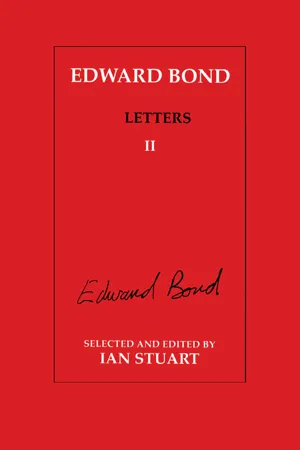
Edward Bond: Letters 2
About this book
First Published in 1996. Contemporary Theatre Studies is a book series of special interest to everyone involved in theatre. It consists of monographs on influential figures, studies of movements and ideas in theatre, as well as primary material consisting of theatre-related documents, performing editions of plays in English, and English translations of plays from various vital theatre traditions worldwide. Complementing the first volume of Edward Bond's letters, which provided a theoretical introduction to many of the social and political issues in his plays, Edward Bond Letters Volume II is organized into seven chapters which explore Bond's approach to some of the plays in performance.
Information
1
THE WORLDS
Erika Beck
Germany
19 December 1986
Dear Erika Beck,
You ask if I had a particular incident in mind when writing The Worlds. No. I wanted to pursue the themes which are common to all my work: the relationship between the individual and society, the origins of human culture, and our likely future — which we, as a species, threaten (though not as class: it is always and only the ruling and owning class which threatens the existence of the ruled and owned.) Im reminded of something Tolstoy wrote in his diary. Tolstoy is something of a disaster because he had no adequate philosophy to serve as a structure for what he felt. However, what he felt was often very useful. He wrote “… if Im to serve people by my writing, the one thing Im entitled and obliged to do is to expose the lies of the rich, and reveal to the poor the delusion practiced on them.”
I’d like to say a few things about the production which perhaps you’d pass on to the director and players. There are various sorts of text within the play. But these shouldn’t be approached aesthetically: there are no aesthetic solutions to political problems. The variations in text are there because the characters need them — or (of other issues) that’s how the character’s diseases (especially in the case of Trench and his enemy-friends) express themselves. Perhaps I could give a few instances. The opening scene you can base on a TV business drama. Young executives plotting for power: the computer world with its roots in Machiavelli’s Italy. This should indicate how to play it. The people are used to words. They anticipate, dove-tail their conversations, know how to exchange wit: its a dance, but a sword-dance. And as they dont live in an era of progressive capitalism (but in the era of its degeneration) — their personal ambitions cant be expressed in universal ideas: so instead of thoughts they deal in clichés — and they try to authenticate these with personal sincerity. They all believe (except the old drunk) that what’s good for them is good for the Company. There are (as often in my scenes) two poles between which the scene is stretched: the cynical drunk with his bottle, and the pseudo-cultured Menschenfiihrer with his poetry-book: the bottle is full, the poetry book empty. (Other poles are the business men’s suits and the terrorist civilianized-uniforms.) As always with directing any scene the point is to find out the internal structures and articulate these. The effect should be odd: like children playing with toys yet speaking with the precision of philosophers.
The “mimed” scene with the money being used to demonstrate power-relations, by the picketers: its important that this isnt patronising to the people to whom Terry is speaking: he tells them what they already know, they’re not like eskimos looking at their first television set and wondering how the little people got inside: it should be more as if they’re being given an illustration about, say, electricity: they wish to appear confident and able to wire a plug, but they’re careful to learn which wire is live, which is the earthed wire and so on: they arent children speaking tiddly-winks with the precision of philosophers: but more like very old people looking back at the school-exercise books of their childhood, or Angels (if there were such things) being explained solutions to the problems of human life (though obviously these would be beyond the understanding of Angels …). The point Im trying to get at is this: the workers know the relationships that Terry is explaining, what is new to them, perhaps, is his ability to encapsulate the relationships in devices which make them malleable and explainable, practical-images, working models — like a capitalist learning, hundreds of years ago, the utility of book-keeping — seeing his money and workers and property reduced to those handy and agile figures. But remember it isnt a game: its a description of the people’s lives — so they approach it confidently but earnestly. Perhaps you should try (in rehearsals) various ways of handling the money: very angrily then very gently — to suggest the human relations that are impregnated in the money. Something useful might come out of this. In a way, to put it a bit extravagantly, art can be the book-keeping of socialism, because it enables the objective and the subjective to be written down together and the interaction between them demonstrated. Usually in life each stands in the shadow of the other, and so there’s confusion, and political manipulation and political superstition and political submission become possible. We could make these relationships transparent. Instead of searching for profound, dark inner-motivations (as Ibsen does: really Ibsen tries to spend his energies asking a corpse what he died of — this passes for modern psychology) — instead throwing light on the weapons in the murderers hands (I’ve just expressed this rather obliquely, but you can work it out).
You should be aware of the headings for speeches at various parts of the play — and introduce the guidance given by the headings into performance: again, this is because of what the characters need (as agents for the author) at that moment. So try to highlight the differences of texts, not smooth them over: but do this not by external images or devices, but by internal movement and internal-rhythms: objective devices may well follow from this, but they shouldnt be imposed as directorial devices. The author (using authorial-devices, so the director neednt be too self-denying!) imposed these structures on the play (acting as agent for his characters) in order to articulate the meaning: sometimes mini-dramas occur: as for instance when Trench unveils his picture: here are the symptoms of the disease taking over, the hecticness of fever (elsewhere you will find the lethargy of Trench’s madness, as a prelude to his hysterical and mephistophelian Gott-dämmerung) — such scenes (the party scene) need great control and precision in order for their natural energy to be released. The scene builds very slowly and carefully to its climax at the unveiling — that’s obvious — each cog of the machine can be seen articulating its neighboring cogs: the actors should enjoy playing this and the audience should enjoy observing the mechanics of it: but when the outburst comes, then the articulation may not be so obvious but it still needs to be there: everything needs to be carefully orchestrated, so that the full tutti has its sweep: we watch the fever rage, but we watch it as the doctor not the patient: curiously the doctor knows more of what’s going on, and so (in this sense) he suffers more, is burdened with more. Now this wont work if you try to take the scene apart. You must take it apart in rehearsal to find out the interlocking nature, the structure, of the bits and pieces: then they can come together to produce their own energy. If this isn’t done, the actors will apply energy from outside, they will try to “agitate things,” produce hectic, comic business — but really the fever isn’t interested in making jokes it just burns with its own thoroughness: so the scene must be fast and funny, and absolutely resting on its structure. Otherwise there is the most dismal spectacle of all in the theatre: the Grand Prix motor-racing driver gets out of his beautiful machine and pushes it to make it go faster: we know that, for all his frantic efforts, the trouble is he doesnt understand his machine. Im afraid my scenes are often put together in this way. Actually there’s quite a serious cultural reason for it: the way things are put together in society becomes its ideology, the reasons for its ideological working. Often I make unusual combinations (if you know my War Plays you might think of the dead soldiers having their picnic of bones after the nuclear holocaust: or at the end of the Tin Can People the scene (probably the most difficult I’ve written: though if we understood ourselves better it would be easy to play) where someone pretends to be dead, someone tries to kill someone, someone fights for their life etc.). Chekhov understood the importance of using such elements: you find them, for example, in the duel-scene in Three Sisters: but because Chekhov lived in a moment when history was gathering its breath before it jumped, he puts the core of the play outside the play, off-stage (he had various devices and insights to deal with this problem — which he certainly sensed — but these are always ignored in the theatre) but that solution isnt open to us, because our history leaps! Chekhov can have a duel in one part of the garden and a tea-party in another: we have to serve tea in, during and around the duel: our social courtesy requires us to hold a teacup and sip, in one hand, and aim our pistol with the other. But we mustn’t create chaos but high-speed definition. Another thing, find out why the author put something there. When you know why, you can ignore it — or rather, improve on it. Consider the relationship between the chairs in the play. Or the tea which is so elaborately served in the boardroom — and the bottle of “pop” in scene 2/4 (actually there are two bottles of “pop” in scene 2/4 and only one cup of tea in the boardroom.) So why is the rose given water to drink in a silver vase (and the hostage in a hood red-coloured liquid meal from a bottle)? The incident with the rose is my favourite “theatre” moment in the play: how is the vase to be set down on the table? Audiences are not consciously putting these moments together as they watch the play: but they increase the audiences awareness as they go through the play — and are then left to work with the audience after the play. Dont discount the importance of such things: the human voice means something to human beings even before they understand language: and is understood even more with language. Unfortunately, we usually limit ourselves to stage voices, when we work in theatre: the voice, which Brecht so hated, which says “this is art” — you also hear it at the English RSC — or else a deliberate debasement, ie., we’re artists being unartistic: as if a surgeon got bored with operating on his patient and decided to do a knife throwing act with the theatre-sister standing against the door of the operating theatre: but when true seriousness goes, so does true comedy and true circus. (The solution always lies in asking: what are we doing this for — not: how do we make it work but what does it mean?)
Since the play was going to invite the audience to enjoy new skills and new games, and therefore I made it in many ways very “pure” and direct, I also needed an aesthetic gesture: so that the audience didnt say, “I have come here to be operated on”, but “I am the doctor.” The aesthetic device, chosen deliberately for its toy-like simplicity, was the circus drum-roll. Its played on motorbikes and other machines. It’s introduced in the message-reading scene — beginning miles and miles away behind the hills and slowly crescendoing till it drowns out the voices. There’s something unreal about that moment because presumably the girl’s voice wouldn’t be recorded clearly on the tape-machine (and the bike would be a clue wilfully offered to the police who’d listen to the tape) — well, you have to ignore this and go for the “theatre of it.” So perhaps towards the end of the speech the girl could cover her head with, say, a coat, and thus block out external sound and speak into the mike under the cover (interesting, because the Hostage has his head covered). The moped that later has difficulty in working will then speak for itself. I deliberately didnt use the idea of the drum-roll before Trench unveils his picture because the slow build-up of the scene is the equivalent of the drum-roll (and I wanted a “ghost” drum-roll, present by its absence — a device that always works well on stage.) The drum-roll idea is pursued at various places in the play and the director should always exploit it. Obviously the climactic drum-roll is the helicopter. This should be so loud that nothing else can be heard on stage (except perhaps strange human-dog barkings through a machine from the helicopter). Sound drowns out language, the white-worm struggles to free itself, Trench becomes part of his picture: the picture shoots. Thus it becomes a deadly drum-roll, like clowns playing drums before the nazis’ portable guillotines.
I based Trench on Samuel Beckett, so there’s no harm at all in him looking like him more and more as part two goes on.
Finally (more or less) if I had to suggest another writer who might serve as a guide to your approach to the play I would say: Molière. Does this surprise you? Molière worked always on a careful thesis, to an intelligent audience capable of using ideas, tempering their passions with wit and style, in order to — at least in some cases — turn bonfires in derelict places into laser beams: Moliere had an urgent, moral and political purpose. So he articulates and doesnt go in for romantic excesses in order to persuade you that he thinks: rather like someone who shouts because they believe this will make their logic clearer: feeling then becomes not a substitute for, but a weapon of, reason. I think my theatre is very emotional — but it doesnt need to whip up emotions; they come from the internal structures of the play, and then they can be devastating. All this has nothing to do with the pseudo-intellectualism of say Tom Stoppard — or the fatiguing search for significant nuance in La Rochefoucauld: he like Ibsen tries to avoid what’s under his nose by saying clever things with his mouth. Im sure that there is a contemporary audience able to do audience-work as skilfully as that done by the audiences of Molière and Shakespeare and the Greeks. We dont usually get them in the theatre because we’re afraid of them. We think art is a sickly plant which they’ll trample on: so often we trample on it first and then offer it. That’s a debasement of our times. I’ve found audiences of great skill — though not all that often in the professional theatre, where we assume they’re the patients and not the doctors.
Im afraid I’ve written quite a lot in this letter! The Worlds is an unusual play — but it works when those who’re doing it understand it. I did a production with teenagers that worked superbly well.1 We did it on top of the Royal Court theatre. When the helicopter landed and the sounds of guns were played a crowd gathered outside in the street, they thought there was an invasion: then they virtually attacked the stage door: I think the symptoms of our social and political disease were brought home too strongly for them — they were genuinely afraid. I remember another thing, when I was rehearsing the play in Newcastle (a port city) some actors were in a lift, they were carrying a dummy-gun and discussing their roles: someone got in the lift, took their conversation for real — ten minutes later the rehearsal building was surrounded by armed police and — we learned — the whole of Newcastle (and the port) had been put on a “red alert”.2 So you see, the play’s lies need the consciousness of the times.
You may be surprised that I havent spoken of the play’s politics. Obviously discussing those is important: but I needed to show you some of the theatrical strategies of the play. I find that when there is a true political understanding of my plays (and the characters) they work well — I saw an amateur production of Human Cannon that became an inspiration for me in its simple and direct honesty: so often in theatre we try to use theatrical tricks to make the truth palatable — but these people made the play so simple and direct that the truth became the bread of life.3 Of course, if you can only fall back on theatrical tricks, then my plays can hobble along as good as the next writers, indeed if you use the crutch as a weapon when you run the race, and strike down the other runners with it, you might even come over the line first (I’d advise the use of the crutch as a weapon in this case). But in such conditions I suppose you mustnt push for the truth too far. However, I hope that isnt your situation: you’d have chosen another play! (A get-out always available to the professional theatre.) You will have to send me a draft of your translation of “The Activist Papers” to check. Either I or my wife will do this quickly so that you’re not held up. I should warn you I write political theory as a poet. There’s a problem of style in modern theory: as a German you will know this from German philosophy… The truth cant have the simple ring of Luther’s bile and anger. But we have to think in our own time that ideas for human beings are expressed within psychology (or within ideologic wraps — its the same thing in this instance) and so we have to invoke and ease (gently) poetic awareness in our good readers — and affront and fear in our bad readers. Two and two are four: but there’s a difference in numbers if you’re holding the branding iron or you’re the prisoner being branded with your number.
Yours sincerely,
Edward Bond
If there are any further questions about the text, please write to me with them. I’ll try to answer them. And please give my best wishes to the players — Im sending them a “new years wishes” poem!
Georges Bas
Paris
25 February 1989
Dear Georges Bas,
Im afraid the situation in our theatre is bad. Seeping Thatcherism undermines any moral purpose — and so any serious political purpose — and so ...
Table of contents
- Cover
- Half Title
- Title Page
- Copyright Page
- Table of Contents
- Introduction to the Series
- Preface
- Acknowledgments
- List of Principal Correspondents
- Chapter One The Worlds
- Chapter Two Summer
- Chapter Three Human Cannon
- Chapter Four War Plays
- Chapter Five Restoration
- Chapter Six Jackets
- Chapter Seven Olly’s Prison
- Index
Trusted by 375,005 students
Access to over 1.5 million titles for a fair monthly price.
Study more efficiently using our study tools.
Frequently asked questions
Yes, you can cancel anytime from the Subscription tab in your account settings on the Perlego website. Your subscription will stay active until the end of your current billing period. Learn how to cancel your subscription
No, books cannot be downloaded as external files, such as PDFs, for use outside of Perlego. However, you can download books within the Perlego app for offline reading on mobile or tablet. Learn how to download books offline
Perlego offers two plans: Essential and Complete
- Essential is ideal for learners and professionals who enjoy exploring a wide range of subjects. Access the Essential Library with 800,000+ trusted titles and best-sellers across business, personal growth, and the humanities. Includes unlimited reading time and Standard Read Aloud voice.
- Complete: Perfect for advanced learners and researchers needing full, unrestricted access. Unlock 1.5M+ books across hundreds of subjects, including academic and specialized titles. The Complete Plan also includes advanced features like Premium Read Aloud and Research Assistant.
We are an online textbook subscription service, where you can get access to an entire online library for less than the price of a single book per month. With over 1.5 million books across 990+ topics, we’ve got you covered! Learn about our mission
Look out for the read-aloud symbol on your next book to see if you can listen to it. The read-aloud tool reads text aloud for you, highlighting the text as it is being read. You can pause it, speed it up and slow it down. Learn more about Read Aloud
Yes! You can use the Perlego app on both iOS and Android devices to read anytime, anywhere — even offline. Perfect for commutes or when you’re on the go.
Please note we cannot support devices running on iOS 13 and Android 7 or earlier. Learn more about using the app
Please note we cannot support devices running on iOS 13 and Android 7 or earlier. Learn more about using the app
Yes, you can access Edward Bond: Letters 2 by Ian Stuart in PDF and/or ePUB format, as well as other popular books in Letteratura & Critica letteraria nel teatro. We have over 1.5 million books available in our catalogue for you to explore.