- 296 pages
- English
- ePUB (mobile friendly)
- Available on iOS & Android
eBook - ePub
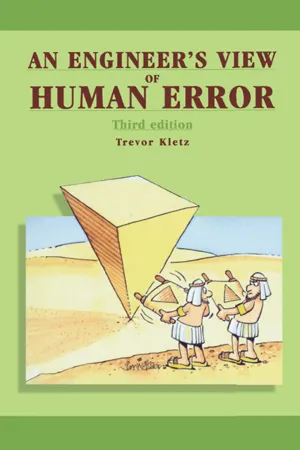
An Engineer's View of Human Error
About this book
This title looks at how people, as opposed to technology and computers, are arguably the most unreliable factor within plants, leading to dangerous situations.
Information
Introduction | 1 |
‘Man is a creature made at the end of the week … when God was tired.’
Mark Twain
Mark Twain
1.1 Accept men as we find them
The theme of this book is that it is difficult for engineers to change human nature and therefore, instead of trying to persuade people not to make errors, we should accept people as we find them and try to remove opportunities for error by changing the work situation — that is, the plant or equipment design or the method of working. Alternatively, we can mitigate the consequences of error or provide opportunities for recovery. (When it is possible for them to do so, people are better at correcting errors than at not making them.) I hope the book will remind engineers of some of the quirks of human nature so that they can better allow for them in design.
The method used is to describe accidents which at first sight were due to human error and then discuss the most effective ways of preventing them happening again. The accidents occurred mainly, though not entirely, in the oil and chemical industries, but nevertheless should interest all engineers, not just chemical engineers, and indeed all those who work in design or production. Apart from their intrinsic interest, the accident reports will, I hope, grab the reader’s attention and encourage him or her to read on. They are also more important than the advice. I did not collect incident reports to illustrate or support my views on prevention. I developed my views as the result of investigating accidents and reading accident reports. You may not agree with my recommendations but you should not ignore the reports.
Browsing through old ICI files I came across a report dating from the late 1920s in which one of the company’s first safety officers announced a new discovery: after reading many accident reports he had realized that most accidents are due to human failing. The remedy was obvious. We must persuade people to take more care.
Since then people have been exhorted to do just this, and this policy has been supported by tables of accident statistics from many companies which show that over 50%, sometimes as many as 90%, of industrial accidents are due to human failing, meaning by that the failure of the injured man or a fellow-worker. (Managers and designers, it seems, are not human or do not fail.) This is comforting for managers. It implies that there is little or nothing they can do to stop most accidents.
Many years ago, when I was a manager, not a safety adviser, I looked through a bunch of accident reports and realized that most of the accidents could be prevented by better management — sometimes by better design or method of working, sometimes by better training or instructions, sometimes by better enforcement of the instructions.
Together these may be called changing the work situation. There was, of course, an element of human failing in the accidents. They would not have occurred if someone had not forgotten to close a valve, looked where he was going, not taken a short-cut. But what chance do we have, without management action of some sort, of persuading people not to do these things?
To say that accidents are due to human failing is not so much untrue as unhelpful, for three reasons:
(1) Every accident is due to human error: someone, usually a manager, has to decide what to do; someone, usually a designer, has to decide how to do it; someone, usually an operator, has to do it. All of them can make errors but the operator is at the end of the chain and often gets all the blame. We should consider the people who have opportunities to prevent accidents by changing objectives and methods as well as those who actually carry out operations (see Appendix 2, item 1, page 261).
(2) Saying an accident is due to human failing is about as helpful as saying that a fall is due to gravity. It is true but it does not lead to constructive action. Instead it merely tempts us to tell someone to be more careful. But no-one is deliberately careless; telling people to take more care will not prevent an accident happening again. We should look for changes in design or methods of working that can prevent the accident happening again.
(3) The phrase ‘human error’ lumps together different sorts of failure that require different quite actions to prevent them happening again (see Section 1.3, page 4).
If all accidents are due to human errors, how does this book differ from any other book on accidents? It describes accidents which at first sight seem to be due wholly or mainly to human error, which at one time would have been followed by exhortations to take more care or follow the rules, and emphasizes what can be done by changing designs or methods of working. The latter phrase includes training, instructions, audits and enforcement as well as the way a task is performed.
It is better to say that an accident can be prevented by better design, better instructions, etc, than to say it was caused by bad design, instructions, etc. Cause implies blame and we become defensive. We do not like to admit that we did something badly, but we are willing to admit that we could do it better.
I do not say that it is impossible to change people’s tendency to make errors. Those more qualified than engineers to do so — teachers, clergymen, social workers, psychologists — will no doubt continue to try and we wish them success. But the results achieved in the last few thousand years suggest that their results will be neither rapid nor spectacular and where experts achieve so little, engineers are likely to achieve less. Let us therefore accept that people are the one component of the systems we design that we cannot redesign or modify. We can design better pumps, compressors, distillation columns, etc, but we are left with Mark I man and woman.
We can, of course, change people’s performance by better training and instructions, better supervision and, to some extent, by better motivation. What we cannot do is enable people to carry out tasks beyond their physical or mental abilities or prevent them making occasional slips or having lapses of attention. We can, however, reduce the opportunities for such slips and lapses of attention by changing designs or methods of working.
People are actually very reliable but there are many opportunities for error in the course of a day’s work and when handling hazardous materials we can tolerate only very low error rates (and equipment failure rates), lower than it may be possible to achieve. We may be able to keep up a tip-top performance for an hour or two while playing a game or a piece of music but we cannot keep it up all day, every day. Whenever possible, therefore, we should design user-friendly plants which can tolerate human error (or equipment failure) without serious effects on safety, output or efficiency3.
1.2 Meccano or dolls?
Let me emphasize that when I suggest changing the work situation, I am not simply saying change the hardware. Sometimes we have to change the software — the method of working, training, instructions, etc. Safety by design should always be the aim, but sometimes redesign is impossible, or too expensive, and we have to modify procedures. In over half the accidents that occur there is no reasonably practical way of preventing a repetition by a change in design and we have to change the software.
At present, most engineers are men and as boys most of us played with Meccano rather than dolls. We were interested in machines and the way they work, otherwise we would not be engineers. Most of us are very happy to devise hardware solutions. We are less happy when it comes to software solutions, to devising new training programmes or methods, writing instructions, persuading people to follow them, checking up to see that they are being followed and so on. However, these actions are just as important as the hardware ones, as we shall see, and require as much of our effort and attention.
One reason we are less happy with software solutions is that continual effort — what I have called grey hairs1 — is needed to prevent them disappearing. If a hazard can be removed or controlled by modifying the hardware or installing extra hardware, we may have to fight for the money, but once we get it and the equipment is modified or installed it is unlikely to disappear.
In contrast, if a hazard is controlled by modifying a procedure or introducing extra training, we may have less difficulty getting approval, but the new procedure or training programme may vanish without trace in a few months once we lose interest. Procedures are subject to a form of corrosion more rapid and thorough than that which affects the steelwork. Procedures lapse, trainers leave and are not replaced. A continuous management effort — grey hairs — is needed to maintain our systems. No wonder we prefer safety by design whenever it is possible and economic; unfortunately, it is not always possible and economic.
Furthermore, when we do go for safety by design, the new equipment may have to be tested and maintained. It is easy to install new protective equipment — all you have to do is persuade someone to provide the money. You will get more grey hairs seeing that the equipment is tested and maintained and that people are trained to use it properly and do not try to disarm it.
1.3 Types of human error
Human errors occur for various reasons and different actions are needed to prevent or avoid the different sorts of error. Unfortunately much of the literature on human error groups together widely different phenomena which call for different action, as if a book on transport discussed jet travel and seaside donkey rides under the same headings (such as costs, maintenance and publicity). I find it useful to classify human errors as shown below. Most classification systems are designed primarily to help us find the information. I have used a system that helps us find the most effective way of preventing the accidents happening again.
• Errors due to a slip or momentary lapse of attention (discussed in Chapter 2). The intention is correct but the wrong action or no action is taken. We should reduce opportunities for errors by changing the work situation.
• Errors due to poor training or instructions (discussed in Chapter 3). Someone does not know what to do or, worse, thinks he knows but does not. These are called mistakes. The intention is carried out but is wrong. We need to improve the training or instructions or simplify the job.
• Errors which occur because a task is beyond the physical or mental ability of the person asked to do it, perhaps beyond anyone’s ability (discussed in Chapter 4). There is a mismatch between the ability of the person and the requirements of the task. We need to change the work situation.
• Errors due to a deliberate decision not to follow instructions or accepted practice (discussed in Chapter 5). These are often called violations but non-compliance is a better term, as people often believe that the rule is wrong or that circumstances justify an exception. We should ask why the rules were not followed. Did someone not understand the reasons for the instructions, were they difficult to follow, have supervisors turned a blind eye in the past? There is fine line between initiative and breaking the rules. Note that if the instructions were wrong, non-compliance may prevent a mistake (as defined above).
Chapter 6 discusses those errors made by managers, especially senior managers, because they do not realize that they could do more to prevent accidents. These errors are not a fifth category but are mainly due to ignora...
Table of contents
- Cover
- Half Title
- Title Page
- Copyright Page
- Table of Contents
- Foreword to the third edition
- 1 Introduction
- 2 Accidents caused by simple slips
- 3 Accidents that could be prevented by better training or instructions
- 4 Accidents due to a lack of physical or mental ability
- 5 Accidents due to failures to follow instructions
- 6. Accidents that could by prevented by better management
- 7 The probability of human error
- 8 Some accidents that could be prevented by better design
- 9 Some accidents that could be prevented by better construction
- 10 Some accidents that could be prevented by better maintenance
- 11 Some accidents that could be prevented by better methods of operation
- 12 Errors in computer-controlled plants
- 13 Personal and managerial responsibility
- Postscript
- Appendix 1 – Influences on morale
- Appendix 2 – Some myths of human error
- Appendix 3 – Some thoughts on sonata form
- Further reading
- Index
Trusted by 375,005 students
Access to over 1.5 million titles for a fair monthly price.
Study more efficiently using our study tools.
Frequently asked questions
Yes, you can cancel anytime from the Subscription tab in your account settings on the Perlego website. Your subscription will stay active until the end of your current billing period. Learn how to cancel your subscription
No, books cannot be downloaded as external files, such as PDFs, for use outside of Perlego. However, you can download books within the Perlego app for offline reading on mobile or tablet. Learn how to download books offline
Perlego offers two plans: Essential and Complete
- Essential is ideal for learners and professionals who enjoy exploring a wide range of subjects. Access the Essential Library with 800,000+ trusted titles and best-sellers across business, personal growth, and the humanities. Includes unlimited reading time and Standard Read Aloud voice.
- Complete: Perfect for advanced learners and researchers needing full, unrestricted access. Unlock 1.5M+ books across hundreds of subjects, including academic and specialized titles. The Complete Plan also includes advanced features like Premium Read Aloud and Research Assistant.
We are an online textbook subscription service, where you can get access to an entire online library for less than the price of a single book per month. With over 1.5 million books across 990+ topics, we’ve got you covered! Learn about our mission
Look out for the read-aloud symbol on your next book to see if you can listen to it. The read-aloud tool reads text aloud for you, highlighting the text as it is being read. You can pause it, speed it up and slow it down. Learn more about Read Aloud
Yes! You can use the Perlego app on both iOS and Android devices to read anytime, anywhere — even offline. Perfect for commutes or when you’re on the go.
Please note we cannot support devices running on iOS 13 and Android 7 or earlier. Learn more about using the app
Please note we cannot support devices running on iOS 13 and Android 7 or earlier. Learn more about using the app
Yes, you can access An Engineer's View of Human Error by Trevor Kletz in PDF and/or ePUB format, as well as other popular books in Technology & Engineering & Industrial Engineering. We have over 1.5 million books available in our catalogue for you to explore.