- 130 pages
- English
- ePUB (mobile friendly)
- Available on iOS & Android
eBook - ePub
About this book
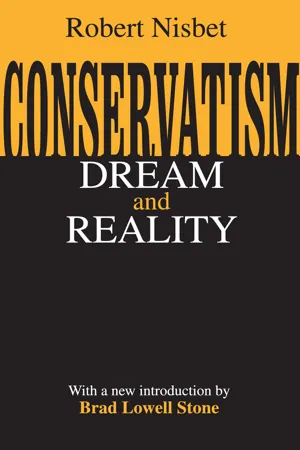
The essential concerns of conservatism are the same as those that motivated Nisbet's first and most influential book. The Quest for Community. In fact, Conservatism unites virtually all of Nisbet's work. In it, Nisbet deals with the political causes of the manifold forms of alienation that underwrite the human quest for community. The sovereign political state is more than a legal relationship of a superstructure of power, it is inseparable from its successive penetrations of man's economic, religious, kinship and local allegiances, and its revolutionary dislocations of established centers of power. Nisbet holds that although political philosophers are often conceived in terms of their views of the individual and the state, a more useful approach adds the factor of social groups or communities mediating between the individual and the state. Such groups comprise "society" the protection of which is the "sole object" of the conservative tradition, according to Nisbet. This conservative ideology arose in the West as a reaction to the French Revolution and its perceived impact upon traditional society. Edmund Burke was the first spokesman of the new ideology. In this book, Nisbet argues that modern conservatism throughout the West can be seen as a widening of Burke's indictment not only of the French Revolution, but of the larger revolution we have come to call modernity. From Edmund Burke and his contemporaries such as Bonald, de Maistre, Haller, and Savigny, down to T.S. Eliot, Christopher Dawson, Michael Oakeshott, Irving Babbit, Paul Elmer More, and Russell Kirk, the essential themes of political conservatism remained the same. They are centered upon history, tradition, property, authority, liberty and religion, and attack equally the political collectivism and radical individualism that have the same irrational outcomes. Nisbet makes the point that, at present, conservatism is also in a crisis, one created in large measure by mixing in the political arena economic liberalism and welfare state socialism - a lethal mix for conservative politics.
Information
1
Sources of Conservatism
Conservatism did not become a part of political speech until about 1830 in England. But its philosophical substance was brought into being in 1790 by Edmund Burke in his Reflections on the Revolution in France. Rarely in the history of thought has a body of ideas been as closely dependent upon a single man and a single event as modern conservatism is upon Edmund Burke and his fiery reaction to the French Revolution. In remarkable degree, the central themes of conservatism over the last two centuries are but widenings of themes enunciated by Burke with specific reference to revolutionary France.
He himself was clearly aware that the French Revolution was at bottom a European revolution, but that truth had to await the writings of such ardent traditionalists as Bonald, de Maistre, and Tocqueville for its detailed statement. In Burke and in them we find the outlines of a philosophy of history that was the diametric opposite of the Whig or progressive philosophy; and we find too a perspicuous statement of the importance of feudalism and of other historically grown structures such as patriarchal family, local community, church, guild and region which, under the centralizing, individualizing influence of natural law philosophy, had almost disappeared from European political thought in the seventeenth and eighteenth centuries. In the writing of Hobbes, Locke and Rousseau, traditional society and its historically evolved groups and traditions was recognized dimly at best, almost always with hostility. What alone was central was the hard reality of the individual; institutions were penumbral.
Burke, above any other single thinker, changed this whole individualistic perspective. His Reflections, by its denunciations of both Revolutionaries and the line of natural rights theorists leading up to the Revolutionaries, played a key role in the momentous change of perspectives involved in the passage from eighteenth-century to nineteenth-century Europe. Within a generation after publication of Reflections a whole Aufklarung blazed up in the West, at its core nothing more than an anti-Enlightenment. Such voices as Bonald, de Maistre and Chateaubriand in France, Coleridge and Southey in England, Haller, Savigny and Hegel in Germanic thought, and Donoso y Cortes and Balmes in Spain were resonating throughout the West. In America, John Adams, Alexander Hamilton and Randolph of Roanoke issued their own warnings and proposals. And all voices, European and American, were rich in respect to Edmund Burke as prophet.
To understand an effect upon the Western mind as immediate as Burke's Reflections was, we must take careful note of the substantial vein of a traditionalism of principle as well as emotion that had been growing up in Western Europe throughout the eighteenth century. Given our normal predilection for the more exciting Enlightenment mentality of the Voltaires, Diderots and d'Holbachs, it is easy to miss, in the histories, this counter-force to the high rationalism and individualism of the Enlightenment. But it is there all the same, a product at one and the same time of the Church and its still considerable numbers of philosophers and theologians committed to orthodoxy instead of the ideas of natural religion and natural ethics which had sprung out of the natural law movement of the seventeenth century. The more that the philosophes declared the enlightenment of their doctrines of natural rights, the more the philosophers and historians in the universities—all religiously oriented, of course—appealed to the traditions which had sustained Europe for more than a thousand years.
In addition to the church, there were the historic towns and guilds throughout Western Europe which turned increasingly, as the cosmopolitanism of the Enlightenment spread, to their own native histories, traditions, saints, heroes, governments and crafts. There were poets, composers, performers, artists, artisans, analysts and chroniclers quite content to work with the materials of their own communities instead of going off to Europe's capitals for possible fortune and fame. Search for native dialects, folk literature, long ignored creators in the arts, military heroes of the distant past, and others comparable to these, was in full swing in many parts of Germany by the middle of the eighteenth century. The fascination with the Middle Ages that would grip so many minds in England and France in the nineteenth century was widely evident in Germany and Eastern Europe throughout the eighteenth century. There was no single city in Germany that could exert intellectual power over a whole nation of the sort that both Paris and London did in their countries. Traditionalism was almost inevitable in the spirit of localism that gripped Germany and also, not to be ignored, in parts of England and France.
Long before the Revolution in France, Burke, in his Annual Register—book reviews which he wrote himself—and speeches had made clear his distaste for the typical rationalist mind of the French Enlightenment, and for none more than Rousseau whose talent Burke recognized but whose morals and politics he found repugnant in the extreme. He detested the Grub Street mentality in London, Paris and every place else, including New York and Boston, where it was found. From the beginning of his career in England Burke was on the side of what he saw as Britain's 'Great Tradition' in political history.
There was thus background, in Burke himself, and in England and in all Western Europe, for the kind of philosophy he set forth forthrightly in his Reflections. Few if any in Europe could equal Burke's eloquence of assault upon the Jacobins and their legislation in France, but by 1789 there was a considerable number of Europeans whose essential conservatism of mind was deeply ravaged by the Revolution. The words conservative and conservatism applied to politics did not appear in the West until about 1830, but the substance long preceded the words.
So far as English conservative thought is concerned, there is no doubt something which Burke, a devoted Whig, owed to the Tory Party, which was older and favored by the monarchy and much of the aristocracy. And Burke was a friend of that quintessential Tory, Dr. Johnson. But what Burke wrote in a letter to Boswell perhaps clarifies his relation to Tory principles: 'I dined with your friend Dr. Johnson on Saturday at Sir Joshua's. We had a very good day, as we had not a sentence, word, syllable, letter, comma, or tittle of any of the elements that make politics.' In the general melee of post-revolutionary politics in Britain it is probable that Tories and Whigs found themselves together often on particular issues and that by the time the new Conservative Party took shape under Peel, there was mixture too of Tory and Whig tenets. But nineteenth-century British conservatism is much more the issue of Burke and his works than of any Tories. Use of 'Tory' by modern British Conservatives has been somewhat more affectation than anything really substantive.
Burke paid a heavy price at home for his call to traditionalists throughout Europe to rally themselves against the French Revolution. He was widely charged, abroad as well as at home, with inconsistency bordering upon faithlessness of principle in taking the position he did on the Revolution in France. How, it was asked repeatedly, could he have supported the colonists in America and other tyrannized peoples of the world as he had and now turn on the French seeking emancipation from monarchical despotism? Whigs in England, including his long time friend and ally Charles Fox, broke with him on the Revolution. However, this is not the place to try to settle accounts; all we can do here is summarize briefly the case Burke made for himself. He was upholding in France the same basic principles which had actuated his defenses of the Americans, Indians and Irish against the 'arbitary power' of the British government. In each of these defenses he had made his case on behalf of the native, historical tradition of a people under assault by an alien power. There could be no rational talk about liberty for the Americans—after all, they were fundamentally an English people abroad, living under the same prescriptions and conventions which governed the British—without the premise of a sufficient autonomy for natural development of American potentialities. The same held for Ireland and India, in each case an indigenous morality under attack by a foreign one.
In France, the assault upon traditional government and morality came from a small group of Frenchmen, the Jacobins, but, Burke argued, the essential principles of the matter were no different from those obtaining in his defense of the American colonists. The issue was freedom then and it was the same now; the violation of freedom was no less due to the fact that the minority governing was of French blood. From Burke's point of view, the Jacobins were as much aggressors upon French history and tradition as the British East India Company had been upon Indian culture. France under the Jacobins was 'exactly like a country of conquest.' Moreover, 'acting as conquerors' the Jacobins used force on the French people precisely as would an 'invading army.'
In Burke's eyes the work of the Jacobins across the Channel was the very opposite of the work done by the American colonists: the work of freedom from 'arbitrary power.' Rather it was leveling in the name of equality, nihilism in the name of liberty, and power, absolute and total, in the name of the people. The American Revolution had sought freedom for actual, living human beings and their customs and habits. But the French Revolution was far less interested in the actual and the living—the peasants, bourgeoisie, clergy, nobility, etc.—than in the kind of human beings the Revolutionary leaders believed they could manufacture through education, persuasion and when necessary force and terror. Not since Reformation insurrections in the name of God, Burke thought, had a revolution occurred in Europe so monolithically consecrated to the salvation of man and to his complete spiritual remaking.
Precisely as Anabaptists had been willing to lay waste to all that interfered with their creation of the New Christian Man, so the Jacobins, Burke perceived, were willing to destroy all institutions that interfered with the making of Revolutionary Man. Burke wrote: 'All circumstances taken together, the French Revolution is the most astonishing that has hitherto happened in the world.'
Tocqueville stressed this uniqueness of the French Revolution, also specifically disavowing a significant relationship between it and the American Revolution. That revolution had been the work of men with a clear stake in society, but not the French. On this point Tocqueville agreed completely with Burke—as he did on more than a few points. The dependence of Tocquevillian analysis—in the measured language of scholarly objectivity and with no overriding suggestion of hostility—upon Burkean polemic has not yet been sufficiently appreciated, it seems to me. In theme after theme Tocqueville dilated on Burke.
Echoing Burke, Tocqueville wrote that 'In all the annals of recorded history, we find no mention of any political revolution that took this form,' that is the form of the French Revolution. Tocqueville too looked to religious outbursts of the past for nearest precedent to the French Revolution. And Tocqueville featured the activist role of political intellectuals in the French Revolution—in striking contrast to the American Revolution. 'Men of Letters,' Burke had called them; Tocqueville used the same phrase. 'Never,' wrote Tocqueville, his very irony drawn from Burke's words, 'had the entire political education [of the French people] been the work of its men of letters.'
In another important respect Tocqueville was Burke's heir; that was the trans-Gallic, the whole European implication of the French Revolution. Burke wrote in his Reflections: 'Many parts of Europe are in disorder. In many others there is a hollow murmuring under ground; a confused movement is felt that threatens a general earthquake in the political world.' Tocqueville specifically designated his Old Regime and the French Revolution as but the first in what he planned to be series of volumes on 'the European Revolution.'
Tocqueville devoted a chapter to the essentially religious nature of the French Revolution, seeing it, as Burke specifically had, more nearly in sequence with the religious uprisings, devastations and terroristic slaughters of the late Reformation than with any political revolutions, such as the English in 1688 and the American in 1776. In somewhat the same key, Tocqueville echoes Burke's repeated charges that the French Revolutionists were men of neither experience or interest in political history or, in the true sense, political reform, 'Our revolutionaries,' Tocqueville wrote in the very phrasing of Burke,
had [a] fondness for broad generalizations, cut-and-dried legislative systems, and a pedantic symmetry; the same contempt for hard facts; the same taste for reshaping institutions on novel, ingenious, original lines; the same desire to reconstruct the entire constitution according to the rules of logic and a preconceived system instead of trying to rectify its faulty parts. The result was nothing short of disastrous; for what is a merit in the writer may well be a vice in the statesman, and the very qualities which go to make great literature can lead to catastrophic revolutions.
Even the Jacobins' language, Tocqueville continued, 'was borrowed largely from the books they read; it was cluttered up with abstract words, gaudy flowers of speech, sonorous cliches and literary turns of phrase.' Tocqueville concludes dryly: 'All they needed, in fact, to become literary men in a small way was a better knowledge of spelling.'
It must be emphasized that throughout his Reflections Burke was addressing himself quite as much, if not more, to English as to French and other European sympathizers with the Jacobins. Richard Price and Tom Paine spoke for most of the sympathizers in declaring the French Revolution basically of copy of the American Revolution, primarily actuated by straggle for freedom from an oppressive power. But Burke (who would be joined here also by Tocqueville) saw the French Revolution as much more a struggle for absolute power than for freedom, the work primarily of political intellectuals who did not have, as did the leading American revolutionists, a 'stake in society,' and were in fact society's enemies.
There is some humor in the reflection that the aims Burke ascribed to the Jacobins in 1790, aims of the reconstruction of all society, of a remaking of individual consciousness, and of the installation of a totally new religion in the place of Christianity, would have seemed much more adequate and relevant to Robespierre and Saint—Just in 1793 than would have the modest, liberal aims Richard Price had given the French Revolution in the speech at Old Jewry which triggered Burke's Reflections.
Burke was of course right in seeing the French Revolution as unique and also as endowed with a mystique that would reach out to all Europe, even Asia and Africa in due time, and would be perhaps the single most obsessive subject in the serious thought of the whole nineteenth century in the West. Not until the Bolshevik Revolution of 1917 would the French Revolution be at last replaced as the chief preoccupation of revolutionists everywhere and also of traditionalists and conservatives everywhere. The French Revolution is, though, the more original in its language and symbolism. In its declarations, manifestoes, and preambles to laws, in its great rolling strophes and sharp, evocative images, printed by the Jacobins to reach and fit every public square in France, the French Revolution inaugurated a kind of revolution of the Word, something previously found only in evangelical, proselytizing religions. As the history of nineteenth-century Europe reveals in almost every quarter, the Jacobin Good News, suitably translated and tactically adapted, could be the equal in force of the Christian. Marxian rhetoric, and the rhetoric of Lenin and Trotsky in 1917, was secondary, in considerable measure derivative indeed.
Burke declared Rousseau to be the chief author of the French Revolution. Tocqueville, more diffident, exonerated Rousseau, by placing responsibility upon the 'men of letters' who had, in the decade or so leading up to the Revolution, driven into the minds of the people, irresistible fantasies of freedom, equality and absolute justice. But there can be no question of Tocqueville's full awareness of Rousseau's significance. Who else, after all, had argued with such passion and eloquence the case for the people, the divinely constituted people once their chains were struck off, the iniquity of all historically formed institutions, and the absolute necessity of a 'Legislator' who would in the name of the people strike deeply and widely into human consciousness? Burke was blunt: 'I am certain that the writings of Rousseau lead directly to this kind of shameful evil.' What we know for a fact is that such Jacobins as Robespierre and Saint-Just, at the height of the Revolution, read Rousseau devotedly and regularly. Their zeal was shared, we learn from a contemporary, by a considerable number of French citizens who could be seen standing in knots at street corners reading aloud and discussing passages from the Social Contract, until now the least read of Rousseau's books.
Traditional groups—gilds, monasteries, corporations of all kinds —had been condemned by Rousseau, in the interest of achieving a pure general will and also the individual's own autonomy. They therefore required obliteration or substantial subordination to the nation. Aristocracy was of course marked early for extinction. But this was only the beginning. In 1791 all gilds were abolished—a goal, it is amusing to recall, that had escaped all efforts by divine-right, 'absolute' monarchies of modern France. 'There is no longer any corporation within the state,' the Law Le Chapelier read; 'there is but the particular interest of each individual and the general interest.'
Inevitably the patriarchal family felt the power of the Revolution. The general belief of philosophes had been that the traditional kinship structure was 'against nature and contrary to reason.' Clearly, many Jacobin governors agreed. In 1792 marriage was declared a civil contract, and a number of grounds for divorce were made available (in 1794 the number of divorces exceeded the number of marriages). Strict limitations were placed upon the paternal authority, among them the disappearance of this authority when the sons reached their legal majority. The traditional laws of primogeniture and entail were set aside forever, with implication to property as well as family.
Property was made a special object of legislative action. The overriding aim was destruction of all linkage between property claim and the corporate organizations such as family, church, gild, and monastery which had been so long the real repositories of a very large amount of property in France—and indeed in most of Europe. With this aim went the objective of individualizing as far as possible the rights of ownership, a part of the larger aim of individualizing all of traditional society. Moreover, the mission of exterminating the aristocracy for its parasitism involved necessarily the appropriation or the atomization of the great landed estates of the aristocracy. More fluid, mobile, and moneyed types of property flourished as one of the by products of the Revolution, elevating to economic power a whole new class. Few things would be more vividly repugnant to the conservative tradition than the Revolution's relationship to property.
There is no space here for anything approaching full recital of the varied impacts of the Revolutionary government upon traditional French society. In general, the efforts of the National Assembly, the National Convention, and the Committee on Public Safety were bent toward, at one and the same time, the individualization of society and the rationalization of everything from coinage and weights and measures to property, education, religion, and all aspects of government. Religion has perhaps claim here as one final instance of revolutionary thoroughness. At different times the government terminated all monastic and other religious vows, nationalized the Church, put all clerics on state salaries, with the binding condition that an oath of allegiance to the Revolution be taken, and then in 1793 the thrilling plan to deChristianize France completely, piously filling the vacuum with a new religion dedicated to reason and virtue. In the interest of the new religion and also of the minds of men, elaborate rituals were written, liturgies were developed for use in meetings of the new religion, and a totally new calendar was introduced for the remaking of these minds. Control of time, of the past and its images, is vital, as Orwell emphasized in Nineteen Eighty-Four. The French Revolutionists were ahead of him, and the proposed new calendar would have adorned a new history of the past, repudiating and destroying the myt...
Table of contents
- Cover
- Half Title
- Title
- Copyright
- Contents
- Introduction to the Transaction Edition
- Preface
- 1 Sources of Conservatism
- 2 Dogmatics of Conservatism
- 3 Some Consequences of Conservatism
- 4 The Prospects of Conservatism
- Bibliography
- Index
Trusted by 375,005 students
Access to over 1.5 million titles for a fair monthly price.
Study more efficiently using our study tools.
Frequently asked questions
Yes, you can cancel anytime from the Subscription tab in your account settings on the Perlego website. Your subscription will stay active until the end of your current billing period. Learn how to cancel your subscription
No, books cannot be downloaded as external files, such as PDFs, for use outside of Perlego. However, you can download books within the Perlego app for offline reading on mobile or tablet. Learn how to download books offline
Perlego offers two plans: Essential and Complete
- Essential is ideal for learners and professionals who enjoy exploring a wide range of subjects. Access the Essential Library with 800,000+ trusted titles and best-sellers across business, personal growth, and the humanities. Includes unlimited reading time and Standard Read Aloud voice.
- Complete: Perfect for advanced learners and researchers needing full, unrestricted access. Unlock 1.5M+ books across hundreds of subjects, including academic and specialized titles. The Complete Plan also includes advanced features like Premium Read Aloud and Research Assistant.
We are an online textbook subscription service, where you can get access to an entire online library for less than the price of a single book per month. With over 1.5 million books across 990+ topics, we’ve got you covered! Learn about our mission
Look out for the read-aloud symbol on your next book to see if you can listen to it. The read-aloud tool reads text aloud for you, highlighting the text as it is being read. You can pause it, speed it up and slow it down. Learn more about Read Aloud
Yes! You can use the Perlego app on both iOS and Android devices to read anytime, anywhere — even offline. Perfect for commutes or when you’re on the go.
Please note we cannot support devices running on iOS 13 and Android 7 or earlier. Learn more about using the app
Please note we cannot support devices running on iOS 13 and Android 7 or earlier. Learn more about using the app
Yes, you can access Conservatism by Robert Nisbet in PDF and/or ePUB format, as well as other popular books in Politics & International Relations & Conservatism & Liberalism. We have over 1.5 million books available in our catalogue for you to explore.