- 382 pages
- English
- ePUB (mobile friendly)
- Available on iOS & Android
eBook - ePub
About this book
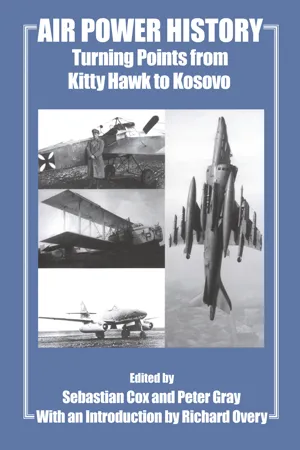
he 20th century saw air power transformed from novelists' fantasy into stark reality. From string and canvas to precision weaponry and stealth, air power has progressed to become not only the weapon of first political choice, but often the only conceivable option. This rapid development has given rise to considerable debate and controversy with those holding entrenched views rarely slow to shout their case. Many myths have grown over the period, ranging from the once much vaunted ability of air power to win wars alone through to its impact as a coercive tool.
This volume examines the theory and practice of air power from its earliest inception. The contributors have been drawn from academia and the military and represent some of the world's leading proponents on the subject. All significant eras on air power employment are examined: some are evidently turning points, while others represent continuous development. Perhaps more importantly, the book highlights the areas that could be considered to be significant, and invites the reader to enter the debate as to whether it constitutes a continuum, a turning point, or indeed a revolution.
PART I:
THE FIRST WORLD WAR AND THE INTER–WAR YEARS
1
Learning in Real Time: The Development and Implementation of Air Power in the First World War
Tami Biddle
In terms of air power history, the First World War has been overshadowed by the Second World War. But the war of 1914–18 is in fact the mother–lode for air power historians. Indeed, virtually every important manifestation of twentieth–century air power was envisioned and worked out in at least rudimentary form between 1914 and 1918. Those who want to understand the role of aircraft in subsequent conflicts do well to turn back to the experience of the Great War precisely because all the roots of modern practice are there to be explored. Both official and unofficial interpretations of the events of the First World War had a strong influence throughout the inter–war years. In this short essay I can draw attention only to some of the highlights. I shall try to explain, concisely, what happened during the war, how it was understood, and how realities and interpretations sometimes conflicted. The essay will examine both tactical and strategic aviation, placing a slight emphasis on the latter. Throughout I shall focus mainly but not exclusively on the British experience.
The First World War brought to the battlefield an intimidating array of new tools for combat; not only did the 1914 generation of military leaders have to equip, organize, train, and direct million–man armies over extended battle fronts, they also had to assimilate and integrate potent new technologies. One of these – the aeroplane – had been anticipated in the popular literature for a long time.1 There was no consensus on the role that aeroplanes would play in a coming war. High expectations in some circles were juxtaposed against the reality that the war had begun only 11 years after the Wright Brothers’ success at Kitty Hawk. Early aeroplanes were experimental, unreliable craft whose military advantages remained speculative; indeed one American aviator called the early First World War aeroplane a ‘little, flimsy spider–work of wood and linen’.2
As is always the case in war, however, progress was telescoped: by 1918 the Germans had a four–engine bomber with a wingspan just shy of a Second World War B–29, and the British were closing in fast. In a sense, both the visionaries and the conservatives were right: the war foreshadowed what was to come in the realm of air power, and saw accelerated development of most of the roles we now associate with combat aircraft. But aviation remained on the periphery of a war dominated by colossal campaigns of attrition on the ground.
The First World War tested theory and became the anvil on which new aerial missions were forged. As was true of land warfare, however, the task of developing doctrine, missions and suitable weapons types for modern warfighting proved to be complex and difficult; it demanded technological and managerial prowess at the national level, insight and flexibility at the operational and tactical levels, and skill and courage at the individual level. No nation managed to achieve all of these simultaneously and consistently throughout the war. Every nation using air power had to wrestle with a wide array of challenges, including building an adequate production base, responding to the technological innovations of the enemy, developing organizational and bureaucratic structures to support and define the use of air power, and finding ways to integrate air and ground operations successfully.
At the outset of the war, all of the European powers were in the midst of working out the competing aviation interests of their armies and navies. In no state had an ideal organizational solution been found, and service rivalries and jealousies persisted throughout the war. Perhaps the biggest challenge of all, though, was for leaders to perceive and understand the roles of aircraft in war even as they watched them develop for the first time. Errors, problems and shortfalls were paid for all too often with the lives of young men who had to entrust themselves to imperfect machines operating on the basis of flawed premises in very difficult tactical conditions.
OBSERVATION AND RECONNAISSANCE
Even those possessed of limited imagination could accept the idea that an aerial perspective would change the nature of warfighting in some fundamental ways. Aircraft, acting as observers and scouts, would be a powerful adjunct to cavalry in the reconnaissance mission. In the event, access to an aerial panorama did prove valuable – indeed, the point was made early and dramatically at both the Marne and Tannenberg.3 Observers were called upon to locate troops, railheads, aerodromes, camps and supply dumps. Reconnaissance information, initially conveyed by notes and hand–drawn sketches, was soon gathered by aeroplane–mounted cameras. As photographic technology improved throughout the war, so did the quality of information provided to commanders; photographs became the basis of highly detailed maps, which could be widely distributed – and which would remain accurate for some time due to the static nature of the war in the west.4
Artillery spotting became particularly important because of the central role artillery came to play in the war. Communication posed obstacles, however, and made the process of air–artillery co–operation difficult, especially early in the war. Initially, only a very small number of planes were equipped with wireless telegraphy, and these sets were so large and clumsy that their utility was greatly compromised; other aircraft used Very lights and electric lanterns to signal back to batteries. By 1916, more and more planes were being fitted with wireless sets, but this communication went only one way — from air to ground. Troops wanting to get information back to aircraft had to rely on awkward cloth ground markers, or signal lanterns. Over time, aerial photographs came to be relied on heavily for counter–battery work.5
Many observer aircraft were light, unstable and possessed of unreliable, vibrating engines. They were vulnerable due to their flight altitudes and slow speeds. Observer training was spotty, and even the trained often had difficulty making out features on the ground, especially in bad weather or under fire.6 The wireless sets of artillery spotters were subject to background noise and other types of interference, and only a limited number of aircraft could operate in a given area and frequency band. Observation for counter–battery work was painstakingly slow: engaging just one target usually took an hour’s effort. And communication broke down simply because spotters were often inadequately indoctrinated in the work of the artillery arm, and thus not in a good position to intuit the kind of information required by its members. One British document on artillery spotting observed laconically, ‘One of the principal factors necessary to enable successful work with the artillery is a slight knowledge of gunnery on the part of the observer.’7
Despite the problems, the information provided by aircraft proved enormously valuable. The inevitable result was the development of anti–aircraft techniques, air–to–air combat, and purpose–built aircraft designed to gain control of enemy airspace and protect those doing observation and artillery spotting. Airspace had become a crucial commodity and, as such, would be hotly contested.
FIGHTERS AND THEIR PILOTS
The evolution of aerial combat is a well–known story; it commences with opposing pilots firing pot shots at one another with pistols and carbines, and moves on to sophisticated dog–fighting techniques with specialized airplanes carrying fixed, forward–firing machine–guns.8 The intense competition for advantage in the air led to a self–generating, spiralling quest for new and better fighter technology. Innovative, energetic and immensely brave individual pilots made their own unique contributions in this realm. Pilots such as Georges Guynemer, Albert Ball, Manfred von Richthofen and Oswald Boelke discovered the performance envelopes of their machines, came to grips with the physics of flying, and caused the tactical manuals to be revised and rewritten every few months.9
There is, of course, a fascinating social and cultural story about the fighter pilots. Heralded as heroes, and offered up as a source of glamour in an otherwise bleak war of masses, these men and their stories were publicized to help maintain morale on the home front and in the trenches.10 Glorified as individualistic ‘knights of the air’, they were frequently contrasted to the war’s faceless armies and massed artillery. But though some of the most talented pilots continued to favour lone– wolf tactics over formations, the growing lethality of aerial combat forced the refinement of mutual support among fighting and bombing aircraft. The technology and tactics employed by fighter escadrilles grew more sophisticated throughout the war. Despite the glamorous images perpetrated by a press desperate for tales of glory, the real lives of fighter pilots were dangerous, physically and emotionally gruelling – and short. Those who beat the fearsome odds of being killed flew exhausted and under constant strain. French ace Charles Nungesser, who was wounded 17 times during the course of the war, was so weakened during the Battle of Verdun that he had to be lifted bodily into the cockpit and could use only one leg on the rudder controls.11
CONTACT PATROL, GROUND ATTACK AND INTERDICTION BOMBING
Infantry contact patrol (monitoring the progress of friendly troops) and ground attack of enemy troops developed during the course of the First World War as well. To be accurate, ground attack had to be low. This meant it was dangerous – and often costly. The costs would be emphasized during the inter–war years by air organizations, like the Royal Air Force, which were trying to de–emphasize ground war– oriented operations. But the fact was (and the Germans well understood it) that, under the right circumstances, ground attack could have potent effects.12
Under the heading of ‘tactical bombing’ one can place not only bombing in direct support of troops engaged in ground battle, but also aerial interdiction meant to isolate the battlefield and deny one’s enemy the ability to supply and manoeuvre his forces. The potential value of aerial interdiction was grasped quickly. In a war that relied heavily on railways to bring forward the masses of men and materiel needed for battle, it made sense to try to interrupt rail traffic by any means available. Writing during the war, aviation author Charles C. Turner remarked that, ‘From the military point of view, perhaps, the most important of all the bearings of aircraft ... concerns the vulnerability of railways to attack from above.’13 The problem was that bombing by aeroplane was a haphazard and inefficient business: getting bombs on target reliably was far harder than anyone had anticipated. Historian Basil Collier has pointed out that an analysis of all–day bombing done by Allied aircraft between 1 March and 20 June 1915 revealed that only three out of 141 attempts to bomb railway stations were known to have succeeded.14
British battle plans for the Somme, commencing in July 1916, involved tactical bombing aimed at German communications, including railway lines, railway stations, bridges and command headquarters. Despite British efforts to provide for communication between different units and arms operating at the Somme, the fog of war intruded on the opening stages of the assault, and air squadrons had to muddle through as best they could on a chaotic battlefield. Complicated systems of signalling between flyers and ground troops were undermined by mist, and swirling clouds of dust and smoke. In general, the opening phase of the battle revealed the persistent difficulty of co–ordination in modern, industrialized warfare and the enduring complexities of communication between the ground and the air. Major–General Sir Hugh Trenchard, head of the Royal Flying Corps (RFC), used tactical bombing not only to attempt to damage enemy targets, but also to draw off enemy fighters, which would be forced to attack bombers and thus unavailable to harass aircraft working over the battlefield. Following the lead of the French at Verdun, Trenchard also had his pilots fly aggressive patrols designed to win freedom of manoeuvre for British reconnaissance, artillery and other ground support aircraft, and to deny such freedom to the enemy. In September 1916 Trenchard issued an important (and later much–quoted) memorandum which asserted that at the Somme British air policy had been one of ‘relentless and incessant offensive’, which, he argued ‘had the effect so far on the enemy of compelling him to keep back or to detail portions of his forces in the air for defensive purposes’.15 If Trenchard’s tactics gave the Germans pause, they were costly to the British. Believing he had little choice but to continue to press his offensive, Trenchard sent novices – many of had whom only the minimum 15 hours’ flying time – into combat. The price was high: 210 planes written off from all causes in July 1916, wit...
Table of contents
- Cover
- Title Page
- Copyright Page
- Contents
- Editors’ Preface
- Introduction
- Part I: The First World War and the Inter-war Years
- 1 Learning in Real Time: The Development and Implementation of Air Power in the First World War
- 2 Achieving Air Ascendancy: Challenge and Response in British Strategic Air Defence, 1915–40
- 3 The Royal Naval Air Service: A Very Modern Service
- 4 The Luftwaffe and Lessons Learned in the Spanish Civil War
- Part II: The Second World War
- 5 The Second World War as a Turning Point in Air Power
- 6 Maritime Air Power and the Second World War: Britain, the USA and Japan
- 7 A Neglected Turning Point in Air Power History: Air Power and the Fall of France
- 8 ‘Learning is Winning’: Soviet Air Power Doctrine, 1935–41
- 9 The Development of Tactical Air Doctrine in North Africa, 1940–43
- 10 Logistics Doctrine and the Impact of War: The Royal Air Force’s Experience in the Second World War
- 11 Australia and the War in the Pacific, 1942–45
- Part III: The Gulf War 1991
- 12 Planning the Air Campaign: The Washington Perspective
- 13 The 1991 Bombing of Baghdad: Air Power Theory vs Iraqi Realities
- 14 The Gulf War and UK Air Power Doctrine and Practice
- Part IV: Air Power in Regional Conflict
- 15 Solidifying The Foundation: Vietnam’s Impact on the Basic Doctrine of the US Air Force
- 16 Air Power Victorious? Britain and NATO Strategy during the Kosovo Conflict
- 17 The Balkans: An Air Power Basket Case?
- Notes on Contributors
- Index
Trusted by 375,005 students
Access to over 1.5 million titles for a fair monthly price.
Study more efficiently using our study tools.
Frequently asked questions
Yes, you can cancel anytime from the Subscription tab in your account settings on the Perlego website. Your subscription will stay active until the end of your current billing period. Learn how to cancel your subscription
No, books cannot be downloaded as external files, such as PDFs, for use outside of Perlego. However, you can download books within the Perlego app for offline reading on mobile or tablet. Learn how to download books offline
Perlego offers two plans: Essential and Complete
- Essential is ideal for learners and professionals who enjoy exploring a wide range of subjects. Access the Essential Library with 800,000+ trusted titles and best-sellers across business, personal growth, and the humanities. Includes unlimited reading time and Standard Read Aloud voice.
- Complete: Perfect for advanced learners and researchers needing full, unrestricted access. Unlock 1.5M+ books across hundreds of subjects, including academic and specialized titles. The Complete Plan also includes advanced features like Premium Read Aloud and Research Assistant.
We are an online textbook subscription service, where you can get access to an entire online library for less than the price of a single book per month. With over 1.5 million books across 990+ topics, we’ve got you covered! Learn about our mission
Look out for the read-aloud symbol on your next book to see if you can listen to it. The read-aloud tool reads text aloud for you, highlighting the text as it is being read. You can pause it, speed it up and slow it down. Learn more about Read Aloud
Yes! You can use the Perlego app on both iOS and Android devices to read anytime, anywhere — even offline. Perfect for commutes or when you’re on the go.
Please note we cannot support devices running on iOS 13 and Android 7 or earlier. Learn more about using the app
Please note we cannot support devices running on iOS 13 and Android 7 or earlier. Learn more about using the app
Yes, you can access Air Power History by Sebastian Cox,Peter Gray in PDF and/or ePUB format, as well as other popular books in History & 20th Century History. We have over 1.5 million books available in our catalogue for you to explore.