- 403 pages
- English
- ePUB (mobile friendly)
- Available on iOS & Android
eBook - ePub
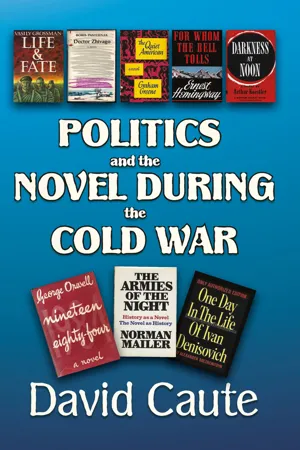
Politics and the Novel During the Cold War
About this book
David Cautes wide-ranging study examines how outstanding novelists of the Cold War era conveyed the major issues of contemporary politics and history. In the United States and Western Europe the political novel flourished in the 1930s and 1940s, the crisis years of economic depression, fascism, the Spanish Civil War,the consolidation of Stalinism, and the Second World War. Starting with the high hopes generated by the Spanish Civil War, Caute then explores the god that failed pessimism that overtook the Western political novel in the 1940s. The writers under scrutiny include Hemingway, Dos Passos, Orwell, Koestler, Malraux, Serge, Greene, de Beauvoir, and Sartre. Strikingly different approaches to the burning issues of the time are found among orthodox Soviet novelists such as Sholokhov, Fadeyev, Kochetov, and Pavlenko. Soviet official culture continued to choke on modernism, formalism, satire, and allegory. In Russia and Eastern Europe dissident novelists offered contesting voices as they engaged in the fraught re-telling of life under Stalinism. The emergence of the New Left in the 1960s generated a new wave of fiction challenging Americas global stance. Mailer, Doctorow, and Coover brought fresh literary sensibilities tobear on such iconic events as the 1967 siege of the Pentagon and the execution of the Rosenbergs.
Information
Part 1
The Spanish Civil War
1
Commentary: The Spanish Labyrinth
‘I remember saying once to Arthur Koestler, “History stopped in 1936,” at which he nodded in immediate understanding. We were both thinking of totalitarianism in general, but more particularly of the Spanish Civil War.’1
The Spanish Civil War began in the summer of 1936 with a revolt of rightwing army commanders resentful of the growing socialist and anti-clerical stance of the Republican government recently elected by popular vote. Francisco Franco became the best-known leader of the ‘nationalist’ (sometimes ‘falangist’) revolt. Cadiz, Saragossa, Seville and Burgos declared for the insurgents, while Madrid, Barcelona, Valencia and Bilbao remained under the control of the legal government. On 7 October 1936 the Soviet government lifted the arms embargo to which it had subscribed in August and which the fascist powers had ignored from day one. Franco’s forces received active military assistance from the German air force and from Mussolini. On 22 October the International Brigades were founded, 90 per cent of the officers being Communists operating under the directives of the Comintern, even though the Spanish CP was miniscule (35,000) compared to the socialist UGT (over 1 million) and the anarcho-syndicalists (2 million). Stalin sent materiel and personnel to shore up Republican defences, gradually bringing the Republican government and army under covert Soviet control. The British, French and American governments are held to have ‘betrayed’ Spanish democracy by refusing to intervene and by imposing an arms embargo which hurt only the Republic and which Hitler and Mussolini happily ignored. On this issue the Communists walked out of the Popular Front government in France.
Meanwhile foreign volunteers arrived, trade unionists, idealists and intellectuals, the majority enlisting in the Communist-controlled International Brigades—Americans of the Abraham Lincoln Brigade alongside German and Italian refugees from fascism. A minority of volunteers (like Orwell) headed for the anarchist and much smaller Trotsykist (POUM) militias operating out of Barcelona, where anarchists were dominant in the trade union federation, the Confederación nacionale del Trabajo (CNT). Ideological tensions within Barcelona, exacerbated by a tradition of Catalan semi-autonomy, led to the fighting witnessed by Orwell in May 1937, followed by a brutal, Soviet-led, purge of the Trotskyists.
Not a few writers made that journey, among them Malraux, Hemingway, Dos Passos, Auden, as well as writers whose international literary fame lay ahead, notably Orwell and Koestler. The writers who went to Spain duly reported back by way of fiction, or direct reportage, or in many cases both. Most of them arrived determined to fight one enemy, fascism, but a minority came away, if they survived the Civil War, obsessed by a new enemy – Stalinism. In some cases the rage showed itself immediately, as with Dos Passos and Orwell; in other cases it surfaced after a ‘strategic pause,’ as with Koestler and Malraux.
Here we find the roots of cold war culture, of the schism within the Left, of ‘the god that failed’ which reached rampant proportions post-1945. This was what Orwell meant when he remarked to Koestler that ‘history stopped’ in 1936 – he meant history perceived as unsteady progress towards socialism. The primal contest between left and right, socialists and reactionaries, was superseded in the course of the Spanish Civil War by the desperate conflict between democracy and totalitarianism.
Malraux and Hemingway accepted the necessity of Communist leadership because wars are wars, not utopias: both these writers reckoned they understood military discipline and strategy, the need for a chain of command, so get it into your head who you’re fighting for, and who against, and then take a break from family bickering. Don’t expect perfect democratic behaviour, perfect tolerance, when fear descends along with death. Here Koestler’s judgment on the two writers unsurprisingly reflected a Continental bias: ‘Their art is so different that it can be said to occupy two opposite poles within the novelist’s range...[the] same values are expressed in contrasting attitudes and idioms. Courage, in Hemingway’s world, has an embarrassingly exhibitionist, adolescent, dumb-hero quality. Courage, in Malraux’s world, is lucid and intelligent bravado, with a discursive Gallic flourish.’2 Koestler regarded the film of Malraux’s L’Espoir (Days of Hope, 1937) as ‘one of the greatest films ever made,’ a reminder that the novel reads in part like an expressionist film script in search of an Eisenstein.
Neither Malraux (a combatant of sorts) nor Hemingway (an engaged observer) witnessed the events in Barcelona which shook Orwell, who fought on the Aragon front in the POUM militia, although this Old Etonian and former colonial policeman believed in military discipline and a proper chain of command, and was appalled to see militia boys enlisting with no clue how to fire a rifle (and with no rifle). Orwell came away from the front-line trenches with a bullet in the neck, a permanent hatred of Stalinists, and a famous sequence of anti-Soviet books germinating in his head. Arthur Koestler was a very different kettle of fish. Spanish Testament marks Koestler’s last stand as a clandestine Communist wearing the mask of the Popular Front.
Many major writers of the 1930s moved freely between fiction, opinion-laden essays and journalism. Their vocabularies and mind-sets remained broadly constant from one genre to the next, even when fiction obviously demanded a shift in literary convention. Good reportage in fact is close cousin to ‘literature’ not only in its descriptive powers but in its narrative strategies. Among the American novelists who went to Spain, Hemingway and Dos Passos had produced a significant journalistic output in advance of their ‘imaginative’ work.3 The political novels of Orwell and Koestler published in the 1940s, can be fully understood only in the light of previous experiences reported autobiographically, not least from the Spanish Civil War.
Front-line reportage often served as a rehearsal, a test-track, for the more complex work of fiction. The level of description, evocation and insight may match one another in the two genres. Koestler’s time in Room 41 of Seville prison, and his largely unsuccessful attempts to remain true to his beliefs and affiliations under interrogation, clearly lead on to Rubashov’s fictional ordeal in Darkness at Noon. Koestler’s tactical accommodations with the truth while in Spain and writing Spanish Testament, his Marxian Machiavellianism, opened the way for interrogator Gletkin’s tactical trial of strength with defendant Rubashov in the novel.
In Orwell’s case, the link between Homage to Catalonia and Animal Farm may seem less obvious; from war-torn, ideology-riven Catalonia to a somnambulant English farm, there is almost no resemblance in setting, tone and style – yet both books are about political integrity, personal honesty, the catastrophic betrayal of the revolution, and the inevitably tragic fate of the oppressed. Both books are about ‘power corrupts’; about the imposition of crippling orthodoxy, about mendacious propaganda and lies, about ‘progress’ hideously deformed. Orwell learned these grim truths from different sources, not least the press of the late 1930s, but they were etched into his soul by the acid personal experience recounted in Homage to Catalonia.
Homage to Catalonia is non-fictional autobiographical reportage, nothing invented or imagined – a genre already explored by Orwell’s foray in Down and Out in Paris and London and into the lives of Lancashire miners during the Depression in The Road to Wigan Pier. But Homage marks his first confrontation with international politics on the basis of first-hand experience, as distinct from occasional essays and book reviews. Orwell’s novels published before the war also convey the same acute power of social observation and analysis but, in the convention of the time, by means of invented action and implication, avoiding explicit authorial intervention. An Orwell novel obeys the convention of authorial self-effacement; his works of reportage thrust him to the highest platform of the observation tower. Orwell regarded himself as a better reporter and essayist than novelist, and few would disagree – though in Animal Farm he achieved, just once, his much admired Swift’s gift for imaginative allegory.
Some French reviewers used the word ‘reportage’ to describe the form Malraux adopted in L’Espoir. Gabriel Marcel, writing in Vendémiaire (12 January) compared it to ‘une sorte de reportage hybride entrecoupé de dialogues inventés.’ Louis Gallet expressed reservations about ‘its incoherent jerky manner, the tough, wild characterisations, the gallopade of jostling images, as on a cinema screen...’4 Curtis Cate complains of the ‘exasperating intermingling of the concrete and abstract, the complex imagery...left deliberately tangled and obscure, leaving the reader to unravel the elements, as in a Cubist painting... this is how a Robert Delaunay or a Juan Gris might have recorded nocturnal impressions of Madrid if either had chosen to live there.’5
2
Malraux: Days of Hope
Among France’s politically committed writers of the interwar years, André Malraux had no equal. Sartre called him ‘a weight of hot blood in the age’s heart.’ This intense young man, ‘nerveux, rapide, au visage un peu allongé,’ whose literary style took on board the Swedish and German expressionist filmmakers, the ethos of Mallarmé, Apollinaire, Picasso, Braque and Léger, went in search of the art treasures of the Far East, became politically involved, and joined the Kuomintang. Out of this came his celebrated political novels, The Conquerors (Les Conquérants, 1928) and the sublime Man’s Fate (La Condition humaine, 1933) – the latter widely regarded as Malraux’s classic, most perfectly shaped novel.
Here he portrays two different species of revolutionaries: the Moscow-led Comintern’s professionals, disciplined bureaucrats, competent, dedicated, even idealistic, but utterly lacking in imagination (Borodin, Katov); and the questing existential fictional heroes like Garine and Kyo, for whom the revolution provides an algebra of personal fulfilment and sacrifice. It was they who captivated young readers, particularly in post-1945 France when Malraux himself had, paradoxically, moved on from communism to Gaullism.1
The exiled Trotsky welcomed the deviations in The Conquerors, although he regretted that the novel was marred by excessive individualism, aesthetic caprices, ‘une petite note de supériorité blasée.’ He praised Malraux for showing how the opportunism of Stalin and his agent Borodin prepared the ground for counter-revolutionary terror in China. Malraux politely rebuffed Trotsky’s embrace, but in Man’s Fate the conflict between the revolutionary militants and the cautious Comintern is revealed as more acute than ever – the revolutionaries must take on not only the bourgeoisie and the French financiers, but also the Comintern leaders at Hankow. The fictional hero Chen’s single-handed attempt to assassinate Chiang Kai-Shek, in defiance of the orders of the Comintern, is not presented as damnable.2 Even the cosmopolitan Ilya Ehrenburg complained that in Man’s Fate, Malraux had transformed a revolution into the story of a group of conspirators – indeed among Communists of the 1930s Malraux was a rare bird, bored by the petty manoeuvres of party politics under the Third Republic, a compulsive itinerant cavalier, admiring solo-adventurers like Saint-Exupéry and T. E. Lawrence – and rarely out of touch with his own celebrity status. Like Sartre, he rejected the prevailing French literary culture: ‘The history of artistic sensibility in France for the past fifty years might be called the death-agony of the brotherhood of man.’3 Louis Aragon recalled how everyone crowded round Malraux when a group of French writers visited Moscow in 1934 to attend the first Congress of the Soviet Writers’ Union – and this despite the fact that he had not yet written a novel granted free circulation in the USSR. (Later Days of Wrath [Le Temps du mépris, 1935] proved more acceptable in Moscow.)
Set in Hitler’s Germany, Days of Wrath is dedicated to the Communist resistance. Kassner, a miner’s son and organiser of a proletarian theatre, with a formidable record as a party ‘delegate’ in China and Mongolia, returns to Nazi Germany to prepare strikes in the Ruhr and to organise an illegal intelligence service. Arrested, Kassner suffers the brutality of the SA and the Gestapo. The novel projects Malraux’s vision of communism as communionalism, a quasi-mystical fraternity, the rebirth of the hero, the man transfigured by a seismic spiritual awakening.
Both Days of Wrath and Days of Hope (L’Espoir, 1937) join the epic to the lyric, stretching their wings beyond the conventions of the ‘well-made novel.’ The heroes of the Spanish Civil War share Kassner’s values: ‘Communism restores to the individual all the creative possibilities of his nature.’4 Clearly in evidence is what Irving Howe called the obsessive need to shift the direction of history, an impulse already observable in Garine, hero of Les Conquérants, and again with Kyo and Chen in La Condition humaine. Howe commented further: ‘It is central to Malraux’s vision of heroism in our time that the moment of trial, the gesture which defines and embodies the heroic, should come into being primarily in anticipation of defeat.’5 Malraux’s conception of shifting the direction of history is existential, a matter of individual will(s) rather than an inscription discovered by Marx, writ large by Lenin, and brought to fulfilment by Stalin. Dialectical materialism –along with every other determinist ‘law’ of history – was of little interest. In The Conquerors it is said of the Swiss revolutionary Garine: ‘While the expert knowledge of the Bolsheviks and their passion for revolution filled him with admiration, the doctrinal trash which accompanied it exasperated him.’ The prototype of Malraux’s later fictional heroes, blending action with culture and lucidity, Garine complains about the Roman mentality of Borodin: ‘He wants to manufacture revolutions as Ford manufactures cars.’ In this Borodin is held to be typical of Moscow-trained cadres. In La Condition humaine Kyo remarks, ‘But Marxism contains both the idea of inevitability and a worship of the power of the will. And whenever I see the first being allowed to predominate over the second, I am ill at ease.’
Two days after the Civil War broke out in Spain Malraux crossed the frontier, arrived in Madrid with raised fist, ‘Salud!’ – then went on to Barcelona, where he met the admired anarchist Durruti (the ‘Negus’ of Days of Hope) at the airport, and witnessed the four days of fighting described early in the novel. He promptly threw himself into organizing an auxiliary air force staffed by foreigners. The Republic had suffered a crushing blow when ...
Table of contents
- Cover
- Half Title
- Title
- Copyright
- Dedication
- Contents
- Introduction
- Part 1: The Spanish Civil War
- Part 2: The God That Failed
- Part 3: History and Fiction in the Soviet Orbit
- Part 4: Solzhenitsyn
- Part 5: The American Novel and the New Politics
- References and Notes
- Bibliography
- Name Index
- Subject Index
Trusted by 375,005 students
Access to over 1.5 million titles for a fair monthly price.
Study more efficiently using our study tools.
Frequently asked questions
Yes, you can cancel anytime from the Subscription tab in your account settings on the Perlego website. Your subscription will stay active until the end of your current billing period. Learn how to cancel your subscription
No, books cannot be downloaded as external files, such as PDFs, for use outside of Perlego. However, you can download books within the Perlego app for offline reading on mobile or tablet. Learn how to download books offline
Perlego offers two plans: Essential and Complete
- Essential is ideal for learners and professionals who enjoy exploring a wide range of subjects. Access the Essential Library with 800,000+ trusted titles and best-sellers across business, personal growth, and the humanities. Includes unlimited reading time and Standard Read Aloud voice.
- Complete: Perfect for advanced learners and researchers needing full, unrestricted access. Unlock 1.5M+ books across hundreds of subjects, including academic and specialized titles. The Complete Plan also includes advanced features like Premium Read Aloud and Research Assistant.
We are an online textbook subscription service, where you can get access to an entire online library for less than the price of a single book per month. With over 1.5 million books across 990+ topics, we’ve got you covered! Learn about our mission
Look out for the read-aloud symbol on your next book to see if you can listen to it. The read-aloud tool reads text aloud for you, highlighting the text as it is being read. You can pause it, speed it up and slow it down. Learn more about Read Aloud
Yes! You can use the Perlego app on both iOS and Android devices to read anytime, anywhere — even offline. Perfect for commutes or when you’re on the go.
Please note we cannot support devices running on iOS 13 and Android 7 or earlier. Learn more about using the app
Please note we cannot support devices running on iOS 13 and Android 7 or earlier. Learn more about using the app
Yes, you can access Politics and the Novel During the Cold War by David Caute in PDF and/or ePUB format, as well as other popular books in Literature & Literary Criticism. We have over 1.5 million books available in our catalogue for you to explore.