- 370 pages
- English
- ePUB (mobile friendly)
- Available on iOS & Android
eBook - ePub
The Language of Sailing
About this book
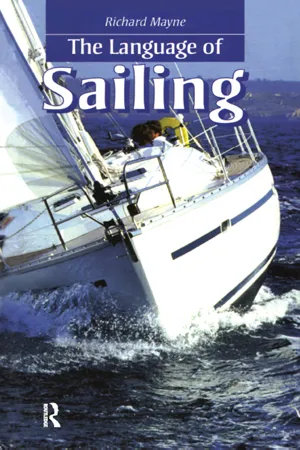
There have been many dictionaries explaining to laymen the technical terms of sailing. None of them, until now, has systematically set out to explore their etymology and evolution. The Language of Sailing demonstrates that many of the American and British words in question are derived-- often in complex and controversial ways--from other languages, mainly European. The diction of the sea, in fact, is a huge and hybrid skein, much of it traceable as far back as Sanskrit. It reveals that seafaring knitted Europeans together, sometimes in conflict and rivalry, often also in comradeship, when sailing crews could be as multinational as today's international conglomerates. The Language of Sailing is not intended simply for the entertainment of sailors and scholars. Anyone interested in the literature of the sea will find here an unusual and suggestive resource.
Information
Saddle a block of wood, hollowed appropriately and fixed to a spar to support another attached to it.
By natural extension from the familiar word. This in turn is from OE ‘sadol’, ‘sadul’ and a common Teutonic root, which itself may be derived from an Indo-European source.
First attested in its nautical sense in 1512–13 in Accounts of the Lord High Treasurer of Scotland 1473– (Scottish Record Series, 1887-), IV, 463.
sag drift (both noun and verb) to leeward; to settle amidships when supported at bow and stern.
Probably from, or at least associated with, the Middle Low German ‘sacken’, to subside: cf. the modern Dutch ‘zakken’, the Swedish ‘sacka’ and the Norwegian dailect ‘sakka’ In English, while the modern spelling is already found in the fifteenth century, the following century produced ‘sacke’ with the same meaning.
First attested as a nautical noun (although the nautical verb almost certainly predated it) meaning drifting, in 1580 in Hakluyt, Principall Navigations (1599 edition), I 436; as meaning to drift, in 1633 in James, Strange and Dangerous Voyage, 93; in the sense of to subside, in 1777 in Hutchinson, Practical Seamanship, 13.
sail shaped piece of canvas or other material held aloft by spars to catch the wind and propel a vessel; to travel in such a vessel (or, loosely, any vessel); a trip in such a vessel. Sail area is the total area of the sails carried, according to wind strength. A sailboard is a single-sail craft like a long surfboard. The sail burton, in square-riggers, is the purchase running from the heads of the topmasts to the deck and used for hoisting sails aloft to be bent to the yards. To sail close on a wind is to keep close-hauled with sails full but not shaking; to sail close to the wind is a metaphorical variant of this, meaning to take a risk, perhaps dishonestly. Sail cloth is a stout canvas of flax and cotton, or any one cloth that is part of a sail; a sail coat or cover is the cover that protects a sail when it is stowed along the boom. To sail downhill is to run before a favourable wind; sailing free is reaching or running, and able to do so on either tack. A sailing thwart is either one used for rowing that can be removed, or a fore-and-aft midship plank secured to the thwarts as a mast support; a sailing tiller is one lengthened to enable the person at the helm to sit out. To sail large is to have the wind between the beam and the quarter, with sheets eased off; to sail like a haystack is to do so badly, perhaps losing way. A sailmaker is one skilled at manufacturing, cutting, sewing, and repairing sails; a sailmaker’s needle is a triangular tapered needle used for working canvas; a sailmaker’s palm is a leather pad to protect the hand when sewing sailcloth; sailmaker’s stitching covers all types of stitching – darning, flat stitching and round sewing – used on canvas; sailmaker’s twine is the flaxen thread used; sailmaker’s whipping is one devised to be strong and permanent, involving the unlaying of two or three inches of rope end, with a bight of whipping twine over the middle strand, relaying the rope, whipping it with a long end of the twine, passing the bight up outside the whipping, tightening the short end, then attaching both ends with a reef knot inside the rope.
Sailmarkings are insignia sewn on both sides of a sail to show class and number. To sail on her ear is to be close-hauled and well heeled over. A sailor is one who sails in ships, a seaman with practical skill; a sailor’s best friend is his bunk or hammock; a sailor’s farewell is an abrupt, rude, or debt-ridden departure. A sail plan is a drawing showing the sizes, shapes, and positions or sails; a sail track is a groove on the mast in which lugs attached to the luff of a sail can travel
From OE ‘seg(e)l’ and a common Teutonic root; however, the only known root form ‘seg-or ‘segh-’ means to hold or conquer, so some trace the word to the root ‘sek’- (Teutonic ‘seh-’), to cut (as in the Latin ‘secare’), with the implication of cutting the sail. Tempting as this may be, it seems far-fetched: so the mystery remains.
First attested as a nautical noun c. AD 888 in King Aelfred (transl.), Boethius, De Consolatione Philosophiae (Sedgefield, 1899), xli, 3; as a nautical verb c. AD 893 in King Aelfred (transl.), Orosius (EETS, 1883), I, I, 14; in the sense of a waterborne trip in 1604 in Shakespeare, Othello, V, ii, 268.
St Elmo’s fire luminous corona discharge of static electricity around a ship’s mast or rigging, often in stormy weather (of which some thought it presaged the end). Cf. Corbie’s aunt, corposant.
The OED confidently calls this term ‘a corruption, via Sant’Ermo, of the name of St Erasmus (martyrded 303), Italian bishop and patron saint of Mediterranean sailors; cf. It. fuoco di Sant’Elmo.’ However, Kemp (ed.), Oxford Companion (1976), 744, points out that the name ‘has also been equated with St Peter Gonzalez (c.l 190–1246), a Dominican friar who accompanied Ferdinand III of Spain on his expedition against the Moors, and then devoted the remainder of his life in [sic] work to improve conditions of the seafaring people along the Spanish coasts’. Kemp also remarks that phenomenon ‘is known by over fifty different names’.
First attested (without ‘fire’) in 1561 in Eden (transl.), Cortes, II, xx, 51b.
sally to run from side to side of a vessel, usually in order to rock her into motion in light airs or to free her from grounding; a heave, often thus produced. A sally port (from the more general meaning of the word as a large exit) is either a large port cut in the side of a fireship or three-decker sailing warship, for egress in the former cae and two-way movement in the latter, or a Portsmouth Harbour landing-place reserved for the boats of men-of-war.
From the French ‘saillie’, an outbreak or outburst.
First attested as a nautical verb in its rocking sense in 1825 in Brockett, Glossary, 181; as a nautical noun in the sense of a heave, in 1867 in Smyth, Sailor’s Word-book.
saloon a large cabin for collective use, especially by passengers in a liner, etc.
From the French ‘salon’ and the Italian ‘salone’, augmenta-tive of ‘sala’, hall. Devotees of the 1930s US singing group known as The Yacht Club Boys may recall the boast that they ‘owned a sal on, not a sal oon but a sal on’ (‘a beauty parlour really a la mode’).
First attested in a nautical context c. 1835 in Johnson (ed.), American Advertising (1960).
salt a sailor, especially a veteran (‘old salt’). Salt horse or salt junk is slang for salted beef; a salting (often plural) is a low-lying area of land covered at high tide, possibly from the (mainly Northern) local word ‘mg’, itself from ON ‘eng’, a meadow.
Alluding to the saltness of the sea, from the familiar word, whose source is OE ‘sealt’ and a common Teutonic root, cognate with the Greek ‘al-s’ and the Latin ‘sal’, whence the Romance-language versions of the word.
First attested denoting a sailor in 1840 in Dana, Two ...
Table of contents
- Cover
- Half Title
- Title Page
- Copyright Page
- Table of Contents
- General Editors’ Preface
- Abbreviations
- Introduction
- A
- B
- C
- D
- E
- F
- G
- H
- I
- J
- K
- L
- M
- N
- O
- P
- Q
- R
- S
- T
- U
- V
- W
- X
- Y
- Z
- Bibliography
Trusted by 375,005 students
Access to over 1.5 million titles for a fair monthly price.
Study more efficiently using our study tools.
Frequently asked questions
Yes, you can cancel anytime from the Subscription tab in your account settings on the Perlego website. Your subscription will stay active until the end of your current billing period. Learn how to cancel your subscription
No, books cannot be downloaded as external files, such as PDFs, for use outside of Perlego. However, you can download books within the Perlego app for offline reading on mobile or tablet. Learn how to download books offline
Perlego offers two plans: Essential and Complete
- Essential is ideal for learners and professionals who enjoy exploring a wide range of subjects. Access the Essential Library with 800,000+ trusted titles and best-sellers across business, personal growth, and the humanities. Includes unlimited reading time and Standard Read Aloud voice.
- Complete: Perfect for advanced learners and researchers needing full, unrestricted access. Unlock 1.5M+ books across hundreds of subjects, including academic and specialized titles. The Complete Plan also includes advanced features like Premium Read Aloud and Research Assistant.
We are an online textbook subscription service, where you can get access to an entire online library for less than the price of a single book per month. With over 1.5 million books across 990+ topics, we’ve got you covered! Learn about our mission
Look out for the read-aloud symbol on your next book to see if you can listen to it. The read-aloud tool reads text aloud for you, highlighting the text as it is being read. You can pause it, speed it up and slow it down. Learn more about Read Aloud
Yes! You can use the Perlego app on both iOS and Android devices to read anytime, anywhere — even offline. Perfect for commutes or when you’re on the go.
Please note we cannot support devices running on iOS 13 and Android 7 or earlier. Learn more about using the app
Please note we cannot support devices running on iOS 13 and Android 7 or earlier. Learn more about using the app
Yes, you can access The Language of Sailing by Richard Mayne in PDF and/or ePUB format, as well as other popular books in Languages & Linguistics & Linguistics. We have over 1.5 million books available in our catalogue for you to explore.