- 335 pages
- English
- ePUB (mobile friendly)
- Available on iOS & Android
eBook - ePub
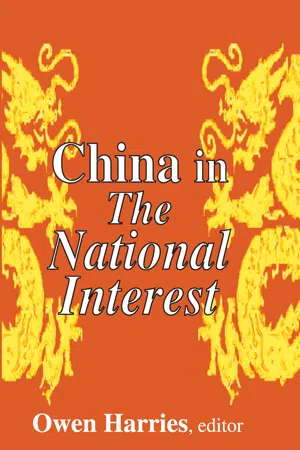
China in The National Interest
About this book
Covering China's history, political economy, culture, military issues, and the U. S.-China relationship, this book presents a fascinating and multifaceted look at a country which is likely to be a major factor in U. S. foreign policy in the twenty-first century. It includes more than 28 articles on China published in The National Interest since 1995. The first in a series of readers drawn from The National Interest, the volume brings together in one place the analysis and insight of some of the leading scholars and practitioners concerned with the Sino-American relationship.China has been and is a particularly difficult subject for Americans, observes Owen Harries in his introduction. This volume tackles the hard questions. Will successful market reforms lead to the emergence of a prosperous liberal democracy or simply extend the life span of an authoritarian regime? Contributors address (and disagree about) whether Chinese culture and society can adapt to the norms of the free market and the open society. They examine whether growing economic disparities between the developed coastal regions and a backward interior threaten to unleash uncontrollable social unrest. They also consider whether or not ethnic and religious tensions among China's minority groups contain the seeds for China's disintegration. Are the United States and China destined to clash?Conclusions provided by the authors vary greatly. For some, China is a dangerous rival, a rapidly modernizing power with hegemonic ambitions to dominate East Asia. For others, China is a strategic partner and prospective ally. Contributors square off on issues of whether China's military poses a real threat or is a paper tiger; whether the future of Taiwan is to trigger a major war between Beijing and Washington or provide a model for peaceful accommodation of Chinese and American interests in the region; and whether containment or engagement is the sounder strategy for coping with a rising China.The distinguished
Information
Part 1
China, Asia, and America
1
Living With China
Zbigniew Brzezinski*
Eurasian politics have replaced European politics as the central arena of world affairs. Once European wars became evidently threatening to America, there was no choice for America but to inject itself into European politics in order to prevent new conflicts from erupting or a hostile European hegemony from emerging. Thus America’s engagement in world affairs was precipitated during the twentieth century by European politics. Today, it is the interplay of several Eurasian powers that is critical to global stability. Accordingly, America’s policy must be transcontinental in its design, with specific bilateral Eurasian relationships woven together into a strategically coherent whole.
It is in this larger Eurasian context that U.S.-China relations must be managed and their importance correctly assessed. Dealing with China should rank as one of Washington’s four most important international relationships, alongside Europe, Japan and Russia. The U.S.-China relationship is both consequential and catalytic, beyond its intrinsic bilateral importance. Unlike some other major bilateral relationships that are either particularly beneficial or threatening only to the parties directly involved (America and Mexico, for example), the U.S.-China relationship impacts significantly on the security and policies of other states, and it can affect the overall balance of power in Eurasia.
More specifically, peace in Northeast and Southeast Asia remains dependent to a significant degree on the state of the U.S.-China relationship. That relationship also has enormous implications for U.S.-Japan relations and Japan’s definition—for better or worse—of its political and military role in Asia. Last but not least, China’s orientation is likely to influence the extent to which Russia eventually concludes that its national interests would best be served by a closer connection with an Atlanticist Europe; or whether it is tempted instead by some sort of an alliance with an anti-American China.
For China, it should be hastily added, the U.S.-China relationship is also of top-rank importance, alongside its relations with Japan, with Russia and with India. In fact, for China the Beijing-Washington interaction is indisputably the most important of the four. It is central to China’s future development and wellbeing. A breakdown in the relationship would prompt a dramatic decline in China’s access to foreign capital and technology. Chinese leaders must carefully take into account that centrally decisive reality whenever they are tempted to pursue a more assertive policy on behalf of their national grievances (such as Taiwan) or more ambitious global aspirations (such as seeking to replace American “hegemony” with “multipolarity”).
In essence, then, in the complex American-Chinese equation, Beijing should be prudent lest its larger ambitions collide with its more immediate interests, while Washington must be careful lest its strategic Eurasian interests are jeopardized by tactical missteps in its handling of China.
It follows that the United States, in defining its longer term China policy and in responding to the more immediate policy dilemmas, must have a clearly formulated view of what China is, and is not. There is, unfortunately, enormous confusion in America on that very subject. Allegedly informed writings regarding China often tend to be quite muddled, occasionally even verging toward the hysterical extremes. As a result, the image of a malignant China as the inevitably anti-American great power of the 2020s competes in the American public discourse with glimpses of a benign China gently transformed by U.S. investors into an immense Hong Kong. Currently, there is no realistic consensus either among the public or in the Congress regarding China.
In recent years, inconsistency has also characterized the attitude of the U.S. government. It is unfortunately the case that the Clinton administration has been guilty of “vacillation and about-faces on China, often in response to popular and congressional pressure”, that the President himself was “not willing to protect U.S.-China relations from tampering by Congress”, and that “some in Congress would destroy the relationship if given the opportunity to do so.”i The presidential mishandling in late spring 1999 of the World Trade Organization (WTO) negotiations with the Chinese and the persisting inclination of Congress to grandstand on the China issue validate that indictment.
In addition, public perception of China tends to be defined by spectacular symbols that allegedly encapsulate the essence of today’s and tomorrow’s China. Thus, for many Americans Tiananmen Square and Tibet have come to reflect the central reality of enduring communist oppression and of intensifying national chauvinism. For others, the Chinese economic “miracle”, dramatized by the skyscrapers of Shanghai, and by China’s growing free-market openness to the world through the Internet, travel, and foreign investment, symbolizes a transforming nation that is progressively shedding its communist veneer. Which China, then, is the real China, and with which China will America clash or cohabit in the years to come?
Having digested much of the available literature on Chinese political, economic and military prospects, and having dealt with the Chinese for almost a quarter of a century, I believe that the point of departure toward an answer has to be the recognition of an obvious but fundamental reality: China is too big to be ignored, too old to be slighted, too weak to be appeased, and too ambitious to be taken for granted. A major and ancient civilization—encompassing 20 percent of the world’s population organized in a historically unique continuity as a single nation-state, and driven simultaneously by a sense of national grievance over perceived (and, in many cases, real) humiliations over the last two centuries, but also by growing and even arrogant self-confidence—China is already a major regional player, though not strong enough to contest at this time either America’s global primacy or even its preponderance in the Far Eastern region.
China’s military strength, both current and likely over the next decade or so, will not be capable of posing a serious threat to the United States itself, unless China’s leaders were to opt for national suicide.ii The Chinese nuclear force has primarily a deterrent capability. The Chinese military build-up has been steady but neither massive nor rapid, nor technologically very impressive. It is also true, however, that China is capable of imposing on America unacceptable costs in the event that a local conflict in the Far East engages vital Chinese interests but only peripheral American ones. In this sense, China’s military power is already regionally significant, and it is growing.
Nonetheless, unlike the former Soviet Union, the People’s Republic of China (PRC) is not capable of posing a universal ideological challenge to the United States, especially as its communist system is increasingly evolving into oligarchical nationalist statism with inherently more limited international appeal. It is noteworthy that China is not involved in any significant international revolutionary activities, while its controversial arms exports are driven either by commercial or bilateral state interests. (As such, they are not very different from those of France or Israel, with the latter actually exporting weapons technology to China.)
Moreover, in recent years China’s international conduct has been relatively restrained. China did not exercise its veto to halt UN-sanctioned military actions against Iraq over Kuwait. Nor did it block the Security Council’s approval of the international protectorate in Kosovo. It approved the deployment of UN peacekeepers in East Timor, and—unlike India in the case of Goa, or Indonesia when it seized East Timor—it peacefully re-acquired Hong Kong and more recently Macau. China also acted responsibly during the Asian financial crisis of 1998, for which it was internationally applauded. Last but not least, its current efforts to gain membership of the WTO, whatever the merits or demerits of China’s negotiating stance, signal the PRC’s growing interest in global multilateral cooperation.
Internal Contradictions
The picture becomes more mixed when the domestic scene in China is scrutinized and when current Chinese views of the United States are taken into account. China is basically unfinished business. Its communist revolution has run out of steam. Its post-communist reformation has been partially successful, particularly at the urban-industrial-commercial levels, but this has required major doctrinal concessions and compromises. The result is that the Chinese system is a hybrid, with strong residues of communist dogmatism in the industrial sectors and in the state bureaucracy coexisting uneasily with dynamic, capitalist entrepreneurship driven by foreign investment. China’s future systemic orientation is thus yet to be fully defined, but it is already evident that the cohabitation within it of communism and commercialism is inherently contradictory.
The trajectories of China’s economic change and of its political evolution are thus parting. At some point, the distance between them will become too wide to sustain. Something, then, will have to give. Moreover, the existing political elite—itself not so young—will soon be replaced by a generation that came to political maturity neither during the Great Leap Forward nor during the Cultural Revolution, both epiphenomena of communist doctrinal exuberance. The emerging political elite matured during Deng Xiaoping’s pragmatic upheaval in the Chinese economy, and hence may be more inclined to correct the political trajectory of China’s evolution, bringing it closer to the economic trajectory.
The issue of human rights is thus likely to become more acute as the political regime seeks one way or another to close the gap between itself and its evolving socioeconomic context. The constraints on personal political liberty, the denial of religious freedom, and the suppression of minorities—most notably in Tibet—cannot be sustained in a setting of growing social and economic pluralism. The recent efforts to suppress the Falun Gong movement testify to the regime’s sense of ideological and political vulnerability. Accordingly, the issue of freedom is bound to become both more critical and more difficult for the existing regime to manage. Indeed, it is almost safe to predict that in the near future—probably within the coming decade—China will experience a serious political crisis.
In any case, whatever its political prospects, China will not be emerging as a global power in the foreseeable future. If that term is to have any real meaning, it must imply cutting-edge superiority of a truly global military capability, significant international financial and economic influence, a clear-cut technological lead, and an appealing social lifestyle—all of which must combine to create worldwide political clout. Even in the most unlikely circumstance of continued rapid economic growth, China will not be top-ranked in any of these domains for many decades to come. What is more, its backward and debilitated social infrastructure, combined with the per capita poverty of its enormous population, represents a staggering liability.
One should note here that some of the current scare-mongering regarding the alleged inevitability of China’s emergence as a dominant world power is reminiscent of earlier hysteria regarding Japan’s supposedly predestined ascendancy to superpower status. That hysteria was similarly driven by mechanical projections of economic growth rates, without taking into account other complex considerations or unexpected contingencies. The Japanese purchase of Rockefeller Plaza became at one point the symbol of the paranoiac, onedimensional glimpse into Japan’s future.
Be that as it may, China’s unsettled domestic scene is likely to reinforce an inherently ambivalent and occasionally antagonistic attitude toward the United States. Though Chinese leaders recognize that they need a stable and even cooperative relationship with the United States if their country is to continue developing, China is no longer America’s strategic partner against a threatening Soviet Union. It became so after the Shanghai breakthrough of 1972 and, even more so, after the normalization of relations in 1980, which dramatically transformed a three decade-long adversarial relationship into a decade of strategic cooperation.iii Today, with the Soviet Union gone, China is neither America’s adversary nor its strategic partner.iv It could become an antagonist, however, if either China so chooses or America so prompts.
Accentuating the Negative
Currently, Chinese policy toward the United States is a combination of functional cooperation in areas of specific interest and of a generally adverse definition of America’s world role.v The latter has prompted Chinese diplomatic initiatives designed to undercut U.S. global leadership. Chinese policy toward Russia is ostentatiously friendly on the rhetorical level, with frequent references to “a strategic partnership.” Such is also the case (perhaps not surprisingly) with Sino-French relations, with both sides proclaiming (as, for example, during the October 1999 Paris summit between Presidents Chirac and Jiang) their passionate fidelity to the concept of global “multipolarity”—not a very subtle slam at the disliked American “hegemony.”
Indeed, the word “hegemony” has become the favorite Chinese term for defining America’s current world role. Chinese public pronouncements and professional journals that deal with international affairs regularly denounce the United States as an overreaching, dominant, arrogant and interventionist power, increasingly reliant on the use of force, and potentially tempted to intervene even in China’s internal affairs.
The NATO action in Kosovo precipitated especially a massive outpouring of Chinese allegations that America has embraced the concept of interventionism at the expense of respect for traditional national sovereignty, with dire implications for China. As one alarmed Chinese expert put it:
Suppose serious anti-Communist Party or anti-government domestic turbulence erupts in China which cannot be quickly brought under control, and, at the same time, the international community commonly joins the anti-China stream. In this case, the hegemonists (perhaps jointly with their allied nations) could launch a military invasion of China.vi
The above was neither an extreme nor an isolated assertion. Such charges have been accompanied by growing concern that the United States is accelerating and intensifying its efforts to construct an anti-Chinese coalition in the Far East, embracing what is represented as a dangerously rearming Japan, South Korea and also Taiwan, a coalition “that resembles a small NATO of East Asia.”vii American, Japanese and South Korean discussions of possible collaboration against theater missile attacks have intensified these Chinese suspicions. Occasional American and Taiwanese press speculation that Taiwan might be included in such a collective effort has also further aggravated the Chinese, who see it as additional evidence that the United States is increasingly inclined to make permanent the current separation of Taiwan from China.
Perhaps the most striking example of the current Chinese inclination to stress the negative dimensions of the U.S.-China relationship is the attempt to provide a deeper intellectual or cultural rationalization for the seemingly intensifying antagonism. The Chinese-owned Hong Kong daily, Ta Kung Pao, published a major editorial entitled “On the Cultural Roots of Sino-U.S. Conflict” in September 1999, advancing the thesis that “the conflict between Chinese and American civilizations is at a deeper level one between sacred and secular lifestyles.” Amazingly for a nominally communist regime, it is China that is said to represent the former: “Chinese civilization has always stressed an integration of heaven with man.” This identity is said to contrast sharply with “the consumerist and hedonist mode of behavior that grew out of American Civilization”, making Americans “look down on Oriental Civilization, holding that it is backward and ignorant.” The policy inference that was drawn from the foregoing was stark: “in China-U.S. relations, it will be absolutely impossible to permanently resolve conflicts of political views in areas such as human rights, democracy, and freedom.”viii
To be sure, the foregoing views are in part instrumental, for they are also meant to serve the current Chinese efforts to put America on the ideological defensive. They do not define for Beijing the overall character of the U.S.-China relationship. Since China seeks to reduce the scope of America’s global preponderance (and its resulting leverage on China), it needs some sort of a doctrinal legitimation for controlled antagonism; yet China also wants to retain for itself, for obvious reasons of domestic self-interest, the vital benefits of collaboration with America. Striking a balance between the two is not easy, especially given the fact that China’s communist leaders have not found an effective substitute for their previous Marxist world-view. That central reality imposes a severe restraint on Chinese anti-American proclivities.
Hence, U.S.-China military links are being preserved, economic ties enhanced and political relations kept relatively congenial—even while “multipolarity” is hailed and “hegemony” condemned in joint declarations with Moscow, Paris and whoever else cares to join. The result is a confused amalgam, involving communist terminology and Chinese nationalist sentiments. That mishmash reflects the ambivalent position in which the Chinese leadership finds itself both at home and at large, given the unresolved ambiguities of Chinese domestic and foreign policy.
Doubtless, China’s leaders, generally intelligent and hardheaded, sense that inherent ambiguity. They must realize that Paris, rhetoric aside, will not join in some fanciful Beijing-Moscow-Paris anti-American coalition. They have to know that Russia does not have much to offer to China, except perhaps some technologically not very advanced military equipment. Ultimately, they have to understand—and their conduct reflects that they do—that at this historical juncture the relationship with the United States is central to China’s future. Outright hostility is simply not in China’s interest.
The foregoing points toward a further observation. China today, in relationship to the wider international system, is neither the militarist Japan of the 1930s nor the ideologically and strategically threatening Soviet Union of the 1950s-70s. Though all analogies, by definition, are partially misleading, there are some important parallels between China’s current situation and imperial Germany’s circa 1890. At that time, German policy was in flux, while Germany itself was a rising power. Like today’s China, Germany’s ambitions were driven by a resentment of a perceived lack of recognition and respect (in the case of Germany, especially on the part of a haughty British Empire, and in the case of today’s China, on the part of an arrogant America), by fears of encirclement by a conf...
Table of contents
- Cover Page
- Half title
- Title Page
- Copyright Page
- Contents
- Introduction
- Part 1. China, Asia, and America
- Part 2. Polititcal Economy
- Part 3. Cultore and Society
- Part 4. Military-Security Issues
- Part 5. History and Historiography
Trusted by 375,005 students
Access to over 1.5 million titles for a fair monthly price.
Study more efficiently using our study tools.
Frequently asked questions
Yes, you can cancel anytime from the Subscription tab in your account settings on the Perlego website. Your subscription will stay active until the end of your current billing period. Learn how to cancel your subscription
No, books cannot be downloaded as external files, such as PDFs, for use outside of Perlego. However, you can download books within the Perlego app for offline reading on mobile or tablet. Learn how to download books offline
Perlego offers two plans: Essential and Complete
- Essential is ideal for learners and professionals who enjoy exploring a wide range of subjects. Access the Essential Library with 800,000+ trusted titles and best-sellers across business, personal growth, and the humanities. Includes unlimited reading time and Standard Read Aloud voice.
- Complete: Perfect for advanced learners and researchers needing full, unrestricted access. Unlock 1.5M+ books across hundreds of subjects, including academic and specialized titles. The Complete Plan also includes advanced features like Premium Read Aloud and Research Assistant.
We are an online textbook subscription service, where you can get access to an entire online library for less than the price of a single book per month. With over 1.5 million books across 990+ topics, we’ve got you covered! Learn about our mission
Look out for the read-aloud symbol on your next book to see if you can listen to it. The read-aloud tool reads text aloud for you, highlighting the text as it is being read. You can pause it, speed it up and slow it down. Learn more about Read Aloud
Yes! You can use the Perlego app on both iOS and Android devices to read anytime, anywhere — even offline. Perfect for commutes or when you’re on the go.
Please note we cannot support devices running on iOS 13 and Android 7 or earlier. Learn more about using the app
Please note we cannot support devices running on iOS 13 and Android 7 or earlier. Learn more about using the app
Yes, you can access China in The National Interest by Owen Harries in PDF and/or ePUB format, as well as other popular books in Politics & International Relations & Political Economy. We have over 1.5 million books available in our catalogue for you to explore.