eBook - ePub
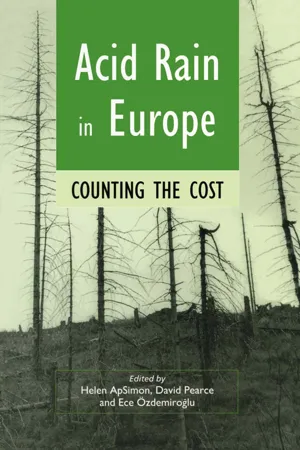
Acid Rain in Europe
Counting the cost
- 210 pages
- English
- ePUB (mobile friendly)
- Available on iOS & Android
eBook - ePub
Acid Rain in Europe
Counting the cost
About this book
The environmental impacts of acid rain: on human health, on buildings and materials, on forests, freshwaters, crops and biodiversity and on global warming have been well-documented. Less is known about the extent and economic costs of these impacts. This book describes the first major implementation of an integrated scientific and economic assessment of the consequences of acid rain. It provides an extensive data review and examines how this unique approach to assessment modelling can be can be used to calculate an acidification cost per unit of pollutant in monetary terms. Part One focuses on the methodological issues of scientific measurement of acidification, dose-response relationships and economic approaches to acidification control. Part Two looks at the environmental impacts and economic consequences of acidification. Affected environmental media and human health are investigated in separate chapters, each including both scientific and economic analyses. Part Three provides a summary of the findings and makes recommendations for further application of these types of results to policy actions.
Information
PART I
METHODOLOGY
1
BACKGROUND TO THE ACID RAIN PROBLEM
The consequences of transboundary transport of acidifying pollutants from the increasing combustion of fossil fuels became apparent in Europe in the 1960s. Large numbers of lakes and streams in Scandinavia showed a marked change in pH, and rain was observed to be significantly more acid over large parts of Europe. Deterioration in the state of forests was also linked to exposure to acid substances and associated changes in soils, in addition to other causes such as drought and frost.
National and international concern led to the establishment of scientific research to investigate the causes of the observed changes and how they could be controlled and reversed. In particular this included the Cooperative Programme for Monitoring and Evaluation of Long-Range Transboundary Air Pollution (EMEP), initiated under the Organisation for Economic Cooperation and Development (OECD) and now an important part of the overall structure under the UN Economic Commission for Europe (UN/ECE) Convention on Long-Range Transboundary Air Pollution (CLRTAP). At first the emphasis was on sulphur dioxide (SO2) as the main pollutant causing damage, but subsequently the significant contribution from nitrogen species was also recognised; these include both oxides of nitrogen (NOx), generated by the transport sector and stationary sources of combustion, and reduced nitrogen originating as ammonia (NH3), mainly from agriculture.
In the 1970s models were developed at the Norwegian Meteorological Institute to simulate the transport of SO2 and other acidic species across Europe, and the contributions of different countries to the overall pattern of deposition. This became the EMEP Centre West, with a sister EMEP Centre East established in Moscow with similar objectives, both covering the whole of Europe. Simultaneously a monitoring programme was established with a number of ‘EMEP stations’ making comparable measurements of the concentrations of the same range of species in air and precipitation.
The clear trends in acidification and increasing concern about the effects on fish and forests resulted in agreement on the need to reduce SO2 emissions, and the First Sulphur Protocol. This was the so-called ‘30-percent club’, whereby signatory countries agreed to reduce their emissions of SO2 by 30 per cent relative to their emissions in 1980 by the end of 1993. A further protocol was set up to stabilize emissions of NOx, which were also increasing steadily, especially with the growth of road transport.
However these steps were insufficient to combat increasing acidification in sensitive areas. Further measures were necessary, and the process of developing new international agreements to reduce acidification began under the auspices of the UN/ECE. Scientific questions arose as to just how low deposition of acidifying species needed to be to avoid further acidification. Furthermore, since some areas of Europe are more sensitive than others and are suffering from acidification far more severely, it was important to place more emphasis on reducing emissions which led to deposition in these areas. It was clear therefore that a further uniform reduction in emissions across all European countries would not be the most effective strategy for the next protocol on sulphur emissions to replace the ‘30-per-cent club’ after 1993, but that it would be important to reduce emissions more in some countries than in others.
THE SECOND SULPHUR PROTOCOL
The Second Sulphur Protocol was signed in June 1994, with a schedule of agreed emission reductions to be achieved at specified times between the years 2000 and 2010 (Table 1.1). The development of this protocol represents a major step forward in recognising scientific criteria for setting environmental standards, as represented by critical loads. Critical loads represent levels at, or below, which annual deposition is expected to have no adverse effects on natural ecosystems. They have been derived across Europe according to objective methods agreed by the UN/ECE Working Group on Effects, and though necessarily simplified, distinguish the relative sensitivity of different regions of Europe in terms of soils and surface waters.
To investigate cost-effective strategies for emission reductions a special Task Force on Integrated Assessment Modelling (TFIAM) was established, which assessed different scenarios for emission reduction. Integrated assessment models were used to combine data on emissions, atmospheric transport between source and receptor regions, critical loads or target loads as an intermediate step towards them, and abatement options and costs. The aim of such modelling studies was to derive tables of emission reductions for each country which provided cost-effective strategies for reducing acidification.
Because of the cost, it was not possible to reduce emissions sufficiently to attain critical loads. Hence the TFIAM investigated a large number of scenarios setting less stringent target loads. Eventually the one adopted as the basis for the protocol was the ‘60-per-cent gap-closure scenario’ whereby deposition in excess of the critical loads is to be reduced by at least 60 per cent relative to 1990. Thus critical loads will still be exceeded in some areas after the new protocol is implemented. This raises questions about the environmental effects that will result, and to what degree loads will be reduced by the year 2010.
| Country | Emissions kT SO2/yr | Percentage cut in emissions relative to 1980 |
| Austria | 78 | 80 |
| Belarus | 370 | 50 |
| Belgium | 215 | 74 |
| Bulgaria | 1127 | 45 |
| Czech Republic | 632 | 72 |
| Slovakia | 240 | 72 |
| Denmark | 90 | 80 |
| Finland | 116 | 80 |
| France | 737 | 78 |
| Germany | 990 | 87 |
| Greece | 570 | 4 |
| Hungary | 653 | 60 |
| Ireland | 155 | 30 |
| Italy | 1042 | 73 |
| Luxembourg | 10 | 58 |
| Netherlands | 106 | 77 |
| Norway | 34 | 76 |
| Poland | 1397 | 66 |
| Portugal | 294 | 3 |
| Russian Federation | 4297 | 40 |
| Slovenia | 71 | 70 |
| Spain | 2143 | 35 |
| Sweden | 100 | 80 |
| Switzerland | 60 | 52 |
| Ukraine | 1696 | 56 |
| UK | 980 | 80 |
Source: UN/ECE (1994)
THE BENEFITS OF EMISSION ABATEMENT
From the above it is clear that the Second Sulphur Protocol was based on a pragmatic approach of reducing the exceedance of critical loads, without considering the damage such exceedance leads to. The concern was purely with the control of acidification and effects on natural ecosystems. However, in addition to reducing acidification there are also other benefits of the emission reductions scheduled under the protocol. In particular there will be more localised benefits in regions with high emissions in terms of improved human health and reduced damage to buildings and materials. Although these impacts may be largely due to domestic rather than transboundary pollution, they represent an important additional incentive to implement the scheduled emission reductions, and may be accorded higher priority than concerns about acidification in the countries involved. It is time to take stock of the overall benefits likely to result from the Second Sulphur Protocol, which will be reviewed in 1997, and subsequent policy decisions regarding further abatement strategies.
The UN/ECE research programme is now also addressing nitrogen species. This is far more complicated; not only is there a far wider range of sources involved, but there are various interrelated environmental effects. It is important to consider how the magnitude and importance of such effects can be evaluated. One approach to such evaluation and comparison is to place monetary values on the effects in order to move towards cost-benefit analysis: the weighing of environmental gains, both direct and indirect, against the cost of implementing emission reductions.
INTEGRATED ASSESSMENT AND THE SECOND SULPHUR PROTOCOL
As a starting point it seems appropriate to review briefly the approach taken with integrated assessment models in the development of the Second Sulphur Protocol. Three models were used: the Regional Air Pollution Information and Simulation (RAINS) model of the International Institute for Applied Systems Analysis (IIASA) (Alcamo et al, 1990), the Coordinated Abatement Strategy Model (CASM) of the Stockholm Environment Institute (SEI, 1991) and the Abatement Strategies Assessment Model (ASAM) developed at Imperial College Centre for Environmental Technology (ICCET) (ApSimon et al, 1994a): at a later stage a model of the EMEP Centre East was also used. Each of these has different strengths and weaknesses, but all have been used to optimize the distribution of emission reductions to meet prescribed target loads at least cost. The approach is summarised in Figure 1.1, and has been applied with a number of different target loads besides the ‘60-per-cent gap...
Table of contents
- Cover Page
- Half Title page
- Series page
- Title Page
- Copyright Page
- Frontmatter
- Original Title Page
- Original Copyright Page
- Contents
- Tables
- Figures
- Acronyms And Abbreviations
- Acknowledgements
- Authorship
- Foreword
- Part I Methodology
- Part II Impacts and Economic Consequences
- Part III Summary and Recommendations
- Annexe The Methodology of Economic Valuation
- References
- Index
Trusted by 375,005 students
Access to over 1.5 million titles for a fair monthly price.
Study more efficiently using our study tools.
Frequently asked questions
Yes, you can cancel anytime from the Subscription tab in your account settings on the Perlego website. Your subscription will stay active until the end of your current billing period. Learn how to cancel your subscription
No, books cannot be downloaded as external files, such as PDFs, for use outside of Perlego. However, you can download books within the Perlego app for offline reading on mobile or tablet. Learn how to download books offline
Perlego offers two plans: Essential and Complete
- Essential is ideal for learners and professionals who enjoy exploring a wide range of subjects. Access the Essential Library with 800,000+ trusted titles and best-sellers across business, personal growth, and the humanities. Includes unlimited reading time and Standard Read Aloud voice.
- Complete: Perfect for advanced learners and researchers needing full, unrestricted access. Unlock 1.5M+ books across hundreds of subjects, including academic and specialized titles. The Complete Plan also includes advanced features like Premium Read Aloud and Research Assistant.
We are an online textbook subscription service, where you can get access to an entire online library for less than the price of a single book per month. With over 1.5 million books across 990+ topics, we’ve got you covered! Learn about our mission
Look out for the read-aloud symbol on your next book to see if you can listen to it. The read-aloud tool reads text aloud for you, highlighting the text as it is being read. You can pause it, speed it up and slow it down. Learn more about Read Aloud
Yes! You can use the Perlego app on both iOS and Android devices to read anytime, anywhere — even offline. Perfect for commutes or when you’re on the go.
Please note we cannot support devices running on iOS 13 and Android 7 or earlier. Learn more about using the app
Please note we cannot support devices running on iOS 13 and Android 7 or earlier. Learn more about using the app
Yes, you can access Acid Rain in Europe by Helen Apsimon, David Pearce, Ece Ozdemiroglu, Helen Apsimon,David Pearce,Ece Ozdemiroglu in PDF and/or ePUB format, as well as other popular books in Politica e relazioni internazionali & Ecologia. We have over 1.5 million books available in our catalogue for you to explore.