- 142 pages
- English
- ePUB (mobile friendly)
- Available on iOS & Android
eBook - ePub
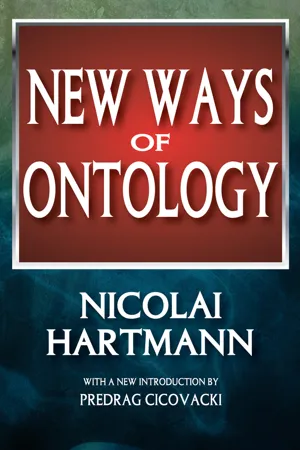
New Ways of Ontology
About this book
Contemporary philosophy has reasserted the belief that philosophy has practical tasks. This turn reflects an understanding that the life of the individual and the community is not molded merely by personal needs and fortunes but also by the strength of dominant ideas. For Nicolai Hartmann, ideas are spiritual powers belonging to the realm of thought, but thought has its own strict discipline and critique of events. In his view, theory must include within its scope problems of the contemporary world and cooperation in work that needs doing.New Ways of Ontology stands in opposition to the tradition of Heidegger. With deep appreciation of the history of philosophical controversy, Hartmann divides mistakes of the old ontology into those related to its method and those concerning its content. Hartmann finds a common mistake behind methodological approaches inspired by late German romanticism in attempts to develop a complete systematic account of the categories of being—not only of the ideal, but of real being.The main task of New Ways of Ontology is to reveal and analyze interdependences and interconnections. The divisions of being and becoming, of the separation of existence and essence, as well as the old view that the real and the ideal exclude each other, require revision. For Hartmann, whose ideas take us close to modern social science research, ontology is the neutral category that includes subject and object, and gets beyond old realism and modern idealism alike.
Information
1
The End of the Old Ontology
TODAY more than ever before the serious-minded are convinced that philosophy has practical tasks. The life of both the individual and the community is not molded by their mere needs and fortunes but also at all times by the strength of dominant ideas. Ideas are spiritual powers. They belong to the realm of thought. But thought has its own discipline and its own critique—philosophy. Therefore philosophy is called upon to include within its scope the pressing problems of the contemporary world and to co-operate in the work that needs to be done.
Many who feel this make it a condition of their occupation with philosophical matters that they be led on as straight a way as possible to the solution of pressing problems of their own present situation; and if, instead of the straight way, manifold detours become necessary, they turn aside disillusioned, believing that philosophy is nothing more than an ivory-tower game of thought. The impatience of the desire for knowledge does not permit them to achieve that engrossment in the problems which is the beginning of insight. They want to start with the end. Thus with the very first step they unwittingly divorce themselves from philosophy.
It has always been the strength of the German mind that it knew how to master its impatience. By not shying away from the long and arduous approach, even when demands were pressing and the tasks urgent, it found the way of meditation. So it was with Cusanus, Leibniz, Kant, and Hegel. So, in all probability, it is basically still today, although we have behind us times of deviation from this line which brought with them all the dangers of shallowness and one-sidedness. Just when the task is most urgent, genuine philosophy must return to its foundations. There is no other way of conquering a new wealth of thought for a new world situation.
Philosophy cannot enter upon practical tasks without knowledge of being as such. For the tasks themselves grow out of a total datum of existing realities, and these must be understood and penetrated to the root before man can venture to shape them according to his goals. So all technical science builds upon the exact knowledge of the laws of nature, medicine upon biological laws, and politics upon historical knowledge. In philosophy it is no different, even though its object is a universal one embracing both the whole man and the world in which he lives. Therefore, it is less immediately evident at which level of being its basic concepts must be found, and philosophers, time and again, come to think they can go their way without an ontological foundation.
Actually, no philosophy can stand without a fundamental view of being. This holds true regardless of standpoint, tendency, or the general picture of the world which it adopts. The reason why not every philosophy begins with a discussion of being lies in the ease with which in this field ideas are accepted and laid down undiscussed. They are not even noticed, nor does one suspect to what degree they are decisive for all that follows. Even the natural world view, which regards all things as substantial bearers of changing qualities and relations, involves an ontological prejudgment. To a much higher degree, however, this applies to philosophical interpretations of the world, determined as they are by a specific point of view.
Among historically recorded systems of philosophy there is none for which the domain of the problems of being, taken in strict universality, is not essential. The more profound among them have at all times raised the question of being, each of them seeking to answer it in accordance with its particular outlook. According to whether this question is either posed and discussed or ignored, doctrinal systems can be classified as founded or unfounded ones, regardless of their respective points of view or doctrinal tendencies. The more significant accomplishments of all periods, recognizable even to a superficial glance because of their far-reaching effect, are without exception "founded” systems.
In no way does this mean that founded systems are ontologically constructed systems or even realist ones. The great theoretical structures of German idealism illustrate this truth in the most characteristic fashion. When Fichte, in his early Über den Begriff der Wissenschaftslehre, derives the being of things from creative activities of the Ego, he furnishes an answer to the question as to what the being of things is. His is a basic ontological thesis, and, as such, it is a foundation for all that follows, even down to the truly burning questions with which his Wissenschaftslehre is concerned—questions about man, will, and freedom.
The same holds, mutatis mutandis, for Schelling and Hegel in all phases of their philosophies, no matter whether the ultimate foundation of being be sought in a subconscious intelligence, in the fusion of subject and object, or in absolute reason. In fact, the same holds true for Kant and even Berkeley. Fundamentally though the immaterialism of the latter may differ from transcendental idealism, the thesis "esse est percipi” is still as much an ontological proposition as Kant’s finely balanced assertion that things in space and time are only phenomena.
By their fundamental theses the idealist systems are no less ontologically constructed than the realist ones. The distinctive mark of the former, as contrasted with the latter, is that their concept of being is a derived one. And therewith they find themselves irreconcilably opposed to the tradition of the old ontology. This opposition is a conscious one, deliberately chosen on epistemological and ethical grounds. Further, it is an opposition which, in view of the indifference of the later idealists of the nineteenth century toward fundamental questions, led to the dissolution of the old ontology.
This dissolution marks a decisive step in the history of philosophical theories. Indeed, the dissolution did not first begin with idealism. The way was prepared for it by the typically modern trend toward an epistemological-critical foundation of philosophy, and by the end of the seventeenth century it reached its first high point in Leibniz’s philosophy. This philosophy is still, in its own way, the creation of a thoroughly ontological type of thought. Yet in the main Leibniz has already left the tracks of the old ontology.
The question then arises as to what the old ontology actually was. We mean by it that theory of being which was dominant from Aristotle down to the expiration of Scholasticism. Although it produced a multitude of divergent varieties of thought and finally ran out in an incurable division of tendencies, it was uniform in its fundamentals, and to the thinkers of the modern age, who from several sides drew up a concentrated attack upon it, it presented a unified hostile camp.
The old theory of being is based upon the thesis that the universal, crystallized in the essentia as substantial form and comprehensible as concept, is the determining and formative core of things. Besides the world of things, in which man, too, is encased, there is a world of essences which, timeless and immaterial, forms a kingdom of perfection and higher being. The extreme representatives of this doctrine even assigned true reality to the universal essences alone, thereby disparaging the world of time and things. Their successors in the nineteenth century, considering universals only under the form of concepts, called this trend "conceptual realism.” The expression is misleading, because it was the point of that theory that universals were not just concepts. Instead, one may well speak of a "realism of universals.”
Scholastic ontology, far from being limited to this extreme view, showed the theory of universals in richly varying gradations. It was not necessary to attribute to essences a being "prior to things” or "above” them. They could be conceived also in the Aristotelian manner as substantial forms subsisting "in the things.” Thus the difficulties of a duplication of the world were avoided without a surrender of the fundamental conception. Of course, medieval philosophers could not entirely rest content with this, because a speculative, theological interest prompted them to conceive universals as entities preexisting in the intellectus divinus.
Apart from this, the gist of this ontology does not lie in the gradations of the fundamental thesis. Nor does it lie in the speculative-metaphysical tendencies combining with it but solely in the basic view of the nature of the universal itself—in the conviction that the universal is the moving and teleologically determining principle of things. Here an age-old motif of mythical thinking enters: the teleological interpretation of temporal occurrence in analogy to human action. Aristotle gave this idea a philosophical form, linking it closely to a theory of eidos patterned chiefly on organic nature. According to this view, essence is a substantial form, and, as the end of an evolutionary process, it determines the growth of the organism. This scheme of interpretation was transferred from the organism to the whole world, and, in analogy to the organic, all processes of inorganic nature were considered teleological.
This scheme had the advantage of solving the riddle of the structure of the world in an amazingly simple manner. If only the observer succeeds in grasping the substantial form of a thing, he holds at once the key to all the changes which it suffers. The substantial form, however, is comprehensible by means of the concept, and the methodological tool for this comprehension is the definition. Definition again is a matter of the intellect whose whole business consists in gathering the essential elements of the form from the final stages of the natural processes of growth and in then putting these elements together in an orderly fashion.
This procedure, surely, must not be conceived in the manner of a crude empiricism. The most general traits of essence, that is, those that are shared by many kinds of essentia, cannot simply be gleaned from a survey of things. Here the Aristotelian epistemology did not offer the right lever, and soon Scholasticism espoused the Platonic idea of intuition (intuitio, visio). Philosophers became more and more used to subordinating the intellect to a superior faculty of insight to which they ascribed a direct contact with the highest ontologically determining formal elements.
Herewith the old ontology took on a deductive character. Once human reason feels itself to be in possession of the highest universals it is readily concluded that reason can actually "derive” from these universals all that which it does not know how to extract from experience. In this manner, there arose that neglect of empirical knowledge and that luxuriant growth of a metaphysics deducing its conclusions from pure concepts which was first challenged by the later nominalism and finally defeated by the beginnings of modern natural science.
It goes without saying that in as summary a discussion as the present one we cannot do justice to medieval metaphysics. Here our concern is not with medieval metaphysics but with contemporary issues. For these, it is imperative that we achieve a clear view of certain fundamental traits of the ontological views which were at the basis of that metaphysics. We must learn from the mistakes of these old ontological views, so that any and every attempt at a new ontology may dissociate itself unambiguously and consciously from all such errors.
The critical epistemology of the modern age from Descartes down to Kant did not succeed in completely replacing the old ontology with a new doctrine of equal value. But it had so thoroughly destroyed its presuppositions that a metaphysics erected on the old basis was no longer possible. The Critique of Pure Reason, in which the work of thorough housecleaning reached its end, marks a historical boundary beyond which ontological thinking all but vanishes. This is noteworthy, because the Kantian critique was actually not leveled against the foundations of the old ontology but rather against the speculative-rational metaphysics which had been built upon it.
In Kant it is above all the deductive mode of procedure which is done away with. Deductions can be made only from a priori certain principles, and apriorism is here subjected to a searching critique. The a priori is limited to two forms of intuition and a few categories. And even these are considered valid only for phenomena and not for things as they are in themselves. Thus substantial forms are excluded as a matter of course, and along with them the doctrine of essentia is obliterated. More important still is the fact that the Critique of Judgment attacks teleology even on its very home ground, that of organic nature, depriving it of all constitutive significance.
The latter point is perhaps the most important of all. At any rate, it hits the weakest side of the old ontology drifting in the wake of Aristotle. But surely it is the point least understood and valued by Kant’s contemporaries and followers. The philosophies of nature of both Schelling and Hegel ignored the critique of teleological judgment and carried on once more in conformity with the Scholastic example. The Kantian critique had been a transcendental one, that is, an epistemological critique of the presuppositions of the theory of organic nature. Rationalist idealism, however, believed itself to be in possession of unassailable universal certainties on the strength of which the enigmatic purposive equipment of living beings—and actually of all nature from the bottom up—is supposed to become amenable to teleological interpretation.
2
The Categories of Being
A SURVEY of this state of affairs at once clearly shows that the new ontology can in no way consist of another resuscitation of the old one. Not only has the teleological scheme of interpretation proved untenable despite all efforts at renewal. It has become necessary, moreover, to exclude every sort of thesis which might serve as a disguise for an outdated metaphysics. That is not quite as easy as it might seem at first glance. The traditional grooves still determine modern thinking, and usually the investigator does not realize to what extent they lead him on. So in the recent past the doctrine of essentia experienced a rebirth in phenomenology—seemingly without any metaphysical aspiration but, in truth, not without the reappearance of very old and often conquered difficulties and not without a temptation to equally old and often censured mistakes.
It will not do to approach the new doctrine of being as an "ontology of essences." In fact we must dissociate ourselves from this doctrine of essences, not only because with it substantial forms again loom up, but also because such a doctrine invariably involves the hypostatizing of universals. This in turn breeds a tendency to transmogrify the universal considered simply in its own right into something all-important and fundamental. And behind this tendency there always lurks, consciously or unconsciously, the postulate of deductivity: "derivation" is possible only from universal statements, and these, therefore, appear to be an expression of the very principles of being.
Behind all this there hides more than one mistake. Although it is very true that all principles are universal, it does not follow that all universals are principles. There is also a very peripheral universal—for instance in the recurrent external characteristics revealed by widely scattered particulars—and it is precisely this universal which first offers itself to experience. Any attempt to classify things or animate beings according to such universals would furnish a classificatory order, but one which would completely miss the ontic condition of things. General traits of external appearance, arbitrarily gathered, do not indicate where the principles of being lie. For that we need other criteria. One of the weaknesses of the old ontology consisted in its failure to provide these criteria.
To this is added a second weakness. Even though it is unassailably true that only from universal statements may something be derived (deduced), yet it does not follow that universal statements from which something is derived express something "ontically" universal. But if they do not, they are untrue statements—in Kantian language, synthetic judgments a priori without "objective validity." Of course, deductions can be logically drawn from such statements just as well as from true ones. But the conclusions will be just as little true as the premises. No philosophical aspiration, however moderate its claims, is thereby served.
Evidently it is this very mistake that the central argument of the Critique of Pure Reason combats. It does so by countering all such deductivity—one might say, the ontological deduction—with a "transcendental deduction" that concerns itself with the objective validity of those a priori principles by virtue of which synthetic judgments are a priori true. It is well known how much store Kant set by this deduction. But considering that it rests completely on categories tied up with experience (for this deduction confined the objective validity of the categories to "possible experience"), it is readily realized that it precludes a limine a purely a priori knowledge of the essence of things. This achievement of the Critique is at first a negative one. But its results are thoroughly affirmative and, as such, are of the greatest importance.
All ontology has to do with fundamental assertions about being as such. Assertions of this sort are precisely what we call categories of being. Like the Kantian categories—which, as far as content is concerned, are also precisely this: fundamental assertions about being—they have the character of universal constitutive principles comprising all more specialized ontological assertions. Hence, the new ontology might be expected to provide a transcendental deduction also of these ontological assertions. Otherwise, it is argued, it could not guarantee their objective validity. That, however, would mean that this ontology in its turn was in need of an epistemological foundation which would have to provide the justification of a priori principles of an even wider scope.
Thereby a way for ontology is traced, and this way once more follows the scheme of the old deductivity. But it is here that the roads of the old and the new ontology part. Just as in regard to the problem of being it is today no longer a question of substantial forms and of the teleological determination of actual processes by these forms, so also the problem at issue is no longer that of a post factum justification of a priori principles. The categories with which the new ontology deals are won neither by a definition of the universal nor through derivation ...
Table of contents
- Cover
- Half Title
- Title
- Copyright
- Contents
- Introduction
- 1 The End of the Old Ontology
- 2 The Categories of Being
- 3 A New Concept of Reality
- 4 The New Ontology and the New Anthropology
- 5 The Stratified Structures of the World
- 6 Old Mistakes and New Critique
- 7 Modification of the Fundamental Categories
- 8 The Strata Laws of the Real World
- 9 Dependence and Autonomy in the Hierarchy of Strata
- 10 Objections and Prospects
- 11 The Stratification of the Human Being
- 12 Determination and Freedom
- 13 A New Approach to the Problem of Knowledge
- Appendix
- Index
Trusted by 375,005 students
Access to over 1.5 million titles for a fair monthly price.
Study more efficiently using our study tools.
Frequently asked questions
Yes, you can cancel anytime from the Subscription tab in your account settings on the Perlego website. Your subscription will stay active until the end of your current billing period. Learn how to cancel your subscription
No, books cannot be downloaded as external files, such as PDFs, for use outside of Perlego. However, you can download books within the Perlego app for offline reading on mobile or tablet. Learn how to download books offline
Perlego offers two plans: Essential and Complete
- Essential is ideal for learners and professionals who enjoy exploring a wide range of subjects. Access the Essential Library with 800,000+ trusted titles and best-sellers across business, personal growth, and the humanities. Includes unlimited reading time and Standard Read Aloud voice.
- Complete: Perfect for advanced learners and researchers needing full, unrestricted access. Unlock 1.5M+ books across hundreds of subjects, including academic and specialized titles. The Complete Plan also includes advanced features like Premium Read Aloud and Research Assistant.
We are an online textbook subscription service, where you can get access to an entire online library for less than the price of a single book per month. With over 1.5 million books across 990+ topics, we’ve got you covered! Learn about our mission
Look out for the read-aloud symbol on your next book to see if you can listen to it. The read-aloud tool reads text aloud for you, highlighting the text as it is being read. You can pause it, speed it up and slow it down. Learn more about Read Aloud
Yes! You can use the Perlego app on both iOS and Android devices to read anytime, anywhere — even offline. Perfect for commutes or when you’re on the go.
Please note we cannot support devices running on iOS 13 and Android 7 or earlier. Learn more about using the app
Please note we cannot support devices running on iOS 13 and Android 7 or earlier. Learn more about using the app
Yes, you can access New Ways of Ontology by Nicolai Hartmann, Fritz Plasser,Nicolai Hartmann, Fritz Plasser in PDF and/or ePUB format, as well as other popular books in Philosophy & Epistemology in Philosophy. We have over 1.5 million books available in our catalogue for you to explore.