- 265 pages
- English
- ePUB (mobile friendly)
- Available on iOS & Android
eBook - ePub
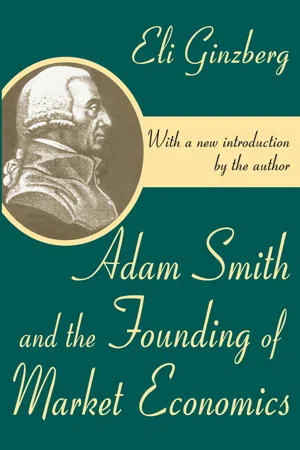
Adam Smith and the Founding of Market Economics
About this book
"Business is a necessary evil that the moral leaders of mankind have tolerated but never condoned. At no time did they view with favor the pursuit of material gain. The Old Testament prophets proclaimed against the rapacity of the rich. Jesus scorned the money lenders. Luther had no kind words to say to the wealthy, nor did Calvin indulge the new bourgeoisie." Thus begins this fi rst book-length study of social philosopher and political economist Adam Smith's The Wealth of Nations. Adam Smith (1723-1790) was a Scottish-born thinker who served as both professor of logic and professor of moral philosophy at Glasgow University. While the publication of his philosophic treatise The Theory of Moral Sentiments at age thirty-six gave Smith fame, The Wealth of Nations, published in 1776, has established his lasting reputation. Recognized in its own day as an important and compassionate examination of economics, the book was praised by Thomas Jefferson for its contribution to the fi eld of economics. Smith wrote The Wealth of Nations for several reasons: he was disgusted with the business methods practiced by merchants and manufacturers, and he was concerned with improving the well-being of society. Refl ecting his own concerns about the contribution economics could make to the betterment of society, Eli Ginzberg published this study of Smith's humanitarian views on commerce, industrialism, and labor. Written for his doctoral degree at Columbia University, and originally published as The House of Adam Smith, the book is divided into two parts. The fi rst part reconstructs and interprets Smith's classic The Wealth of Nations, while the second part examines Smith as the patron saint and prophet of the successes of nineteenthcentury capitalism. Adam Smith and the Founding of Market Economics is a fascinating study, and contributes signifi cantly to our understanding of capitalism, free trade, the division of management and labor, and the history of world economics in the ninete
Part One
1 Merchants and Knaves
Business is a necessary evil, which the moral leaders of mankind have tolerated but never condoned. At no time did they view with favor the pursuit of material gain. The Old Testament prophets proclaimed against the rapacity of the rich. Jesus scorned the money lenders. Luther had no kind words to say to the wealthy, nor did Calvin indulge the new bourgeoisie.
The eighteenth century was not given to religious exuberance; philosophers and scientists were more prominent in intellectual circles than members of the clergy. The most enlightened people considered God the Great Watchmaker, and his ministers unimportant apprentices. But not everyone was emancipated. The Scottish professor who lectured on economics at Glasgow during the fifties and sixties was not free from the nagging of fanatical Presbyterians. And though he disliked their hard and strict rules of life, he absorbed not a little of their moral fervor. The waning interest in religion resulted in a more intensive study of ethical and moral problems.
The Wealth of Nations is a gentlemanly and scholarly, though pointed, indictment of a large group in the society of the day. In common with the reformers of old, Adam Smith looked askance at the knavery and meanness of business men. His wrath was kindled against the merchants and manufacturers, for he hated their invidious practices. He hoped that after the public had been enlightened, remedial action would be taken.
The corruption of individuals is a problem for the courts. The moral degeneracy of an important sector of the population ought to be the concern of the commonwealth. Adam Smith preached to the nation.
The violence and injustice of the rulers of mankind is an ancient evil which scarce admits a remedy.1 All for ourselves, nothing for others, has long been the vile maxim of masters.2 The English had decapitated one sovereign and banished another. With the passage of time, they acquired great skill in dealing with the Lord's anointed. They were able to put the fear of Satan into all self-righteous administrators. However, the peoples of other lands were still oppressed by their princes.
England, though fortunate not to have suffered from the violence of the crown, was no earthly paradise. Throughout the greater part of the eighteenth century the country experienced growing pains, but the doctors were unable to diagnose the ailment. Adam Smith, however, was firmly convinced that he had discovered the cause of the malady. The rapacity and monopolizing spirit of the merchants and manufacturers was racking the commonweal's constitution. This was an optimistic conclusion, for he felt certain that the infection was curable.3 As a careful internist, he paid special attention to the case history.
Since the days öf Queen Elizabeth, the legislature had taken trade and commerce under its protecting wing.4 Delicate plants had to be nurtured with care. It is surprising that the aristocratic landowners who sat at Westminster concerned themselves with the life and fortunes of the urban upstarts, for country folk have never been fond of their city relatives. The action of the noble lords and honorable squires was born in fear and perpetuated in ignorance.
The trading and manufacturing groups played their cards shrewdly, their daily pursuits having schooled them in the arts of deception. They had no difficulty in outwitting and outmaneuvering the untrained and naïve gentlemen, thereby erecting the sneaking arts of underling tradesmen into political maxims for the conduct of a great empire.5
Commercial and manufacturing activities on a small local scale were easily comprehensible, but only the expert could fathom the intricacies of international trade. Tillers of the soil could be expected to understand only the most simple business enterprises. In forming opinions on more involved subjects, they were forced to consult the authorities, who were only too glad to furnish them with the necessary information and advice.
A bill became law when a majority in the House of Commons and the House of Lords voted in its favor. The legislators, however, were not truly free agents. They were tools in the hands of a small but vociferous clique. And although bribery was used from time to time, the dutiful members were not properly recompensed for their labors. They were overwhelmed by the craftiness of the mercantile strategists. The ignorance and indolence of the legislators made them docile victims. But even if they had defended themselves, the onslaughts of the aggressors would have been difficult to withstand.
The pleadings of the commercial interests were neither modest nor logical. They followed an extreme opportunistic policy, employing one line of approach until another seemed more suitable. The pliability of their methods was matched only by the rigidity of their objective.
At one period it appeared advantageous to keep the available gold and silver within the country, for mercantile and manufacturing activities could not be conducted without the aid of precious metals. To ship currency abroad would have had unfavorable repercussions upon the internal business structure. Stringent prohibitions were therefore established by the several governments to insure that none of the domestic specie should leave the country. Very severe penalties were established for the violation of this statute.
Economic conditions changed, and shortly thereafter the state adopted a new attitude toward precious metals. The merchants no longer benefited from the restrictions upon the movements of gold and silver. Business profits would probably rise if one could engage in the free import and export of bullion. The old doctrine that the amount of specie reflected the wealth of a country was abandoned, and in its place was substituted the theory of a favorable balance of trade. This shift in economic ideology had certain practical implications. Learned analyses were written for the benefit of the members of Parliament. The business men engaged in polemics with the hope of forcing the government to pass specific legislation which they desired. Many of their petitions were granted, and only the occasional criticism of other groups prevented the legislature from becoming the completely docile servant of the merchants and manufacturers.
Governmental aid to commerce and industry was not entirely above suspicion because it frequently reacted unfavorably upon other branches of the national economy. At recurring intervals, the laboring class proclaimed that the indulgences extended to the trading and manufacturing interests were working to its disadvantage. The shrewd commercial groups quickly established a strong defense, pointing out that unless native mercantile and manufacturing establishments were specifically encouraged, many would give up the ghost. If the privileges were rescinded the working class would suffer most grievously; factories would cease operating and there would be neither work nor wages for the poor. The logic of this argument silenced most of the outbursts.
During the eighteenth century the vast majority of the English people worked the land; the farm element predominated in the national culture. This group was not well versed in political controversy, but occasionally complaints would arise in its midst against the machinations of the business classes. The latter defended themselves most spiritedly, just as they had done in combating the assaults of the laboring poor. In fact, they counter-attacked. They emphasized the fact that the welfare of the farming groups depended upon markets where their products could be sold at remunerative prices. The market was a creation of mercantile genius. However, the traders, being liberally inclined, did not object to the landed interests benefiting from their handiwork. Manufactured goods were exchanged for the surplus products of the land. Merchants who engaged in foreign trade purchased the wares of distant countries with the surplus products of English agriculture, and thereby enhanced the standard of living of the entire nation. The farmers profited greatly by the enterprise of the industrial and commercial classes; hence their complaints were unjustifiable.
The civil servants and the members of the court did not completely trust the business interests, for they feared that certain favors which the mercantile classes received were perhaps detrimental to the welfare of the country. The rights of monopoly made possible the oppression of the many by the few.6 A wise sovereign knows, however, that his dominions will be prosperous and secure only if the many and not the few are contented. But once again the dialectic talent of the accused did not fail them. They reminded the king that money was the sinews of war.7 And who but merchants and manufacturers could increase the gold and silver of a nation? If the people were engaged solely in agriculture, no wars could be waged, no victories gained, no territories conquered. In a large measure, the glory and security of the empire depended upon the navy; hence the encouragement of shipping, was one of the most worthy means of employing governmental funds. The grandeur of England was rooted in the prosperity of her manufacturing and the trading classes.
The arguments of the mercantile group might have convinced the laboring poor, the landed interests, and the crown, but Adam Smith who was not artisan, tiller of the land, nor courtier, scoffed at their defense. He bemoaned the success of the merchants” sophistry in befuddling Parliament. Smith hoped that if the public could be enlightened, national policy would become more intelligent. The ignorance of a jury can often account for its obtuseness.
The manufacturers and merchants employed mean and malignant expedients in attempting to further their arrogant demands. They requested a prohibition upon the export of unmanufactured goods, and likewise desired to prevent the import of most foreign wares. They did not hesitate to demand subsidies for native industries, nor rebates upon taxes which they were forced to pay. Their theory proclaimed that no expenditure of energy or money could be too great, if the fortunes of the mercantile classes were involved. The public finally acquiesced in the justice of this doctrine.
During the seventeenth century the death penalty was prescribed for the exportation of unmanufactured wool.8 English wool was considered to be the best in the world; hence if foreign countries could purchase it, the monopoly of English manufacturers would be broken. Foreign nations were economic competitors and political enemies. It was treasonable to afford them an opportunity of manufacturing goods with English wool. However, if the processing were completed on the Isles, it was not improper for a merchant to sell woolen goods abroad. He could demand a monopoly price for his wares and hence the wealth of Great Britain would be enhanced. And although few, if any, individuals ever paid the extreme penalty for engaging in the illicit export of unprocessed wool, Parliament continued to exert itself on behalf of the woolen manufacturers. During the 1740's the woolen trade appeared to be declining at an alarming rate.9 Interested parties probably exaggerated conditions. Some went so far as to prophesy that England would soon become a province of France if more stringent steps were not taken to prevent the latter country from obtaining a large supply of British wool.10 The most elaborate schemes were proposed to Parliament. No plan of relief, no matter how fantastic, appeared ridiculous to the merchants and manufacturers of woolen goods, who were meeting with severe competition in foreign markets. The government was sufficiently frightened by the ominous forebodings of the appellants to accede to many of their requests.
Native manufacturers most frequently demanded high tariffs, and occasionally they would attempt to prohibit entirely the import of foreign commodities. At the time of Adam Smith's birth, duties were levied on no fewer than twelve hundred items.11 Most of these remained in force throughout the century for, shortly before his death, he remarked that the public was really unaware of the large numbers of commodities which could not be imported at all, or only upon the payment of very high duties.12
Merchants and manufacturers could combine with ease, which was of great advantage to them in forcing their demands through the Houses of Parliament. They resembled an overgrown standing army which was a constant threat to the government. Naturally, the merchants and the manufacturers received the greatest benefit from the monopoly of the home market.13 But there was no plausible reason why they should possess a monopoly, for clearly they were more interested in fattening their own purses than in enhancing the welfare of the commonwealth.
Governmental aid to industry, which took the form of restraining the import and export of goods, was of indirect benefit to the merchants and manufacturers. One could not calculate in shillings and pence the advantage which the woolen industry derived from interdicting the export of raw wool. But the business interests were not satisfied with these favors. They demanded direct monetary aid. The powerful linen manufacturers wheedled from Parliament a subsidy upon the export of their goods.14 They likewise desired to secure their raw products as cheaply as possible. A petition was submitted begging Parliament to remove all duties upon their imports. The legislators agreed; moreover, they established a bounty upon the import of flax.
At the beginning of the eighteenth century, bounties were also granted upon the import of naval stores from America.15 England used much wood and her forests were no longer sufficient for her needs. The shipbuilding industry was a large customer for tar, pitch, and turpentine. Parliament did not hesitate to make large grants from the public treasury to these trades. Ship construction was profitable without governmental support, but the builders pointed out that they were working for the nation's welfare by increasing the navy. Hence their noble efforts ought to be liberally rewarded. And they were.
To receive governmental favors, it was not essential to engage in a trade which directly increased the security and greatness of England. Bounties were granted on the importation of colonial indigo, as well as on hemp and undressed flax. To bring raw silk, pipe, hogshead, and barrel staves into the country was also considered worthy of public recognition. During the American Revolution, the bounty on American hemp was of little value to British manufacturers. They successfully petitioned Parliament, however, to grant a bounty upon the same goods when imported from Ireland. Not even a war could interfere with the avidity of these patriots.
Drawbacks were of lesser significance, although they again illustrated the ability of the mercantile classes to take good care of themselves. Shipping was an important part of England's economic system. The merchants who ...
Table of contents
- Cover Page
- Half Title
- Title Page
- Copyright Page
- Dedication
- Introduction to the Transaction Edition: The Wealth of Nations and the Founding of Market Economics
- Preface
- Introduction
- Part One
- 1 Merchants and Knaves
- 2 Farmers and Gentlemen
- 3 The Laboring Poor
- 4 Big but Bad Business
- 5 The Costs of Evil
- 6 The Learned and the Pious
- 7 A Better World for All
- Part Two
- 8 False Prophets
- 9 Hell Called Heaven
- 10 A Dangerous Oracle
- 11 Flesh and Spirit
- Part Appendices
- Appendix I. English Economic Life in the Eighteenth Century
- Appendix II. The Effect of Machinery on the Laboring Poor
- Appendix III. Natural Law; Adam Smith and Pope Pius XI
Trusted by 375,005 students
Access to over 1.5 million titles for a fair monthly price.
Study more efficiently using our study tools.
Frequently asked questions
Yes, you can cancel anytime from the Subscription tab in your account settings on the Perlego website. Your subscription will stay active until the end of your current billing period. Learn how to cancel your subscription
No, books cannot be downloaded as external files, such as PDFs, for use outside of Perlego. However, you can download books within the Perlego app for offline reading on mobile or tablet. Learn how to download books offline
Perlego offers two plans: Essential and Complete
- Essential is ideal for learners and professionals who enjoy exploring a wide range of subjects. Access the Essential Library with 800,000+ trusted titles and best-sellers across business, personal growth, and the humanities. Includes unlimited reading time and Standard Read Aloud voice.
- Complete: Perfect for advanced learners and researchers needing full, unrestricted access. Unlock 1.5M+ books across hundreds of subjects, including academic and specialized titles. The Complete Plan also includes advanced features like Premium Read Aloud and Research Assistant.
We are an online textbook subscription service, where you can get access to an entire online library for less than the price of a single book per month. With over 1.5 million books across 990+ topics, we’ve got you covered! Learn about our mission
Look out for the read-aloud symbol on your next book to see if you can listen to it. The read-aloud tool reads text aloud for you, highlighting the text as it is being read. You can pause it, speed it up and slow it down. Learn more about Read Aloud
Yes! You can use the Perlego app on both iOS and Android devices to read anytime, anywhere — even offline. Perfect for commutes or when you’re on the go.
Please note we cannot support devices running on iOS 13 and Android 7 or earlier. Learn more about using the app
Please note we cannot support devices running on iOS 13 and Android 7 or earlier. Learn more about using the app
Yes, you can access Adam Smith and the Founding of Market Economics by Eli Ginzberg in PDF and/or ePUB format, as well as other popular books in Economics & Business General. We have over 1.5 million books available in our catalogue for you to explore.