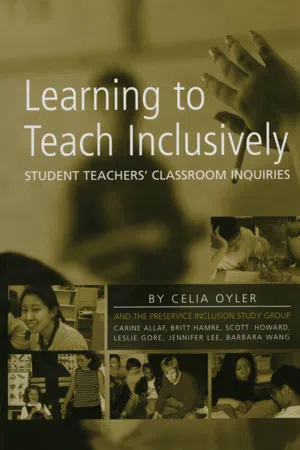
This book—co-authored by a teacher educator, a diverse group of five pre-service student teachers, and their student teaching supervisor—takes a unique, illuminating look at the experience of student teaching from the perspective of student teachers. It is premised on learning to teach as an inquiry process enriched by collaborative conversations. Readers are invited into student teachers' dilemmas and decisions as they negotiate between their public school placements and their university-based coursework. Throughout the year of student teaching, the authors document their discussions and reflections about teaching in inclusive classrooms that shed light on the complex process of learning to teach and also offer insights into issues of teaching for equity.
Each of the central chapters is written by an individual student teacher and tracks a specific question over the course of two semesters. Topics include:
*contrasting models of inclusion and teachers' differing orientations toward issues of community, difference, and normalcy;
*how teachers foster peer relationships;
*classroom management and discipline;
*heterogeneous instruction; and
*school-wide culture and systems that promote or mitigate against inclusion.
A new perspective on what can be learned from student teaching is provided by the student teachers' supervisor. In the concluding chapter, the teacher educators address the connections among the student teachers' inquiries and offer an analysis from a disability studies/disability rights perspective on how inclusion fits into a social (rather than a medical) model of disability. All of the authors of this book seek to contribute to conversations that place advocacy, inquiry, contestation, and challenge at the center of the teacher's role. This volume is their invitation to readers to join in a larger conversation about the challenges of, and necessity for, becoming inclusive teachers.
Learning to Teach Inclusively is intended for inservice and preservice courses in elementary education, inclusion, and teacher research, and for field experience seminars. It is also suitable for graduate courses in teacher research, supervision, and research in teacher education.
- 180 pages
- English
- ePUB (mobile friendly)
- Available on iOS & Android
eBook - ePub
About this book
Information
Chapter 1
Learning to Teach in Heterogeneous Elementary Classrooms
Starting new things brings both trepidation and excitement. Recently, while accompanying a preservice teacher to her new student teaching placement, we took a shortcut through a city park to get from the university to the yellow brick, three-story elementary school. On the way, she tentatively confided in me about the nervous feeling in her stomach as she began this new venture. I nodded in agreement, “It’s always hard to walk into a new place and get to know your way around in a community of strangers.”
Such a collection of strangers—five student teachers, their university supervisor, and me, their professor—began meeting one Tuesday afternoon in early September. What brought us together was an articulated commitment to teaching inclusively; although at the time we started, we meant different things by saying we were interested in becoming inclusive teachers. This book was written throughout their year of student teaching and was mostly finished before all the members of the Preservice Inclusion Study Group had secured their first teaching positions.
We formed what some have termed a community of practice (Lave & Wenger, 1991), in our case the Preservice Study Group on Inclusion, and decided early on in our venture together to collect our inquiries as a book. Thus, our weekly 1-hour meetings throughout the school year were organized around first defining, and then conducting topic-focused inquiries centered around the inclusion of students with disabilities in general education classrooms. As we came to know more about each other—as students, as student teachers, and as university-based teacher educators—we also grappled with the various meanings and manifestations of schooling practices that fall under the general term of “inclusion.”
We discovered early on that we shared a broad—rather than a narrow— understanding of inclusion. That is, in addition to our commitments to teach children with disabilities alongside their typical peers, we also understand inclusion to mean that teachers see their students as members of various other groups as well: racial, ethnic, gendered, socioeconomic, religious, linguistic, and political. We strive to design curriculum and instruction so that all members of the classroom community are visible and valued—not despite their differences, but with their differences.
This version of inclusion asks teachers to not be “color-blind” (Irvine, 2003), but to understand how children’s racial and ethnic identities can be taken up in ways that promote social justice. For example, to say to a colleague, “When I look at Lashandra I don’t notice that she’s African American,” is a denial of not only the historic marginalization and segregation of Black people in the United States, but a failure to understand how learning and teaching are cultural practices. Teachers must therefore be knowledgeable about the ways that African Americans are portrayed in mainstream media, how some children speak African American English and perhaps use more episodic narrative styles (Champion, 2003), and the ways that racism affects various members of many Black communities still today. (And this list is just a small piece of the knowledge that is required to be a culturally competent and responsive teacher.)
Likewise, to teach children with disabilities alongside their typical peers requires teachers to acknowledge the learner’s differences, and do so in a way that preserves the dignity and worth of each classroom member. Yet, such teaching, which foregrounds difference, runs contrary to many long-held societal assumptions. For example, many children—and thus many preservice teachers—learn at a very young age that it is not “nice” to notice difference. Think of the young child who points to a man in a wheelchair and asks, “Daddy, what’s wrong with him?” The father, because he too was taught not to call attention to difference, completes the learning circle and replies, “Shhh, it’s not polite to stare.”
When asked to explore assumptions, values, and biases around an issue of race, class, gender, disability, or sexuality one student teacher wrote this recollection in her autobiographical analysis paper:
In elementary school, Bettina, my classmate was paralyzed from the waist down and used crutches to move around. She was also a child with significant intellectual disabilities. She did not spend much time in our classroom: never came to math, reading, writing, or gym. She did not even lunch with the rest of the class. I remember during the first week of third grade wondering where Bettina disappeared to after 11:00 in the morning. She was part of our classroom for a few hours each day and then seemed to have vanished. When we asked where Bettina was, our teacher responded: “Don’t worry about it. It doesn’t concern you.” I soon stopped wondering why Bettina didn’t get to go on field trips or eat lunch with the rest of the class. I quickly learned that the correct response to difference was to turn the other way and avoid it at all costs.
By becoming inclusive classroom teachers, we seek to create classroom communities where Bettina does not disappear, and where Bettina and all students are both supported and challenged. This requires a very sophisticated pedagogy: one that provides no ceiling, and no floor. This requires an open-ended curriculum that does not pigeon-hole learners in categories that are meant to define them, but leaves the door open to differential academic, emotional, and social growth.
As anyone who has spent any time in classrooms can tell you, there is no class where everyone is on the same level. Whatever the dimension of analysis (gross motor performance, artistic skills, social interactions and decision making, to reading, and writing, and mathematics), all classroom teachers can expect a wide range of skill development. As one inclusive kindergarten teacher said to me in an interview when asked to talk about her reasons for developing multilevel instruction, “Everyone’s on a different level, they just don’t make people any other way!”
Developing the Inclusion Study Group
In an effort to contribute to increasing the inclusion of students in the New York City Schools, each year I invited the elementary education master’s students who were interested in inclusion to join a discussion/study group that met across both semesters of student teaching. Concurrently, they were placed in inclusive classrooms in various New York City public schools. (Since the writing of this book, New York City has dramatically expanded its number of inclusive classrooms and now more of our program’s approximately 75 to 100 placements are in inclusive settings.)
Early on in our year together this extraordinary group of five took up my suggestion to write a book together. With more than 25 years experience as a teacher, I have come to understand the power of authentic products in both shaping and sharpening the learning process. Particularly in collaborative efforts, I have found that a specific end product keeps the group focused and motivated, and is an excellent vehicle for prompting the necessary discussions about process and content. This is certainly true for teacher-research, which is supported by sharing written and oral reports of inquiries with other educators (Cochran-Smith & Lytle, 1993; Goswami & Stillman, 1987; Hubbard & Power, 1999).
Our method was simple. We met for an hour each week, Britt (the doctoral student and student teaching supervisor) and I brought food (as the meetings were at 5:00 p.m. one semester and at 12:45 p.m. the next), we dragged chairs into a circle in my office, and we talked. We rotated responsibility for taking notes on our group conversations, but often engaged in individual, quiet writing, and occasionally viewed a videotape in my collection. Mostly, we told stories, posed questions about particular children or specific practices, asked for advice, or vented our frustrations at what we saw in the field.
Our elementary teacher education program is heavily oriented toward inquiry and reflective practice, and the tone of our meetings was resonant with that. Rarely, then, did student teachers arrive at our Tuesday meetings with questions they expected could be definitively answered. Rather, we engaged in long-winded, passionate dialogues that answered questions with further questions. The spirit in the room, however, was one of support, rather than critique. Indeed, in the process of our work together we have come to see that we all place community at the center of our work. That is, we all agree that the formation and nurturance of a community spirit is essential to our work as both inclusive teachers and teacher-researchers. As members of the inclusion study group we have formed a supportive web of relationships that sustain us in the inquiries we report on in this book; so too, as classroom teachers we understand the full inclusion of all students in classroom learning activities to hinge on the establishment of interdependent relationships among students that cross class, gender, race, linguistic, ethnic, religious, and disability lines (Sapon-Shevin, 1999).
An Inquiry Stance While Learning to Teach
In coming together to write this book we are in agreement that we write from a position of questioning, rather than answering. As Scott put it, “We’re not saying, ‘this is it, we have the answers.’ Rather, we are saying, ‘Come listen to the journeys we took during a school year as we came to inquire deeply into our experiences of learning to teach and learning from teaching.’ ” In each of the chapters our aim is to lend insight into the experience of becoming a teacher from the angle of the student teacher. We write, then, not to tell others what to do, or even to tell others what to believe, but rather, we write to make sense of our “early pilgrimages” (Tomlinson, Callahan, Eiss, Imbeau, & Landrum, 1997) as inclusive teachers.
Each of the student teachers has organized her or his chapter around a particular inquiry question or focus. In a wonderfully serendipitous way, each of our first round of chapter choices fit beautifully together; we selected these themes in early December which allowed the student teachers to tailor some of their spring semester’s inquiries around their focusing question. In this way, some of the material for the individual chapters is drawn from papers and projects that were required as part of the student teaching program. Another main source of material has been the student teaching journal required of every student teacher in our program. This is a daily reflective journal read and commented on by their fieldwork supervisor. In writing these chapters, the journals (which were sometimes viewed as burdensome busy-work) proved to be invaluable sources for information regarding the changes in thinking that took place over the course of this school year.
Those changes in thinking and practice, ideas and action, philosophy and implementation are what we seek to highlight in this volume. Student teaching is most surely a journey of discovery, a process of thinking, rethinking, experimentation, observation, planning, and much pondering. Yet most accounts of student teaching are filtered through the lenses and analysis of teacher educators; rarely do student teachers have the privilege to share their trials and tribulations with a wider audience. In the sharing that we undertake here, we have been persistent in our efforts to unearth the ongoing process of learning to teach. That is, we do not want to present stories from the field as stories conveying even tentative truths set out to tempt the reader to believe us. Rather, we want to uncover the range of emotions and thoughts that swirl around student teachers as they strive to make meaning of their often overwhelming experiences. We share these reflections and inquiries not to provide solutions to the dilemmas of inclusive schooling—the student authors often asked themselves while writing this book, “Who are we to give answers when we are just starting out as teachers?” Instead, we write to invite the reader into the uncertain dilemmas of learning to teach all children.
Viewing teaching as a moral endeavor filled with uncertain and inevitable dilemmas positions the teacher always as an inquirer. In discussing the view of student teaching presented in the preceding paragraph, the coauthors of this book wondered how different actual full-time teaching will be. “Won’t these uncertainties, questions, and dilemmas be with us throughout our teaching career?” they queried. “Don’t you think you should link this back to teaching and say that this journey through not-knowing is a necessary journey? That being able to learn about yourself is a central aspect of teaching? Isn’t teaching an experience that must be embodied like Leslie wrote about in her chapter? That we just have to do it and feel all the emotions that come up and sort through all the tensions and make our sense of the messiness and difficulties?”
It is important to communicate how much we enjoyed our time together while compiling this book. We spent part of May, all of June, and part of July meeting twice a week for 2 hours at a time sharing drafts of our chapters. We conferenced in various pairs and threesomes, we shared references, we told stories that would help others fill in gaps in their chapters, we posed questions to each other, we designed an organizational approach to our chapters to lend textual unity. Therefore, this volume has been crafted in a community of thinkers and writers: a community committed to the possibilities that schools can make a difference not only in the lives of children, but in the future of our democratic practices; a community that believes we are stronger together than alone.
Student Teachers Negotiate their Roles
Student teaching must be understood as one of the most challenging experiences in one’s entire teaching career. You arrive in the classroom with all sorts of hopes and dreams about what kind of teacher you will be, but you never really get to fully explore your own approaches as you are a guest in a “borrowed classroom” (Rodriquez, 1998). Very early on in the placement your dreams start to clash with reality when you find not only that teaching is enormously exhausting and mentally demanding, but that your best laid plans are often a disappointment to your cooperating teacher, not quite right for the students, or deemed entirely ineffective by you. What could be so hard about getting 25 students in from recess?
To add to this mix of rude awakenings, students in teacher education programs also have to contend with a society that undervalues teaching and teachers, and with parents and friends who seem to continually question, “Why are you spending so much time and money on becoming a teacher?” It becomes harder and harder to explain to people how much you realize you must learn in this teacher education program and how incredibly difficult you are finding it.
A major challenge throughout student teaching is finding what roles you can play in this borrowed classroom. Much of this, of course, depends on the relationship you have established with your cooperating teacher, and her/his view of what a student teacher should be. The chapters in this book shed light on the various functions student teachers can take on. The traditional understanding of the student teaching role is that of apprentice. That is, the student teacher is placed in someone’s version of a “model” classroom and the cooperating teacher acts as the exemplar and coach; the job of the student teacher is to imitate the cooperating teacher, and success is viewed as faithfully reproducing the master teacher’s practices. The terms here—master and apprentice—come from the craft guilds of the Middle Ages, when young boys were apprenticed to master craftsmen and did increasingly more complex tasks until they fully learned the craft.
Since teaching can certainly be viewed at least in part as a craft, this approach to teacher education has been embraced for nearly a century wherever student teachers are found. Yet over the years, criticisms have been raised of this apprenticeship model, and many teacher educators are pondering the question, “What makes a good student teaching placement?” (Cochran-Smith, 1991; Kroll, LaBoskey, & Richert, 2002; Rust & Koerner, 2002). If teaching is viewed as more than just a series of practices—such as you would find in a skilled craftsperson—then what should be the role of the student teacher?
This issue of deciding where to place student teachers is one fraught with tension for many teacher educators, and also for the students in the program. “Why,” recently pleaded one student teacher to me, “aren’t we placed in schools with children who really need us?” In exploring her question further, I came to understand that what drew her to teaching was her desire to make a difference in the world by teaching poor students of color in an underresourced school. I explained to her our philosophy on this: As a student teacher, your job is to learn to be the very best teacher you can be; we do not consider that you have the skills to make a meaningful difference in school situations where the teachers are struggling with systemic problems. We do place student teachers in schools where the students are immigrant children, are eligible for free lunch, are considered “high-needs” districts, or are children of color. However, all our schools and teachers are carefully chosen to provide a focus on reflective teaching, rather than mere day-to-day survival.
That said, it must be explained that in the year this book was written, a number of student teaching placements were made in pilot inclusive classrooms. As is visible from the student teachers’ inquiries (particularly Carine Allaf’s—chapter 2), the teachers themselves had not worked out many of the structural or ideological barriers to full inclusion of students with disabilities. It must be understood from the outset that inclusion does not just mean putting children with and without disabilities together in classrooms. To be fully included in the learning community of a classroom requires sophisticated attention to pedagogy: including a focus on social-emotional issues, a plan for all instructional activities to challenge and support all learners (Kluth, Straut, & Biklen, 2003; Oyler, 2001; Peterson & Hittie, 2003), a willingness to deal directly with children’s questions about differential treatment, and the courage to talk explicitly about human difference.
By designing our teacher education program around critical reflection and sustained inquiry, the faculty seek to expand and deepen the roles student teachers can play. While reading these student teachers’ inquiries you will notice the shifts they go through as they seek to position and re-position themselves in their cooperating teachers’ classrooms. Spending so much time in someone else’s classroom is an exceedingly intimate act; and in the intimacy that often develops between student teacher and cooperating teacher it is often a struggle to know what balance to strike in regard to criticism. Although the teacher education program asks for almost continual reflection and analysis we also require that students seek to understand the teacher’s decisions, rather than simply to judge and then accept or reject these decisions. This stance—of critica...
Table of contents
- Cover Page
- Title Page
- Copyright Page
- Contents
- Preface
- 1 Learning to Teach in Heterogeneous Elementary Classrooms
- 2 Carine Allaf’s Inquiry: My Search for the Perfect Classroom
- 3 Barbara Wang’s Inquiry: How Teachers Foster Peer Relationships
- 4 Scott Howard’s Inquiry: Investigating the Challenge of Managing a Classroom Full of Individuals
- 5 Leslie Gore’s Inquiry: Designing Accessible Instruction
- 6 Jen Lee’s Inquiry: Struggle and Change in School Communities
- 7 Scaffolding Student Teachers’ Inquiries: The Vision in Supervision
- 8 Being an Inclusive Teacher
- References
- About the Authors
- Author Index
- Subject Index
Trusted by 375,005 students
Access to over 1.5 million titles for a fair monthly price.
Study more efficiently using our study tools.
Frequently asked questions
Yes, you can cancel anytime from the Subscription tab in your account settings on the Perlego website. Your subscription will stay active until the end of your current billing period. Learn how to cancel your subscription
No, books cannot be downloaded as external files, such as PDFs, for use outside of Perlego. However, you can download books within the Perlego app for offline reading on mobile or tablet. Learn how to download books offline
Perlego offers two plans: Essential and Complete
- Essential is ideal for learners and professionals who enjoy exploring a wide range of subjects. Access the Essential Library with 800,000+ trusted titles and best-sellers across business, personal growth, and the humanities. Includes unlimited reading time and Standard Read Aloud voice.
- Complete: Perfect for advanced learners and researchers needing full, unrestricted access. Unlock 1.5M+ books across hundreds of subjects, including academic and specialized titles. The Complete Plan also includes advanced features like Premium Read Aloud and Research Assistant.
We are an online textbook subscription service, where you can get access to an entire online library for less than the price of a single book per month. With over 1.5 million books across 990+ topics, we’ve got you covered! Learn about our mission
Look out for the read-aloud symbol on your next book to see if you can listen to it. The read-aloud tool reads text aloud for you, highlighting the text as it is being read. You can pause it, speed it up and slow it down. Learn more about Read Aloud
Yes! You can use the Perlego app on both iOS and Android devices to read anytime, anywhere — even offline. Perfect for commutes or when you’re on the go.
Please note we cannot support devices running on iOS 13 and Android 7 or earlier. Learn more about using the app
Please note we cannot support devices running on iOS 13 and Android 7 or earlier. Learn more about using the app
Yes, you can access Learning to Teach Inclusively by Celia Oyler in PDF and/or ePUB format, as well as other popular books in Education & Education General. We have over 1.5 million books available in our catalogue for you to explore.