
- 275 pages
- English
- ePUB (mobile friendly)
- Available on iOS & Android
eBook - ePub
Dictionary of Psychology
About this book
Psychology as a subject is notorious for its often confusing use of language, particularly as many words that have one meaning in common everyday language have quite a different meaning when used as specialist terms in psychology. Dictionary of Psychology is an A-Z guide to key terms in the subject. Each entry begins with a clear, one-sentence definition and is followed by explanation and examples. Entries are developed in line with the relative importance of the topic covered. For many of the more central topic areas, further commentary is included to assist the reader in acquiring a critical understanding of the topic in question. Entries are carefully cross-referenced, and the format makes the Dictionary of Psychology very easy to use.
Information
S
salience refers to the distinctiveness or prominence of something. For example, when we are hungry, images of food are more salient. Social learning theory explanations of gender role development explain the identification of a male child to his father around the age of six as a result of the increased salience of the father in the life of the child at that time.
sample: a group of people who take part in a research investigation and are presumed to be representative of the population from which they have been drawn. Because of the constraints of time, money and practicality, psychologists rarely study the whole population, and therefore are forced to sample from it using one of the sampling methods.
sampling refers to the process by which research psychologists attempt to select a representative group from the population under study. As an entire population tends to be too large to work with, a smaller group of participants must act as a representative sample. In an attempt to select a representative sample and thus avoid sampling bias (the overrepresentation of one category of participant in the sample), psychologists utilize a variety of sampling methods, such as:
• random sample – each member of the population under study stands the same chance of being selected
• stratified sample – the composition of the sample reflects the composition of the population, e.g. 30 percent males, 70 percent females in the population determines that the sample shall contain a selection of 70 percent females, 30 percent males
• quota sample – the researcher selects a quota of people roughly in proportion to their occurrence in the population (e.g. a quota of different age groups)
• opportunity sample – roughly a case of selecting whoever is available at the time at that location.
satiation: in its more common usage, this refers to the state in which an organism is no longer motivated by its need for something because the need has been satisfied. A hungry rat is motivated to respond in any way that brings the reward of food, but when it is no longer hungry, it will not respond with the same urgency, if at all.
scaffolding refers to the way in which adults may begin an instructional interaction by using direct instruction, but gradually withdraw their involvement in recognition of the child’s developing mastery of the task. This term, coined by Lev Vygotsky in his developmental theory, emphasizes the social context of children’s learning.
scapegoat theory: an explanation of discrimination based on the idea of frustration-aggression. It proposes that when we strive for personal goals (such as becoming rich or getting a new job), this causes the arousal of psychic (mental) energy. If we are frustrated from reaching this goal, the psychic energy remains activated and we are in a state of disequilibrium that can only be changed through aggression. As the legitimate targets of our aggression are normally unavailable (our teachers, the telephone company, etc.), we displace all the frustration-produced aggression onto a convenient alternative. This can be a person, a group of people, an animal or even an inanimate object. History has conveniently provided scapegoats so that in times of economic frustration, aggression in the form of active discrimination can be directed against what are seen as “legitimate” targets. Anti-Semitism in 1930s Germany is an example of scapegoating, as Jews were blamed for the decline of the German economy. In the deep south of America, blacks were used as scapegoats for the frustration of a failed cotton crop: the worse the crop, the greater number of blacks lynched.
scattergram: a graphical representation of the correlation between two sets of measurements (for example, between IQ and SAT scores achieved). The more the points on the scattergram are clustered around some definite pattern, the stronger the correlation. In a linear correlation (in which the points go in only one direction), a direction of bottom left to top right represents a positive correlation, while a direction of top left to bottom right indicates a negative correlation.
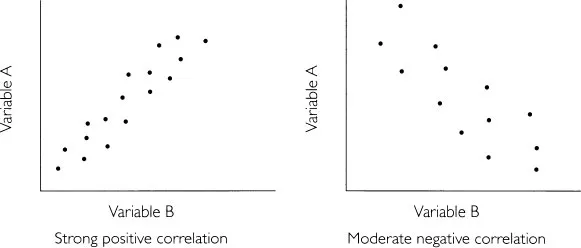
Scattergrams
schedules of reinforcement: these are different ways of delivering a reinforcer with the aim of maintaining a person’s present rate of response. According to operant conditioning theory, individuals who acquire a new behavior may typically receive a reinforcer every time they give the right response (continuous reinforcement). This ensures rapid acquisition of the behavior being reinforced. Once the rate of response reaches a certain level, it is more appropriate to switch to a schedule that presents the reinforcer only some of the time. This is more like how reinforcers are available in real life, and is likely to maintain the response rate for a much longer period. If we played the lottery every week and won every time, we would, no doubt, become lottery addicts and would spend much of our time filling out lottery tickets. If our success suddenly ended and continued to desert us for a few more weeks, we would probably stop buying tickets. If, however, success was occasional, our interest would be maintained over a much longer period. In this way, full reinforcement is most influential in the acquisition stage of a response, partial reinforcement in the maintenance stage.
Reinforcement schedule | Example |
Full (continuous) | Every example of the desired response is reinforced. |
Fixed interval | A reinforcer is delivered at fixed time intervals provided a response occurs during that time. |
Variable interval | A reinforcer is given, on average every so many seconds, but the interval is varied so that it is not predictable. |
Fixed ratio | A reinforcer is given every so many responses, regardless of time intervals. |
Variable ratio | A reinforcer is given on average every so many responses, but the actual number varies for each presentation of the reinforcer. |
schema: this has two major meanings in psychology:
• in social psychology, it refers to a store of information about previous experiences that is used to evaluate future experiences and make decisions about them. For example, you are asked to attend an all-night party at a friend’s house. Your previous experience of all-night parties (a blanket on the floor, little sleep and hangovers) convinces you they are to be avoided. The schema both organizes your experience of events, and also influences how you perceive future events of the same type
• in Piagetian theory, a schema is an organized structure of knowledge or abilities that changes with age or experience. We have physical schema (such as bike-riding schema) and mental schema (such as multiplication and division schema).
schizoid is often used to describe schizophrenia-like symptoms, yet without a diagnosis of schizophrenia being made. More accurately, it is a shortened form of the schizoid personality disorder, which is characterized by emotional coldness and isolation, and an inability to form close relationships with others.
schizophrenia: a serious mental disorder characterized by severe disruptions in psychological functioning. Schizophrenics may experience a variety of disturbing and frightening symptoms such as:
• thought disturbances – schizophrenia produces a kind of reasoning that appears obscure and incoherent to others. Schizophrenics may also suffer from delusions, unwarranted interpretations of events that have no basis in reality
• perceptual disturbances – a tendency to perceive the world differently from others, including the experience of hallucinations and an inability to recognize others’ emotional states
• emotional disturbances – some schizophrenics display no emotions at all, while others may display inappropriate emotional reactions
• motor disturbances – sufferers may display unusual physical actions such as giggling and laughing, or standing immobile for hours at a time
• disturbances in social functioning – an inability to maintain social relationships with others, and a lack of social skills.
Schizophrenics can be divided into those with negative symptoms and those with positive symptoms. Positive symptoms refer to the presence of something that is normally absent (such as hallucinations). Negative symptoms refer to the absence of something that is normally present (such as apathy, absence of emotion, etc.).
The complex origins of schizophrenia cause a good deal of argument among psychiatrists and psychologists. Some of the main explanations of causes are as follows:
• genetic explanations emphasize the inheritance of a genetic vulnerability toward schizophrenia for certain individuals. Whether this vulnerability develops into the disorder depends on how supportive or stressful the home environment is (the diathesis-stress model)
• biochemical explanations emphasize the role of the neurotransmitter dopamine in the onset of the disorder (see dopamine hypothesis)
• increasing medical evidence suggests that schizophrenia may be related to damage to specific areas of the brain. In particular, schizophrenics have enlarged brain ventricles (cavities within the brain), which may be due to damage in other areas of the brain around them.
The major treatments for schizophrenia are the antipsychotic drugs that eliminate many of the symptoms of schizophrenia (but are ineffective in around 30-40 percent of schizophrenics), and psychotherapies such as insight therapy and family therapy. A controversy exists over whether schizophrenics should be treated within institutions or not. Many schizophrenics go through cycles of hospital admission, discharge back into society and then readmission back into the hospital (the “revolving door syndrome”). A lack of adequate support out in the world may also result in schizophrenics experiencing long bouts of unemployment and homelessness.
schizophrenia in remission: a diagnostic label referring to the fact that a client has had periods of schizophrenia, but at the time the diagnosis was made, was free of schizophrenic symptoms. There is considerable disagreement among mental health professionals concerning how long a client has to remain free of all schizophrenic symptoms before this diagnostic label is finally dropped.
schizophrenogenic family: a term given to a family that has poor communication patterns and high levels of conflict among its members. The idea of a schizophrenogenic family has been implicated with the development of schizophrenia, particularly in adolescents, who seem particularly vulnerable to the stress that develops in such family atmospheres.
science, psychology as: the belief that the behavior of human beings is similar in all relevant aspects to the subject matter of other sciences. Human behavior is therefore seen as being no different from other naturally occurring phenomena in that the following assumptions apply:
• determinism – all behavior is seen as being caused (see free will vs. determinism)
• predictability – if behavior is determined, then it should be possible to predict future events
• control – if behavior is predictable, then it raises the possibility that it might be controlled.
Problems with the view of psychology as science include:
• systematicity – science assumes a coherent body of knowledge. This assumption is fine in principle, but the complexity of the subject matter, together with the difficulties of investigating it, present problems for psychology in this respect
• reflexivity – both observer and observed are members of the same species, therefore it is difficult to maintain an objective, distanced perspective on the subject matter
• generality – scientific laws are seen as being generalizable across space and time, whereas psychological explanations are often restricted to specific times and places. For example, many of the findings from research into conformity and obedience in the 1950s and early 1960s have been attributed to the particular social climate at that time
• testability – much of the subject matter of psychology is unobservable, and therefore cannot be accurately measured. It is probably true to say that of all the sciences, psychology is t...
Table of contents
- Cover Page
- Half Title Page
- Title Page
- Copyright Page
- Preface
- Dedication
- Acknowledgments
- A
- B
- C
- D
- E
- F
- G
- H
- I
- J
- K
- L
- M
- N
- O
- P
- Q
- R
- S
- T
- U
- V
- W
- X, Y, Z
Trusted by 375,005 students
Access to over 1.5 million titles for a fair monthly price.
Study more efficiently using our study tools.
Frequently asked questions
Yes, you can cancel anytime from the Subscription tab in your account settings on the Perlego website. Your subscription will stay active until the end of your current billing period. Learn how to cancel your subscription
No, books cannot be downloaded as external files, such as PDFs, for use outside of Perlego. However, you can download books within the Perlego app for offline reading on mobile or tablet. Learn how to download books offline
Perlego offers two plans: Essential and Complete
- Essential is ideal for learners and professionals who enjoy exploring a wide range of subjects. Access the Essential Library with 800,000+ trusted titles and best-sellers across business, personal growth, and the humanities. Includes unlimited reading time and Standard Read Aloud voice.
- Complete: Perfect for advanced learners and researchers needing full, unrestricted access. Unlock 1.5M+ books across hundreds of subjects, including academic and specialized titles. The Complete Plan also includes advanced features like Premium Read Aloud and Research Assistant.
We are an online textbook subscription service, where you can get access to an entire online library for less than the price of a single book per month. With over 1.5 million books across 990+ topics, we’ve got you covered! Learn about our mission
Look out for the read-aloud symbol on your next book to see if you can listen to it. The read-aloud tool reads text aloud for you, highlighting the text as it is being read. You can pause it, speed it up and slow it down. Learn more about Read Aloud
Yes! You can use the Perlego app on both iOS and Android devices to read anytime, anywhere — even offline. Perfect for commutes or when you’re on the go.
Please note we cannot support devices running on iOS 13 and Android 7 or earlier. Learn more about using the app
Please note we cannot support devices running on iOS 13 and Android 7 or earlier. Learn more about using the app
Yes, you can access Dictionary of Psychology by Mike Cardwell in PDF and/or ePUB format, as well as other popular books in Psychology & History & Theory in Psychology. We have over 1.5 million books available in our catalogue for you to explore.