eBook - ePub
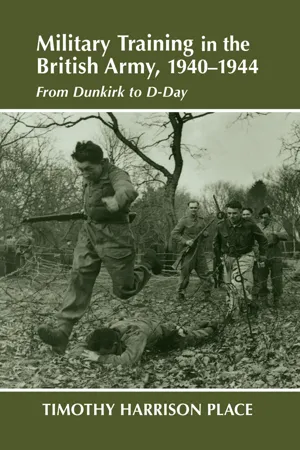
Military Training in the British Army, 1940-1944
From Dunkirk to D-Day
- 244 pages
- English
- ePUB (mobile friendly)
- Available on iOS & Android
eBook - ePub
Military Training in the British Army, 1940-1944
From Dunkirk to D-Day
About this book
In this study, the author traces the reasons for the British Army's tactical weakness in Normany to flaws in its training in Britain. The armour suffered from failures of experience. Disagreements between General Montgomery and the War Office exacerbated matters.
1
Introduction
It is perhaps the function of historians to split hairs. The backdrop to this work is the highly successful campaign waged by British troops against Germany in North-West Europe, starting on 6 June 1944 and ending with Germany’s unconditional surrender 11 months later. The success was not wholly or even mainly Britain’s: American troops far outnumbered British for most of the campaign; Canada provided substantial forces, as on a lesser scale did exiled Poles, French, Belgians and Dutch; all served under American supreme command. Nor would the victory have been possible without the hard fighting of Soviet troops against the Germans on the eastern front. None the less, it is with the British contribution to the military forces that overcame Germany that this book is concerned.
For all its success, controversy has roamed the campaign’s annals almost since the day it started. Most of it has centred on issues associated with high command, including the very command structure and a host of questions surrounding grand strategy and campaign strategy. None of those issues will be revisited here. Two relatively recent contributions to the campaign’s literature, however, have introduced new bones for historians to pick over. The works of D’Este and Hastings, first published in 1983 and 1984 respectively, for the first time went into detail on the frequently poor tactical performance of British troops in Normandy, the three-month-long battle that arguably determined, although it did not actually seal, Germany’s fate. Their findings form the point of departure for this study.
Using a variety of sources, both D’Este and Hastings highlight the poor standard of co-operation between tanks and infantry among British troops and the reluctance of the infantry to fight without high volumes of fire-power in support or to continue the struggle when their officers became casualties. D’Este argues that the lacklustre performance of the British Army in Normandy was partly the product of the cautious strategy of attrition by which Montgomery directed the operations of the British and Canadian troops in the eastern sector of the lodgement area.1 Hastings’ interpretation, contrarily, holds that Montgomery’s generalship was constrained by the mediocre tactical qualities of his troops.2 That the general standard of British troops in the Second World War was mediocre is confirmed by Professor Sir Michael Howard, a veteran of the Italian campaign as well as a distinguished military historian.3
Numerous reasons have been advanced for the British Army’s mediocrity. The parochialism engendered by the regimental system has been cited as a bar to effective co-operation between tanks and infantry.4 British weapons and equipment were frequently inferior to those available to the Germans: not only were German tanks better armoured and better armed than their British counterparts, but German infantry weapons, especially anti-tank weapons, were superior.5 In Normandy the bocage terrain supposedly favoured the defence. This factor had not been foreseen in training and the three veteran British divisions in Normandy, which had won their spurs in the desert, found the adjustment peculiarly hard.6
In his wide-ranging treatment of the British Army’s tactical effectiveness during the Second World War, Murray cites the revelations in Hastings’ work and numerous other sources of circumstantial evidence relating to other theatres in which the British Army was engaged pointing to a similar malady, before offering the following diagnosis: ‘The real cause of such a state of affairs lay in the failure of the army leadership to enunciate a clearly thought-out doctrine and then to institute a thorough training program to insure its acceptance throughout the army.’7
The assurance of that sentence belies what is quite properly a rather tentative discussion of the subject, for the evidence that Murray adduces in its support is thin to say the least. None the less, although it offers no hint of the full complexity in which tactical doctrine and training became entangled, Murray’s diagnosis is meaningful enough to serve as the text for this study.
Murray’s conviction is not only that the British Army was tactically retarded but also that it need not have been. Other commentators have been far more indulgent. Howard suggests that the rather unmilitary ethos of the typical British citizen soldier caused regular officers to lower their expectations of the wartime army.8 It is beyond the scope of this study to pursue that theory, although it doubtless has some validity. Bidwell, however, maintains that the British Army of 1939–45, a largely non-professional outfit manned mainly by temporary soldiers drawn from ‘ciwie street’ simply did not have time to become skilled in its business. It therefore resorted extensively to the expedient of sweeping its tactical inadequacies beneath the carpets of fire-power provided by its most effective component, the Royal Regiment of Artillery (RA).9 Let us examine that claim, for it is not devoid of truth.
Firstly, the British and Allied Armies’ heavy reliance upon artillery fire-power and other forms of metalline force is not a point of historical dispute. Indeed, it has recently been comprehensively catalogued in a study aptly entitled Brute Force.10 Murray agrees with Bidwell that reliance upon fire-power was the ‘response to tactical weaknesses (and perhaps partially their cause)’.11 Secondly, of course the British Army was largely a non-regular outfit. Particularly in the early years of the war the large numbers of conscripts, called-up reservists and territorials could not have received the degree of training that they might have got had strategic conditions been more accommodating of the requirements of military preparedness. Such were the pressures upon the Army at home after Dunkirk, due to the requirements of home defence, non-military commitments, overseas drafting and the shortages of equipment and facilities, that of six armoured and 19 infantry divisions surveyed in April 1942 only three were immediately fit for battle.12 The process of raising a mass army under pressure of war was undoubtedly fraught with difficulty. Not only should it not be surprising but it should also be forgivable if troops sent into the North African fray in 1941 and 1942 lacked the full range of professional tactical skills one should expect in fully trained career soldiers.
But can one accept such an excuse for the troops sent across the English Channel in June 1944? In the first place, three of the 12 British fighting divisions involved had recent battle experience in the Mediterranean, as did two of the ten independent brigades. Citizen soldiers or no, the troops of those formations could, and undoubtedly did, consider themselves the equals of the many regular soldiers whom fate had confined to the home islands. Secondly, the British Army at home had enjoyed four years of respite since Dunkirk in which to prepare itself for the challenges of Normandy. And since the end of 1942, home defences (given the bare minimum of precautionary attention) had inflicted little diversion from training. The formation under which British troops fought the campaign, 21 Army Group, cannot be compared to Kitchener’s New Armies, thrown into battle virtually untrained in 1916, whose troops – those who survived their first battle – had to learn their trade under fire. Their successors of June 1944 might have been unblooded, but there was no excuse if they were untrained.
It simply will not do to put down the lacklustre tactical performance of the British Army in North-West Europe to a lack of opportunity for training. There was no such lack. Murray’s hypothesis – for that is all it is – that it was unsuitable doctrine and training that hampered the tactical performance of British arms clearly stands the test of logical reasoning. This book investigates whether it can be sustained by the evidence of what the British Army at home actually did during the four years between Dunkirk and D-Day. That is why the campaign in North-West Europe provides only the backdrop to this study. Its main focus is the hitherto neglected subject of those four tedious years of home service.
Naturally, that renders this study an incomplete test of Murray’s hypothesis. Doctrine and training among formations that took part in the Mediterranean and Far East campaigns will not be covered here, although extensive reference will be made to the lessons learned from the former. Nor will there be much reference to training in the prewar or Phoney War periods. This is a Dunkirk to D-Day study. There is also an important conceptual limitation in that the analysis in this work is confined largely to the infantry and armoured arms of the British Army. It is as well to elaborate upon the reasons for this.
The combatant arms of the British Army included not only the Royal Armoured Corps and the infantry but also the Royal Regiment of Artillery, the Royal Corps of Signals, the Corps of Royal Engineers and the Reconnaissance Corps. These were in one sense or another support arms which is why they are not considered in this study. With the exception of the artillery, their primary function was not to fight but to perform some other function that served to facilitate the fighting action of the infantry and armour. That is not to say that the jobs of personnel in those arms were not dangerous – they certainly were – nor that they did not at times have to fight. They did, but only so far as it was necessary to facilitate their main job and, of course, in self defence.
The exclusion of the Royal Artillery might seem perverse. There are two reasons for it. Firstly, chiefly thanks to the labours of Bidwell and Graham,13 British artillery doctrine and tactics during the Second World War are well understood. It is also generally accepted that the Royal Artillery was by far the most professionally skilled fighting arm of the British Army during this period.14 Secondly, the role of the artillery was not to close with and directly effect the enemy’s overthrow. On many occasions the enemy closed with the artillery: close-quarters combat was by no means foreign to gunner experience. However, always in theory and usually in practice, the artillery was an arm of remote fire-support that participated in the attack from positions often thousands of yards behind the front line. This book is concerned chiefly with the attack and the actions of the troops who carried out the attack, namely the infantry and armour. Reference will be made, where appropriate, to the function of supporting artillery fire. A minute examination of artillery doctrine and technique is not necessary because it has already been done and close attention to training in artillery units would be mainly technical rather than tactical.
That leads to another important point to be made in defining the object of this study. The chief concern will be with doctrine and training for the minor tactics of the attack. ‘Minor tactics’ is conventionally defined as single-arm tactics, that is the tactical methods of, for example, infantry, without reference to the input of other arms with which the infantry co-operate in battle.15 This further explains why artillery is not a central concern of this book: infantry or tanks acting alone can attack and overthrow the enemy but artillery acting alone can only cause a nuisance to him. However, by the war’s end it was widely recognised that tanks acting alone were in most circumstances incapable of attacking successfully without infantry in close attendance. Minor tactics by the conventional definition thus came to represent a purely theoretical notion that was meaningless in practice. Necessarily, therefore, this book will consider co-operation between tanks and infantry. Higher tactics, however, the business of divisions and higher formations, are of merely peripheral concern here: operations and strategy, exclusively the business of generals and their staffs, will not be broached at all.
To restrict the scope of this book to the attack only is to ignore the activity in which most fighting troops on active service spent most of their time: defence. Indeed, every successful attack must rapidly be transformed into defence so that the ground won can be held against enemy efforts to recover it. German defensive tactics made extensive use of prepared counterattack to evict successful attackers from the position they had won before they could consolidate it. Accordingly, British doctrine stressed the need to organise gains for defence without delay.16 Important though defence was, it was not in defence that the British Army’s shortcomings were most obvious, at least not in North-West Europe. Moreover, although the design of a defensive position offered plenty of scope for tactical creativity among the commanders responsible, especially in regard to the achievement of surprise against an attacking enemy, for the troops involved defence was mainly a matter of hard toil digging and concealing positions, staying awake while on guard and obeying orders, particularly in regard to the control of fire, when an attack came. Of course it was rather different when the defensive task of a unit or sub-unit was counterattack, but the minor tactics for such an operation fall into the category of attack rather than defence.
Turning to sources, readers will find in the Bibliography an account of the wide variety of official and unofficial records consulted. A brief introduction to two categories of those records is appropriate here, however. This book compares doctrine for the attack with the training actually carried out in units and formations. Doctrine, a word of which the literal meaning and etymological origin is ‘teaching’ (as a noun), existed on many different levels. For the purpose of this study it means the officially sanctioned doctrine of the British Army as expressed in the many manuals and pamphlets published by the War Office and other military authorities. Those publications represent a primary source of the first importance in this study. The arrangements for formulating and publicising doctrine are of such interest that Chapter 2 is made over to exploring that very subject.
The main source of evidence on training in practice is the War Diary kept by every unit and formation HQ. Because the quality of such sources is very patchy, to secure a fair picture of training in a particular division demands examination of War Diaries at unit, brigade and divisional level across the period covered by this book. This has been done in the case of three divisions: 43rd Infantry Division, 11th Armoured Division and Guards Armoured Division. Those of one independent brigade, 34th Tank Brigade, have also been covered. The War Diaries of numerous other units and formations have been examined in a more selective manner. The object has been to form a picture of the training of those troops that saw no action before OVERLORD. For that reason the three divisions and two independent armoured brigades repatriated for OVERLORD after fighting in the Mediterranean campaigns have been excluded.
The evolution of doctrine in response to the lessons of battle in the Mediterranean theatres is an integral feature of the analysis unfolded in the following chapters, especially those concerned with armoured forces. But no work of this nature could be complete without some effort to judge doctrin and training, as informed by such lessons, against the test of battle in North West Europe. A closer look at the backdrop is necessary. Chapters 5 and 9 answer that need. Contemporary after-action reports are the main source used. War Diaries and secondary sources have also been used. However, the material on battle experience in North-West Europe included in this book while allowing some firm conclusions to be drawn on the real quality of doctrine and training before D-Day, represents only a first attempt in this particular field. The recent publication of a comprehensive study of the combat experience of the US Army in North-West Europe17 merely under lines the need for similar work on the British Army.
Before getting started it will help the reader to know something of the higher organisation of the British Army at home during the war. The head office of the British Army was the War Office, which exercised authority over all Britisl troops everywhere through the commanders-in-chief located in the region where those troops served. All British troops in Great Britain came under the Commander-in-Chief (C-in-C) of Home Forces, except those detached to form expeditionary formations, such as First Army in 1942 and 21 Army Grou] in 1943, and those in Anti-Aircraft Command. The office of C-in-C was held firstly by General Sir Walter Kirke, who retired in May 1940. General Si Edmund Ironside, his successor, lasted only two months and was succeeded by General Sir Alan Brooke who remained in the post until December 194 when he became Chief of Imperial General Staff (CIGS). General Sir Bernard Paget succeeded Brooke.
The C-in-C was based with his General Headquarters at St Paul’s School Hammersmith, to where it moved from Twickenham during Ironside’ tenure. In July 1943, 21 Army Group HQ was formed to control the force slated for the invasion of Europe. Paget relinquished his Home Forces job to become C-in-C of the new formation which appropriated St Paul’s School a its HQ. GHQ Home Forces moved to Hounslow with its new C-in-C, Genera Sir Harold Franklyn. Before July 1943 GHQ Home Forces was in effect an Army Group HQ and the C-in-C an Army Group Commander. Rankec below GHQ were the five home Commands: Southern, Western, Eastern Northern and Scottish, joined in 1941 by the new South-Eastern Command which took over Kent, Sussex and Surrey from Eastern Command. ...
Table of contents
- Cover
- Half Title
- Title
- Copyright
- Contents
- Dedication
- Series Editor’s Preface
- Acknowledgements
- List of Abbreviations
- 1 Introduction
- 2 The Dissemination of Doctrine
- 3 ‘Full-Sail’ Exercises
- 4 Infantry and Battle Drill
- 5 The Failure of Infantry
- 6 The Armoured Arm
- 7 Armoured Divisions
- 8 Tank Co-operation with Infantry
- 9 Armour in North-West Europe
- 10 Conclusion
- Notes
- Bibliography
- Index
Trusted by 375,005 students
Access to over 1.5 million titles for a fair monthly price.
Study more efficiently using our study tools.
Frequently asked questions
Yes, you can cancel anytime from the Subscription tab in your account settings on the Perlego website. Your subscription will stay active until the end of your current billing period. Learn how to cancel your subscription
No, books cannot be downloaded as external files, such as PDFs, for use outside of Perlego. However, you can download books within the Perlego app for offline reading on mobile or tablet. Learn how to download books offline
Perlego offers two plans: Essential and Complete
- Essential is ideal for learners and professionals who enjoy exploring a wide range of subjects. Access the Essential Library with 800,000+ trusted titles and best-sellers across business, personal growth, and the humanities. Includes unlimited reading time and Standard Read Aloud voice.
- Complete: Perfect for advanced learners and researchers needing full, unrestricted access. Unlock 1.5M+ books across hundreds of subjects, including academic and specialized titles. The Complete Plan also includes advanced features like Premium Read Aloud and Research Assistant.
We are an online textbook subscription service, where you can get access to an entire online library for less than the price of a single book per month. With over 1.5 million books across 990+ topics, we’ve got you covered! Learn about our mission
Look out for the read-aloud symbol on your next book to see if you can listen to it. The read-aloud tool reads text aloud for you, highlighting the text as it is being read. You can pause it, speed it up and slow it down. Learn more about Read Aloud
Yes! You can use the Perlego app on both iOS and Android devices to read anytime, anywhere — even offline. Perfect for commutes or when you’re on the go.
Please note we cannot support devices running on iOS 13 and Android 7 or earlier. Learn more about using the app
Please note we cannot support devices running on iOS 13 and Android 7 or earlier. Learn more about using the app
Yes, you can access Military Training in the British Army, 1940-1944 by Dr Timothy Harrison Place,Timothy Harrison Place in PDF and/or ePUB format, as well as other popular books in History & National Security. We have over 1.5 million books available in our catalogue for you to explore.